• Skip to primary navigation
  • Skip to main content
  • Skip to footer
Chaminade University of Honolulu

Chaminade University of Honolulu

  • VISIT
  • APPLY
  • GIVE
  • STUDENTS
  • PARENTS
  • ALUMNI
  • FACULTY/STAFF
  • Admissions
    • Admissions Home
    • Undergraduate Students
      • First-Year Students
      • Transfer Students
      • Admitted Students
    • Graduate Students
    • Flex Online Undergraduate Program
    • Military Students
    • Non-Degree/Visiting Students
    • Experiential Honors Program
    • Early College Program
    • New Student Orientation
  • Tuition & Aid
    • Financial Aid Home
    • Tuition & Expenses
    • Federal Updates & Changes
    • Scholarships
    • $5,000 Graduate Scholarship
    • VA Education Benefits
    • Net Price Calculator
  • Academics
    • Academics Home
    • Academic Programs
    • Office of Student Success
      • Academic Advising
      • Records and Registrar
    • Kōkua ʻIke (Support Services)
      • ADA Accommodations
      • Career Services
      • Proctoring Services
      • Tutoring Services
    • Sullivan Family Library
    • Undergraduate Research & Pre-Professional Programs
    • Commencement
  • Campus Life
    • About Campus Life
    • Student Engagement
    • Student Government Association
    • Residence Life and Housing
      • Summer Conference Housing
    • Health Services
    • Marianist Leadership Center
    • Counseling Center
    • Campus Ministry
    • Campus Security
    • Dining Services
    • Bookstore
  • Athletics
  • About
    • Chaminade University News
    • Our Story
    • Leadership
    • Chaminade University Strategic Plan 2024-2030
    • Mission & Rector
    • Association of Marianist Universities
    • Facts & Rankings
    • CIFAL Honolulu
    • Accreditation & Memberships
    • Montessori Laboratory School
Search
×

Search this web site

Homepage

Economic Education

March 9, 2023

Including indigenous cultures and values into education is not about making the Indigenous populations stronger. They are already strong. It’s about changing the way the world perceives that strength.”

Guanlin Gao, Ph.D., adapted from G.D. Anderson’s famous quote about feminism

Economics professor promotes financial literacy

Guanlin Gao, Ph.D., likes to play games. And during the recent National Association of Economic Education (NAEE) Conference at the Federal Reserve Bank of St. Louis, the Chaminade Economics associate professor and Director of Economic Education Center for Excellence devoted part of her presentation playing the Public Goods Game (PGG), in which players are given tokens—in this case Kona coffee beans—and given the opportunity to anonymously allocate them in either private or public funds.

“The purpose of the game is to let participants experience the indigenous culture through a hands-on game,” Gao explains. “The game is also related to the shared natural resources and land management of ahupua‘a, where people have shared responsibility and contribute to the common good with their expertise.”

This fundamental economic game has become a classic laboratory environment for studying collective group decisions in which participants decide how much to contribute to a common pool. The countervailing effect, however, is that there is an incentive for group members to “free-ride” on individuals who contribute positive amounts to the common pool. 

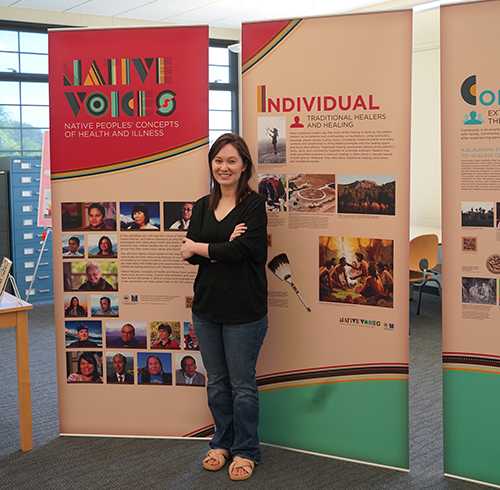
Guanlin Gao presents at the National Association of Economic Education Spring Conference at the Federal Reserve Bank of St. Louis

Those who invested in the private fund could keep the funds, and divide the shares among its members. However, for those who invested in the public fund, they could either share the return among all the groups or simply keep the yield within their own group.

“On the East Coast, players would largely invest in private funds,” Gao says. “But in Hawaii, most players contribute to public funds, which evenly distributes the return among all members. We have a more inclusive culture in Hawaii, as opposed to individualism.”

The NAEE’s three-day Spring Professional Development Conference was attended by economic educators at the state and federal level, as well as educational institutions that house the equivalent to Chaminade’s Economic Education for Excellence. One of NAEE’s primary missions is to provide professional development programs and training for educators to promote economics, personal finance and entrepreneurial education in the classroom.

“Right now, the country is having a movement about economic literacy, and it starts at an early age,” Gao says. “We want the younger generation to have a foundational understanding of personal finance and economics. We want to provide them the tools they need to make informed financial decisions, and create a better life for themselves and for those around them.”

The overall goal of the three-day conference was to promote economic and personal financial education from K-12 through college. Various departments of education around the country already stipulate that students take an economics or personal financial class in order to graduate. Gao is working on this with Hawaii Department of Education but, in the meantime, she’s sharing her knowledge with other teachers.

“I wanted the participants to walk away knowing more about the unique, yet diverse cultures, in this country, and promote economics and personal finance education in a way that relates and speaks to the populations we serve,” Gao notes. “I also talked about the traditions of sharing, not owning in Hawaii (for example, abundance means we have a lot to share, not how much we own), and why the conventional economic assumptions of ‘everyone is self-interested’ and ‘the only goal for a firm is to maximize profit’ do not resonate with our students’ identities and beliefs.”

Consider the Facts*

Many young people lack the basic financial knowledge and skills to prosper in life. Like many educators, the Council for Economic Education cares about equipping students with the knowledge they need to improve their futures.

40% of Americans have less than $300 in savings
24%
of Millennials demonstrate basic financial literacy
50%
of America’s youth will earn less than their parents

2 Million+
Students reached by CEE programs and teachers
Over 50,000
Teachers reached worldwide
1,000+
Lessons, guides & activities for teachers

*Council for Economic Education

Posted by: University Communications & Marketing Filed Under: Business & Communication, Diversity and Inclusion, Education, Faculty, Homepage Tagged With: Business Administration, Economic Education Center for Excellence

White Coat Ceremony

March 6, 2023

Nursing students enter clinical phase of their education

Health care team work is most successful when team members respect each other, trust each other, and can depend on each other for the delivery of ethical and effective patient care.

Rhoberta Haley, Ph.D.

The journey to become a nurse often begins with a desire and commitment to help improve peoples’ lives. Along the way, several milestones mark a nursing student’s road to progression, including the White Coat Ceremony.

“Gaining entrance into nursing school and progressing to this point is an accomplishment, and we hope that this ceremony is associated with much pride and anticipation for all of you,” said Nursing and Health Professions Dean, Rhoberta Haley, Ph.D., in her opening remarks to the students. “The giving and accepting of a white coat in this ceremony symbolizes your commitment to the values and responsibilities of the nursing profession.”

Sophomores received their white coats during an annual ceremony.

What started in 1993 for strictly medical students, the White Coat Ceremony would later extend to nursing programs in 2014, recognizing the vital role that nurses play in the healthcare profession. Since then, more than 450 schools of nursing have participated, with Chaminade’s School of Nursing & Health Professions among them.

“This ceremony emphasizes the ethics of the profession, and the responsibilities that come with wearing the uniform of the healer,” Haley said. “You are making a commitment to grow your compassion, your ability to provide kind and wise care to patients, families and communities in any setting worldwide.”

A group of 112 mostly sophomores participated in the White Coat Ceremony, which recognizes students’ entry into the health profession as they undertake clinical education. After receiving their white coats, nurses-to-be took the International Council of Nurses pledge to uphold nursing ethics and deliver the best care.

“In addition to congratulating each one of you in receiving your white coat today, I would like to personally thank you all for your pledge to serve in this noblest of professions,” said Dr. Lynn Babington, Chaminade president, who is also a nurse and former healthcare administrator. “Healthcare and nursing were my calling, and I’m proud that so many have made it yours.”

In her closing remarks, Haley delineated three cornerstones of the nursing profession: responsibility, trustworthiness and respect.

“At Chaminade, we believe in these values, and we are committed to help you achieve your highest level of performance and providing assistance when needed,” she said. “It is a privilege for Nursing faculty and staff to promote professionalism and share what we know and love about nursing with all of you.”

Posted by: University Communications & Marketing Filed Under: Homepage, Nursing & Health Professions, Students Tagged With: Campus Event, Honors and Awards

I Go To College

February 17, 2023

Fifth-Graders Attend Classes and a Mock Graduation Ceremony

The excitement was palpable as 254 fifth-graders from Catholic schools across the islands descended on campus to participate in the inaugural “I Go To College” event. Gathering at the Sullivan Family Library Lawn, 20 students from St. Theresa Honolulu were playing cornhole, spike ball and Jenga, as they waited for fellow students to arrive from St. Catherine, St. Anthony’s on Maui, St. Theresa Kauai, Holy Family Catholic Academy, Mary Star of the Sea, Our Lady of Good Counsel, Saint Louis, St. John Vianney, St. Joseph Parish School, and St. Joseph in Hilo. Chaminade President Dr. Lynn Babington welcomed the students, their teachers and chaperones to campus.

“This is all they could talk about yesterday and today on the bus,” said St. Theresa Honolulu fifth-grade teacher Alyssa Yabes of the students. “Some of them were even saying that they were going to graduate from college even before their older siblings.”

Started approximately 15 years ago on the mainland, the “I Go To College” program aims to expose 9-12-year-old students to higher education, even before they step onto a middle school campus. According to Llewellyn Young, Ph.D., superintendent of Hawaii Catholic Schools, this type of early exposure encourages these fifth graders to start thinking about attending college.

“I’ve seen the anecdotal results of these visits,” said Young, a former dean at Arizona Western, where “I Go To College” visits have taken place since 2010. “We want these kids to see that going to college isn’t such a far-fetched idea. It is achievable.”

Sitting across from each other during “What’s for Dinner? Setting an Interfaith Table” with Sister Malia Wong, Ph.D., Keslen Carroll and Julia Carlos from Holy Family Catholic Academy were enthusiastic about being on campus, both expressing that they plan to attend college.

Keslen Carroll receives her diploma from Drs. Lynn Babington and Lance Askildson during a mock commencement at Mamiya Theatre.

“This is going to be a good day,” said Carlos, with a wide smile. “I’m not sure where I want to go college, but maybe Idaho University because I like the snow.”

A seven-year longitudinal study* of a college prep program for middle school students showed that “college visits were an integral part of the program.” Students who went on a campus visit had more positive perceptions of college than those who did not. Research also shows the importance of starting college and career planning, and awareness in middle school. Early exposure to a college campus makes a difference, especially among first-generation college-bound, and other underrepresented groups, which are an integral element to increase college enrollment and diversity on campus.

“We’re trying to make the transition from grade school to university as seamless as possible,” said Dr. Janet Davidson, Chaminade Vice Provost and Academic Affairs Professor, who helped organize the day’s event. “We’re hoping that these kids will continue with their education and with their Catholic journey.”

Before setting off on their campus tour, students were divided into eight groups, offering a more intimate setting to simulate the typical Chaminade class size. Class topics varied from “Landing on the Moon on Mars—An Engineering Design Challenge” and EDventures in Science: Water is Life” to “Agriculture and Food Waste” and “Pocket Sharks & Water Bears: An Introduction to Biodiversity.”

“By the time they’re in grade eight or nine, it’s almost too late to spark their interest in college,” Young said. “We’re collaborating with Chaminade in a way that we’ve never collaborated in the past. When I approached Drs. Babington and Askildson about ‘I Go to College,’ they were thrilled, and immediately said yes. This is our pilot year and we’re already talking about how to refine it for next year.”  

Students ended the day with a “graduation” ceremony at Mamiya Theatre with Dr. Lynn Babington and Chaminade Provost Dr. Lance Askildson presenting them with certificates. 

“You are now part of our Silversword ‘ohana,” Babington told students. “I hope you learned a lot after completing your first full day of college.” 

*Research in Middle Level Education, Rich A. Radcliffe & Liz C. Stephens, 2008

Fifth-graders attended classes, toured the campus and participated in a mock Commencement during “I Go To College” event, which aims to expose 9-12-year-old students to higher education.

Posted by: University Communications & Marketing Filed Under: Campus and Community, Catholic, Diversity and Inclusion, Early College, Homepage, Institutional Tagged With: #hawaiicatholicschools, Campus Event, Marianist

Scholarship Luncheon

February 10, 2023

Students thank donors for their continued support

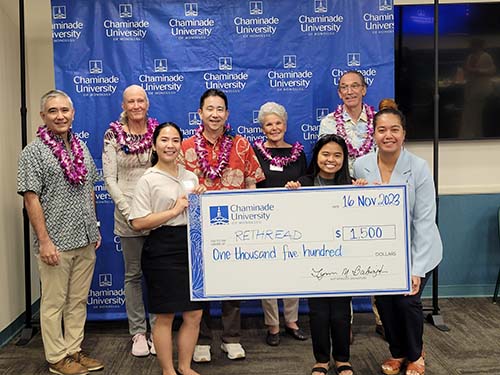
More than 80 donors, students and staff attended this year’s Mahalo Scholarship Luncheon on February 9, 2023, in-person and online. Dr. Lynn M. Babington, President of Chaminade University of Honolulu addressed the audience and expressed her gratitude for the support of our students. Dr. Babington shared how Chaminade offers more than 100 scholarships that have been generously established by individual donors and foundations. Many of them are endowed, and several are renewable investments that are replenished each year. This year alone, students received nearly $2.3 million in donor-funded scholarships.

“This is a wonderful opportunity for our students to thank and to let donors know how much their support has made a difference in their educational journey,” said Jimmy Tran, Stewardship and Scholarships Manager in the Office of Advancement. “Our donors see how their support helps fulfill our students’ dreams of obtaining a quality college education and to go on to successful careers.”

Chaminade juniors Caitlin Bocobo and Aleeyah Lemons shared their appreciation for their scholarship. “Words are not enough to express how grateful we are for your gifts that made our scholarships possible. I am here today to offer my sincerest gratitude and appreciation to you all,” said Bocobo ’24.

“Donors allow students, like me, to get the most out of their college experience—to grow, mature and make a difference in this world,” said Lemons ’24. “The Silversword ‘ohana is grateful to have you all. I am grateful to have your support and faith.”

Dani Masuda, Assistant Vice President for Student Success shared with the gathering how the scholarships can be the difference between attending college or not. “Scholarships contribute to a student’s wellness and the reach goes far beyond just the individual student. Mahalo nui loa to our donors for your continued generosity, commitment, and investment in our students,” said Masuda.

If you would like to support a student attending Chaminade University, contact Jimmy Tran at [email protected]

Dr. Lynn Babington Address Scholarship Luncheon Attendees

Donors, faculty, staff and students gathered for the annual Scholarship Luncheon.

Posted by: University Communications & Marketing Filed Under: Alumni, Campus and Community, Donor Profiles, Education, Faculty, Homepage, Institutional, Students Tagged With: Campus Event, Scholarship

Building Blocks

February 1, 2023

Ayko Group owner Chris Lee ’17 hammers home his commitment to Habitat for Humanity

It wasn’t all bad. In fact, some good did emerge from COVID-19. Vaccine production ramped up. Economic stimulus programs helped families weather financial hardships. And businesses—small and large—received Coronavirus Aid, Relief, and Economic Security (CARES) Act funding to keep their workforce employed during the pandemic. For Chris Lee ’17, the Paycheck Protection Program (PPP) allowed him to build a relationship with Honolulu Habitat for Humanity.

“During the coronavirus scare, some of our planned/negotiated projects were suspended due to government restrictions,” says Lee, a Chaminade MBA graduate and owner of the construction company, Ayko Group. “Luckily, we received the PPP loans and we were able to keep the employees paid during the shut downs.”

 A community-service-oriented business owner, Lee talked to a friend—the president of a local HVAC company—about business slowdowns, and because of this stagnation, he learned his friend’s company started taking on philanthropic endeavors with their employees. This prompted Lee to call Habitat for Humanity Honolulu and Habitat for Humanity West O‘ahu to see if Ayko could lend a hand in their home builds.

“My thought process being we are carpenters, and knowing that we could assist others at the same time as keeping our skills honed, would be a win-win,” Lee notes.  “Habitat for Humanity Honolulu replied and was interested in this partnership, and we helped them on a few new builds along with some critical repairs.” 

Ayko staff helped build a home for Habitat for Humanity. ©Howard Wolff

In pre-pandemic times, Ayko Group strictly focused on commercial and military projects, given Lee’s background as a former U.S. Navy Civil Engineer Corps officer, who has worked as a civilian manager for both Navy Facilities Engineering Command (NAVFAC) and the Department of Veterans Affairs. Not keen on pursuing residential builds—because he’s uncomfortable about taking people’s money—his own admission—the 43-year-old entrepreneur decided to make an exception.

“The timing could not have been any better,” says Honolulu Habitat for Humanity CEO TJ Joseph, who is also a beneficiary of a Habitat for Humanity home. “Because of COVID, we had to stop all volunteer efforts, which we largely rely on to start and finish all our projects. So Chris’ call was a true godsend, and if it wasn’t for him coming out, we would not have finished the homes.”

The jobs started small, with some carpentry, drywalling, fire blocks, flooring issues, and leveling and patching a driveway for a new homestead home. Then came the Sniffen home in Waimānalo, which had only reached the demolition stage before the pandemic hit.

“It was just a slab,” Lee says. “So we brought in seven guys to work on-site and we finished the build in probably two, three weeks. I only like to do residential projects with organizations like Habitat.”

Workers framed a home for the Piohia Ohana construction project. ©Howard Wolff

In comparison, Joseph says the timeline for Habitat for Humanity to complete a single project could take months since the workforce consists of volunteers, who may or may not have any construction experience.

“Habitat for Humanity’s business model is based on a community building together,” Joseph explains. “With this old model, we were only able to finish one or two homes a year since we were only building on Saturdays. But now we’re using sub-contractors to lay the foundation, and install the roof, drywall, electric and plumbing.”

The concept that became Habitat for Humanity first grew from the fertile soil of Koinonia Farm, a community farm outside of Americus, Georgia, founded by farmer and biblical scholar Clarence Jordan.

On the farm, Jordan and Habitat’s eventual founders, Millard and Linda Fuller, developed the idea of “partnership housing,” which centered on those in need of adequate shelter working side-by-side with volunteers to build quality, affordable residences. The homes would be built at no profit. New homeowners’ housing payments would be combined with no-interest loans provided by supporters and money earned by fundraising to create “The Fund for Humanity,” which would then be used to build more houses.

Chris and Tara Lee named their company Ayko after their two kids—Ayla and Niko.

Thanks in no small part to the personal involvement of former U.S. President Jimmy Carter and his wife Rosalynn, and the awareness they have raised, Habitat now works in all 50 states in the U.S. and more than 70 countries. Habitat’s advocacy efforts focus on policy reform to remove systemic barriers preventing low-income and historically underserved families from accessing adequate, affordable shelter.

“Right now, we have 16 families on our waiting list,” Joseph says. “And of the 16, 14 or 15 of them already have funding.”

Lee plans to continue to help Habitat for Humanity, whenever he is able to do so. Quoting former Hogan Entrepreneur Program director, John Webster, Lee says he is abiding his creed: “Doing business things that make social sense and doing social things that make business sense.” 

“John always stated that before the Wednesday speaker sessions,” Lee says.

“It has always rang true to me, and when given the opportunity to help, I will, especially during a time like Covid. I’m fulfilling my service mission, which lines up with the values of a Chaminade education, and it also matches what my mom instilled in me when I was a kid.”

Posted by: University Communications & Marketing Filed Under: Alumni, Business & Communication, Homepage Tagged With: Alumni, Hogan Entrepreneurs Program

Scents and Sensibility

January 26, 2023

Chaminade freshman turns her love of candles and Hawaii into a business

Part science, part apothecary, the art of candle making can be traced as far back as 1000 BCE when ancient Romans would use tallow—a rendered form of beef or mutton fat—to make molded candles. The idea intrigued Chaminade freshman, Tahiya Kahaulelio ‘26, so much so that she established her own candle-making enterprise, Kahaulelio Candle Company.

Tahiya Kahaulelio poses with her finished candle.

“It wasn’t the first idea I had for a business,” says Kahaulelio, who plans to major in Environmental + Interior Design. “At first, it was actually to establish a clothing business but, knowing myself, I knew I would get bored, so I needed to find something that I could stick [no pun intended] with for a long time.”

The young entrepreneur, though, knew she wanted to continue her education and attend college. Chaminade beckoned over Saint Joseph’s and La Salle, two universities located closer to her hometown of Philadelphia. A devout Catholic, Kahaulelio chose to leave The City of Brotherly Love to get in touch with her island roots. Her Nigerian mother had already taught her the values and customs of her West African home country, but she wasn’t familiar with her father’s Hawaiian heritage.

“I had questions about my Hawaiian side,” Kahaulelio says. “I feel like I was missing a piece of my heritage and I needed to get answers.”

Having never been to Hawai‘i, Kahaulelio was understandably nervous. She knew it would be challenging to be 5,000 miles away from her mother, step-father and siblings, but she was also comforted knowing that her biological dad’s family lived on O‘ahu. Questions of not being good enough, meeting new friends, college life and all the doubts associated with the responsibility of a young adult, all swirled in her mind. She was anxious.

And then she arrived on campus.

“I immediately felt comfortable and the people were so nice,” says Kahaulelio, with an infectious smile. “I didn’t feel like an outsider because everyone was so welcoming. I no longer see Chaminade as a school but as a family that I can reach out to for guidance and help.”

Now in her second semester, Kahaulelio juggles between being a student and running a business. When she’s not designing interior spaces with colors and texture for class, she’s experimenting with different combinations of scents, infusing her bees-wax-based candles with such local-inspired essential oils as hibiscus, coconut, cucumbers, papaya, mango and rosewood.

Using a digital scale to precisely weigh 12 ounces of wax, Kahaulelio places the wedges in a pitcher and slowly melts the wax over a Nesco stainless burner for four minutes. She then incorporates four teaspoons—two teaspoons at a time—of essential oils, stirring the elixir to release the fragrances. Now to the tricky part: cutting the length of the circular wick so that it’s not too long nor too short.

“My stepdad is so much better at this than I am,” admits Kahaulelio, while eyeballing the length of the wick. “He’s a chef so he has a really keen eye and an excellent sense of aroma.”

Freshman Tahiya Kahaulelio has developed a variety of island-fragrant-infused candles.

Posted by: University Communications & Marketing Filed Under: Campus and Community, Catholic, Diversity and Inclusion, Homepage, Innovation, Student Life, Students Tagged With: Environmental + Interior Design

  • « Go to Previous Page
  • Page 1
  • Interim pages omitted …
  • Page 32
  • Page 33
  • Page 34
  • Page 35
  • Go to Next Page »

Footer

Chaminade University Logo

3140 Waialae Avenue
Honolulu, Hawaii 96816

Contact Us
Phone: (808) 735-4711
Toll-free: (800) 735-3733

facebook twitter instagram youtube linkedin

Visit

  • Plan Your Visit
  • Campus Map (PDF)
  • Events

Resources

  • Campus Security
  • Student Consumer Information
  • Concerns, Feedback, and Reporting
  • Institutional Review Board
  • Title IX / Nondiscrimination Policy
  • Compliance
  • Emergency Information
  • Careers
  • Institutional Statement

People

  • Students
  • Parents
  • Alumni
  • Faculty & Staff

Policy

  • Privacy Policy
  • Terms and Conditions of Use


© Chaminade University of Honolulu