• Skip to primary navigation
  • Skip to main content
  • Skip to footer
Chaminade University of Honolulu

Chaminade University of Honolulu

  • VISIT
  • APPLY
  • GIVE
  • STUDENTS
  • PARENTS
  • ALUMNI
  • FACULTY/STAFF
  • Admissions
    • Admissions Home
    • Undergraduate Students
      • First-Year Students
      • Transfer Students
      • Admitted Students
    • Graduate Students
    • Flex Online Undergraduate Program
    • Military Students
    • Non-Degree/Visiting Students
    • Experiential Honors Program
    • Early College Program
    • New Student Orientation
  • Tuition & Aid
    • Financial Aid Home
    • Tuition & Expenses
    • Federal Updates & Changes
    • Scholarships
    • $5,000 Graduate Scholarship
    • VA Education Benefits
    • Net Price Calculator
  • Academics
    • Academics Home
    • Academic Programs
    • Office of Student Success
      • Academic Advising
      • Records and Registrar
    • Kōkua ʻIke (Support Services)
      • ADA Accommodations
      • Career Services
      • Proctoring Services
      • Tutoring Services
    • Sullivan Family Library
    • Undergraduate Research & Pre-Professional Programs
    • Commencement
  • Campus Life
    • About Campus Life
    • Student Engagement
    • Student Government Association
    • Residence Life and Housing
      • Summer Conference Housing
    • Health Services
    • Marianist Leadership Center
    • Counseling Center
    • Campus Ministry
    • Campus Security
    • Dining Services
    • Bookstore
  • Athletics
  • About
    • Chaminade University News
    • Our Story
    • Leadership
    • Chaminade University Strategic Plan 2024-2030
    • Mission & Rector
    • Association of Marianist Universities
    • Facts & Rankings
    • CIFAL Honolulu
    • Accreditation & Memberships
    • Montessori Laboratory School
Search
×

Search this web site

Featured Story

Bridging the Age Gap

January 26, 2021

Relationships are one of the critical ingredients in our happiness and wellbeing—bonding not only with partners and peers, but also with those spanning different ages.
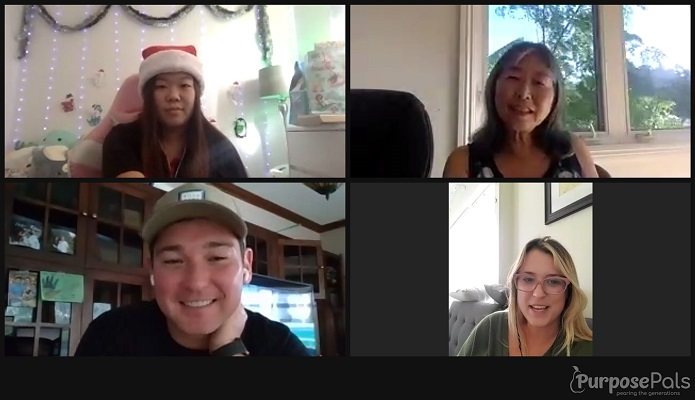
Nursing students participating in their service learning project with Purpose Pals

Thirty-two Chaminade nursing students did just that by connecting with kūpuna through Purpose Pals, a pilot program designed to foster friendships across generations through the click of a mouse.

“The biggest takeaway from our talks was that I don’t know everything there is to life,” says freshman Kaylen Fernandez. “My kūpuna gave valuable advice in balancing work-life, and the importance of enjoying what you do. If you don’t love it, then it’s time for a change.”

Engaging across generations, benefits kūpuna and helps students learn and grow as healthcare professionals.

“This experience provides the nursing students with a more positive attitude toward aging,” says Purpose Pal organizer Dr. Christy Nishita. “In their future careers, many of their patients will be from our oldest age groups. We hope this experience gives them awareness and empathy toward kūpuna that translates to better care.”

Connectedness is important now more than ever, especially since COVID has created social isolation. With an increase of loneliness and stress, Purpose Pals has played a critical role in helping kūpuna stay socially active.

Purpose Pals was made available through a service-learning project in Dr. Edna Magpantay-Monroe’s NUR 200 Introduction to Nursing Concepts course. The project not only provided students with an experiential learning opportunity but also forged meaningful relationships with their kūpuna. Many have been inspired to stay in touch with their pals beyond the commitment of the project.

Students’ participation in the pilot program has provided a number of key insights for Purpose Pal’s development and capacity building. The goal is to continue to attract new volunteers each semester and continue Chaminade’s mission serving the community and being an active participant in it.
Posted by: University Communications & Marketing Filed Under: Featured Story, Nursing & Health Professions, Service Learning Tagged With: Nursing

Islands of Opportunity: First-Ever Virtual DataCamp

January 16, 2021

In November 2020, the Islands of Opportunity-Louis Stokes Alliances for Minority Participation (IOA-LSAMP) and Chaminade University Honolulu partnered to launch an online data analytics proficiency course for university STEM students from Hawai‘i and the Pacific. The DataCamp was run by Chaminade faculty and staff under the supervision of a molecular immunologist and biologist. The program offered a unique opportunity for Native Hawaiian and Pacific Islander students to learn about the data analytics field through hands-on learning modules.

The University of Hawai‘i Hilo was also a participant in the DataCamp. Check out this article to learn more about the professors and students involved. We see bright futures ahead for Hawai‘i’s next generation of data scientists and can’t wait to see them use their newfound skills in our community! IOA-LSAMP includes 10 institutions across the Pacific region: Chaminade University of Honolulu, American Samoa Community College, College of the Marshall Islands, College of Micronesia—FSM, Guam Community College, Hawaiʻi Pacific University, Northern Marianas College, Palau Community College, University of Guam and University of Hawaiʻi at Mānoa.

Posted by: University Communications & Marketing Filed Under: Campus and Community, Diversity and Inclusion, Featured Story, Natural Sciences & Mathematics Tagged With: Data Science

Events at the Nation’s Capitol

January 7, 2021

President Lynn Babington’s Statement Regarding Violence at the U.S. Capitol

Chaminade community:

Today has been a difficult day for our nation.

The actions undertaken by protesters at the US Capitol should shock us all—and give us pause.

As a Marianist Catholic institution of higher learning, we condemn violence of any kind and call on everyone to seek peaceful and respectful avenues for dialogue. The scenes we have witnessed on the news in recent hours are not emblematic of our nation, its peoples or our shared principles.

As we seek to make sense of all that has occurred, let us recommit ourselves to peace, to social justice and to creating spaces for a diversity of opinions shared thoughtfully and respectfully. We know the value of debate; it deepens our understanding of one another and helps us find common ground.

As educators, we have a duty to prepare an involved and engaged citizenry. Indeed, inspiring tomorrow’s leaders and preparing them to serve in a vibrant and functioning democracy is the most important role we have. That role is now more critical than ever.

Please join me in praying that our elected leaders find the courage they will need during this trying time.

Regards,
Lynn Babington, Ph.D.
President, Chaminade University

What is a faithful soul to do in the chaos of events which seem to swallow it up? Sustain itself calmly by that faith which assures us that all things work together unto good for those who love God.
~ Blessed William Joseph Chaminade ~

Posted by: University Communications & Marketing Filed Under: Campus and Community, Diversity and Inclusion, Featured Story, President

Chaminade Receives Grant in Support of Distance Learning

January 5, 2021

Chaminade University of Honolulu recently received a $20,000 grant from the G. N. Wilcox Trust, Bank of Hawaii, Trustee to provide educational technology packages to high-need students. The packages will include a laptop computer, headphones with a microphone, and an external flash drive for secure data storage.

“This generous grant from G. N. Wilcox Trust will help us meet some of our students’ critical technology needs and allow for continued student success,” said Dr. Helen Turner, Chaminade’s Vice President for Strategy and Innovation. “Even as face-to-face classes have resumed, ensuring our students have the proper equipment will provide resiliency against future lockdowns, and provide for those students who have elected to stay online because they or their family members have compromised immune systems.”

Across the nation, the transition to distance education in response to COVID-19 has exposed a digital divide. The Technology Package program reflects Chaminade’s continuing mission to serve low income students with an exceptional college education.

G. N. Wilcox Trust provides support for programs that better the lives of individuals and families in Hawai‘i. It was created by George Norton Wilcox, who began his career growing sugar at Hanalei, Kauai in 1863 and later became owner of Grove Farm plantation. He also served as a representative for Kauai from 1887 until annexation of the Islands in 1898. As a philanthropist, Wilcox’s interests centered largely around religious and educational work and expanded to include arts & culture, community, environment, health and human services.

# # #

Chaminade University of Honolulu provides a collaborative and innovative learning environment that prepares graduate and undergraduate students for life, service and successful careers. Established in 1955, the university is guided by its Catholic, Marianist and liberal arts educational traditions, which include a commitment to serving the Native Hawaiian population. Chaminade offers an inclusive setting where students, faculty and staff collectively pursue a more just and peaceful society.

Posted by: University Communications & Marketing Filed Under: Featured Story, Press Release

Data and Design: A Powerful Storyteller

December 16, 2020

Majoring in data science means you spend a lot of your time combing through data, learning to use coding software, digitally mapping data and analyzing results. But at Chaminade University, it also means learning how to tell a story, understanding color theory, learning how to use design software and understanding the principles of visual communication.

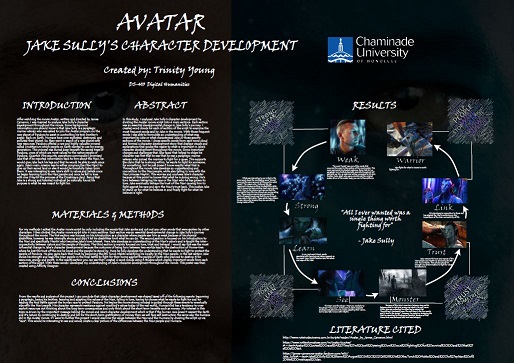
Digital Humanities Avatar presentation

Data Science 403: Digital Humanities is a new interdisciplinary course taught by Dr. Junghwa Suh, associate professor of environmental + interior design and Dr. Laura Tipton, assistant professor of data science, that all data science majors at Chaminade are required to take. The course merges the fields of humanities and data science, and teaches students how to turn data into meaningful, visual stories and relate it back to various dimensions of human living.

“We wanted to challenge the more analytic students in the course to think more creatively, both in their presentations and in their topics of study,” says Dr. Suh. “We wanted to show that not every data science analysis is based on a scientific study, sometimes we use data science to analyse classic literature or song lyrics.”

For many of the students, this was their first foray into the humanities and they weren’t quite sure what to expect.

“At the beginning of the semester, I interpreted digital humanities solely as studying the history of data science and technology,” says Trinity Young, a fourth-year student. “But now, after taking this course, I better understand that digital humanities is the study of applying data and technology to analyze and better understand human society and culture.”

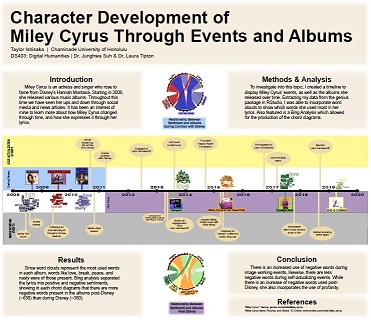
Digital Humanities Miley Cyrus presentation

In the first iteration of the course this past fall semester, each student was tasked with choosing a topic for a semester-long project that either brings them happiness or sparks their interest and passion. They then spent the first-half of the semester collecting and analyzing data, and the second half of the semester learning to develop a visually appealing story out of the data and present their findings. 

“[This course] really gave me another perspective in this area and allowed me to see the story behind everything,” says Taylor Ishisaka, a third-year student who used the project to explore how Miley Cyrus’s character has developed throughout various events and albums. “As of now, I truly think that it is necessary to have previous knowledge in humanities in order to understand the digital world better.”

Digital Humanities Australian Wildfires

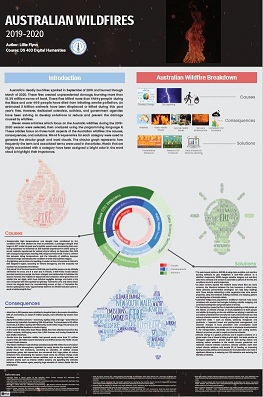
Lilianna Flynn, a senior who is majoring in business administration and minoring in data science, did her project on the recent Australian wildfires. She used data visualizations and word clouds to determine the causes and consequences of the wildfires and to identify solutions. 

“I believe my word clouds were my best visual aid,” says Flynn. “They displayed the most important words and gave the readers a basic understanding of the news articles.”

But her favorite part was seeing how creative her fellow classmates were in choosing their topics.

“My favorite part of the semester was listening to everyone’s presentations,” says Flynn. “Everyone had different ways of analyzing their data and unique presentation designs. Now, I believe design is even more important to communicate data visualizations effectively.” 

While the course was fun and meaningful for the students, the professors also had a good time with it. 

“I was really excited when I saw this course listed as part of the data science curriculum because it gave me a chance to highlight some of my “passion project” research areas, including dance history and mythology,” says Dr. Tipton. “And it gave me a chance to see what non-science interests the students have.”

On the other side, Dr. Suh was excited to take a dive into the sciences. “I have always wanted to teach a course where science meets art and design, and vice versa,” she says. “I usually don’t have a chance to meet students from other disciplines, so it was great interacting with the data science students.”

The pair is now brainstorming ways to expand the course in the future.

“Now I’m excited to see where this collaboration goes and how we can include students from other majors, like design and other humanities, next year,” says Dr. Tipton.

Posted by: University Communications & Marketing Filed Under: Featured Story, Humanities, Arts & Design, Natural Sciences & Mathematics Tagged With: Data Science, Environmental + Interior Design

A Family Affair

December 15, 2020

As a child, Tesia Chang, MSJCA ’15 was always intrigued by detective and cop shows. Her father used to read her Nate the Great books, a children’s detective series about a young boy who solves mysteries written by Marjorie Weinman Sharmat.

“I always knew I wanted to become an investigator,” says Chang. “I wanted to follow in my mother’s footsteps.”

Chang’s mother passed away when she was three-years-old. It was always her goal to carry on her mother’s legacy.

Her mother had started as a clerk, until one of her supervisors recognized that she had an ability to do even more and go on to bigger things. Her supervisor encouraged her to seek higher education, so she got her college degree and advanced to become an investigator with the State of Hawaii Department of Commerce and Consumer Affairs.

There was a time in Chang’s life, toward the end of her undergraduate career, when she considered becoming an attorney and going to law school. She studied hard, took the LSAT and applied for law school—but those doors didn’t open.

She didn’t know it at the time, but it was a blessing in disguise. She’s now an investigator with the State of Hawaii Department of Commerce and Consumer Affairs, just like her mother used to be.

After graduating from college and realizing she was not going to become an attorney, Chang felt lost. She got a job working at a law firm as a file clerk while she tried to figure out her next move and worked at McDonald’s on the side. She used the opportunity to gain life skills, and to try to change the way she had been thinking about things.

“The one major thing that the whole process taught me was to think about things differently,” says Chang. “It helped prepare me for my current line of work. We’re often confronted with a wide range of complaints—some are very simple and others are very complex. It regularly requires analyzing things from a different perspective.”

Then, one day her father let her know about Chaminade’s Master of Science in Criminal Justice Administration program. He had friends in the law enforcement community who highly recommended it.

Chang enrolled, and got accepted. She kept her job at the law firm, and through Chaminade’s program she found an internship at the Honolulu Police Department in the Crime Scene Unit.

“I was shadowing evidence specialists,” recalls Chang. “There’s a lot of thought about how the scene was when you found it, and you have to use a lot of science and deductive reasoning. That was a really great opportunity.”

The experience re-ignited her passion for becoming an investigator and set her back on the career path she had always thought she’d follow.

Today, Chang talks about how the program gave her direction and believes it can give other students direction also.

“If you go through Chaminade’s program, it will definitely give you better direction or at least confirm where you want to be,” she says. “This is definitely the program that’s going to help you realize what you want to do.”

Toward the end of her time at Chaminade, she became a student helper at the Department of Commerce and Consumer Affairs, and when she graduated, the folks at the department let her know about a temporary emergency hire—someone from the unit was being deployed and they were looking to fill the position in the interim. A few months later, she became a permanent employee and has been there ever since.

Chang spends her days investigating consumer complaints about unfair and deceptive acts.

“We investigate a broad spectrum of different scams,” describes Chang. “Mortgage rescue fraud scams, refund and exchange laws and more. If a store doesn’t post proper signage, then that could be considered an unfair or deceptive act or practice.”

Chaminade taught her how to process information and think critically about a subject. She learned how to pick a topic and research it, and how to go about gathering information to support or disprove a theory. She finds herself using that knowledge on a daily basis.

“It’s the same process when you receive a complaint,” she says. “You analyze it and process it into pieces, and that allows you to analyze the evidence effectively. Based on that, you can draw a pretty good conclusion.”

She particularly remembers her courses with Professor Collin Lau, a lecturer of criminology and criminal justice.

“His classes forced you to cut down on the flowery stuff and get straight to the point and to the meat of the issue,” says Chang. “The complaints we receive give all sorts of information and you need to be able to cut through to get the who, what, when, where and why. Professor Lau’s courses taught me to dissect through all the information.”

Chang truly believes the experience she had at Chaminade has helped make her a better investigator. “I honestly feel like I wouldn’t be as effective of an investigator if I hadn’t gone through Chaminade’s masters program, and I can see that as I continue to work here.”

She thrives on the thrill of her job. She loves that it keeps her on her toes, and she never knows what kind of complaint she’s going to get next. Her favorite complaints involve refunds and exchanges, because she often goes undercover on site inspections.

“Being incognito is part of the fun,” says Chang excitedly. “We can dress up and pose as customers. We’re able to have a different experience that’s pretty close to how a customer would experience it.”

Her job has definitely impacted the way she shops and it’s made her a much more wary consumer. She’s learned to ask a lot of questions, something she always encourages other consumers to do. She believes questions are one of the best defenses against scams.

“If there’s one thing this job teaches you, it’s to not take anything at face value,” says Chang. “This job definitely opens your eyes to a lot of things that you wouldn’t have been aware of if you were just a consumer. Knowledge is definitely power.”

Despite all of the excitement and thrill she finds on a daily basis at work, Chang’s reasons for loving her job are very personal. Knowing that she’s carrying on her mother’s legacy has been way more meaningful than she ever anticipated. She’s found a closeness to her mother that she hadn’t known before.

“Because I was so young when she passed away, the reality of not having her in my life didn’t really kick in until I started working here,” shares Chang. “Once I started working here, I could actually imagine working with her.”

Sometimes, she plays through different scenarios in her head about what it would have been like to work with her mother.

“Sometimes I think ‘wow, if we worked in the same office, we could have been taking lunch breaks together, come to work together, left work together,’” says Chang. “It definitely helps me in my mind create a stronger connection to her.”

When she gets sad, she tries to focus on the fact that she’s helping people, just like her mother did.

“Whether we’re helping someone get some sort of restitution, or helping them by filing a complaint, our office is able to take action and stop the respondent from hurting anyone else,” she says. “It feels great when we’re able to help a consumer.”

Posted by: University Communications & Marketing Filed Under: Alumni, Behavioral Sciences, Featured Story Tagged With: Master of Science in Criminal Justice Administration

  • « Go to Previous Page
  • Page 1
  • Interim pages omitted …
  • Page 69
  • Page 70
  • Page 71
  • Page 72
  • Page 73
  • Interim pages omitted …
  • Page 92
  • Go to Next Page »

Footer

Chaminade University Logo

3140 Waialae Avenue
Honolulu, Hawaii 96816

Contact Us
Phone: (808) 735-4711
Toll-free: (800) 735-3733

facebook twitter instagram youtube linkedin

Visit

  • Plan Your Visit
  • Campus Map (PDF)
  • Events

Resources

  • Campus Security
  • Student Consumer Information
  • Concerns, Feedback, and Reporting
  • Institutional Review Board
  • Title IX / Nondiscrimination Policy
  • Compliance
  • Emergency Information
  • Careers
  • Institutional Statement

People

  • Students
  • Parents
  • Alumni
  • Faculty & Staff

Policy

  • Privacy Policy
  • Terms and Conditions of Use


© Chaminade University of Honolulu