• Skip to primary navigation
  • Skip to main content
  • Skip to footer
Chaminade University of Honolulu

Chaminade University of Honolulu

  • VISIT
  • APPLY
  • GIVE
  • STUDENTS
  • PARENTS
  • ALUMNI
  • FACULTY/STAFF
  • Admissions
    • Admissions Home
    • Undergraduate Students
      • First-Year Students
      • Transfer Students
      • Admitted Students
    • Graduate Students
    • Flex Online Undergraduate Program
    • Military Students
    • Non-Degree/Visiting Students
    • Experiential Honors Program
    • Early College Program
    • New Student Orientation
  • Tuition & Aid
    • Financial Aid Home
    • Tuition & Expenses
    • Federal Updates & Changes
    • Scholarships
    • $5,000 Graduate Scholarship
    • VA Education Benefits
    • Net Price Calculator
  • Academics
    • Academics Home
    • Academic Programs
    • Office of Student Success
      • Academic Advising
      • Records and Registrar
    • Kōkua ʻIke (Support Services)
      • ADA Accommodations
      • Career Services
      • Proctoring Services
      • Tutoring Services
    • Sullivan Family Library
    • Undergraduate Research & Pre-Professional Programs
    • Commencement
  • Campus Life
    • About Campus Life
    • Student Engagement
    • Student Government Association
    • Residence Life and Housing
      • Summer Conference Housing
    • Health Services
    • Marianist Leadership Center
    • Counseling Center
    • Campus Ministry
    • Campus Security
    • Dining Services
    • Bookstore
  • Athletics
  • About
    • Chaminade University News
    • Our Story
    • Leadership
    • Chaminade University Strategic Plan 2024-2030
    • Mission & Rector
    • Association of Marianist Universities
    • Facts & Rankings
    • CIFAL Honolulu
    • Accreditation & Memberships
    • Montessori Laboratory School
Search
×

Search this web site

Featured Story

Student-Athletes Score Awards

August 4, 2023

54 Silverswords honored with Academic Achievement Award
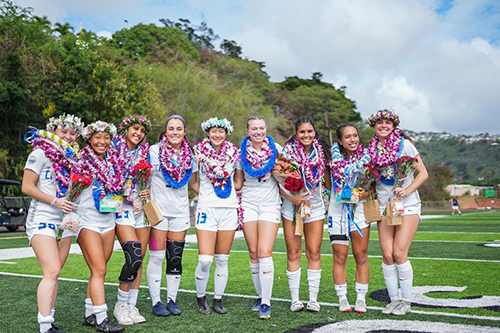
Nine seniors played their final game with the Silverswords Women's Soccer team.
Nine seniors played their final game with the Women’s Soccer team.

Now in its 16th year, the Division 2 Athletic Directors Association (D2 ADA) Academic Achievement Award is a program that recognizes the scholastic accomplishments of student-athletes at the Division II level. This year, a record 54 Silversword student-athletes were honored with the award, eclipsing last year’s number of 52.

“Intercollegiate athletics is an important component of the student experience at Chaminade,” says President Dr. Lynn Babington. “As a Marianist, Catholic institution, we value the development of the whole person, and athletics creates the opportunity for our students to not only excel in sports, but to learn teamwork and leadership and provide school spirit to the campus.”

To be honored with the D2 ADA Academic Achievement Award, the school’s athletic director must be a current dues-paying member of the D2 ADA. Also, a student-athlete must have a minimum cumulative grade-point average of 3.5 or higher on a 4.0 scale, have attended a minimum two years (four semesters) of college level work ,and have been an active member of an intercollegiate team during his/her academic year.

Eleven Silverswords posted 4.00 grade-point averages during their time at Chaminade with two senior student-athletes—Peyton Oshiro (men’s cross country) and Hoku Schatz (women’s soccer)—wrapping up their playing careers with perfect GPAs.

In all, a record-breaking 19,646 student-athletes from across 196 NCAA Division II institutions were recognized with the award.
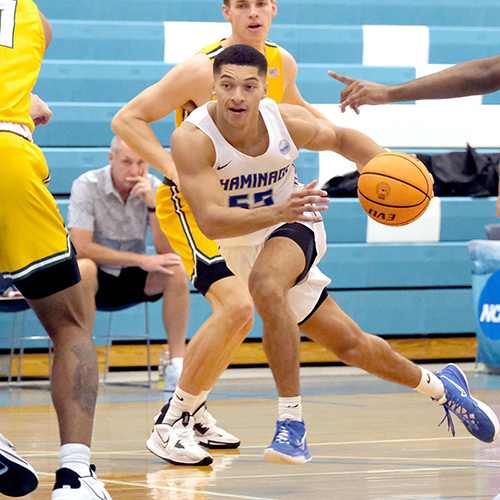
Isaac Amaral-Artharee ranks 11th in the all-time scoring list with 1,326 points ... second in 3-pointers made (192) ... fourth in free throw percentage (83.5; 198-of-237) ... seventh in starts (69) ... sixth in minutes played (2,842).
Isaac Amaral-Artharee ranks 11th in the all-time scoring list with 1,326 points.

“I couldn’t be more proud of our student-athletes, who earned the prestigious honor of being a D2 ADA Academic Achievement Award winner,” said Chaminade Athletic Director Tom Buning. “Having a school record number of awardees is a testament to our Silverswords dedication to excellence in the classroom and competition. This accomplishment is even more noteworthy when considering that travel for the PacWest Conference competition requires extended absences from class.”

Of the more than 1,100 NCAA member universities and colleges, about 300 classify their athletics programs in Division II.
 
Division II is all about balance. Students participate in highly competitive athletics, have the best access ratio to NCAA championships of any division and can earn athletics scholarships, but their college experience includes so much more than sports participation. The balanced approach in athletics, academics and community engagement allows Division II student-athletes to focus on their academic pursuits, internships, studies abroad and all that interests them.
 
Among the most distinguishing features in Division II is its athletics scholarship model, which awards partial scholarships that students combine with academic or need-based grants to construct their financial aid package. Division II believes it is important to acknowledge and financially reward students’ athletics abilities. This partial scholarship model keeps athletics budgets more closely proportioned with the total institutional budget.

The following Silversword student-athletes were recipients of the D2 ADA Academic Achievement Award (listed by sport):

Men’s Basketball
Isaac Amaral-Artharee
Scott Ator
Dorian Harris
Kameron Ng
Braden Olsen
Patrick Renane
Kobe Young
 
Women’s basketball
Olivia Crigler
Mia Ming
Emma Morris
 
Men’s Cross Country
Elijah Bernardo-Flores
Peyton Oshiro
Peter Jan Ramos
Josiah Rodrigues
 
Women’s Cross Country
Leila-Jayne Casison
Montserrat Lanfranco
Eri Leong
Ashley Yoshikawa
 
Men’s Golf
Kal O’Brien
Schuyler Peterson
 
Men’s Soccer
Kekoa Kuloloia
Kaulana Navares
Daniel Villalva
Brandon Yasue
 
Women’s Soccer
Lece Aviles
Gracie Bowers
Ruby Burroughs
Caili Cain
Gracie Knowd
Jenna McLean
Kira Nishiki
Dayna Nishimura
Hoku Schatz
Clara Slate-Liu
Kyla Takazono
Nicole Vontsolos
 
Women’s Softball
Kobe Brown
Taryn Fujioka
Kailah Gates-Coyaso
Taylor Genera
Haley Hayakawa
Bailey Jacobsen
Kieren Lopez
Chasity McKean
Cheyne Obara
Keolani Takemura
 
Women’s Tennis
Sydney Danielson
Emily Ramirez Miranda
 
Women’s Volleyball
Alexia Byrnes
Sasha Colombo
Greta Corti
Brooklen Pe’a
Kaybrie Pe’a
Sophie Schilling
 

Posted by: University Communications & Marketing Filed Under: Athletics, Campus and Community, Diversity and Inclusion, Featured Story Tagged With: Athletics, Honors and Awards, Men's Basketball, Women's Volleyball

Silversword Reunion Blooms

July 31, 2023

Criminal Justice alumni reunite at Vi and Paul Loo Student Center

Dr. Greg Mark makes it clear that Criminal Justice reunions involve more than just those who may have been one-time dorm mates or who may have taken classes together. Because attendees come from varied disciplines with different majors, the event holds a lot more meaning and makes for a qualitatively powerful experience, according to Mark.

“There’s lots of spirit and camaraderie,” says Mark, a former Criminal Justice professor with Chaminade from 1977-1989. “I’ve been involved with a couple of reunions, one eight years ago at The Willows and a second on campus, which took place right before COVID.”

When Mark taught at Chaminade, the program was called Justice Management until he took over the chairmanship of the department. Because he obtained his doctorate in Criminology—a degree not many people in the country held at the time—and simultaneously taught Ethnic Studies, the then young 20-something-year-old professor decided to change the name to Criminal Justice, which was more accurately reflective of what they were teaching at Chaminade.

Dr. Babington welcomed Criminal Justice alumni and faculty back to campus.
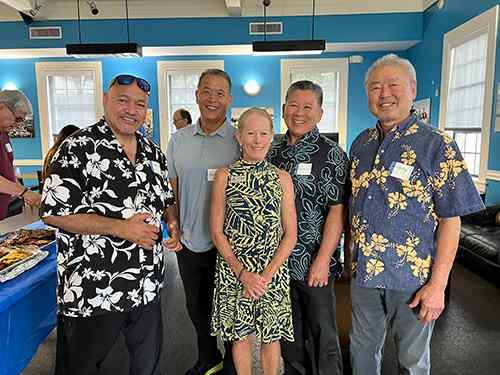
Chaminade President Lynn Babington, Ph.D., welcomed Criminal Justice alumni and faculty, including, from left Pulasi “Sam” Puletasi, Frank Okamura, Kevin Shimoda and Dr. Greg Mark.

“I took fragments of Management Justice and developed a criminology curriculum,” says Mark, who recently attended a Criminal Justice mini reunion held at the Vi and Paul Loo Student Center on campus. “It was a very exciting time to be part of the Chaminade faculty.”

A Criminal Justice major who graduated in 1986, Frank Okamura remembers taking Mark’s Criminal Justice Agencies class and describing him as fair and just like “one of us.” This may be true since some of the students—like Okamura, already a father of two and working as a U.S. Customs Service Inspector and bartender—were closer in age to Mark.  

“I think he (Mark) felt sorry for me because he named me ‘Outstanding Student’ or something like that,” laughs Okamura, who also attended the recent reunion on campus and had a chance to spend some time with his former professor. “I really enjoyed his class, which provided me a better understanding of the different law enforcement agencies.”

A tight-knit group, Criminal Justice alumni members will often socially meet either for lunch or dinner, reminiscing about their days as Silverswords, updating each other on their kids and grandkids, and their achievements since graduation.   

“During my time at Chaminade, we did so many things together, which brought us closer together,” says Mark, referring to students and faculty. “There was a lot of aloha among people in the department and it was a dynamic time.”

At the mini reunion, Okamura was impressed that Chaminade President, Dr. Lynn Babington,  had showed up to welcome them back to campus, making them all feel like they were home.

“Chaminade provided me with a path that I would have never known,” says the 62-year-old retiree and grandfather of five grandkids. “Whenever I needed help, my professors were always there; they were always so supportive and attentive. I am just so appreciative and grateful for my time there.”

Asked if they plan to attend the October Silversword Reunion, Okamura and Mark unhesitatingly said “Yes.” “It will be another chance to talk about each other and some of the work we did together,” Mark says. “Teaching at Chaminade was a great experience. It’s where I grew up professionally, and it’s where I developed my academic and administrative skills.”

Posted by: University Communications & Marketing Filed Under: Alumni, Behavioral Sciences, Education, Featured Story Tagged With: Alumni, Criminology and Criminal Justice, Master of Science in Criminal Justice Administration

Campus Romance Endures

July 21, 2023

Emily Palmer and Jason Perez enjoy life together after Chaminade

Her mom, Erinn Palmer ’81, graduated from Chaminade University. So, too, did her dad, Ron Palmer ’81. So a visit to the Kalaepohaku campus in 2010 easily convinced Emily Palmer ’17 that Chaminade University was the right fit. Meanwhile, Jason Perez’s ’18 reason to become a Silversword was so he could join his sister, Christela Perez ’19, on her journey to Hawaii.

“We met through my sister,” says Perez of his initial encounter with Palmer. “They were already close friends and because I’m close with my sister, I was always hanging around them.”

The young couple would eventually begin dating, and seeing each other every day. They would frequent the Sullivan Family Library’s lanai to study, preferring it over other outdoor areas because of its serenity and proximity to research literature.

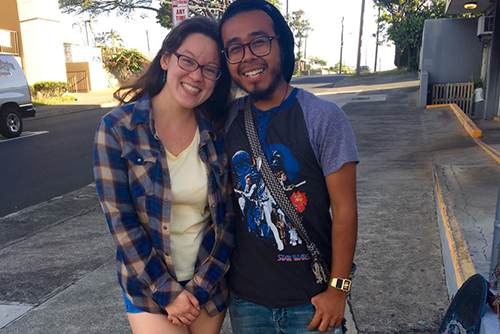
Emily Palmer and Jason Perez constantly walked along Waialae Avenue.

Yet, what makes Palmer’s and Perez’s students-to-husband-and-spouse fairytale story is its rarity. Pew Research Center data reveals that when it comes to marriage after graduation, 28 percent of married graduates attended the same university as their spouse. But that percentage precipitously plummets to two percent when it comes to marriages between college sweethearts, according to researchers with CreditDonkey, a personal finance website.

This statistic highlights the fact that, while many college students may find themselves in romances, the chances of those relationships lasting into marriage are slim. It also serves as a reminder that college affairs can often be fleeting, and that it is important to be mindful of the potential for heartbreak.

However, because Chaminade has a nurturing environment and is rooted in community—which is the resounding sentiment echoed across the campus—students can be reassured that they will receive the necessary support. It’s not uncommon for this phrase—the prided, capital-c Community—to be interchanged with an even stronger word: ’Ohana.

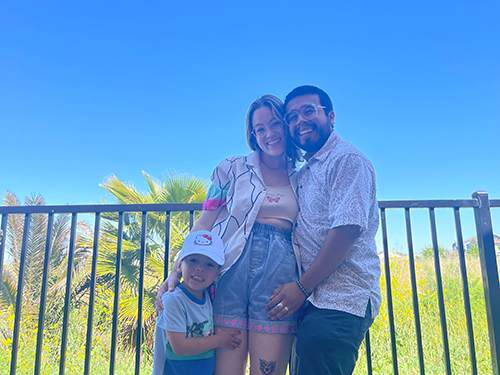
Aside from the broader, communal ‘ohana that Chaminade fosters, it also often provides the backdrop to the infinite beginnings of new families, flesh and blood. Families like that of Palmer and Perez, and their 3-year-old son, Raiden.

“Maybe he’ll be the next generation to attend Chaminade,” jokes Palmer, who received her BS in Biochemistry, and is presently pursuing a pharmacology degree from Touro University California. “It was such a good choice for me to move away from California to attend university in Hawaii.”

Emily Palmer and Jason Perez are parents to 3-year-old Raiden.

Graduating with a bachelor’s degree in Communications Mass Media, Perez’s greatest takeaway while at Chaminade was the university’s diverse student population and its ability to bring people together.

“I still communicate with a lot of my classmates,” said Perez, who, along with Palmer, attended a Chaminade alumna event at Pitch Sports Bar at SALT at Our Kakaako earlier this year. “I really liked the different clubs, which were welcoming and inclusive.”

When Palmer’s education began at Chaminade, she was a shy, reserved teenager, and barely spoke out. But the four years she spent on campus transformed her from a meek 18-year-old teen to a confident young woman.

“I can speak out for myself now,” Palmer asserts. “I have my own voice and independence; I am a woman hear me roar!”

During her sophomore year, Palmer became an Admissions Department Telecounselor, entering prospective students’ data into the university computer system, maintaining contact with them to update their student status, and conducting campus tours of the university for incoming students and their families.

“Choosing Chaminade allowed me to be out on my own,” Palmer says. “It was a safe place where faculty, staff and peers would come to my aid if I ever needed it. It felt truly like ‘ohana.”

Perez says he became more worldly, especially as a staff writer with the Chaminade Silversword student newspaper, where he covered hot-button, controversial issues like the U.S. presidency, immigration and reform. “I liked the fact that the students all came from different walks of life and many from interracial families,” adds Perez, who is now the lead brewer for Heretic Brewing Company in Fairfield, Calif. “It felt so comfortable; it felt like being at home.”

Posted by: University Communications & Marketing Filed Under: Alumni, Business & Communication, Campus and Community, Featured Story, Natural Sciences & Mathematics Tagged With: Alumni

NCIS Special Agents in Hawaii

July 19, 2023

Chaminade Alumni Represent True NCIS Agents

They don’t go around pointing their guns at people. They don’t detonate bombs. And they certainly don’t solve major crimes in an hour. But, what five Chaminade alumni do help to accomplish is to keep Hawaii safe.

​​As special agents for the Hawaii Field Office of NCIS headquartered at Pearl Harbor Naval Base, Chris Meana ’12, Pia Teves ’85, Tamara Kenessey ’16, Olivia DeQuiroz ’12 and Kay Een ’02  are tasked with monitoring crime, conducting polygraph tests, supporting criminal investigations, and providing analytical support and technical surveillance countermeasures (TSCM).

They’re important jobs for sure. And for Meana, it has been a “life calling.”

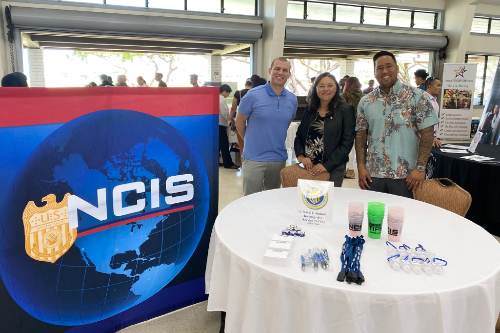
Chris Meana, right, and Kay Een promote NCIS at a recruitment affair.

“When I attended Chaminade, I was really into my religious classes, and I thought that was my calling,” says Meana, an Intelligence  Specialist with NCIS since 2015 who also acts as NCIS Honors Student Internship Coordinator, and is a member of Member of the Special Agent in Charge Advisory Group. “But then I served with the Hawaii National Guard and I refined my calling, wanting to make an impact in my hometown.”

For DeQuiroz, it was not so much a calling but a necessity that led her to the NCIS Hawaii Field Office. “I needed to pay for college so I applied for an administrative position,” says the Polygraph Examiner. “Then a job came up and I was encouraged to apply, and I passed a series of tests during the hiring process.”

Today, DeQuiroz provides counterintelligence, monitoring spies, terrorists and any matter that pertains to our national security across all branches of the military. She’s also involved with “Operation Keiki Shield,” which is part of the Hawaii Department of the Attorney General’s Internet Crimes Against Children Task Force that is comprised of a national network of 61 coordinated task forces, representing more than 5,400 federal, state and local law enforcement.

“Internet crimes are always challenging,” DeQuiroz says. “But we’ve managed to arrest more than 100 child predators in our Task Force in Hawaii.”

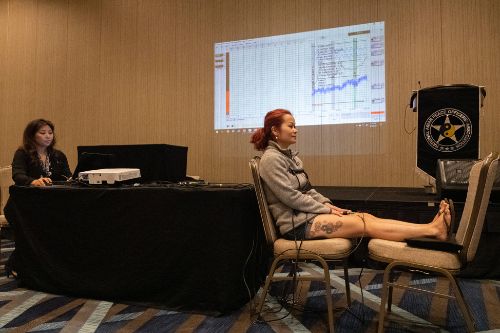
Olivia DeQuiroz administers a mock polygraph test.

With the nation’s strategic focus shifting towards the Indo-Pacific region, the NCIS Hawaii Field Office’s multi-faceted capabilities are even more in demand. Stretching from the Pacific coastline to the Indian Ocean, the area  is home to more than half of the world’s people, nearly two-thirds of the world’s economy and seven of the world’s largest militaries. And in the years ahead, as the region drives as much as two-thirds of global economic growth, its influence will only grow—as will its importance to the United States.

A former electrician with his family’s business, Teves started as a Technical Investigative Specialist (TIS) Agent in 1987 and became a Technical Enforcement Officer in 2014. He is now the sole provider of technical support for the Internet Crimes Against Children Task Force, as well as providing technical security for the entire Pacific Command.

“Before there was internet, I was looking at an actual bulletin board while I was on campus, and I came across this poster that read: Naval Investigative Service  (NIS), Office of Naval Intelligence (ONI), Special Agent position. Overseas travel, Worldwide locations,” recalls Teves, whose official NCIS title is currently Technical Surveillance Specialist. “I had no idea what it was, but it sounded sexy so I applied. About nine months later, I was hired as an Agent.”

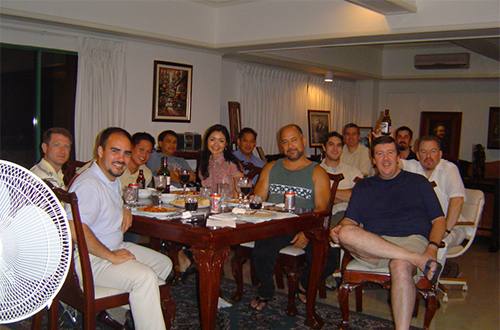
Pia Teves, wearing tank top, were on temporary duty travel to provide protective service for Adm. Samuel J. Locklear, Commander, U.S. Pacific Command during his official visit to Manila, Philippines in 2004.
Pia Teves, wearing tank top, and his colleagues were on temporary duty travel to provide protective service for Adm. Samuel J. Locklear, Commander, U.S. Pacific Command, during his official visit to Manila, Philippines in 2004.

Often misperceived as a branch of the military, NCIS is not. It is, however, the federal law enforcement arm of the Department of the Navy. Comprised primarily of civilian 1811 special agents and a small cadre of active duty Marine Corps active duty investigators, NCIS has more than 14 field offices and over 190 locations. Its special agents are stationed worldwide in support of military operations.

With historical roots tied to the Office of Naval Intelligence, the modern NCIS was formally established in 1966 as the Naval Investigative Service.  It was re-organized and assigned a civilian director in 1992, along with a name change to the now Naval Criminal Investigative Service. With this re-branding, NCIS also became a primarily civilian agency as an insulation against military command influence.

“We’re an agency of around only 2,500 members, which is relatively small compared to the major players, like the DEA, ATF and FBI,” Meana points out. “But our capabilities are well respected, and we are well known for our role in counterintelligence, protective service and force protection operations.”

Solving crimes and catching the bad guys, though, aren’t the only issues that the NCIS Hawai‘i Field Office faces. Integrating itself into the local community is vital, as well, which is why the team can be seen throughout the year at a variety of functions. Some outreach efforts focus on awareness and education, spanning across such topics as internet safety and sexual assault prevention to identity theft and cybercrime.

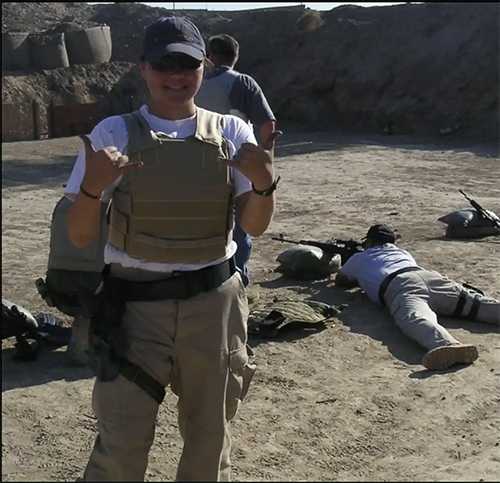
Kay Een flashes a shaka while in Baghdad, Iraq circa 2005.

A Special Agent since 2020, Kenessey deals with death investigations, child enticement, fraud, arson and all federal-level investigations that involve criminal and security matters with the Navy.

Upon learning that her mentor, Associate Professor Dr. Joe Allen, passed away in December 2021, Kenessey was saddened by the news. “Technically I wouldn’t be here if Dr. Allen hadn’t written a letter, and told me to check out NCIS,” Kenessey says. “I think Chaminade lost a valuable professor and mentor. As I said, he was an integral part of where I am today both academically and professionally.”

Kay Een, meanwhile, praises Chaminade for its welcoming atmosphere and for the experiential learning that helped her land a job with NCIS. As NCIS’ Chief Diversity and Inclusion Officer,  Een supports NCIS’ progression in the DEI arena by supporting enterprise initiatives to implement the best business practices, encouraging collaboration, and delivering proven solutions to nurture a ready and resilient, globally-engaged workforce. She was introduced to the NCIS Honors Internship Program while a Silversword.

“Much like my time at Chaminade, I believe there is great value being surrounded by people with different backgrounds, experiences and perspectives,” says Een, who is now in her 20th year with NCIS. “Being in a place that fosters diversity through inclusion is key to growing an innovative and agile workforce.”

As far as the authenticity of CBS’ popular NCIS franchise, Meana, Teves, DeQuiroz, Kenessey and Een agree that the drama doesn’t always get it right. “We have a close relationship with the show, and we’ve worked with them closely,” Meana says. “They try to stay close to reality, but they do add their own fictional twist.”

Posted by: University Communications & Marketing Filed Under: Alumni, Behavioral Sciences, Featured Story, Homepage, Institutional Tagged With: Alumni, Forensic Sciences, Psychology

Surf Studies

July 18, 2023

Culture, history and future intersect to create the perfect wave

Surf studies may just well be the new wave in some academia circles. As more scholars publish academic books about the sport of surfing, from “Waves of Resistance: Surfing and History in Twentieth-Century Hawaiʻi” to “Waves of Knowing: A Seascape Epistemology,” universities around the world have begun to embrace the discipline as worthy of research, education and scholarship.

A decade ago, a love for surfing prompted a group of Chaminade faculty members, including Drs. Jim Kraus, Pete Steiger, Michio Yamasaki and Hank Trapido-Rosenthal, to brainstorm the idea of teaching an undergraduate surf class. Yet, it wasn’t until a few years ago, during a casual faculty pau hana, that the notion of “Critical Surf Studies” re-emerged.

“I mentioned it to Lynn (President Babington) and she was interested,” recalls Kraus, an avid surfer since the ’60s and the former publisher of “Hawai‘i Surf & Sea;” from 1980-1984. “Then Lance (Provost) walked by, and I pitched the idea to him, too.”

Eventually, it was Cheryl Edelson, Ph.D., Dean of School of Humanities, Arts, and Design, who presented the topic to the full Chaminade Curriculum Council, which is the final recommending voice in curricular matters with the definitive stamps of approval resting with Drs. Babington and Askildson.

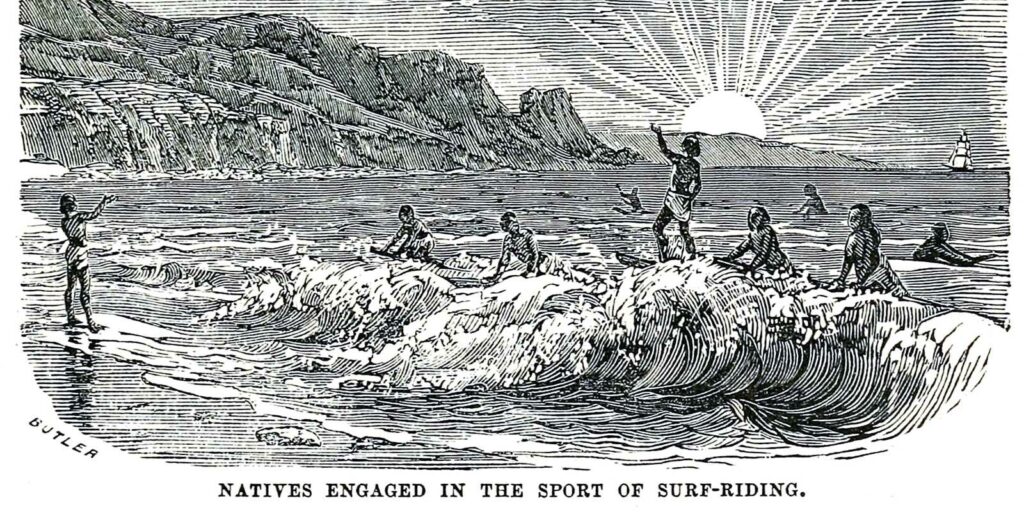
Magazine illustration of native Hawaiians surf-riding (surfing) from an article entitled “Our Neighbors of the Sandwich Islands” in Hutchings’ California Magazine, November 1858.

“Surfing is such an integral part of Hawaiian culture that it deserves to be part of our curriculum,” Babington says. “This program is the first of its kind in Hawai‘i, and it challenges students to explore surf culture’s indigenous origins, its growing popularity globally and its importance to Hawai‘i’s sense of place.”

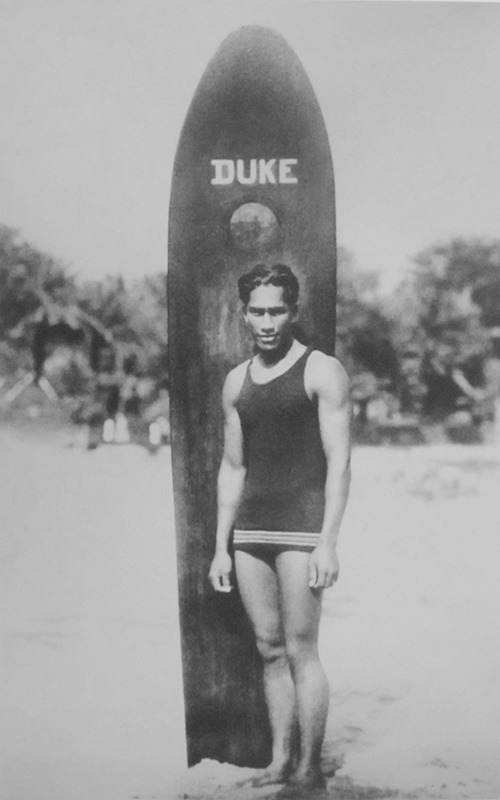
Duke Paoa Kahinu Mokoe Hulikohola Kahanamoku (August 24, 1890 – January 22, 1968) was a Hawaiian competition swimmer who popularized the sport of surfing.
Duke Paoa Kahinu Mokoe Hulikohola Kahanamoku (August 24, 1890 – January 22, 1968) was a Hawaiian Olympic swimmer who popularized the sport of surfing. 

Celebrating its second anniversary, the Surf Studies Minor examines the broad area of surfing communities and the complicated conflicts that define them, conflicts over access—to beaches, to parking and to the surf zone (po‘ina nalu) itself. Also of central concern is “ownership” of individual waves. It’s a question that Kraus posed in his first class of the semester.

“The idea behind wave ownership and the entitlement that accompanies the belief that one could own any wave signifies a pretty strong misunderstanding of the relationship between surfers and the wave,” Environmental Studies major, Kahana Yokoyama ’23, posted to the class’s online forum. “A good example is merging while driving. If two lanes combine, regardless of where, there is a relatively similar degree of respect when leaving room for others to merge. Taking turns is the most basic basis for this and the same is true for surfing.”

The SURF 480 class uses an asynchronous-learning model, which does not require consistent real-time interactions with an instructor. Students can access course materials—lectures, readings and assignments—on their own time. Although this is an online class, students are required to regularly participate by posting responses to questions posed on the forum. And they must also keep a journal in a conventional bound paper notebook, which they will have to submit regularly, and which Kraus says he reserves the right to read.

“We examine surfing in an academic sense and as part of pop culture,” Kraus explains. “We look at surfing from three perspectives: as a spectator watching surfers from the beach, in the movies and online; as a participant who enters the water and finds a way to the po’ina nalu; and as a literalist, someone who watches weather reports and predicts the surf, promotes surfing, or designs surf boards or clothing.”

According to Kraus, by the end of the term, students should be able to 1) define key terminology used in the interpretation and analysis of surf culture; 2) articulate the relationship between surfing communities and coastal ecosystems; and 3) report on what is of personal, ethical or religious significance in surfing and surf studies by applying Marianist values related to “Education in Family Spirit.”

“This class accentuates my environmental studies, and gives context to the Hawaiian culture and what we read about in texts,” says Yokoyama, who already has a job lined up as an environmental consultant with a Kailua firm. “It teaches you how to apply what you’re learning about surfing to reef health, and how coastal eco-systems interact with surfing as a sport and an industry.”

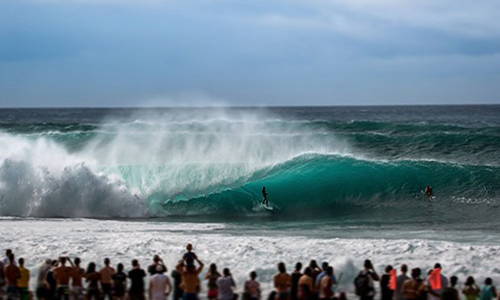
One of the most famous surf spots in the world, Oahu’s North Shore’s Banzai Pipeline, is the site of one of three of the competitions for the Vans Triple Crown of Surfing title.

While Chaminade students are able to minor in Surf Studies, other universities now offer fully-fledged bachelor’s degrees in surfing, while a few schools even enroll students in post-graduate programs that focus on surfing.

Dr. Gail Grabowsky, Dean of the School of Natural Sciences & Mathematics and Executive Director U.N. CIFAL Honolulu, believes that there’s a lot of activity related to getting on a board and riding the waves. “Many of the Environmental Studies students love the ocean, and are also very conscious of issues like marine debris and materialism,” says Grabowsky. “There are also some wonderful service opportunities with charitable organizations that really look after the ocean, such as the Surfrider Foundation, which has raised awareness and kept wonderful data.”

Askildson has developed a deep connection with surfing since he first learned the art of riding waves off the shores of Daytona Beach in Florida 25 years ago. His affinity towards the surf has grown even deeper since first moving to Australia and now to Hawai‘i.

“I found the Surf Studies program compelling because it is as much about the history of the Hawaiian culture as it is about the history of surfing,” Askildson asserts. “At Chaminade, we serve the people of Hawai‘i and celebrate the culture that makes our islands both unique and special; this program is a striking articulation of that mission and legacy.”

Posted by: University Communications & Marketing Filed Under: Diversity and Inclusion, Featured Story, Homepage, Humanities, Arts & Design, Institutional Tagged With: Curriculum, Surf Studies

SPICE Institute Peppered with Data

July 5, 2023

Monthlong seminar focuses on helping students understand data 

Data science continues to evolve as one of the most promising and in-demand disciplines, and budding data scientists are all too happy to explore the field … one byte at a time. Just ask Rylan Chong, Ph.D., Chaminade’s Data Science Program Director.

“Chaminade received approval in 2018 to launch a Data Science major, which was the first of its kind in Hawaii,” Chong says. “And we had our first cohort of 40-50 students in 2019. Now our classes are practically maxed out each semester.”

This summer, 35 students participated in the Supporting Pacific Indigenous Computing Excellence (SPICE) Data Science Summer Institute—from June 2-30—marking the largest number of participants since SPICE’s inception five years ago. Funded by a National Science Foundation grant, and in partnership with the Texas Advanced Computing Center, SPICE aims to level the playing field for Native Hawaiian and Pacific Islander (NHPI) students, who are woefully underrepresented in science, technology, engineering and math (STEM) fields, and specifically cutting-edge data science.

Of the 35 SPICE Data Science Institute participants, 19 of them were Silverswords.
Of the 35 SPICE program participants, 19 of them were Silverswords.

“We want to advance computing and data for social change and justice,” says Chong, who graduated with a bachelor’s in Computer Science from Chaminade in 2010, and with a doctorate in Information Security from Purdue University of West Lafayette in 2018. “We want to work with our community partners and upscale people’s knowledge about the use of data.”

SPICE participants include 22 undergraduate students from Hawaii, including 19 from Chaminade University. The remaining eight undergraduates hail from the Northern Marianas College (5), Mount Mercy University in Iowa, University of Portland and Guam Community College. Five undergraduate student mentors also were involved.

“Not to sound cliché, but data science is everywhere,” says Biology Assistant Professor Chrystie K. Naeole, Ph.D. “Students get to mesh science with data science, and to look at disparities among Native Hawaiians and Pacific Islanders.”

With one of the largest wealth gaps in the nation, high rates of incarceration, and high rates of illness and health disparity, Hawaii has a compelling need to address social justice issues. Students of Hawaiian descent have something they want to fix because they see the inequality every day in their families and their communities, from health and homelessness to the environment and sustainable energy.

Of the 35 SPICE Data Science Institute participants, 19 of them were Silverswords.
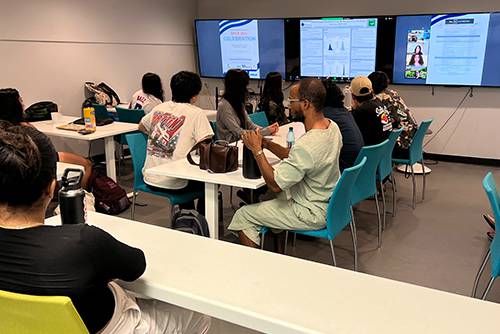
Participants collaborated on research projects even during lunch.

“Most people have a passion. Most people care about something significant, something that they have a personal connection to,” says Kelly Gaither, director of Health Analytics at TACC and Associate Professor in Women’s Health at the Dell Medical School. “When you have a personal connection, it’s like a glue. It allows other concepts that you need to stick. In the absence of that glue, students may not realize they’d be happy working in computer science or data science because of the way it’s taught and presented to them.”

Chong believes we already apply data science in our daily routines. We compare prices, for example, when we’re shopping for groceries. We’ll shop at stores that offer better deals. Think of Longs Drugs on a Sunday or Safeway on $5 Fridays. We compare quantity and quality, a generic brand versus brand name.

“You can apply data science to every field—education, healthcare and mental health, environment science and climate change, and criminal justice,” Chong explains. “It’s not just about crunching numbers, but ensuring the numbers reflect different viewpoints and getting those numbers into the right hands.”

A 2022 Chaminade University alumna with a degree in Data Science, Analytics and Visualization and one-time SPICE participant, Zoey Kaneakua is now a data analyst with the Department of the Attorney General’s Crime Prevention and Justice Assistance Division. And her job: To monitor crime statistics in Hawaii and to share the data with the Federal Bureau of Investigation’s National Incident-Based Reporting System (NIBRS), an incident-based reporting system in which law enforcement collects data on each crime occurrence.

Zoey Kaneakua '22 at her computer
Zoey Kaneakua ’22 now works for the Department of the Attorney General’s Crime Prevention and Justice Assistance Division

“That was my first independent research involving juvenile justice,” recalls Kaneakua of her participation in SPICE during her junior year. “And I think I built my first dashboard in three days using Python (a high-level, general-purpose programming language).”

Like Artificial Intelligence (A.I.) of the past, data science was barely mentioned a decade ago in scientific circles. Now it’s everywhere. In the same way that A.I. is an umbrella term for intelligence, Data Science is an umbrella term for insights from data.  Sometimes these two terms appear to be in conflict or competition, but this is not the case. The field of data and machine intelligence is vast and involves everything from understanding data to helping computers learn from the data and solve problems automatically using their learnings. Arguably, both Data Science and A.I. are critical for businesses and maintain a complicated symbiotic relationship.

“The underlying theme of SPICE is about building capacity and learning communities in the Pacific to harness the power of technology and data to address challenges,” Chong says, borrowing from the National Science Foundation’s Harnessing the Data Revolution initiative. “We focus on social aspects, applied ethics and responsibility working with people and data.”

In their final projects, SPICE participants studied various issues, from Indo-Pacific Resilience and Hawaii Biodiversity to Tax and Housing Equity and Health.

“All their projects were based on the United Nations’ 17 Sustainable Development Goals,” Chong said. “These students upskilled in analytics, research and programming. We also had a lot of firsts this year. To name a few, it included an opportunity to use the TACC supercomputers at the University of Texas at Austin; we had technical directors who joined us in helping on sponsored projects; and three students presented their projects in their preferred or native language that included Spanish, Carolinian and Native Hawaiian.”

Posted by: University Communications & Marketing Filed Under: Center for Strategy and Innovation, CIFAL Honolulu, Featured Story, Homepage Tagged With: CIFAL, Data Analysis & Visualization, Data Science, Research

  • « Go to Previous Page
  • Page 1
  • Interim pages omitted …
  • Page 42
  • Page 43
  • Page 44
  • Page 45
  • Page 46
  • Interim pages omitted …
  • Page 92
  • Go to Next Page »

Footer

Chaminade University Logo

3140 Waialae Avenue
Honolulu, Hawaii 96816

Contact Us
Phone: (808) 735-4711
Toll-free: (800) 735-3733

facebook twitter instagram youtube linkedin

Visit

  • Plan Your Visit
  • Campus Map (PDF)
  • Events

Resources

  • Campus Security
  • Student Consumer Information
  • Concerns, Feedback, and Reporting
  • Institutional Review Board
  • Title IX / Nondiscrimination Policy
  • Compliance
  • Emergency Information
  • Careers
  • Institutional Statement

People

  • Students
  • Parents
  • Alumni
  • Faculty & Staff

Policy

  • Privacy Policy
  • Terms and Conditions of Use


© Chaminade University of Honolulu