• Skip to primary navigation
  • Skip to main content
  • Skip to footer
Chaminade University of Honolulu

Chaminade University of Honolulu

  • VISIT
  • APPLY
  • GIVE
  • STUDENTS
  • PARENTS
  • ALUMNI
  • FACULTY/STAFF
  • Admissions
    • Admissions Home
    • Undergraduate Students
      • First-Year Students
      • Transfer Students
      • Admitted Students
    • Graduate Students
    • Flex Online Undergraduate Program
    • Military Students
    • Non-Degree/Visiting Students
    • Experiential Honors Program
    • Early College Program
    • New Student Orientation
  • Tuition & Aid
    • Financial Aid Home
    • Tuition & Expenses
    • Federal Updates & Changes
    • Scholarships
    • $5,000 Graduate Scholarship
    • VA Education Benefits
    • Net Price Calculator
  • Academics
    • Academics Home
    • Academic Programs
    • Office of Student Success
      • Academic Advising
      • Records and Registrar
    • Kōkua ʻIke (Support Services)
      • ADA Accommodations
      • Career Services
      • Proctoring Services
      • Tutoring Services
    • Sullivan Family Library
    • Undergraduate Research & Pre-Professional Programs
    • Commencement
  • Campus Life
    • About Campus Life
    • Student Engagement
    • Student Government Association
    • Residence Life and Housing
      • Summer Conference Housing
    • Health Services
    • Marianist Leadership Center
    • Counseling Center
    • Campus Ministry
    • Campus Security
    • Dining Services
    • Bookstore
  • Athletics
  • About
    • Chaminade University News
    • Our Story
    • Leadership
    • Chaminade University Strategic Plan 2024-2030
    • Mission & Rector
    • Association of Marianist Universities
    • Facts & Rankings
    • CIFAL Honolulu
    • Accreditation & Memberships
    • Montessori Laboratory School
Search
×

Search this web site

University Communications & Marketing

Doctor of Nursing Practice Program: More Than a Degree—An Opportunity to Make a Difference

April 2, 2021

The first students in Chaminade’s new online Doctor of Nursing Practice (DNP) program start in August.

Dr. Pamela Smith (Associate Dean, School of Nursing and Health Professions)

The new doctoral degree is designed for the registered nurse or advanced practice nurse who wants to provide evidence-informed practice to culturally diverse populations and take a leadership role as an advocate for health and social justice using the latest technology for learning and practice.

Dr. Pamela Smith, Associate Dean of Chaminade’s School of Nursing and Health Professions, says potential students should know the school truly cares that each student has a positive and successful experience. 

She says that’s why interviews are part of the application process. “We want to know what a student’s goals are, so we know we can help them succeed. We want it to be a good match.”

Three DNP degree paths

Students will choose one of three Doctor of Nursing Practice tracks: Family Nurse Practitioner (FNP), Psychiatric Mental Health Nurse Practitioner (PMHNP) or Executive Leader (EL). 

The FNP and PMHNP, both nurse practitioner tracks, will allow graduates to work as advanced practice registered nurses (APRNs) who manage patients’ conditions. Smith says APRNs diagnose, provide treatment and manage patients’ care in a holistic, comprehensive manner.

“They’ll have the tools and learn the skills to provide quality improvement in their patient population in their clinics and hospitals,” she says. “They’ll be able to review the evidence-based literature and make clinical decisions based on that evidence.”

“The focus is on being able to determine a need and create a plan, implement that plan and evaluate its effectiveness in terms of looking at organizational improvement, or patient outcomes improvement or delivering care as a Nurse Practitioner.” 

The nurse practitioner tracks are for nurses who have their BSN and are ready to advance their nursing education and clinical practice.

The Executive Leader track is for the qualified nurse who wants the skills, knowledge and career opportunities that come with a DNP degree but chooses to focus on nursing leadership. 

“Executive leaders are nurse managers and leaders in a hospital, or clinical nurses looking to be able to lead their organization or their unit to improve patient outcomes,” she says. “These nurses have their master’s degrees and want the education and career advancement that the DNP provides but do not have the desire to become a nurse practitioner. They want to take their nursing role to an advanced level.”

The Post-MSN to DNP option is designed for the advanced practice nurse or registered nurse who already has a Master of Science degree in Nursing (MSN) and wants to follow the Executive Leader track.

The need for DNPs: shortage of healthcare professionals

There’s a shortage of primary care providers not only in Hawai‘i right now but throughout the country, says Smith, and nurse practitioners can help meet the needs. “Nurse Practitioners can deliver accessible care as a provider.”

The COVID-19 pandemic highlighted the need for strong healthcare and nursing leadership. “Many advanced practice registered nurses pivoted to providing patient care via telehealth in order to provide accessible care and serve the patient population safely.”

And, she says, Chaminade will have the state’s only psychiatric mental health nurse practitioner program. “There’s a huge need for this program because of an increased need for mental health services.”

Healthcare needs keep changing, and she points out that “adaptation and change” is one of the Marianist values that Chaminade embraces. “That’s exactly what is happening with COVID,” she says. “We continue to learn new information about COVID. How do we keep our patients and our staff safe? What do we need to do to make a new policy, implement it and carry it through until we realize we have to change it again? These are the problems being solved by well-prepared DNPs.” 

She says the DNP program is positioned to deliver content that will adapt and change as healthcare and nursing evolves. “We’re very willing to implement new technologies and new evidence-based material as they present.”

The pandemic, she says, has illuminated the need for strong nursing leadership skills. “Nurse leaders know what their staff and patients need. They know what the day-to-day and system needs are, and our graduates will have the skillset to come up with effective solutions.”

An online DNP program with wraparound support

“We wanted to provide a personable, online program that’s accessible to people in many different areas across the nation,” says Smith. “Many of our students might be from the neighbor islands, and we might have students from rural parts of America, where it’s challenging to drive to a campus while balancing family and work in order to receive a high quality education.” 

The year-round DNP program consists of two 15-week sessions (in the fall and spring) and a 12-week summer session. The two nurse practitioner programs take three years to complete, and the executive leader program can be completed in just under two years. There are three annual multi-day immersion sessions on campus.

“The immersions will provide an opportunity for connectedness to the community and for students to gain a sense of place, of where we are. We serve the Native Hawaiian and Pacific Islander populations, and as a university, we feel it will be valuable for all our students to understand the culture in which we provide care, even if they’re from the mainland. Because understanding the culture, the health and health disparities of a specific region allows that information to be applied to other communities of need. 

“Say somebody is coming from another state, and they learn about the populations we serve here in Hawai‘i,” she says. “They can take many of those models of care, or awareness, and apply them where they live for the cultures they serve. We’re hoping the immersions will bring light to many of the vulnerabilities our community faces, so that students will recognize the vulnerabilities in their own patient populations.”

The DNP program focuses on serving high-need communities. Smith says they want students to learn how to address health disparities and plan optimal and comprehensive care. 

“One of our Marianist values is social justice—service, justice, and peace.” She says they wove those values into the new curriculum and program goals. 

“Vulnerabilities need to be identified, and we need to pay attention to the people that need care the most. Not only for their benefit, but for the community as a whole. By determining high need areas, and learning how to provide care and striving for health equity, we improve the health of all people.”

The first immersion session, in August, will be an introduction to the islands’ culture, an opportunity to connect with peers, and a time to strengthen writing and statistical skills. “They’ll meet the faculty and leadership team, and learn about library resources and other components of our university,” says Smith.

Dr. Lynn Babington

Chaminade President Dr. Lynn Babington says that although the degree program is online, students will have close relationships with faculty and students of their cohort. “The faculty will support students and connect them with a network of field experts and opportunities.”

The second and third immersions will continue to offer unique learning opportunities such as standardized patient simulations, suturing, casting and splinting and project management. “It’s some of the nuts and bolts of what the students are going to see in their clinical environments,” says Smith.

The cohort model, in which small groups of students progress through the program together, creates a supportive peer-learning environment. Each student is also paired with a DNP faculty member, who will provide guidance and support through the program until they successfully complete a scholarly project. 

“The student can come with a project already in mind, something they’d like to implement in their own workplace, or we will assist them in selecting from a menu of projects needed in our community that are appropriate for their specific track and their specific interests,” says Smith.

She says they want students to do scholarly projects they’re interested in. “And they’ll all learn how to truly care for patients and their populations and communities in a way that is meaningful.”

She stresses that the program is very hands-on. “Students are treated as individuals, in terms of what their interests and strengths are, and we will have writing and statistical support for them. It sounds so cliché, but they are not just a number. This is a personalized and intimate university program where we have a lot of collegial support and also opportunities for networking.” 

She says the potential applicants she’s been meeting with have so far been unique and very strong candidates. 

“In terms of where they’ve been as nurses so far, they come with strong backgrounds and have much to offer the world. We want to cultivate those strengths and also discover what their deficiencies are, their gaps, so we can fill those for them.”

That’s the purpose of the interview, she says. “We want it to be a good match between the student and our organization. We really do care about each individual and optimizing their pathway.”

A Marianist foundation

The new program’s goals fit well with Chaminade’s Marianist values and the idea of improving one’s community. Another Marianist value carefully woven into the new degree program is educating the whole person. And then there’s Chaminade’s family spirit, of course, which means caring for each other at the university as well as in the community.

Rhoberta Haley Dean of Nursing Chaminade University

Dr. Rhoberta Haley, Dean of the School of Nursing and Health Professions, says they will care for the DNP students by offering them all the support they need. “Advanced degrees at that level take time and dedication. We want the students to be successful, and that takes time, dedication, and a lot of support, which we’ll give them.”

Smith points out one more benefit of the DNP degree—that it opens doors. “That advanced practice degree on your resume can help even if you don’t change jobs. You’ll have the tools and skills to perform better, to look at things from a different lens, and to be able to problem-solve with more capabilities. 

“It’s not just a degree,” she says. “It’s an opportunity to improve yourself, and therefore improve others.”

Posted by: University Communications & Marketing Filed Under: Featured Story, Institutional, Nursing & Health Professions Tagged With: Doctor of Nursing Practice

Chaminade University Launches Economic Education Center

April 2, 2021

Chaminade University’s School of Business and Communication, in partnership with the Hawaiian Council for Economic Education (HCEE), has launched the Economic Education Center for Excellence. The Center’s vision is to create a higher quality of life in Hawai‘i through economic and financial education and research and through support of sustainable nonprofit organizations and projects.

“At Chaminade, we understand that in order to continue to offer an excellent and relevant education we must be able to rapidly respond to the needs of learners, the workforce, and statewide and global priorities,” said Chaminade President Dr. Lynn Babington. “Our new Economic Education Center for Excellence does all of that by supporting local and national financial literacy mandates and the state’s vision for a sustainable Hawai‘i.”

The Center’s mission is to train teachers and students in financial literacy and to provide meaningful research to aid upward social mobility and an economically healthy society. Initial activities are focused on the Spring 2021 Economics Challenge hosted by HCEE for Hawai‘i high school students and teacher training sessions in alignment with Hawai‘i Department of Education standards for K-5 economic education.

“We’re pleased to partner with Chaminade University on the Economic Education Center for Excellence to provide pathways to reach and equip public and private K-12 educators,” said HCEE Chair Jim Dixon. “The Center will foster economic educational leadership and establish measurable learning outcomes for economic and financial literacy education in the state.”

Future Center initiatives will include high school entrepreneurship camps, upward social mobility research and programming, collaborative curricular development with Chaminade’s School of Education and Behavioral Sciences, and interdisciplinary research in support of economic education, the economics of climate change and the support of sustainable and effective nonprofit organizations. 

“I applaud Chaminade University for establishing its Economic Education Center for Excellence,” said Rich Wacker, president & CEO of American Savings Bank. “Improving education, and especially financial literacy, is incredibly important for the future of our island community.”

# # #

Chaminade University of Honolulu provides a collaborative and innovative learning environment that prepares graduate and undergraduate students for life, service and successful careers. Established in 1955, the university is guided by its Catholic, Marianist and liberal arts educational traditions, which include a commitment to serving the Native Hawaiian population. Chaminade offers an inclusive setting where students, faculty and staff collectively pursue a more just and peaceful society. For more information, visit chaminade.edu.

Posted by: University Communications & Marketing Filed Under: Business & Communication, Featured Story, Institutional, Press Release Tagged With: Economic Education Center for Excellence

One Year MBA Teaches Business for Good Through Strategic Decision-Making

April 1, 2021

Using an innovative program design built around a “business for good” philosophy, Chaminade University will launch its One Year MBA program in Fall 2021. The new program is geared toward experienced professionals interested in advancing their careers and maximizing their positive impact–as quickly as possible.

The One Year MBA, unique in the islands and fully International Accreditation Council for Business Education (IACBE) accredited, features a specialized hybrid class format. Students will attend daylong courses and participate in project-based learning on campus on alternating Saturdays and then supplement their learning with asynchronous instruction through Chaminade’s easy-to-use online platform.

In addition to the accelerated curriculum that allows students to complete their degree in just 12 months, the program weaves in ample opportunities for networking and professional growth. And as part of a capstone experience, students will have the option to travel internationally together to apply key on-site skills for a client.

“The One Year MBA underscores Chaminade’s commitment to provide new avenues to leadership for Hawai‘i,” said University President Dr. Lynn Babington. “This degree offers the excellence and quality, the access to resources and support and the experienced faculty you can expect from Chaminade in an innovative format that allows working professionals to take the next step in their career goals.”

Across sectors in Hawai‘i and nationally, managers and executives with MBAs are in high demand. At Chaminade, the degree stresses a broad foundation of knowledge, from finance to business analytics to marketing and strategic planning. As part of the program, participants will develop professional business reports, evaluate organizational decision making and apply their new skills to real-world situations.

A mission and values-based MBA program

Guided by its public service mission, Chaminade also puts a strong emphasis on seeking out opportunities to do “business for good,” by considering the societal, environmental and social justice impacts of business on communities. An additional Hawai‘i- and Pacific-centered focus allows students to unpack the importance of cultural intelligence and a global perspective in their work.

“Business for good means business with a heart,” said Dr. Bill Rhey, dean of Chaminade’s School of Business and Communication. “With our One Year MBA program, we are focused on helping students excel personally and professionally as they make positive contributions to their communities.”

A one-year MBA with built-in support

Rhey said he is especially looking forward to welcoming One Year MBA students to Chaminade’s mentorship-focused environment, giving them the individualized support, guidance and tools they need to succeed. The cohort-based program also allows students to build strong relationships with their peers. As each cohort moves through the program together, students will benefit from a growing network of professional support.

“Our in-person Saturday instruction won’t be lecture-focused, but experiential and hands-on. Your relationships with your fellow cohort members will allow you to tackle problems together, learning and collaborating along the way,” Rhey said. “While the program will only last a year, cohort members will continue to learn from and support one another throughout their careers.”


The inaugural cohort begins October 2021. Visit the program page for more information about the One Year MBA.

Posted by: University Communications & Marketing Filed Under: Business & Communication, Featured Story, Institutional Tagged With: One Year MBA

Chaminade University Welcomes Jeff Scofield as Dean of Financial Aid

March 29, 2021

Jeff Scofield, Dean of Financial Aid

Chaminade University has named Jeff R. Scofield as Dean of Financial Aid, where he will oversee operations of the financial aid office. He brings more than 30 years of experience to the position.

“We’re excited to welcome Jeff to the Silversword team,” said Dr. Lynn Babington, president of Chaminade University. “His expertise will prove invaluable as he leads our experienced team of financial aid professionals in helping to guide students and their families through our many scholarships and financial aid opportunities available.”

Scofield most recently served as Assistant Vice President, Student Financial Services for Seattle University. Prior to that, he was Director of Financial Aid at University of Hawaii at Hilo. He also held financial aid positions with Longwood University in Virginia, Our Lady of the Lake University in Texas and Schreiner College in Texas.

Active in professional organizations, Scofield is a member off the Pacific Financial Aid Association, National Association of Student Financial Aid Administrators, Western Association of Student Financial Aid Administrators and The College Board. He received his master’s degree in higher education administration from the University of Texas at San Antonio and a bachelor’s degree in business administration from Coe College in Iowa.

Chaminade University’s Financial Aid Office offers numerous financial aid opportunities, including merit aid, scholarships, grants, federal loans, alternative loans and federal work study. For the 2020-2021 academic year, 97 percent of undergraduate students received some form of financial aid; more than $15.8 million was awarded in undergraduate aid; and an average of $15,340 in grants and scholarships was awarded to each student.

To learn more about Chaminade’s financial aid program, visit Chaminade.edu/financial-aid.

# # #

Chaminade University of Honolulu provides a collaborative and innovative learning environment that prepares graduate and undergraduate students for life, service and successful careers. Established in 1955, the university is guided by its Catholic, Marianist and liberal arts educational traditions, which include a commitment to serving the Native Hawaiian population. Chaminade offers an inclusive setting where students, faculty and staff collectively pursue a more just and peaceful society.

Posted by: University Communications & Marketing Filed Under: Featured Story, Institutional, Press Release

Finding Solutions Through Data Science

March 20, 2021

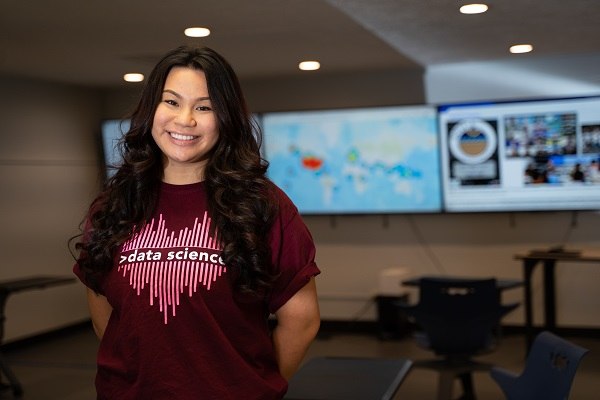
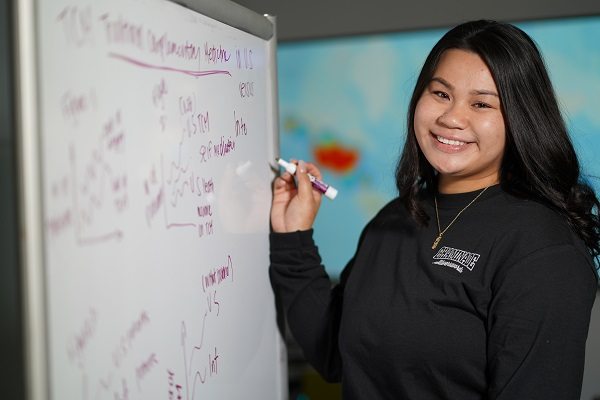
Dairian Balai '22, Data Science major

Dairian Balai ’22 peers into data to find solutions. That’s where she found her passion, too.

The Data Science major likes to say that all those numbers—on everything from community health disparities to poverty to race and education—represent people, with hopes and dreams, just like her. She’s on a mission to tell their story (and hers) by spotlighting the data that speaks to real experiences.

“I want to shine a light on the problems we’re facing,” she said.

And even though she hasn’t yet graduated, Balai is already making her mark. Thanks to a series of programs at Chaminade, Balai scored a paid remote internship with a University of Texas lab to research maternal and infant mortality and co-morbidities in Native Hawaiian communities.

She hopes to use data science to spotlight what factors can help protect moms and babies.

Balai grew up in Waiʻanae and graduated from Waiʻanae High. During her junior and senior year, she applied to a long list of potential universities in Hawaii and on the mainland. And she was pretty set on going out-of-state for her undergraduate education. But then her high school counselor told her about the Hoʻoulu STEM Scholarship, which covers 100% of Chaminade tuition and offers support services.

Dairian Balai '22, Data Science major

The scholarship convinced Balai to take a tour of Chaminade—and she’s glad she did.

“Off the bat, I liked how it was a small community. The campus was small,” she said, adding that she later spoke to her high school adviser and realized that the financial support offered through the Hoʻoulu STEM Scholarship far outweighed other aid universities on the mainland were offering her.

“I decided to stay. If I went back in time, I would make that decision again,” she said.

Balai said the thing she appreciates most about Chaminade is the one-on-one support she gets from professors and advisers, who have connected her with key opportunities. “They really make it a point to help you plan out your future,” she said. “They say ‘Chaminade is a family.’ I really believe that.”

Balai originally majored in Biology because she planned to go into healthcare.

But the course of her studies changed after she was participated in Chaminade’s Supporting Pacific Indigenous Computing Excellence (SPICE) program. The intensive, immersion experience, in partnership with the Texas Advanced Computing Center at the University of Texas at Austin, is designed to help train students to lead in data science and visualization efforts that support social justice projects in Hawaiʻi.

Balai said she learned coding in the SPICE program and worked with other students to create visualizations that helped illustrate her research area—how socio-economic status impacts healthcare.

From the SPICE program, Balai participated in a Computing4Change event in Chicago. The national competition challenges students to use computing for positive social change. Balai said through SPICE and the Computing4Change conference, she learned that data science wasn’t just about highlighting problems “but helping to solve them.” That, she realized, was the career she wanted to pursue.

Dairian Balai '22, Data Science major

So Balai switched majors to Data Science, taking the plunge even though it meant a little more time completing her undergraduate degree. She also started considering how she could eventually bring Data Science home—back to Waianae and the community she loves and eventually wants to serve.

She said Data Science helped her understand that having vulnerable populations doesn’t define Waiʻanae (and other communities with larger concentrations of low- and moderate-income families), but that socio-economic and other factors have a significant impact on the lives of Waianae residents.

She is especially interested in uncovering the factors that contribute to health disparities in her hometown. Data Science solutions to those gaps, she said, will help build a healthier community. And ultimately, that will help build a healthier state and nation, Balai added.

In 2019, Balai was offered a paid internship studying maternal health in Native Hawaiians. She said as a Native Hawaiian, the research feels personal—and all the more important given the healthcare challenges the community faces. She’s continuing that work and hopes to build on it.

In fact, Balai is now planning to go to graduate school.

She’s working with her adviser weekly to consider programs, and on crafting her long-term dream: returning to Waiʻanae to “build a better, a more aware community”—with Data Science.

Posted by: University Communications & Marketing Filed Under: Featured Story, Natural Sciences & Mathematics, Students Tagged With: Data Science

Returning Home to Chaminade

March 19, 2021

Lupita Ruiz-Jones

Dr. Lupita Ruiz-Jones, Assistant Professor of Environmental Science at Chaminade University, wants students to plan their careers with intention, so they end up doing work they love.

The key, she says, is pursuing and doing the things you are interested in, even when you don’t know where they will lead. After all, that’s what worked for her.

She was in high school in Santa Fe, New Mexico, when she learned about Chaminade University at a college fair. “I don’t think I ever would have heard of Chaminade except for that booth.”

She wanted to study human impacts on the environment, and she wanted to move away from the desert. Chaminade offered a major in environmental studies, and she was sold.

Seeking out opportunities and going after them has been a life-long pattern for Ruiz-Jones. It’s especially impressive when you learn she was raised by parents who didn’t complete college in a family without the trappings of success.

Her mother was always supportive but struggled with bipolar disorder. Ruiz-Jones’ father went to prison when she was 12, which she says had a significant impact on her. “I really appreciated the ability to choose where I put my attention,” she says.

Luptia Ruiz-Jones and Gail Grabowsky

In one of her first classes, Dr. Gail Grabowsky, now dean of the School of Natural Sciences and Mathematics, told the students it was great they were there. “She told us, ‘You’re going to love what you do, you’ll make an impact, but you’re not going to become rich.’”

“That was fine with me,” says Ruiz-Jones. “I felt like as long as I loved what I did and made an impact, that was what was important to me.”

During her freshman year, she applied and was selected for a five-week summer program in India. “The goal of that trip was to see what small non-profits were doing in India,” she says. “It was really about human well-being and the different ways people were contributing by doing service to the really poor. It was an incredible experience.”

But the summer after her sophomore year at Chaminade, she started doing undergraduate research at Kewalo Marine Lab. That’s where she first got excited about biology and organisms in coral reefs.

Dr. Lupita Ruiz-Jones, professor and alumna

At the end of her summer research at Kewalo Marine Lab, her advisor Dr. Mike Hadfield invited her to continue there in an internship. He also encouraged her to take all the science courses she could, which pushed her into a fifth year of college.

She didn’t mind, though, because she wanted to participate in a Sea Education Association summer-at-sea sailing program that focused on environmental studies. She spent four weeks sailing from Hawai‘i to San Francisco on a tall ship sailboat.

“Wow, that was a really powerful experience,” she says. “We did biological oceanography research. I focused my project on invertebrates that live on the surface out in the middle of the ocean.”

Dr. Lupita Ruiz-Jones, professor and alumna

After graduating from Stanford University with her PhD, she received the Thinking Matters Teaching Fellowship and spent four years team-teaching there. That, she says, is where she developed her identity as a teacher and her love for teaching.

During the summers, she started collaborating with scientists at the Hawai‘i Institute of Marine Biology.

That’s how she ended up back at Chaminade, as an assistant professor this time, in Fall 2020.

Right now, she says, her goals are to find ways to integrate her passion for research, coral reef ecology, and restoration into her teaching. And she’d love to take students on field trips to neighbor islands or other Pacific islands. “If we could do something like that where we took students to more remote Pacific Islands for environmental education, that’d be very cool.”

Posted by: University Communications & Marketing Filed Under: Alumni, Faculty, Featured Story, Natural Sciences & Mathematics Tagged With: Environmental Sciences, Environmental Studies

  • « Go to Previous Page
  • Page 1
  • Interim pages omitted …
  • Page 75
  • Page 76
  • Page 77
  • Page 78
  • Page 79
  • Interim pages omitted …
  • Page 150
  • Go to Next Page »

Footer

Chaminade University Logo

3140 Waialae Avenue
Honolulu, Hawaii 96816

Contact Us
Phone: (808) 735-4711
Toll-free: (800) 735-3733

facebook twitter instagram youtube linkedin

Visit

  • Plan Your Visit
  • Campus Map (PDF)
  • Events

Resources

  • Campus Security
  • Student Consumer Information
  • Concerns, Feedback, and Reporting
  • Institutional Review Board
  • Title IX / Nondiscrimination Policy
  • Compliance
  • Emergency Information
  • Careers
  • Institutional Statement

People

  • Students
  • Parents
  • Alumni
  • Faculty & Staff

Policy

  • Privacy Policy
  • Terms and Conditions of Use


© Chaminade University of Honolulu