• Skip to primary navigation
  • Skip to main content
  • Skip to footer
Chaminade University of Honolulu

Chaminade University of Honolulu

  • VISIT
  • APPLY
  • GIVE
  • STUDENTS
  • PARENTS
  • ALUMNI
  • FACULTY/STAFF
  • Admissions
    • Admissions Home
    • Undergraduate Students
      • First-Year Students
      • Transfer Students
      • Admitted Students
    • Graduate Students
    • Flex Online Undergraduate Program
    • Military Students
    • Non-Degree/Visiting Students
    • Experiential Honors Program
    • Early College Program
    • New Student Orientation
  • Tuition & Aid
    • Financial Aid Home
    • Tuition & Expenses
    • Federal Updates & Changes
    • Scholarships
    • $5,000 Graduate Scholarship
    • VA Education Benefits
    • Net Price Calculator
  • Academics
    • Academics Home
    • Academic Programs
    • Office of Student Success
      • Academic Advising
      • Records and Registrar
    • Kōkua ʻIke (Support Services)
      • ADA Accommodations
      • Career Services
      • Proctoring Services
      • Tutoring Services
    • Sullivan Family Library
    • Undergraduate Research & Pre-Professional Programs
    • Commencement
  • Campus Life
    • About Campus Life
    • Student Engagement
    • Student Government Association
    • Residence Life and Housing
      • Summer Conference Housing
    • Health Services
    • Marianist Leadership Center
    • Counseling Center
    • Campus Ministry
    • Campus Security
    • Dining Services
    • Bookstore
  • Athletics
  • About
    • Chaminade University News
    • Our Story
    • Leadership
    • Chaminade University Strategic Plan 2024-2030
    • Mission & Rector
    • Association of Marianist Universities
    • Facts & Rankings
    • CIFAL Honolulu
    • Accreditation & Memberships
    • Montessori Laboratory School
Search
×

Search this web site

University Communications & Marketing

Honorary Luncheon

February 15, 2024

Students share the meaning of their scholarships with donors

Her voice quivering with emotion as she described the meaning of being awarded a scholarship during an annual honorary luncheon for donors, Audrey Pilar ’24 cited her mom and dad for instilling a belief in herself, sharing her parents’ story as a young couple struggling to make ends meet but never giving up and wanting more for her and her brother. Graduating in May with a major in Forensic Sciences, and minors in Chemistry and Data Science, Analytics and Visualization, the Mililani native admitted that, without her Dr. Feung Lee and Mrs. Mew Sin Lee Endowed Scholarship, she probably would have had to work three or more part-time jobs just to pay her tuition.

“When my mom wanted to come to America to have a better life for me and her, she did,” Pilar said. “When my dad was belittled for having a young family, he and my mom hustled, got an education, and successfully raised my brother and me. What I am trying to get across here is that someone gave them a chance in their lives. Someone gave my mom and dad a chance to succeed in life, and they took it. This is what receiving a donor scholarship means to me. Hope and a chance for a better future.”

In the pursuit of higher education, many students face formidable barriers, with financial constraints being among the most prevalent. For many individuals from low- to even middle-income backgrounds, the dream of attending college or university often seems like an unattainable aspiration. However, scholarships serve as beacons of hope, illuminating pathways to academic success and unlocking doors to opportunities that would otherwise remain shut.

“This year, between individual and Foundation scholarships, we supported 332 students with over $2 million, for an average scholarship award of $6,100, which is huge,” said Chaminade President, Lynn Babington, Ph.D. “Today, you’ll hear some of these students’ stories, and you’ll get a sense about their ambitions, their areas of academic interest and what they may have overcome to get here.”
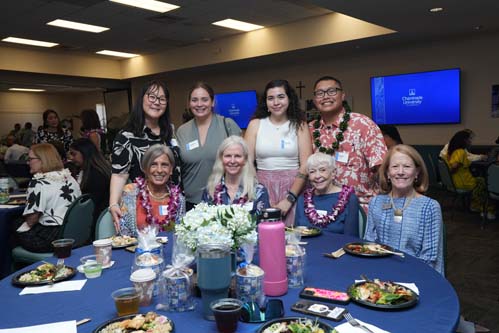
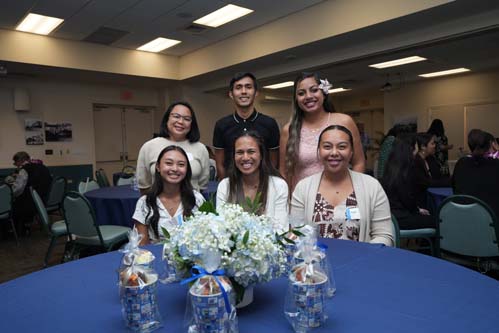
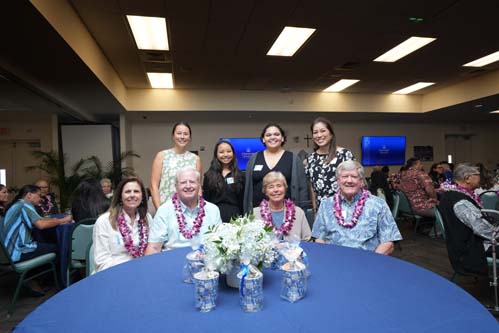
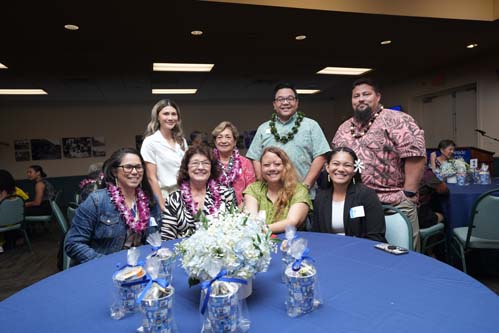
Scholarship Luncheon attendees include, standing from left, Edna Magpantay-Monroe, Michael Monroe, Tiannah Ohta and Genie Reutirez, and, seated from left, Bella Frasure, Alyssa Mori, and Keven and Diane Matsuura.
Scholarship Luncehon attendees include, standing from left, Edna Magpantay-Monroe, Michael Monroe, Tiannah Ohta and Genie Reutirez, and, seated from left, Bella Frasure, Alyssa Mori, and Keven and Diane Matsuura.
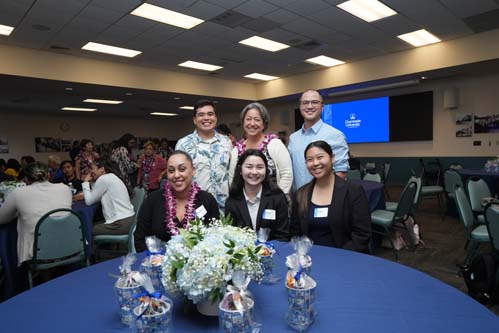
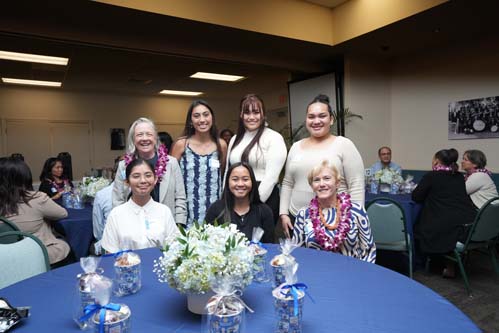
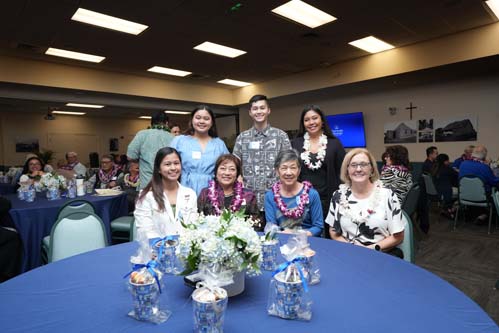
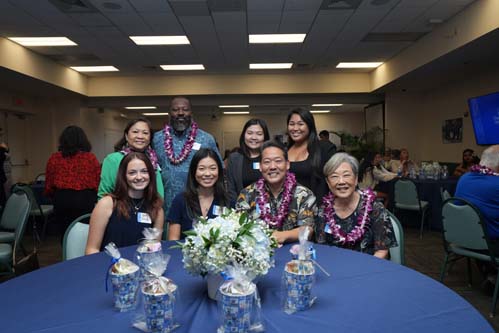
Scholarship Luncheon attendees include, standing from left, Jill Higashi, Kimberly Kameshige, Brianna Gutierrez Aceves and Easton DelaCruz, and, seated from left, Jeannine Wiercinski, Estelle Kelley, Jeannie Rolles and Chaminade President Dr. Lynn Babington.
Scholarship Luncehon attendees include, standing from left, Janice Glade, Peter Jan Ramos and Anastasia Tangatailoa, and seated from left, Leila Casison, Caitlin Bocobo and Paige Garcia.
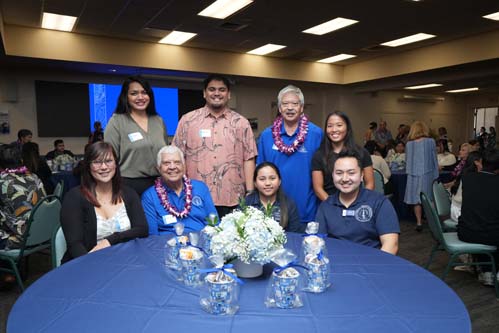
Scholarship Luncehon attendees include, standing from left, William Bernaldez, Amber Milsap and Greg Lagapa, and seated from left, Natasha Flores, Nicole Tanabe and Kelsey Nakagawa.
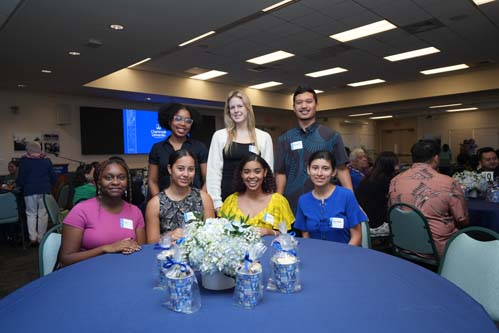
Scholarship Luncehon attendees include, standing from left, Tyanna Hemmings, Leah Carrington and Kaimipono Abella, and seated from left, Keila Anderson, Tessa Stanley, Aniyah Hazen and Ana Isabel Aranda.
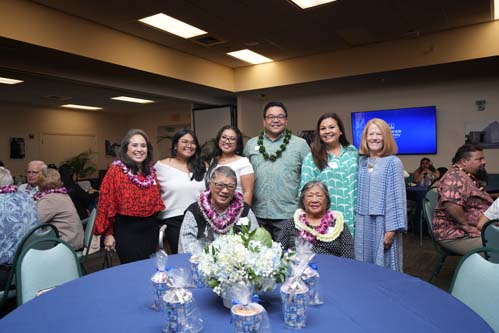
Scholarship Luncehon attendees include, standing from left, Adrienne Aquino, Katherine Liu, Erica Tiwari and Alani Meltel, and seated from left, Jessica Schlais, and David and Christne Arita.
Scholarship Luncehon attendees include, standing from left, Kendra Sia, Nicole Kegine, Aleeyah Lemons and Heidi Bow, and seated from left, Sally and Michael Coovert, and Susie and John Field Jr.
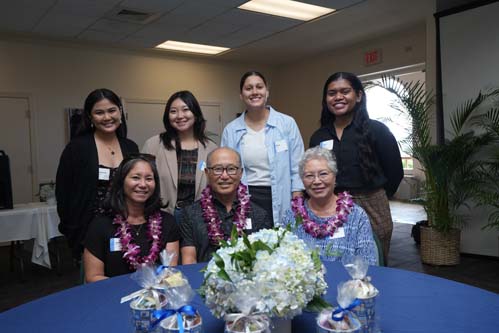
Scholarship Luncehon attendees include, standing from left, Debbie Ng Furuhashi, Michalla Burtado, Aloha Lei Garo, Bro. Alan Pacquing, Jodi-Anne Yoshida and Chaminade President Dr. Lynn Babington, and seated Bernard and Lolita Lum Hoy.
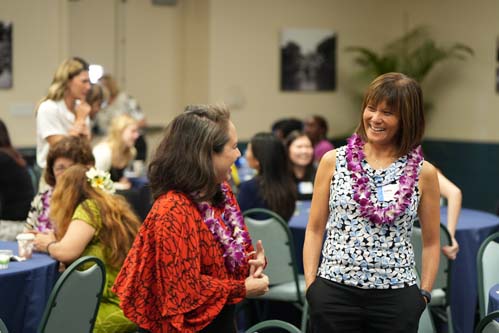
Debbie Ng Furuhashi and Cathy Ching share a laugh before the start of the Scholarship Luncheon.
Scholarship Luncehon attendees include, standing from left, Angelica Tangatailoa, Nathaniel Leomiti, Wayne Tanna, JD, and Jazzy Yasuda, and seated from left, Dorie Sanborn, Bro. Thomas Jalbert, Jasmine Mondelo and Pono Riddle.
Scholarship Luncehon attendees include, standing from left, Nagem Uiagalelei, Patricia Takamiya, Bro. Allen Pacquing and Richard Uiagalelei, and seated from left, Napua Rosehill, Carol Gouveia, Kawila and Kyla Castro.
Scholarship Luncehon attendees include, standing from left, Lauren Moriarty, Constance Keao, Huong Pham and Mame Hideyos, and seated from left, Alyssa Torres, Junelle Tangalin and Diane Peters-Nguyen.
Scholarship Luncehon attendees include, standing from left, Heather Kate Jarmillo, Marlon Francisco and Audrey Pilar and seated, from left, Kryzandreah Espanol, Tertia Freas, Elizabeth Hokada and Dr. Janet Davidson.

Seated with students, Adrienne Aquino ’26, Katherine Liu ’26, Erica Tiwari ’24 and Alani Meltel ’25, donors David and Christine Arita with daughter Jessica Schlais discussed each one’s goal, inspiring them to continue their education even long after they’ve graduated. The Aritas’ and Schlais’s American Floor and Home Foundation Scholarship is specifically earmarked for majors in the Environmental + Interior Design program.

An aspiring elementary education teacher, Aquino believes that early schooling provides a strong foundation for future learners. “Our graduation rates are getting lower and lower,” said the Kaneohe native. “We need more teachers if we want a better future for our keiki.”

Applauding Aquino for her dedication to becoming an elementary teacher, David Arita dispensed a bit of advice to her: “If you inspire them, they will always remember you,” he told her. “I still remember the teachers who made a major impact in my life, and I will never forget them.”

A sophomore Communication major, Easton DelaCruz ’26 has taken advantage of all the opportunities afforded to him since arriving on campus two years ago. He has been fortunate enough to engage in experiences that have enriched his education and broadened his perspective.

“Your commitment to financial assistance has allowed students like me to engage in transformative experiences, shaping us into well-rounded individuals prepared to contribute to society,” DelaCruz said in his address to donors. “With the wealth of past and current experiences, and the ones to come at Chaminade, I plan to return home and become a public servant to help my home become a better place for my parents’ generation, my generation and generations to come.”

In this landscape of financial uncertainty, scholarships emerge as powerful catalysts for change. These financial awards, often based on academic merit, financial need, or a combination of both, play a pivotal role in dismantling barriers to higher education. By providing financial assistance, scholarships enable deserving students to access resources, facilities and opportunities that would otherwise remain beyond their grasp.

Beyond financial assistance, scholarships also offer myriad opportunities for academic and personal growth. Many scholarship programs provide mentorship, networking opportunities and career development resources, empowering students to thrive both inside and outside the classroom. Furthermore, scholarships may fund internships, study abroad experiences and research projects, allowing students to broaden their horizons and cultivate valuable skills that enhance their employability and competitiveness in the job market.

“We know education transforms lives; our students set out to change the world, and they are making a difference,” said Babington. “Our reach is all over the world. And we are proud of our Chaminade students and alumni.”
Posted by: University Communications & Marketing Filed Under: Campus and Community, Diversity and Inclusion, Featured Story, Institutional, Students Tagged With: Honors and Awards, Marianist, Scholarship

Ian Terayama, MBA ’22

February 14, 2024

How did your education at Chaminade contribute to your professional success?

My time in the One-year MBA program has helped to contextualize and prepare me to better manage and address the challenges I see in my everyday role as a Project Manager.

Can you recall a specific moment or experience during your time that had a significant impact on you, either academically or socially?

I recall having “aha” moments during our Accounting and Business Analytics courses. Business Analytics was instrumental in helping me to understand the data infrastructure in my organization and across the construction industry.

How did your education at Chaminade shape your perspective and personal growth?

My Chaminade education reinforced my belief that there is value in all voices if we take the time to engage and learn.  I enjoyed learning from and with my classmates in an environment that allows us to push each other towards our goals. 

How have you continued to invest in your professional development since graduating?

Unfortunately, I haven’t had the opportunity since taking on my new role at Pacific Resource Partnership. I’m looking forward to continuing my development in the near future.

How has your education influenced your personal goals and achievements?

My Chaminade education has taught me that my short-term goals may not be ambitious enough to match my desired impact and professional trajectory. I am in the process of re-evaluating the impact I can make in Hawaii, and feel better equipped to tackle the challenges our communities are facing.

Posted by: University Communications & Marketing Filed Under: Uncategorized Tagged With: Silversword Spotlight

Peer-Reviewed Paper

February 12, 2024

International journal accepts paper from Professor David Carter and colleagues

David Carter, Ph.D., literally wrote the book on forensic microbiology so, it was only natural that he was invited to co-author a published paper that will appear in Nature Microbiology. Completely comfortable discussing an issue that is often squeamish for many, the Forensic Sciences Program director casually speaks of cadavers and PMI (Post Mortem Interval) as if he’s talking about the weather.

“There’s definitely increasing interest in PMI (or the time that has elapsed since an individual’s death),” Carter says. “It’s critical information that could be key to solving a crime—or providing an alibi—in absence of any witnesses … or insects.”

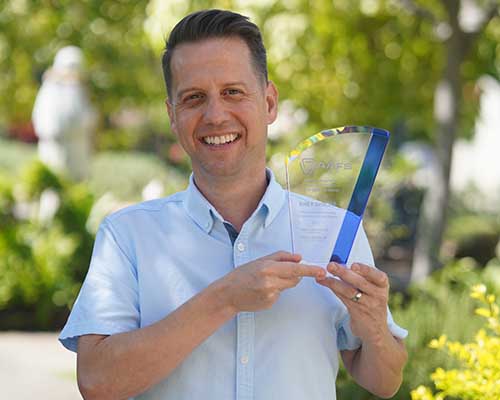
Dr. David Carter holding his AAFS Pathology/Biology Section Award for Achievement in the Forensic Life Sciences.

The microbiomes associated with decomposing human cadavers are universal regardless of location or environmental conditions, the paper published in Nature Microbiology suggests. The findings show a conserved and predictable sequence of microbial interactions that break down organic matter, which could have implications for forensic science.

Decomposition is essentially nature’s recycling system. It is a fundamental process that recycles dead biological material to fuel biological processes, such as plant productivity and soil respiration. Microbial fungi and bacteria are predominantly responsible for decomposition, and although this process is well studied, research has focused predominantly on the breakdown of dead plant biomass. In contrast to plants, animal carcasses, including those of humans, are enriched in readily decomposable proteins and lipids, but their impact on biogeochemistry and community ecology are poorly understood.

In their research, Carter and his colleagues tracked the decomposition process in 36 human cadavers, which had been willed to science. The bodies were placed in three locations with either a temperate or semi-arid climate, with three cadavers placed at each location for each of the four seasons, and the researchers took samples of the cadavers’ skin and surrounding soil throughout the first 21 days postmortem. Their study found that decomposing human cadavers had a universal consortium of microbes, regardless of the location, climate or season, that are rare in non-decomposition environments and appear unique to the terrestrial breakdown of flesh.

“Jessica Metcalf of Colorado State and Rob Knight of UC San Diego and I initiated this research in 2011,” Cater says. “Our findings are a sign of success, but we’re still not quite there.”

With metagenome-assumed genomes and metabolomic profiling of soils adjacent to cadavers, Carter and his co-authors reconstructed a network of interaction that revealed how fungi and bacteria share resources as they metabolize decomposition products. Carter and his colleagues suggest that insects may serve as vectors that disperse these microbes from one decomposing animal to another.

According to Carter, using data on the microbial timeline of cadaver decomposition, combined with a machine learning model, they were also able to predict the time since death, which could have potential future applications for forensic science.

“We now have techniques that we didn’t have 20 years ago,” Carter asserts. “It’s also a lot easier for new science and other developments to get in the hands of lawyers and investigators, which makes for a stronger working relationship with criminologists to achieve criminal justice.”

Posted by: University Communications & Marketing Filed Under: Faculty, Homepage, Innovation, Uncategorized Tagged With: Faculty, Forensic Sciences, Honors and Awards

Rebecca Cochran, MBA ’22

February 7, 2024

How did your education at Chaminade contribute to your professional success?

The leadership knowledge I gained through the MBA program has been invaluable in my career, and it has led to several growth opportunities. The Executive-style program worked well with my busy work schedule, so well that I recognized that I could handle far more than I thought. After this experience, I was more confident in my abilities, and sought greater opportunities and more challenging assignments in my career. 

Can you recall a specific moment or experience during your time that had a significant impact on you, either academically or socially?

Our cohort traveled to New Zealand for the International Finance course. This was such a fantastic experience. The trip brought the cohort members closer, and created what I’m sure will be a few lifelong friendships. We made some valuable contacts along the way, and had the opportunity to experience New Zealand Parliament, the Stock Exchange and the tourism industry from a unique perspective. 

How did your Chaminade education shape your perspective and personal growth?

There was such a great diversity of backgrounds in my MBA program that I realized, this knowledge applies to a large variety of career paths—far more than I had previously considered. I feel confident that I will never be without career opportunities. 

How have you continued to invest in your professional development since graduating?

After completing my MBA, I was excited to find the next step, which is to apply to a doctoral program. I’ve realized there does not need to be a definitive end to education, it is a lifelong journey! 
“Her confidence wasn’t in her existing knowledge, but in her ability to learn.” -Adam Grant

How has your education influenced your personal goals and achievements?

This program and a few of my peers encouraged me to really assess my career goals. I have completely re-routed my career path. The traditional “corporate path” that was laid out in front of me is not the only option, I now have the knowledge and foresight to see more creative opportunities on the horizon.

Posted by: University Communications & Marketing Filed Under: Uncategorized Tagged With: Silversword Spotlight

Heritage Awards

January 30, 2024

Honoring those who personify the Marianist Values

Overcome by emotion, tears cascaded down the cheeks of Victoria DelaCruz ’24 as Bro. Ed Brink named her as this year’s Founders’ Award winner, describing her traits of selflessness, commitment, hospitality, graciousness, faith and her family. A Chaminade Scholar majoring in Data Science, Analytics and Visualization (DSAV), DelaCruz ’24 exemplifies the Marianist education and values.

“Faith has been a part of her journey before coming to Chaminade,” said Brink, Vice-President of Mission and Rector. “This year, she joined the new Student Ministry Team and made a suggestion about having a praise and worship evening at the end of one of the meetings. Although it was one of the last ideas talked about at the meeting, it was one of the first events to move from an idea to an actual event. And that was because of Victoria’s commitment to it.”

Every year during Founders’ Week, the Rector’s office presents the Chaminade Award, the Marianist Award and Founders’ Award to a faculty member, supporting staff member and student, respectively, who embodies the Marianist values.

His voice crackling at times while reading the achievements of the winners of the Heritage Awards, Brink announced the other two honorees: Chaminade Award recipient Dr. Janet Davidson, Vice Provost and professor of criminology, who was described by one of her nominators as resilient, reliable and consistent; and Amy Takiguchi, Director of Financial Aid, Marianist Award, whose efforts to help students go beyond and above a simple answer.

“It was a chicken-skin moment when Dr. Babington informed me of the award,” said Takiguchi ’02, an alumna who started her career at Chaminade as a student worker with Human Resources and has since moved up the ranks. “I have a great team and that’s what makes working here such a rewarding experience.”

For Davidson, the Chaminade Award is not an individual feat, but one that belongs to her team. “I am honored and humbled, but I don’t like the attention,” she said. “But I could have never done it alone. The accolades and attention I receive are because of a great supportive team that works collaboratively to accomplish a lot.”

In his presentation during a special mass ceremony to celebrate Founders’ Week, Brink said these awards are meant to remind all of us of the mission of this University, and the importance of trying to live out that mission on a daily basis. “We gather today to be inspired and to hopefully recommit ourselves to being the best member of this community that we can be,” he added. “Fr. Chaminade wanted those who got caught up in the work that he inspired to be ‘a spectacle’—to give witness to others of how a life based in faith and service could make a difference in the world.”

Posted by: University Communications & Marketing Filed Under: Campus and Community, Catholic, Homepage, Institutional Tagged With: Campus Event, Honors and Awards, Marianist

Environmental Science

January 25, 2024

After earning her bachelor’s, Casidhe Mahuka joins CRAG in American Samoa

In recent years, scientists, world leaders, politicians and environmentalists have been warning us about a dire existential threat, noting that climate change poses a grave risk that needs to be urgently addressed and mitigated. As an invasive species coordinator (ISC) at the Coral Reef Advisory Group (CRAG) in American Samoa, Casidhe Mahuka ’22 is doing her part in monitoring and protecting the waters encircling the small U.S. territory.

Since graduating with a BS in Environmental Sciences, the American Samoa native has used her Chaminade education to make an impact in her community. As the ISC for CRAG, Mahuka collects ocean data and implements bi-monthly phytoplankton monitoring in association with the National Oceanic and Atmospheric Administration’s National Phytoplankton Monitoring Network (PMN), which is a community-based network of volunteers who monitor marine phytoplankton and harmful algal blooms (HABs).

Mahuka explains that she has three overarching goals: 1) Integrate community-based methods to restore village-level ecosystems using ridge-to-reef approach in Aua and Fagasa; 2) increase invasive species management policy and activity coordination in and among local and regional organizations; and 3) bolster invasive species management in other priority sites.

“Other priorities include monitoring ballast water, biofouling, reef flats, and testing the water’s salinity, turbidity and overall quality,” Mahuka further describes. “I also work with the US Coast Guard to stay informed on stony coral tissue loss disease, the Vessel Incidental Discharge Act (VIDA) and other regional biosecurity issues.”

Covering more than 70 percent of our planet, the world’s oceans play a crucial role in regulating climate and supporting diverse ecosystems. However, the alarming rise in ocean temperatures due to climate change is threatening marine life, particularly the delicate balance of coral reefs.

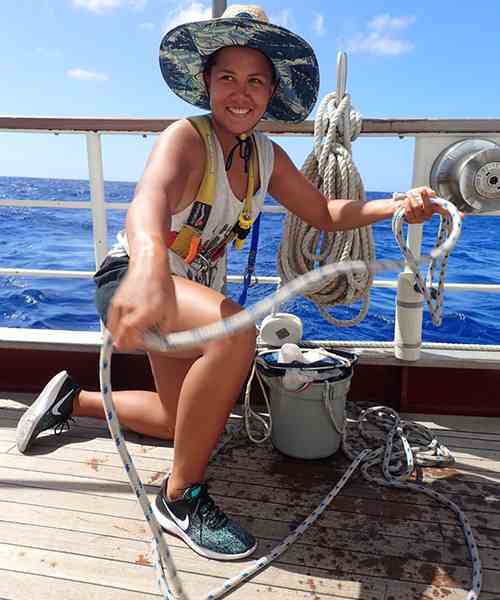
Casidhe Mahuka prepares to tie an Anchor Bend knot.
In the summer of 2018, Casidhe Mahuka participated in the SEA Semester, which is Boston University’s Study Abroad Program. The ship traveled from Tahiti to the Hawaii islands.

Primarily driven by human activities such as the burning of fossil fuels and deforestation, climate change has led to a significant increase in global temperatures. As a result, the world’s oceans are also experiencing warming trends, the consequences of which are far-reaching and affect marine ecosystems in various ways.

“Our ecosystems are fragile,” Mahuka says. “Although they cover only a small fraction of the ocean floor, coral reefs support about 25 percent of all marine species. The intricate structures of reefs provide habitats and food for a vast array of marine life, including fish, invertebrates and microorganisms.”

Furthermore, coral reefs act as natural barriers that protect coastlines from the impacts of storms, hurricanes and erosion. The complex structures of coral reefs also dissipate wave energy, reducing the intensity of waves that reach the shore.

Mahuka has had a passion for ocean science ever since she visited the National Marine Sanctuary of American Samoa in the 7th grade. It was the first time that she discovered that she could not only breathe underwater, but she could also breathe underwater for a living.

“That was it; I was totally hooked,” Mahuka says. “I was determined to be an ocean scientist because I have always loved being in the water. And to get paid for it, I was all in.”

As a member of the first cohort of students who majored in Environmental Science at Chaminade, Mahuka mirrors a growing trend among students who are pursuing their degrees in this field, marking a 24 percent increase in degrees awarded since 2016. Data from the U.S. Department of Education shows a steady uptick over five years. In the 2017–2018 academic year—the most recent year for which aggregate data is available—a total of 6,697 students earned bachelor’s degrees in environmental science. That means 1,155 more graduates earned such degrees than did five years earlier.

The trend is illustrated by Chaminade’s School of Natural Science and Mathematics’s introduction of an Environmental Science major four years ago. While a major in Environmental Studies has existed since 2000, the decision to focus on hard sciences was a natural progression for such programs.

While there is an overlap that exists between the two majors, Environmental Science is an interdisciplinary science-based major, which combines biological, ecological, chemical, geological and mathematical principles often used to solve environmental challenges or manage natural resources. Conversely, Environmental Studies is an interdisciplinary social science and humanities-based major. It focuses on the human relationship with the environment, and how environmental challenges intersect with politics, economics, society and culture. 

For 10 days in November, Mahuka was aboard the Exploration Vessel Nautilus surveying previously unmapped seafloor in U.S. waters south of the Hawaiian Islands. She was selected as a Seafloor Mapping Intern by Ocean Exploration Trust (OET), an organization that works to explore the ocean, seeking out new discoveries, while pushing the boundaries of STEAM education (Science, Technology, Engineering, the Arts, and Math) and technological innovation.

“It was a great experience after I found my sea legs,” Mahuka says. “I definitely chose the right career because marine science allows you to travel around the world, where you get to meet and learn from amazing and intellectual people who have the exact same passion as you do!”

Posted by: University Communications & Marketing Filed Under: Alumni, Diversity and Inclusion, Homepage, Innovation, Natural Sciences & Mathematics Tagged With: CIFAL, CIFAL Center, Environmental Studies

  • « Go to Previous Page
  • Page 1
  • Interim pages omitted …
  • Page 33
  • Page 34
  • Page 35
  • Page 36
  • Page 37
  • Interim pages omitted …
  • Page 150
  • Go to Next Page »

Footer

Chaminade University Logo

3140 Waialae Avenue
Honolulu, Hawaii 96816

Contact Us
Phone: (808) 735-4711
Toll-free: (800) 735-3733

facebook twitter instagram youtube linkedin

Visit

  • Plan Your Visit
  • Campus Map (PDF)
  • Events

Resources

  • Campus Security
  • Student Consumer Information
  • Concerns, Feedback, and Reporting
  • Institutional Review Board
  • Title IX / Nondiscrimination Policy
  • Compliance
  • Emergency Information
  • Careers
  • Institutional Statement

People

  • Students
  • Parents
  • Alumni
  • Faculty & Staff

Policy

  • Privacy Policy
  • Terms and Conditions of Use


© Chaminade University of Honolulu