• Skip to primary navigation
  • Skip to main content
  • Skip to footer
Chaminade University of Honolulu

Chaminade University of Honolulu

  • VISIT
  • APPLY
  • GIVE
  • STUDENTS
  • PARENTS
  • ALUMNI
  • FACULTY/STAFF
  • Admissions
    • Admissions Home
    • Undergraduate Students
      • First-Year Students
      • Transfer Students
      • Admitted Students
    • Graduate Students
    • Flex Online Undergraduate Program
    • Military Students
    • Non-Degree/Visiting Students
    • Experiential Honors Program
    • Early College Program
    • New Student Orientation
  • Tuition & Aid
    • Financial Aid Home
    • Tuition & Expenses
    • Federal Updates & Changes
    • Scholarships
    • $5,000 Graduate Scholarship
    • VA Education Benefits
    • Net Price Calculator
  • Academics
    • Academics Home
    • Academic Programs
    • Office of Student Success
      • Academic Advising
      • Records and Registrar
    • Kōkua ʻIke (Support Services)
      • ADA Accommodations
      • Career Services
      • Proctoring Services
      • Tutoring Services
    • Sullivan Family Library
    • Undergraduate Research & Pre-Professional Programs
    • Commencement
  • Campus Life
    • About Campus Life
    • Student Engagement
    • Student Government Association
    • Residence Life and Housing
      • Summer Conference Housing
    • Health Services
    • Marianist Leadership Center
    • Counseling Center
    • Campus Ministry
    • Campus Security
    • Dining Services
    • Bookstore
  • Athletics
  • About
    • Chaminade University News
    • Our Story
    • Leadership
    • Chaminade University Strategic Plan 2024-2030
    • Mission & Rector
    • Association of Marianist Universities
    • Facts & Rankings
    • CIFAL Honolulu
    • Accreditation & Memberships
    • Montessori Laboratory School
Search
×

Search this web site

Students

Nursing Students Part of Hawaii’s COVID Vaccination Efforts

February 18, 2021

One vaccine at a time, Hawaii is beating back COVID-19.

And Chaminade University is proud to be part of the effort.

Working with community healthcare partners, the University has deployed senior Nursing students to clinics on O‘ahu to administer COVID-19 vaccines.

Dr. Lynn Babington, Chaminade President, said the project underscores the University’s public service mission and its commitment to build a healthier Hawai‘i. “Being part of the community and being able to serve our community is part of our mission,” she said, adding that the vaccines are a “light at the end of a long tunnel” and offer hope that many of the activities we used to consider normal will soon be resumed. She said it’s heartening to see students play a key role in “helping to bring the pandemic under control.”

Dr. Lorin Ramocki, Chaminade University School of Nursing and Health Professions Assistant Professor and clinical/academic partnership coordinator, said the students giving vaccinations are seniors in their Public Health Nursing rotation. To prepare for the challenge, they participated in mock clinics on campus, studied CDC and facility training modules, and attended on-site orientations.

The students will be administering vaccines through the duration of vaccination efforts.  

Nursing senior, Serina Lipman, is among those serving as vaccinators. She said she feels incredibly fortunate to participate in a vaccination clinic and do her part to stop the spread of COVID-19. “It felt humbling knowing that we were out in the community making a difference,” she said.

Lipman added her training and preparation at Chaminade helped her feel up to the challenge.

“Through this experience, I have learned about how much effort and planning it takes to set up a massive vaccination clinic,” she said. “This experience was one of the best I have had throughout school and I hope that I get the opportunity to continue to vaccinate even after graduation.”

Dr. Rhoberta Haley, School of Nursing and Health Professions Dean, said the vaccination project highlights the importance of experiential learning and strong partnerships in the community. “For our nursing students to play a role in the State’s vaccination efforts not only strengthens our partnerships with healthcare organizations, it gives our students additional first-hand experience,” Haley said.

Ramocki said the vaccination clinics are powerful educational experiences, offering students a strong appreciation of the value of focusing on population health, and of the role of community education and disaster response during periods of disease outbreak. “By participating in these efforts, they will be able to make the connection between what they are learning in the classroom and the importance of these topics,” Ramocki said. “They get to be a part of these efforts during one of the greatest public health crises in our lifetime. This is what public health nursing is all about, responding to and meeting the needs of the community.”
Posted by: University Communications & Marketing Filed Under: Campus and Community, Featured Story, Nursing & Health Professions, Students Tagged With: Nursing

A Winning Pair

November 19, 2020

When Aurelia Vining and Jacqueline (Jaci) Harbin met during their first design studio course at Chaminade University, they became fast friends. They had both come from Army backgrounds before joining the Environmental + Interior Design program as transfer students in 2018, and their shared experiences matched with their opposing design approaches quickly proved to be a winning combination.

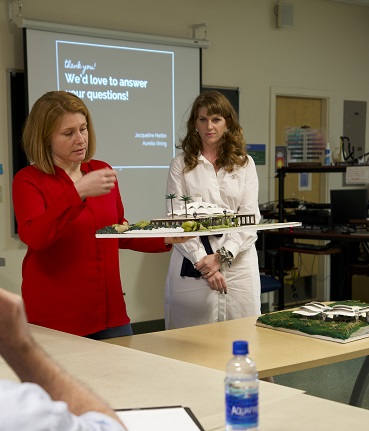
E+ID students Aurelia Vining and Jacqueline Harbin presenting their MRO project

They worked on a group project together during that first class, and it went so well that it solidified their partnership for much of the last two years. Since then, they’ve collaborated on several extracurricular projects, including working with the Marianist brothers to design a new exterior patio for the Mystical Rose Oratory.

“We had the chance to work on several extra-curricular design projects together, and it became clear that we balanced each other well,” says Harbin. “Things that I struggle with, Aurelia has completely mastered and areas where she might not be so strong, I excel.”

Their synergy recently came to fruition when it won them the 2020 Award of Excellence at the recent American Society of Interior Designers (ASID), Hawaii Chapter virtual award ceremony.

In January, their senior level commercial design studio course comprised a semester-long partner project. The class had chosen to design a boutique hotel—they were all given the footprint of an imaginary hotel in Vancouver, Canada and the pairs were tasked with designing three public spaces: the ground level, the lower level and the penthouse. The final design was due at the end of the semester in May.

“For this project we got to choose our partners so of course I was going to pick my Ace, Jaci Harbin,” says Vining. “She’s a wonderful designer and our styles are completely opposite of one another. I think that aspect of our relationship makes us question each other enough that we make sure our designs are purposeful, intentional and beautiful.”

Harbin and Vining designed The Glacier, an immersive hotel designed to capture the serenity that comes from being in nature. Upon arrival, the design protects guests with an outdoor vestibule positioned specifically to mitigate the northeastern winds. The lobby is darned with curved woods, semi-transparent materials and multi-faceted built-ins that help create a sense of humility and a feeling of being part of something bigger. On the inside, the ground floor included a lounge with a kids play space, a bar and space for casual dining, and outside the designers made space for an outdoor lounge, a rental area and an outdoor ice skating rink.

But the part that really captured the attention of the ASID judges was the outdoor star-gazing balcony in the penthouse. The virtual award ceremony specifically called out this area, with a quote from one of the judges saying “My favorite is the stargazing area. I like that the students thought through every scenario so that visitors would be able to see the constellations and stars day or night and all times of the year.”

The project wasn’t without its challenges—halfway through the semester COVID-19 hit and in-person classes were canceled.

“Zoom presentations are completely different from in-person presentations,” recalls Harbin. “The way you present yourself, how you showcase your work, all of that changes. You cannot have physical material boards because they don’t showcase well on a digital platform but that also means the client cannot touch the materials.”

It helped that the pair was already so close and had such a solid partnership to begin with. “The fact that we were already so comfortable with one another made a huge difference—it would have been very difficult to excel if we had just met one another,” admits Harbin.

But they did excel. Combined, the two put in over 600 hours to perfect the design of The Glacier. And when the project was completed, they submitted it for the ASID award, and won.

“Winning the ASID Hawaii Award of Excellence is a pinnacle moment for Jaci and Aurelia,” says Joan Riggs, the director of the Environmental + Interior Design program and a cherished professor and mentor. “This pair of emerging professionals hit the ground running with wanting to learn everything about design, taking risks with ideas and stretching themselves from day one.”

The two credit a lot of their success to the mentorship they received from both Riggs and their professor, Liza Lockard.

“I don’t think [Professor Lockard] ever told us we couldn’t do something—she just guided our explorations in the design process,” says Vining. “I loved when we’d ask her if we could do something and her response would be ‘I don’t know, can you?’ That was so encouraging and refreshing.”

Though they will both graduate this semester, this is likely just the beginning of the duo’s journey together. 

The day after submitting their final design of The Glacier, they received an email from Joan Riggs saying she had a paid summer project for them if they were interested. The project was to design the tour check-in and retail area for Magnum Helicopter Tours at their Honolulu Airport facility. The space was being constructed, and they were looking to the design students to help them execute their vision.

“It was fascinating to watch a project happen in real time,” says Harbin. “There was a real sense of urgency regarding this project, but they were looking to us as the professionals and trusted our opinions and recommendations.”

Now, with graduation just a few weeks away, Harbin and Vining are trying to work out the logistics of a long-term professional partnership doing real estate development in San Antonio, Texas, where Vining will be moving next summer.

“I think hands down, you have to find someone that you can work with and trust they will put in the same amount of effort,” says Vining. “Jaci and I have been pairing together whenever we can, and have done multiple school projects, service learning and freelance projects together. She is by far the best partner!”

Posted by: University Communications & Marketing Filed Under: Featured Story, Humanities, Arts & Design, Students Tagged With: Environmental + Interior Design

A Passion for Criminal Justice Reform

November 16, 2020

At the age of 16, Shekina Boling had her first experience with the criminal justice system. It was, as she describes it, unfavorable. She had been sexually assaulted, and the criminal justice process that followed her attack was lengthy and uncomfortable, to say the least. 

After a drawn out and emotional trial, Boling’s attacker was ultimately found guilty. She is one of the lucky few—according to the Rape, Abuse and Incest National Network (RAINN), only 3 out of 4 sexual assaults are ever reported. And for every 230 sexual assaults that are reported to the police, only 46 reports will lead to arrest and only 5 cases will lead to a federal conviction. 

“I’m very thankful my assailant was found guilty,” recalls Boling. “My attorney had kept prepping me that it’s not very often these types of individuals are convicted. It shed light on something that I hadn’t realized took place.”

Shekina Boling, Master of Science in Criminal Justice Administration

The experience was what first made Boling interested in a criminal justice career. And it’s what drove her to pursue her undergraduate degree in public administration and justice administration.

But as an undergraduate taking criminal justice classes, she discovered another side of the criminal justice system that she became even more passionate about—wrongful convictions.

“After learning these things, I found it was something I felt really strongly about,” describes Boling. “It was always something that saddened me, knowing that wrongful incarceration was a very common occurrence in the U.S. And there still haven’t been a lot of reform efforts to reduce these kinds of things.”

Upon graduating, she knew she wanted to get her master’s in criminal justice. The Waipahu native didn’t know what to expect enrolling in graduate school, particularly since she lands on the side of criminal justice reform.

She decided to enroll in Chaminade’s Master of Science in Criminal Justice Administration program partly because of Chaminade’s well-known and well-respected forensic science department. Ultimately, she’d like to work for the Innocence Project, helping to overturn wrongful convictions, and she believes having an understanding of forensic science plays a vital role in proving innocence.

“A lot of the time forensics is used as this infallible idea and it’s not questioned,” says Boling. “I believe the legal system has flaws and in order to propose effective solutions you need to understand the system to the fullest extent.”

Despite her initial nerves, she’s found a welcoming and friendly environment at Chaminade. She knows her calls for criminal justice reform are not always popular within the field, but that’s why she loves Chaminade’s program so much. The classes are small and intimate, and make for a really transparent environment to have lively and informed discussions.

“People are all very passionate and are willing to have discussions even if you have contradicting beliefs,” says Boling. “So far everyone has been very respectful, even if they have a different opinion.”

She likes the inclusivity that Chaminade promotes, and loves how her professors constantly present ethical dilemmas and questions that force her to reevaluate her position.

“Without a doubt, I would say it’s helping me solidify my beliefs on everything and helping me find my voice,” says Boling. “Every class provides a safe space for voicing your opinions and backing them up.”

Boling thinks it’s the perfect time to be pursuing a Master’s in criminal justice, with so much of the nation’s spotlight on criminal justice reform. And she’s really enjoying that her professors are not shying away from talking about current events.

“Not only is there such an abundance of information that keeps coming out every single day—we’re moving into such a divisive period of American history—but every day illustrates themes that we learn about in the program,” explains Boling. “It’s a way for students to really hone their beliefs and see where they really stand and what they’re for and what they’re against, and find the reasons why they believe what they do.”

This last year in the program has helped Boling solidify her own stance on things and have the substance to back up her own positions. She’s also really enjoyed having friends and classmates that she can text when she sees things in the news, and has enjoyed sharing her passions and interests with them. 

Boling will graduate in March, and then wants to get her Ph.D. in forensic analysis. She’s looking at programs across the mainland for next fall, while keeping a close eye on the COVID-19 situation. 

“Because of where we are right now with the pandemic, I’m a little hesitant to want to move,” admits Boling. Since Hawaii does not currently offer a Ph.D. in forensics, she’s also exploring local internship opportunities in case she chooses to stay local and wait out the pandemic. 

Long term, she would like to become a State Policy Advocate with the Innocence Project and contribute to policy reform in Hawaii. To become eligible and competitive for the position, she needs at least three years of experience working with the legislative system. For now, if a Ph.D. program doesn’t work out for the fall, that’s where she plans to start.

Posted by: University Communications & Marketing Filed Under: Behavioral Sciences, Featured Story, Students Tagged With: Master of Science in Criminal Justice Administration

Experiential Learning In the Time of COVID

November 10, 2020

At first glance, a field trip described as both “virtual” and “hands-on” seems to be a bit contradictory. But for 13 Chaminade education students, their recent “field trip” with the United States Naval Academy was exactly that—a virtual, hands-on experience made possible by Chaminade’s partnership with the Pearl Harbor Aviation Museum.

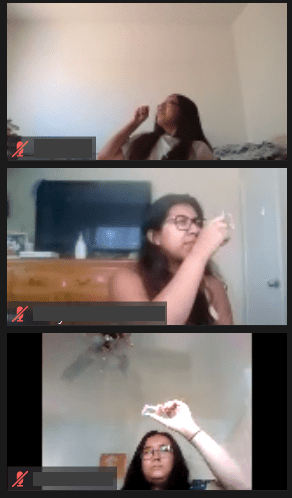
Education students participating in a virtual, hands-on workshop

The students participated in a two-day virtual workshop to explore scientific phenomena related to waves, sound, reception, refraction, chemistry, circuits and more. For these aspiring teachers, the experience provided valuable tools for thinking about how to conduct their future classrooms and communicate complex scientific concepts.

“Zoom sessions and virtual fields trips are looking like the new norm for us, and as a future teacher, I need to start thinking of ways to still make school fun and interactive for students,” says Daysha Kau, a fourth-year Elementary Education major who participated in the workshop. “Many of the experiments we were shown and led through required easy-access materials that can be provided to students to continue hands-on learning, even if they aren’t physically in school.”

The workshops were provided by the United States Naval Academy STEM Center and were assisted by Engineers on Deck, a nonprofit that specializes in STEM teacher workshops. The students logged into the digital meeting platform, and followed instructions to conduct their own experiments from home.

“The United States Naval Academy made sure to clearly show us what to do with the experiments,” says Kau. “I was surprised at how simple everything was, and it was great to still be able to do hands-on experiments through virtual learning.”

The virtual field trip was a new type of experience for Kau. She particularly enjoyed playing with the hydrophobic sand, or sand that repels water.

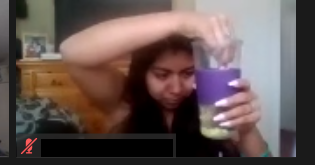
Education students participating in a virtual, hands-on workshop

“This sand, also called magic sand, has hydrophobic properties, so it repels water,” says Kau. “It was so cool to see the sand, when submerged in water, clumped together; however, when lifted out of the water with a spoon, the sand turned back into regular sand grains.”

But perhaps her biggest takeaway was seeing how the United States Naval Academy was able to demonstrate complex scientific concepts into easy-to-understand visualizations that even younger kids could comprehend—and in a virtual environment, no less.

For example, to demonstrate how sound waves travel, they used a metal slinky and shook it up and down at various paces. For younger children, they showed the education students how to demonstrate the concept using construction paper.

“They showed us how to make loops with paper strips, and then tape them onto a bigger piece of paper,” explains Kau. “When we tapped on the paper loops, they bounced. This also exemplified sound waves and the movement of sound.”

Kau sees this as an activity she can implement in her future classroom one day. “It not only gave me a better understanding of the concept, but it can also be used in a future elementary school classroom and help students interact with the concept.”

Kau, who is graduating in Spring of 2021, hopes to become a first- or second-grade teacher. She’s grateful for the opportunity to learn from the United States Naval Academy STEM Center, and she knows the skills she learned will prove valuable to her in the future.

“I believe this experience with the naval academy gave me more ideas on how to conduct hands-on science experiments and break down scientific concepts for students in those grade levels,” says Kau. “It really brought the concepts to life.”

Posted by: University Communications & Marketing Filed Under: Education, Featured Story, Students

Lifelong Learner

October 13, 2020

By the time Lysa Rutledge decided to go back to school, she already had an extensive career under her belt and was approaching retirement. But getting her master’s was the perfect gateway to her long-time dream: becoming a teacher.

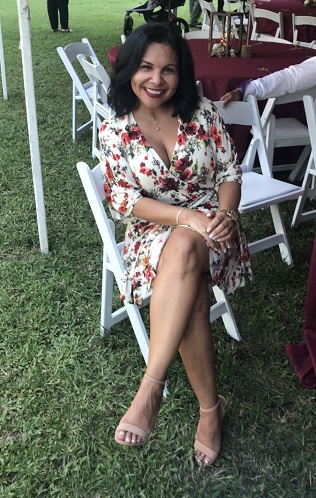
Lysa Rutledge, MSCJA '20

Rutledge first attended Chaminade as an undergraduate student over 20 years ago. She was in the Army at the time, stationed at Schofield Barracks, and enrolled for Chaminade’s on-base program. She graduated in 2000 with a degree in psychology and a minor in criminal justice.

At the time, Rutledge wanted to become a probation officer. She has family members that work in corrections in her home state of California, and she wanted a career that would make a difference. Her first job after graduating was as a case manager with the Federal Bureau of Prisons in California. And from there, her passion grew.

“My initial motivation was to get case management experience,” says Rutledge. “I wanted to be a probation officer and in federal probation they want you to have at least three years of case management experience. I ended up really enjoying working for the Bureau so I stayed with it. I’ve had a great career.”

As a case manager, Rutledge felt like she could really have an impact on the lives of the individuals she worked with. Her job was to work with inmates, review their progress and help them prepare for release and reentry into society. Essentially, she was a social worker in a prison setting. She’s always had an interest in social work and being a case manager was a way for her to tap into that passion.

“I was a case manager for ten years,” says Rutledge. “All of my inmates were females…they are eventually going to get out and go into our communities, and it was just a sense of responsibility to help these women come out and be better citizens in society. I would come across these women who have never had opportunities, and it’s really rewarding. It’s just very rewarding.”

Rutledge worked for the Federal Bureau of Prisons in California for 16 years. But in 2016, when an opportunity to return to Hawaii presented itself, Rutledge jumped at the chance.

“I came here on a promotion,” says Rutledge. “When I had the opportunity to come back, I kind of jumped at it. I love living here.”

Lysa Rutledge, MSCJA '20

Rutledge now works at the Federal Bureau of Prisons in Hawaii. She’s a case management coordinator and is part of the management team. She oversees the receiving and discharge department and supervises all of the case managers.

It’s a hard time to work in federal law enforcement with so much divisiveness in communities across the country. But being in Hawaii and working in corrections, Rutledge has felt fairly removed from a lot of that.

“It does affect us, what happens on the streets every day with the police officers, but what affects us more are the policy changes,” says Rutledge. “Fortunately, in Hawaii, we don’t see as much of what goes on in the mainland. I have heard different things about what goes on with different parts of the country, some people feel they can’t wear their uniform to and from work. I haven’t found that here in Hawaii.”

If anything, Rutledge has encountered a more welcoming and supportive community in Hawaii. There’s also more support for those with a criminal past.

“I feel like there’s so much community support and so many resources for ex-offenders here,” she says. “It’s just part of the Hawaiian culture of helping out. All of the resources we can get in the community definitely help these inmates with reentry and make my job a lot easier.”

She’s also noticed a difference in the inmates she works with—they’re less aggressive in Hawaii than what she encountered on the mainland.

She enrolled in the Chaminade’s Master of Science in Criminal Justice Administration program in 2017, and will graduate in December. Her motivation was mostly one of self-improvement—after an extensive career, she wasn’t looking for job growth. She was looking to learn and to expand her knowledge so that she could one day teach criminal justice.

“I feel like I have so much experience in corrections that I would like to teach undergraduates,” says Rutledge. “That’s what motivated me to get my master’s degree.”

But the program also helped give her a better understanding of her role at the Bureau and the policies they abide by.

“It has helped me with my writing skills and just kind of opening my eyes to what’s out there in the new age of corrections and law enforcement,” describes Rutledge. “With a lot of things that we do at the Bureau, I really see how they come out from laws that have passed or grievances that have gone to the supreme court. It’s neat to see where the policies and the laws have come from. For me, that’s been really interesting.” 

It hasn’t been easy to go back to school after 20 years in the workforce. She’s had to retrain herself to be a student and reestablish her study skills. But having a core group of supportive and knowledgeable professors has really helped. And even though most of her classmates are a lot younger and are just starting their careers, Rutledge has enjoyed hearing their perspectives.

“It was really nice to see and interact with that young perspective,” says Rutledge. “And I think they enjoyed picking my brain as well. There are actually two Chaminade students that just became corrections officers and joined the Bureau because I helped guide them. It’s nice to be able to recruit people in.”

Rutledge plans to retire from the Federal Bureau of Prisons in four years, and when she does, she’d love to come back to Chaminade—this time as a professor.

Posted by: University Communications & Marketing Filed Under: Behavioral Sciences, Featured Story, Students Tagged With: Master of Science in Criminal Justice Administration

NASPA Undergraduate Fellows Program

September 28, 2020

Two Chaminade students, Eri Leong ’23 and Andrew Ancheta ’21 were accepted into the 2020–2021 class of NASPA Undergraduate Fellows Program (NUFP). Hosted by the National Association of Student Personnel Administrators (NASPA) in Higher Education, the highly competitive fellowship gives students from traditionally underrepresented and historically disenfranchised communities a chance to learn more about careers in student affairs and higher education.

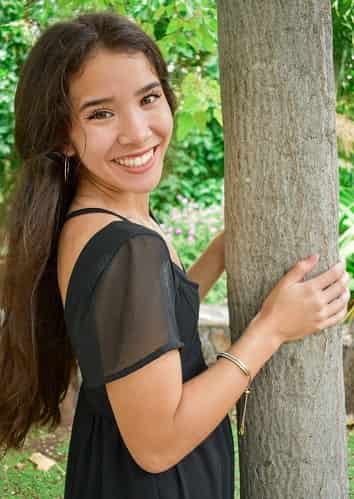
Eri Leong '23, 2020–2021 class of NASPA Undergraduate Fellows Program
Eri Leong ’23

Students apply together with a mentor from their home university, and spend one year participating in on-campus mentorship, professional development events and scholarship opportunities.

For her mentor, Leong chose Allison Jerome, Vice President for Student Affairs and Dean of Students at Chaminade. “She seems to be brilliant at everything she does, and if I were to become a student affairs professional, I would want to embody that brilliance of hers as much as possible” says Leong when asked about her decision. “I chose Dean Allison because I look up to her immensely and I know she has an incredible amount of information to guide me with.”

Ancheta had similar praise for the mentor he selected, Joseph Granado, Chaminade’s Director of Student Activities and Leadership. “It is easy to tell that Joseph genuinely wants to see all of his students succeed,” says Ancheta. “He knows how to connect with them, how to understand them, and most importantly, how to challenge them to reach for the stars that they desire. He is a great inspiration to many.”

Leong and Ancheta both felt connected to the organization’s mission: to increase the number of historically disenfranchised and underrepresented professionals in student affairs and/or higher education, including but not limited to those of racial and ethnic-minority background; those having a disability; and those identifying as LGBTQ. And they both see student affairs as a potential long-term career path.

“I’ve always loved helping people and student affairs is a profession that has the joy of getting to do that everyday,” says Leong. “I’m drawn to the possibility of having a profession that allows me to assist the next generation in flourishing into the best possible versions of themselves.”

Andrew Ancheta '21, 2020–2021 class of NASPA Undergraduate Fellows Program (NUFP)
Andrew Ancheta ’21

“My lifelong journey is one of self-improvement,” explains Ancheta. “I am really just hoping to gain the tools and skills that will help me be successful in improving lives. I want to walk with others on their journey toward self-discovery, internal reflection and professional development.”

Leong and Ancheta will have access to the entire Student Affairs division at Chaminade and gain a better understanding of what a profession in student affairs entails. They’ll also participate in the regional NASPA conference that will be held in November.

Although the conference will be virtual, they’re both excited about the networks they’ll create with students from other universities.

“I’m looking forward to meeting and connecting with other NUFP members,” says Leong. “People-oriented is a characteristic I heavily consider myself to have, so with every new experience I’m always looking forward to the people I get to meet and learn from.”

Similarly, Ancheta says: “As someone who was born and raised in the beautiful state of Hawaii, it is not too often that I hear fresh perspectives. Hearing new stories from new people is a great way to continue the development of my own personal outlook on life situations, social issues, etc.”

In the meantime, they’re just excited to continue learning from their mentors and gaining new insight into student affairs as a profession.

“As [Joseph’s] NUFP mentee, I am looking forward to learning more about all of the skills, techniques, and methods that he has picked up throughout his years as a student affairs professional,” says Ancheta. “I have absolute confidence that I will continue to learn from him.”

Posted by: University Communications & Marketing Filed Under: Diversity and Inclusion, Featured Story, Student Life, Students

  • « Go to Previous Page
  • Page 1
  • Interim pages omitted …
  • Page 14
  • Page 15
  • Page 16
  • Page 17
  • Page 18
  • Interim pages omitted …
  • Page 36
  • Go to Next Page »

Footer

Chaminade University Logo

3140 Waialae Avenue
Honolulu, Hawaii 96816

Contact Us
Phone: (808) 735-4711
Toll-free: (800) 735-3733

facebook twitter instagram youtube linkedin

Visit

  • Plan Your Visit
  • Campus Map (PDF)
  • Events

Resources

  • Campus Security
  • Student Consumer Information
  • Concerns, Feedback, and Reporting
  • Institutional Review Board
  • Title IX / Nondiscrimination Policy
  • Compliance
  • Emergency Information
  • Careers
  • Institutional Statement

People

  • Students
  • Parents
  • Alumni
  • Faculty & Staff

Policy

  • Privacy Policy
  • Terms and Conditions of Use


© Chaminade University of Honolulu