• Skip to primary navigation
  • Skip to main content
  • Skip to footer
Chaminade University of Honolulu

Chaminade University of Honolulu

  • VISIT
  • APPLY
  • GIVE
  • STUDENTS
  • PARENTS
  • ALUMNI
  • FACULTY/STAFF
  • Admissions
    • Admissions Home
    • Undergraduate Students
      • First-Year Students
      • Transfer Students
      • Admitted Students
    • Graduate Students
    • Flex Online Undergraduate Program
    • Military Students
    • Non-Degree/Visiting Students
    • Experiential Honors Program
    • Early College Program
    • New Student Orientation
  • Tuition & Aid
    • Financial Aid Home
    • Tuition & Expenses
    • Federal Updates & Changes
    • Scholarships
    • $5,000 Graduate Scholarship
    • VA Education Benefits
    • Net Price Calculator
  • Academics
    • Academics Home
    • Academic Programs
    • Office of Student Success
      • Academic Advising
      • Records and Registrar
    • Kōkua ʻIke (Support Services)
      • ADA Accommodations
      • Career Services
      • Proctoring Services
      • Tutoring Services
    • Sullivan Family Library
    • Undergraduate Research & Pre-Professional Programs
    • Commencement
  • Campus Life
    • About Campus Life
    • Student Engagement
    • Student Government Association
    • Residence Life and Housing
      • Summer Conference Housing
    • Health Services
    • Marianist Leadership Center
    • Counseling Center
    • Campus Ministry
    • Campus Security
    • Dining Services
    • Bookstore
  • Athletics
  • About
    • Chaminade University News
    • Our Story
    • Leadership
    • Chaminade University Strategic Plan 2024-2030
    • Mission & Rector
    • Association of Marianist Universities
    • Facts & Rankings
    • CIFAL Honolulu
    • Accreditation & Memberships
    • Montessori Laboratory School
Search
×

Search this web site

Institutional

Pathway to Success

May 23, 2023

Articulation Agreements help advance careers in healthcare

A 2018 alumnus, Hyo Park graduated with his Doctor of Medicine from George Washington University earlier this month. And he credits Chaminade with helping him get there. Thanks to the university’s Articulation Agreement program with The George Washington University School of Medicine and Health Sciences, Park was able to secure an early admission spot at the institution. And he recently learned that his first choice of residency at Hilo Medical Center (HMC) was approved. He will start later this summer.

“While at Chaminade, I learned the importance of dedicating myself to something greater than my personal ambitions—through service,” said Park, who attributed his successes to the connections, mentorships and support he received from the university. “I’m happy to return to Hawaii to serve the community.”

At its essence, an Articulation Agreement document is between two colleges or universities, and lays out a transfer plan between two program offerings. Depending on the program and degree, students can set an early course to advanced studies as an undergraduate—establishing a strong academic record and completing prerequisites while at Chaminade. The agreement helps the student by ensuring all completed classes (credits) transfer and shows a clear pathway for continued advancement.

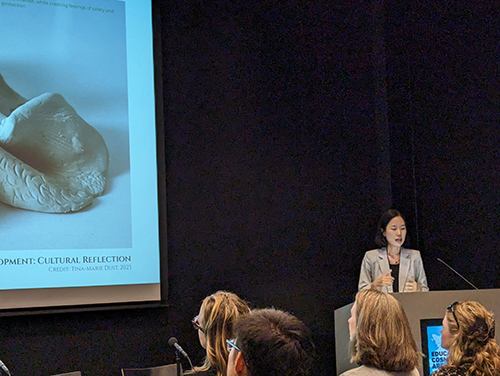
Amber Noguchi met with Dr. Hyo Park while visiting Washington, D.C.

“Each agreement differs by institution, as well as degree,” explained Amber Noguchi, Ph.D., Chaminade’s Program Director with the Undergraduate Research & Pre-Professional Programs. “And each agreement represents a binding legal contract between the universities.”

Students who want to take advantage of participating in an Articulation Agreement, for example with Boston University or George Washington University, should apply in January of their sophomore year. “This timeline avoids any gap year between undergraduate and graduate programs,” Noguchi noted. “They would learn of their acceptance by April, and invited to take summer courses after their sophomore year. They would return to Chaminade for their junior year and then move to Boston for their senior year.”

Articulation Agreements streamline the transfer process for everyone involved. This will help alleviate the stress surrounding the application process, the credit transfer process and several other issues students might encounter when applying to a graduate program. By simplifying this process with transfer agreements, it is beneficial to all parties involved. 

In an editorial that she wrote for the Hawaii Dental Association Journal, Dr. Nora K. Harmsen shared Chaminade’s Healthcare Articulation Agreement Programs with her fellow dentists, citing that she was interested in the programs because many times her patients or staff members would discuss their goals of becoming a hygienist, dentist, occupational therapist or pharmacist.

“Chaminade University’s pre-professional program places students on a path that will lead them to a position in one of the much-needed healthcare fields here in Hawaii,” Harmsen wrote. “The student works with the profession’s counselors, and follows the required curriculum and requirements to graduate from Chaminade. They will then apply to one of the graduate programs, following the requirements for the program’s application process, which may include an interview and required GPA or DAT, MCAT, etc.

“As a result, these students will be on a direct path to the program of their choice, at one of the Programs with which Chaminade has a current Articulation Agreement,” Harmsen further noted. “Using this plan, the student does not have to apply to multiple programs to achieve their vocational dreams. I am always skeptical about the ‘too-good-to-be-true’ programs or ideas, but Chaminade has multiple graduates from these programs who have come back to encourage other students to use this plan for their future.”

Chaminade currently has Articulation Agreements with 11 different healthcare graduate schools across the nation, including A.T. Still University, Boston University, George Washington University, Pacific University, Samuel Merritt University, Tufts, University of Dayton and Western University. A recent contract with St. Mary’s University School of Law marks the first Articulation Agreement outside of the medical field.

“Since our pre-health program was established in 2010, we’ve seen tremendous growth,” Noguchi said. “Forty percent of our students, who apply to a health professional program, now do so with one of our 11 Articulation Agreements.”

Posted by: University Communications & Marketing Filed Under: Alumni, Diversity and Inclusion, Institutional, Nursing & Health Professions Tagged With: Alumni, Community and Public Health, Honors and Awards, Office of Health Professions Advising and Undergraduate Research

Commencement Address

May 15, 2023

Kauai Mayor Derek Kawakami ’01 delivers keynote speech

She had him at Chaminade. For many senior high-school students, trying to determine where to attend college depends on several factors: cost, location, size, personal interests, campus life, graduation rates and the potential return on investment. However, for Kauai Mayor Derek Kawakami ’01, the primary reason he chose Chaminade University was simple—he met a girl.

“I know it sounds shallow, but it’s the truth,” said Kawakami, this year’s 65th Commencement keynote speaker. “But knowing what I know now about Chaminade, I would have chosen it 1,000 times over any college in the country.”

The son of the late Charles and Arlene Kawakami, Mayor Kawakami is a third-generation Kaua‘i resident, and is now serving his second term as the Garden Isle’s chief executive officer. Having shepherded the island through a once-in-a-century pandemic and now through recovery, Kawakami does not shy away from the necessary hard work of what he calls, “the people’s business.” The physically fit 46-year-old is a no-nonsense-type of leader who likes to roll up his sleeves, get into his steel-toe-capped boots and don his hard hat at the drop of a dime.

During COVID, he was forced to make a series of difficult—and, at times, unpopular—decisions, including lockdowns, turning public camp sites into Safe Zones to prevent the spread of the virus, enforcing mandatory vaccine mandates and curfews, and instituting strict protocols and safety measures. Yet, through it all, he became widely known, erroneously by the way, as the TikTok mayor. A 30-second clip that he posted went viral on Instagram and not the aforementioned social media site. In the video, he performs an amusing dance and a card trick, then encourages people to wash their hands. It was all an effort, he said, to break the monotony of staying home.

With his wife Monica by his side, Kauai Mayor Derek Kawakami was sworn in for his first term by Kaua‘i Circuit Judge Randal Valenciano. (Photos courtesy County of Kauai)
Mayor Kawakami welcomed 11 new firefighters with the Kauai Fire Department. (Courtesy of County of Kauai)
Mayor Kawakami enjoys meeting and greeting his constituents from across the island. (Photo courtesy of Friends of Derek Kawakami)
The Twitter video that went viral.
Mayor Kawakami knew from a young age that he wanted to serve the people of Kauai. (Photo courtesy of Amanda C. Gregg)
Members of Mayor Kawakami’s cabinet.
Mayor Derek Kawakami during a groundbreaking ceremony.
Mayor Derek Kawakami during a groundbreaking ceremony. (Photo courtesy of Friends of Derek Kawakami)
Monica and Derek Kawakami enjoy participating in community events, including the long-running Taste of Hawaii.

“I have to say my wife put me up to it and my daughter instigated it,” Kawakami chuckled. “We just wanted to help people get through some tough times, we wanted to do it together, and at the end of the day, we wanted people to feel like they mattered and that we cared about them.”

He attributes this empathy as one of the values he learned while completing his bachelor’s degree at Chaminade, where his now-wife, Monica nee DeBusca Lizama, also graduated with an undergraduate degree in 2001 and a master’s in education in 2003. A self-described average “C” student, Kawakami evoked the memory of several Chaminade professors, who made an impact in his life, during his commencement address.

One such individual was the late Marlene Baker, who enjoyed a 45-year career in the Students Success and Records office. Kawakami said he would bring Kauai cookies to her so that she would build him a favorable schedule, quipping that was probably his first sign of being a politician. Henry Gomes, or “Uncle Henry” as Kawakami affectionately refers to the late revered professor, would talk to him about “country-kine things,” and made him feel like it was perfectly OK to just be him. Then there was recently retired Yukio Ozaki, who opted not to cancel an art class, even though enrollment plummeted from 15-20 students to a lone Kawakami overnight.

“Now that I have 20/20 hindsight vision, what I’m about to say is the last thing my professors would want to hear,” Kawakami said. “As the sands of time have passed, some of the knowledge, some of the details of the countless hours of classroom lessons, lectures and knowledge have faded. But what has remained is how the power of the human element can change the trajectory of one person’s life. All it takes is just one person. One person that believes in someone and is willing to invest time, effort and kindness can uplift a community.”

It’s with this indomitable spirit that helps inform Kawakami’s leadership. He cited three principles that he follows: 1) Act in good faith, which helps build trust; 2) always act with the community’s best interest; and 3) establish a sound, prudent process of decision making.

“Not everyone will agree, but I can defend my position,” Kawakami asserted. “Compromise is an art, and by compromise, I don’t mean consensus, which, when I hear, often tells me that things are not going to move forward.”

Life for Kawakami has certainly had a forward momentum. When he graduated from Chaminade, his first job was a grocery clerk for Longs Drugs Kaimuki. The pay was $200 per week, and his duties included sweeping the floors, stocking the shelves and racks with those familiar yellow books, and whatever needed to be done.

“I had to put my business degree to work,” Kawakami said. “I started at the entry level, but that’s how I thought it would work. Just because I had a degree didn’t mean I was going to start at a higher level. My degree was supposed to give me the tools to get to that next level, and it did.”

One day, he received a call from his dad, asking him to come home to help out in their own grocery store. His dad told him If he could work at Longs, then certainly he can work at the family’s own enterprise. However, there was one problem: Monica was pursuing her master’s, and she wasn’t about to quit and return to Kauai. So, she proposed an ultimatum: He had to marry her.

“I went to Kahala Mall and applied for a loan, which was my first loan ever,” Kawakami recalled. “I qualified for $9,000—which was big bucks back then for me who was making $200 a week—and I went upstairs to a diamond specialist, and chose an engagement ring.”

Married now to Monica for 20 years, the couple has two children, Hailee and Christopher. A dedicated family man, Kawakami praises his family for their support throughout his two terms as Kauai’s Mayor, as well as his years of service on the State Legislature. He also credits his experience at Chaminade as helping shape his style of leadership.

“I have a lot of clear memories of my time at Chaminade, and the people who made an impact on my life; the faculty and staff truly cared for us,” Kawakami said. “I gained a worldly view of different cultures, and how to appreciate our differences.”

And despite all the pressures of governing, Kawakami said, from a pressure standpoint, being the Commencement keynote speaker was a big one.

“If I were to go back to my 20- or 21-year-old self, and be told that I was going to be the Commencement speaker at Chaminade one day, I would have said ‘Get out of here!’” Kawakami said. “I never imagined a picture in which I would be in a position speaking to the graduating class and their families. I’m grateful for this opportunity to come back around and to be part of this Commencement.”

Kauai Mayor Derek Kawakami ’01 shared his memories of Chaminade while a student majoring in business administration.

Posted by: University Communications & Marketing Filed Under: Alumni, Campus and Community, Diversity and Inclusion, Featured Story, Homepage, Institutional Tagged With: Campus Event, Commencement, Guest Speakers

Congratulations to the Class of 2023

May 10, 2023

Inspiring words from Dr. Lynn Babington, Kauai Mayor Derek Kawakami and Selected Student Speakers

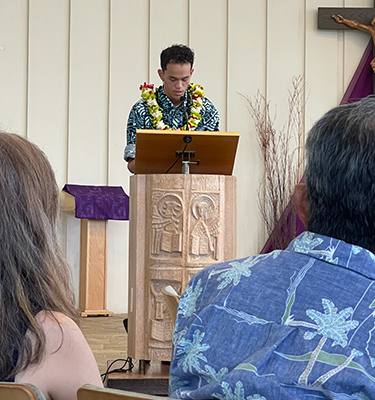
In his opening remarks to graduating students, Kauai Mayor Derek Kawakami ’01, reflected on his time on campus with his wife Monica and his own commencement. “As I look out into the sea of graduates, I see my own reflection in you,” said the 2001 Chaminade alumnus. “It makes me realize how quickly time goes by. But time is just a measurement, until it is filled with very special people who make tremendous impacts in our lives. And today, on this beautiful occasion, as you generously give me your time, each of you becomes a part of my life as well.”

The Commencement ceremony began with a special invocation from Fr. Martin Solma, Chaplain and Special Assistant to the President at Chaminade. President Dr. Lynn Babington then addressed graduates, acknowledging their accomplishments and sacrifices—especially in the face of global uncertainty.

Chaminade President Dr. Lynn Babington addresses graduates at Commencement.

“One of the distinguishing features of a Marianist education is a focus on adaptation and change—skills critically important in today’s challenging world,” Babington exhorted. “You have certainly become more comfortable with navigating the unknown. The ability to work with ambiguity means you’ll be able to face uncertainties, adapt to change and be flexible as the mysteries of life unfold.”

For many graduates, the ceremony is a time of reflection, pride and perseverance, especially with this particular graduating class, which endured a once-in-a-century pandemic, Covid protocols and restrictions, social distancing and a pivot to an online schedule before transitioning to a hybrid model.

“We’re all here today together, making it across that finish line,” said undergraduate speaker Eri Leong. “Through fears and failures, exams and assignments, break-ups and breakdowns, even through a global pandemic, no hurdle was high enough to keep us from walking this stage. Instead, we emerged triumphant over every adversity under the sun. And we’ll carry that unwavering resolve into the abundant opportunities that lie ahead.”

In Simon Bronner’s 1990 book “Piled Higher and Deeper: The Folklore of Student Life,” a chapter devoted to graduation explores how commencement has been celebrated across campuses and throughout the years.

According to the book, some colleges host 100-day countdowns to commencement, with a number of graduation-themed activities. At other schools, graduating seniors leave wills to underclassmen. Some institutions celebrate graduation with a balloon launch to symbolize students moving upward, while others have held ceremonial bonfires where seniors burn course materials or early drafts of their senior theses. 

However, even with variation from campus to campus, the commencement ceremony itself remains very much a traditional event, a punctuation point to the collegiate experience with many customs deeply rooted in history, including the caps and gowns, university mace, and guest and student speakers.

“Commencements are a time to join as a community to celebrate the work of our faculty and staff who have supported you throughout your years of study with us, and we celebrate new beginnings,” Babington said in in her address to students. “You are leaving Chaminade University to go out and engage in the world as professionals, as neighbors, as citizens.”

Graduating with a Master of Arts in Teaching, Todd Sibley was selected by his peers to be the evening’s graduate speaker. Immediately preceding the pandemic, the native Californian worked as a social worker for a Hawaii nonprofit organization. When COVID spread across the islands, Sibley lost his job, and he decided to pursue his master’s in teaching social studies in secondary schools.

“Graduates, we have proven ourselves to be resilient, resourceful and resistant to giving up,” Sibley asserted. “The global pandemic would have been an easy excuse to have quit on ourselves and our dreams, but we didn’t. We persevered no matter the obstacle because that’s what we faced—obstacles not barriers.”

As Kauai Mayor during the pandemic, Kawakami confronted his own difficult decisions, turning camp grounds into Safe Zones, ordering shut downs and unpopular vaccine mandates. And through it all, he thought only of his constituents, responding to their needs in the most dire of times.

“What I got most out of my time at Chaminade wasn’t the correct way to structure a sentence or what I gained out of my statistics class; it wasn’t what I gained out of a book,” Kawakami said.  “It was the importance of the human element, and the power that simple random acts of kindness can shape the future of one person’s life. That although certain things will fade overtime, the people who cared, the ones that shared, the ones that believed, and made you believe in yourself, will remain with you.

“I feel incredibly grateful to witness this commencement of your next step,” he concluded. “Fair winds and following seas, always be caring and always be trustworthy. Congratulations to this beautiful graduating class of Chaminade University!”

Dr. Lynn Babington presents diploma to graduating student
Student Athlete
Graduating Students
Father Chaminade
Sarah Robertson is all smiles, even with crutches
Janine Abad posed with her family and friends.
MBA graduate Jeremiah Bautista poses with family and friends.
Provost Dr. Lance Askildson
Keynote speaker Kauai Mayor Derek Kawakami
Graduate speaker Todd Sibley
Undergraduate student speaker Eri Leong
A promising message on a mortarboard
Emcee Kaipo Leopoldino
All smiles and laughs
BSN graduates with Student Athlete
Graduates' family and friends attended the Chaminade Commencement at the Waikiki Shell on May 6.
Graduates’ family and friends attended the Chaminade Commencement at the Waikiki Shell on May 6.

Posted by: University Communications & Marketing Filed Under: Alumni, Campus and Community, Diversity and Inclusion, Featured Story, Homepage, Institutional Tagged With: Alumni, Campus Event, Guest Speakers

Above and Beyond

May 4, 2023

Co-Curricular Awards recognize students for their leadership

As it has often been said, “Most students learn the most outside of the classroom.” And last month, students, student organizations and clubs proved this adage to be true during the 18th annual Co-Curricular Awards. The annual event recognizes awardees for their unwavering commitment to better the campus and the community as a whole.

In all, 22 awards were presented, including for service, scholarship and to outstanding student-athletes. Students are either nominated by fellow classmates or faculty and staff. Students may also nominate themselves.

Chaminade President Dr. Lynn Babington gives students a round of applause for going above and beyond their academic curricula.

“Chaminade’s co-curriculum programs intentionally align with, augments and enhances standard curricular goals,” says Chaminade President Dr. Lynn Babington. “Our co-curriculum is developmental, transformative and future-focused. It is also experiential, offering authentic, hands-on opportunities to hone skills, put ideas into practice, and showcase achievements of potential interest to employers.”

One member of each undergraduate class was selected to receive the Bro. Joseph Becker Award of Excellence, which recognizes those who display exceptional leadership skills through involvement in co-curricular activities. The awardees, with a diversity of scholarly ambitions, were: freshman Selena Buttery ’26, sophomore Sophia “Noe” Tugaoen ’25, junior Sean-Zacharry Lorenzo Jr. ’24, and senior Kobe Young ’23.

The Bro. Elmer Dunsky Outstanding Student Organization Award went to the Student Organization of Latinix, which promotes awareness, within and beyond the Latinx community, and incorporates all facets of the culture. The award recognizes the organization’s significant contributions to helping create an inclusive campus environment that embraces all cultures and fosters a true sense of ‘ohana.

Nominees for the Fr. Stephen Tutas Program Award of Excellence could be a student who—or student organization that—demonstrates exceptional creativity, planning and execution of a university program that contributes to the quality of life and academia at Chaminade. This year’s recognition went to The Chemistry Club.

Dr. Abby Halston, Associate Professor and Psychology Clinical Director at the School of Education and Behavioral Sciences, was named the Rev. David Schuyler Advisor of the Year. The award recognizes members of the faculty, staff or administration who seek to encourage and support students in leadership development and campus involvement.

Women’s Volleyball Coach, Kahala Kabalis Hoke, presented the Male Athlete of the Year to Men’s Basketball guard Isaac Amaral-Artharee.

With an infectious can-do personality, Eri Leong ’23 personifies the characteristics required by a Frederick K.K. Kauhane, Sr. Aloha Spirit Awardee. She exhibits a humble, cheerful and generous spirit; a dedication to fostering a sense of ‘ohana around campus, and the ability to buoy other’s spirits by consistently improving the environment around them. Leong was also awarded the Outstanding Peer Mentor.

Lucy Lee ’23 was named this year’s Henry Halenani Gomes Alaka‘i Award winner, recognized for her excellence in leadership and service to the Native Hawaiian community.

“After the nomination due date, a small group of staff members will go through the nominees and select the winners,” explains Allison Jerome, Vice President for Student Affairs & Dean of Students. “In addition, many of the departmental awards are chosen by staff within those departments (ie. Athletics, Student Success, Campus Ministry and so forth).”

The Resident Assistant Award of Excellence went to Jannabel Bielza ’23, while Christopher Diego ’23 and Jacqueline Martinez ’23 were bestowed the Outstanding Orientation Leader Awards. Kamipono Abella was awarded Tutor of the Year and Kobe Ngirailemesang ’23 picked up the Dean of Students’ Special Recognition Award.

For the third straight year, men’s basketball’s Isaac Amaral-Artharee ’23 was named Chaminade’s Male Athlete of the Year, while women’s volleyball players Lataisia Saulala ’23 and Kaybrie Pe‘a ’23 captured the Female Athlete of the Year and The Silversword Award, respectively.

To round off the ceremony, Campus Ministry handed out three awards: Kaycia Mailo-Kaheaku ’23 for Retreat Leader of the Year; Tyanna Hemmings ’23 for The Liturgy Award; and Alaina Mercado ’23 for Campus Ministry Award.

Posted by: University Communications & Marketing Filed Under: Campus and Community, Diversity and Inclusion, Institutional, Service Learning, Student Life Tagged With: Honors and Awards

Nursing Scholarship

May 4, 2023

Hawaii Central Federal Credit Union Announces New Scholarship Fund

During a check presentation to Chaminade President Dr. Lynn Babington, Hawaii Central Federal Credit Union’s Board Chairman, Neil Shimogawa, said this would be the first of hopefully many to follow in the years to come.

“We couldn’t do this without our community partners like yourselves,” said Dr. Babington to Shimogawa and fellow board members Ariel Chun, Director, and Alan Yasuda, Secretary. “Scholarships are often the optimal form of financial aid since, unlike student loans, scholarships do not need to be repaid.”

According to U.S. News & World Report, the average college student graduates with about $30,000 in student loans. That’s nearly a 25 percent increase from a decade ago. Many of these student loans carry high interest rates, and create a severe financial burden for young professionals. In contrast, scholarship programs can help students afford college without strings attached. As a result, scholarship recipients can pay off loans more quickly and use their extra income to start saving for the future.

Following the COVID-19 pandemic, many colleges and universities experienced significant budget cuts. And while public schools experienced a squeeze in funding, passing these costs along to students, Chaminade did the opposite. Instead of increasing its tuition, the university introduced its Hawaii Guarantee pilot program, which ensures all graduates of Hawaii high schools entering as first-time freshmen pay the exact same tuition rate as the University of Hawaii at Manoa’s annual resident undergraduate tuition, and an achievable path to graduate in four years.

These days, many scholarship opportunities target communities that haven’t historically had access to higher education. These include students from communities with lower household incomes and who also represent the first generation of their families to attend a four-year university.

While many scholarships are need-based, or select winners based on academic achievement, others prioritize community service. The latter is one of the reasons that spurred board members of the Hawaii Central Federal Credit Union to establish its scholarship at Chaminade.

“Chaminade has one of the best nursing programs in Hawaii, and it was a perfect fit for what we wanted to do for the community,” says Shimogawa, with Chun and Yasuda nodding in agreement. “Our scholarship fund is targeted at nursing students, who are entering a field that the community really needs.”

Chaminade’s student-centric focus also appealed to the three Board Members. “This is all for the students,” Babington said. “I was reading the remarks of our student speakers at Commencement this year and it was inspiring to hear, and it’s why I come to work every day.”

Posted by: University Communications & Marketing Filed Under: Campus and Community, Institutional, Nursing & Health Professions Tagged With: Campus Event, Scholarship

Na Liko Naʻauao

April 28, 2023

Students present their thought-provoking research findings

She suspected that she couldn’t be the only one feeling isolated and alone. With COVID cases spiking during her freshman year, Iris Hirata sheltered in place in her dorm room with her family support 5,000 miles away.

“I usually like being alone, but that was too much—even for me,” Hirata recalls. “It was depressing and I felt I had no one to talk to.”

As pandemic numbers started to decrease, and a semblance of normalcy emerged, Hirata never forgot those earlier times. “Biologically, I knew about COVID’s impact on the lungs,” Hirata says. “But I told Dr. Darren Iwamoto, we didn’t know the impact that COVID had on the mental health of individuals.”

It turned out to be a lot.

In an earlier research project she worked on with psychology professor Tracy Trevorrow, Ph.D., Hirata studied the effects of COVID on sleep quality. They learned that during the nascent stages of the pandemic, people tended to be more on their phones, which would disturb their sleep patterns and quality of sleep.

Iris Hirata stands in front of her presentation about COVID-19 and mental health.

“I was really big on healthcare at the time, which is what led me to do a research project on the impact of COVID on mental health,” says the biology major, who presented her findings during the 21st annual Na Liko Na’auao Symposium on April 14.

Pointing to a chart with spikes of blue and red lines, Hirata explains that the graph indicates the “bounce back” or the resiliency rate of the 200 students surveyed during her research.

“The epidemic has had a significant impact on university students’ mental health, including things like stress, anxiety, depression, and a lack of behavioral and emotional control,” Hirata concludes in her findings. “The findings support the literature that resilience is a key factor in influencing mental health and overall wellness.”

According to Amber Noguchi, Ph.D., Undergraduate Research and Pre-Professional Programs director, undergraduate and graduate research experience can look like a number of things. It can range from formal and clinical studies to data analysis, and creative works and beyond. On the occasion of this year’s Na Liko Na’auao Symposium, 25 student presenters covered a broad spectrum of issues and questions, from Hirata’s “How does COVID-19 Impact the Mental Health of Individuals?” to “Eat Healthy, Live Strong: Understanding Eating Behaviors of NHPI on Oahu” and “Sports Analytics: What Factors Determine a Winning Team?” and “Decolonizing Hawaii’s Diet.”

“All of these presentations stem from research projects that have been collaborations between the student researchers and their faculty mentors,” Noguchi explains. “This undergraduate conference celebrates student scholars from across all academic disciplines.”

In her research project with Dr. Guanlin Gao, “Eat Healthy, Live Strong: Understanding Eating Behaviors of NHPI on Oahu,” Autumn Fairall, ’23, examined the barriers to eating a healthy diet. “I started working with Dr. Gao as a research assistant in the Spring of 2022,” says Fairall, who will earn her Bachelor of Science in Nursing in May. “Initially, the project we worked on focused on the landscape of economic and personal finance in Hawaii. However, after talking with Dr. Gao and discussing personal interests in wellness and past, informal research connected to diet, the research focus altered.”

Chaminade President Dr. Lynn Babington presents Dr. Rylan Chong and Kawailani Luat with their respective awards.

During the conclusion of the Symposium, President Dr. Lynn Babington, defined a scholar as “A person with a desire to pursue and learn new things; a person on a quest for knowledge and a dedication to learning.” By not focusing on one academic discipline, Na Liko Na’auao gives all student scholars an opportunity to present their work in a formal setting, and receive feedback from both faculty and other scholars within their field.

Every year, after all the student scholars have presented their work, the Symposium concludes with a presentation of two special awards. Given annually, The President Sue Wesselkamper Award acknowledges a student who has demonstrated extensive community and university service. In order to qualify for the prize, a student must have a minimum 3.5 GPA, show scholarship beyond classroom requirements by undertaking their own independent research or study, and must have presented their work both on and off campus.

Kawailani Luat is this year’s recipient of the President Sue Wesselkamper Award. A senior, majoring in Data Science, Analytics and Visualization and minoring in Forensic Science, Luat consistently excels in her coursework and has taken on leadership roles through her extracurricular and volunteer services.

“To be recognized with this award validates all the hard work I’ve done to get here,” Luat said. “I finish my senior year with this last achievement, so I am beyond ecstatic.”

“Kawailani is very active within our Chaminade community, including the Animal Advocacy Club, I am a Scientist, and has helped at every Preview and Admitted Students Day,” Babington says. “She also served as a student panelist for the Women in Data Science Hawaiʻi program and volunteers at Palama Settlement, a non-profit community-based social service agency working in the Kalihi and Palama neighborhoods.”

Honoring the close student-faculty relationships formed at Chaminade, the President Mackey Award is presented to an outstanding faculty mentor, nominated by a student participating at the conference. This year’s recipient is Dr. Rylan Chong, nominated by LaVelle White.

“He personally helps students step outside themselves to try things that were not thought possible,” wrote White in his nomination letter. “He encourages and pushes students to go for internships and research programs like SPICE. He stays after class to help students answer questions, and he has a way of speaking that demystifies the whole process, giving students the confidence to essentially go for the gold.”

Posted by: University Communications & Marketing Filed Under: Behavioral Sciences, Campus and Community, Diversity and Inclusion, Humanities, Arts & Design, Innovation, Institutional, Natural Sciences & Mathematics, Students Tagged With: Campus Event, Honors and Awards

  • « Go to Previous Page
  • Page 1
  • Interim pages omitted …
  • Page 16
  • Page 17
  • Page 18
  • Page 19
  • Page 20
  • Interim pages omitted …
  • Page 34
  • Go to Next Page »

Footer

Chaminade University Logo

3140 Waialae Avenue
Honolulu, Hawaii 96816

Contact Us
Phone: (808) 735-4711
Toll-free: (800) 735-3733

facebook twitter instagram youtube linkedin

Visit

  • Plan Your Visit
  • Campus Map (PDF)
  • Events

Resources

  • Campus Security
  • Student Consumer Information
  • Concerns, Feedback, and Reporting
  • Institutional Review Board
  • Title IX / Nondiscrimination Policy
  • Compliance
  • Emergency Information
  • Careers
  • Institutional Statement

People

  • Students
  • Parents
  • Alumni
  • Faculty & Staff

Policy

  • Privacy Policy
  • Terms and Conditions of Use


© Chaminade University of Honolulu