• Skip to primary navigation
  • Skip to main content
  • Skip to footer
Chaminade University of Honolulu

Chaminade University of Honolulu

  • VISIT
  • APPLY
  • GIVE
  • STUDENTS
  • PARENTS
  • ALUMNI
  • FACULTY/STAFF
  • Admissions
    • Admissions Home
    • Undergraduate Students
      • First-Year Students
      • Transfer Students
      • Admitted Students
    • Graduate Students
    • Flex Online Undergraduate Program
    • Military Students
    • Non-Degree/Visiting Students
    • Experiential Honors Program
    • Early College Program
    • New Student Orientation
  • Tuition & Aid
    • Financial Aid Home
    • Tuition & Expenses
    • Federal Updates & Changes
    • Scholarships
    • $5,000 Graduate Scholarship
    • VA Education Benefits
    • Net Price Calculator
  • Academics
    • Academics Home
    • Academic Programs
    • Office of Student Success
      • Academic Advising
      • Records and Registrar
    • Kōkua ʻIke (Support Services)
      • ADA Accommodations
      • Career Services
      • Proctoring Services
      • Tutoring Services
    • Sullivan Family Library
    • Undergraduate Research & Pre-Professional Programs
    • Commencement
  • Campus Life
    • About Campus Life
    • Student Engagement
    • Student Government Association
    • Residence Life and Housing
      • Summer Conference Housing
    • Health Services
    • Marianist Leadership Center
    • Counseling Center
    • Campus Ministry
    • Campus Security
    • Dining Services
    • Bookstore
  • Athletics
  • About
    • Chaminade University News
    • Our Story
    • Leadership
    • Chaminade University Strategic Plan 2024-2030
    • Mission & Rector
    • Association of Marianist Universities
    • Facts & Rankings
    • CIFAL Honolulu
    • Accreditation & Memberships
    • Montessori Laboratory School
Search
×

Search this web site

Institutional

Surf Studies

July 18, 2023

Culture, history and future intersect to create the perfect wave

Surf studies may just well be the new wave in some academia circles. As more scholars publish academic books about the sport of surfing, from “Waves of Resistance: Surfing and History in Twentieth-Century Hawaiʻi” to “Waves of Knowing: A Seascape Epistemology,” universities around the world have begun to embrace the discipline as worthy of research, education and scholarship.

A decade ago, a love for surfing prompted a group of Chaminade faculty members, including Drs. Jim Kraus, Pete Steiger, Michio Yamasaki and Hank Trapido-Rosenthal, to brainstorm the idea of teaching an undergraduate surf class. Yet, it wasn’t until a few years ago, during a casual faculty pau hana, that the notion of “Critical Surf Studies” re-emerged.

“I mentioned it to Lynn (President Babington) and she was interested,” recalls Kraus, an avid surfer since the ’60s and the former publisher of “Hawai‘i Surf & Sea;” from 1980-1984. “Then Lance (Provost) walked by, and I pitched the idea to him, too.”

Eventually, it was Cheryl Edelson, Ph.D., Dean of School of Humanities, Arts, and Design, who presented the topic to the full Chaminade Curriculum Council, which is the final recommending voice in curricular matters with the definitive stamps of approval resting with Drs. Babington and Askildson.
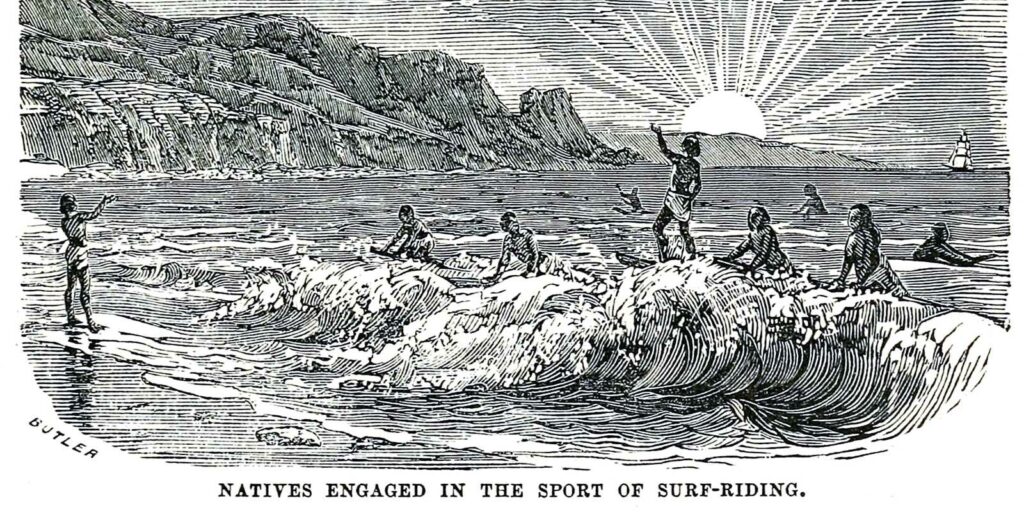
Magazine illustration of native Hawaiians surf-riding (surfing) from an article entitled “Our Neighbors of the Sandwich Islands” in Hutchings’ California Magazine, November 1858.

“Surfing is such an integral part of Hawaiian culture that it deserves to be part of our curriculum,” Babington says. “This program is the first of its kind in Hawai‘i, and it challenges students to explore surf culture’s indigenous origins, its growing popularity globally and its importance to Hawai‘i’s sense of place.”
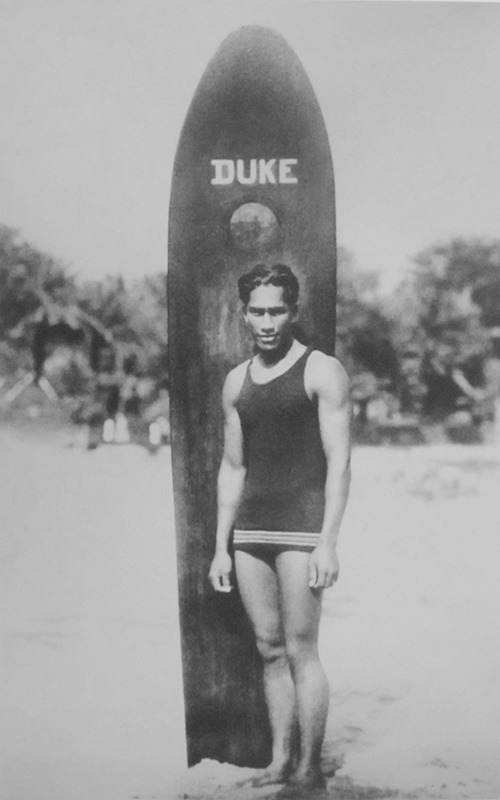
Duke Paoa Kahinu Mokoe Hulikohola Kahanamoku (August 24, 1890 – January 22, 1968) was a Hawaiian competition swimmer who popularized the sport of surfing.
Duke Paoa Kahinu Mokoe Hulikohola Kahanamoku (August 24, 1890 – January 22, 1968) was a Hawaiian Olympic swimmer who popularized the sport of surfing. 

Celebrating its second anniversary, the Surf Studies Minor examines the broad area of surfing communities and the complicated conflicts that define them, conflicts over access—to beaches, to parking and to the surf zone (po‘ina nalu) itself. Also of central concern is “ownership” of individual waves. It’s a question that Kraus posed in his first class of the semester.

“The idea behind wave ownership and the entitlement that accompanies the belief that one could own any wave signifies a pretty strong misunderstanding of the relationship between surfers and the wave,” Environmental Studies major, Kahana Yokoyama ’23, posted to the class’s online forum. “A good example is merging while driving. If two lanes combine, regardless of where, there is a relatively similar degree of respect when leaving room for others to merge. Taking turns is the most basic basis for this and the same is true for surfing.”

The SURF 480 class uses an asynchronous-learning model, which does not require consistent real-time interactions with an instructor. Students can access course materials—lectures, readings and assignments—on their own time. Although this is an online class, students are required to regularly participate by posting responses to questions posed on the forum. And they must also keep a journal in a conventional bound paper notebook, which they will have to submit regularly, and which Kraus says he reserves the right to read.

“We examine surfing in an academic sense and as part of pop culture,” Kraus explains. “We look at surfing from three perspectives: as a spectator watching surfers from the beach, in the movies and online; as a participant who enters the water and finds a way to the po’ina nalu; and as a literalist, someone who watches weather reports and predicts the surf, promotes surfing, or designs surf boards or clothing.”

According to Kraus, by the end of the term, students should be able to 1) define key terminology used in the interpretation and analysis of surf culture; 2) articulate the relationship between surfing communities and coastal ecosystems; and 3) report on what is of personal, ethical or religious significance in surfing and surf studies by applying Marianist values related to “Education in Family Spirit.”

“This class accentuates my environmental studies, and gives context to the Hawaiian culture and what we read about in texts,” says Yokoyama, who already has a job lined up as an environmental consultant with a Kailua firm. “It teaches you how to apply what you’re learning about surfing to reef health, and how coastal eco-systems interact with surfing as a sport and an industry.”

One of the most famous surf spots in the world, Oahu’s North Shore’s Banzai Pipeline, is the site of one of three of the competitions for the Vans Triple Crown of Surfing title.

While Chaminade students are able to minor in Surf Studies, other universities now offer fully-fledged bachelor’s degrees in surfing, while a few schools even enroll students in post-graduate programs that focus on surfing.

Dr. Gail Grabowsky, Dean of the School of Natural Sciences & Mathematics and Executive Director U.N. CIFAL Honolulu, believes that there’s a lot of activity related to getting on a board and riding the waves. “Many of the Environmental Studies students love the ocean, and are also very conscious of issues like marine debris and materialism,” says Grabowsky. “There are also some wonderful service opportunities with charitable organizations that really look after the ocean, such as the Surfrider Foundation, which has raised awareness and kept wonderful data.”

Askildson has developed a deep connection with surfing since he first learned the art of riding waves off the shores of Daytona Beach in Florida 25 years ago. His affinity towards the surf has grown even deeper since first moving to Australia and now to Hawai‘i.

“I found the Surf Studies program compelling because it is as much about the history of the Hawaiian culture as it is about the history of surfing,” Askildson asserts. “At Chaminade, we serve the people of Hawai‘i and celebrate the culture that makes our islands both unique and special; this program is a striking articulation of that mission and legacy.”
Posted by: University Communications & Marketing Filed Under: Diversity and Inclusion, Featured Story, Homepage, Humanities, Arts & Design, Institutional Tagged With: Curriculum, Surf Studies

First Pitch Fundraiser

June 26, 2023

Proceeds to support new Baseball Program

Play Ball! Chaminade University of Honolulu hosted its “First Pitch” Baseball fundraiser on Saturday, May 20, 2023 at Murphy’s Bar and Grill. Head Baseball Coach, Chad Konishi, mingled with attendees, sharing his strategy for the upcoming season. Guests enjoyed delicious food, local entertainment and a silent auction.

All proceeds from First Pitch benefited the Chaminade Baseball program, which is set to resume its regular season action in Spring 2024. Go Swords!

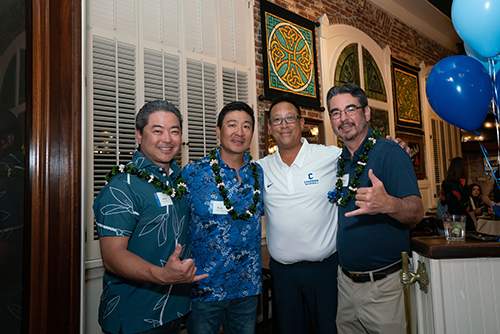
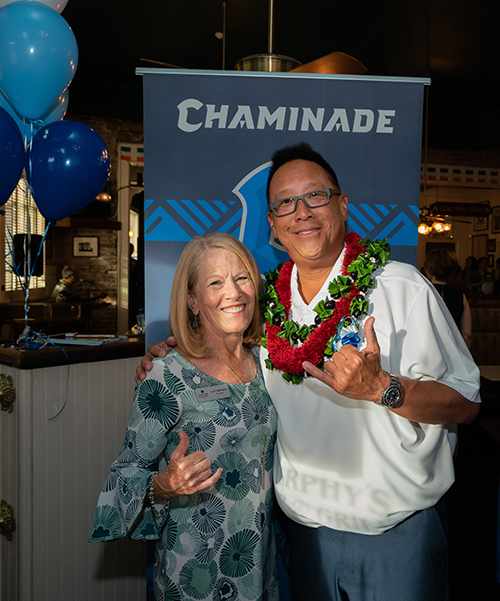
Chaminade President Dr. Lynn Babington and Baseball Head Coach Chad Konishi flash their shaka of approval.
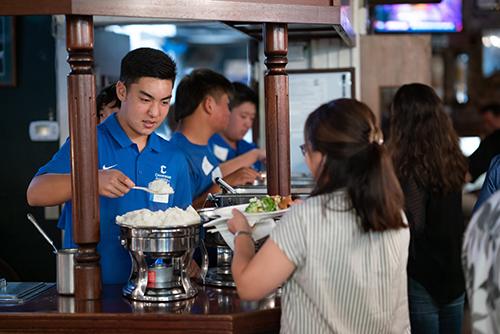
The evening featured a buffet of island favorites.
First Pitch attendees enjoyed the convivial atmosphere during a Silversword Baseball Program fundraiser at Murphy's Bar & Grill.
First Pitch attendees enjoyed the convivial atmosphere during a Silversword Baseball Program fundraiser at Murphy’s Bar & Gr

Konishi has extensive experience in collegiate baseball, serving as associate head coach at the University of Hawai’i Manoa from 2002 to ’13 where he was also the pitching coach and recruiting coordinator. During his 12-year career at Hawai’i, the Rainbow Warriors reached two NCAA Regionals (2006 and 2010) with a Western Athletic Conference title in 2011 while posting one 40-win season and eight 30-win campaigns. His pitching staffs were consistently near the top of WAC pitching statistics including posting the conference’s lowest ERAs in 2006 (3.79) and 2007 (3.97).

Since 2014, Konishi had been a high school athletics director, the past three at Saint Louis School, which shares the same campus as Chaminade. Prior to his time at Saint Louis, he headed the extremely successful athletics program at Saint Francis School in Manoa before the institution closed its doors in 2019. Both Saint Louis and Saint Francis won numerous Hawai’i High School Athletic Association state championships and Interscholastic League of Honolulu titles during his tenure as athletics director.

He is only the second head coach in program history, succeeding Leroy Goo who was Chaminade’s only baseball coach during the 1980 and ’81 seasons before the program was dropped.

“I am thrilled to join the Silverswords ‘ohana,” Konishi told the crowd. “Having a close working relationship with them while I was at Saint Louis I know how special this university is. I am very much looking forward to building the foundation of Chaminade baseball and to eventually become a force in the PacWest of a sport I am passionate about.”

Posted by: University Communications & Marketing Filed Under: Alumni, Athletics, Institutional Tagged With: Athletics, Baseball, Fundraiser

People, Planet and Prosperity

June 21, 2023

Three-day conference sharply focused on issues of sustainability

We can no longer use the NIMBY (not in my backyard) argument when it comes to advancing future projects. We’ve arrived at a hinge moment when solving our biggest problems—from environmental to social—means we need to start saying YIMBY, yes to some things: from solar panels and wind turbines to battery production and lithium extraction to universal basic income and food security. These are challenges for sure, but left unaddressed, the consequences could spell disaster, as discussed during a three-day conference sponsored by Chaminade University’s CIFAL Center of Honolulu.

On the final day of the People, Planet and Prosperity for a Sustainable Future symposium, Dr. Gail Grabowsky addressed the United Nations Institute for Training and Research’s  (UNITAR) Agenda 2030 for Sustainable Development and its corresponding 17 Sustainable Development Goals (SDG), which cover a vast range of subjects that impact all of us.

“I’ve been steeped in environmental studies for more than 25 years,” said Grabowsky, Chaminade’s Dean of the School of Natural Sciences & Mathematics and Executive Director of CIFAL Honolulu during her keynote address to attendees. “And a year and a half into establishing CIFAL Honolulu, we’ve brought sustainability into people’s consciousness. And we’ve sponsored more than 50 events.”

The CIFAL Global Network is composed of 32 International Training Centers for Authorities and Leaders, all coordinated by UNITAR’s Social Development Program. The strategic locations of the 32 centers, which can be found across Asia, Oceania, Africa, Europe, the Americas and the Caribbean, ensure a global outreach. Each CIFAL—a French acronym for Centre International de Formation des Autorités/Acteurs Locaux (International Training Centers for Local Authorities and Local Actors)—outpost provides innovative training and serves as a hub for the exchange of knowledge among government officials, the private sector and civil society. 

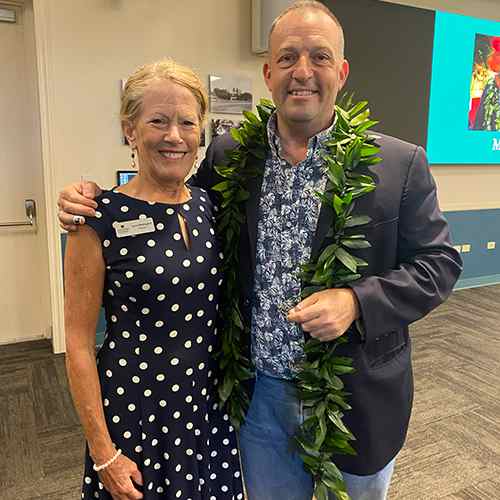
Chaminade President Dr. Lynn Babington with Hawaii Gov. Joshua Greene during the People, Planet and Prosperity Conference.
Chaminade President Dr. Lynn Babington with Hawaii Gov. Josh Green during the People, Planet and Prosperity Conference.

In his keynote address, Hawaii Gov. Josh Green pledged to generate billions of dollars from philanthropy and outside investment to make Hawaii the first state to become fully reliant on clean energy. It’s a familiar stance that Green has taken since he introduced a slew of major climate policy initiatives earlier this year, including a recommitment to the U.S. Climate Alliance and the establishment of a Climate Advisory Panel.

“We have so many people in this room, find a project that will help Hawaii, help us with health care, help us with the environment,” Green told attendees. “I will bring in investors from across the globe because they are interested in Hawaii, but we will still need to do the job.  Be ready. It should be a dynamic few years.”

The presentations indeed reflected this dynamicism, featuring such diverse topics as “Teaching the Importance of the Ocean to Fight Climate Change,” “The First Statewide Initiative to Connect All Public Universities to Advance PK-12 Climate Literacy, Justice and Action,” “Innovation and Sustainability: The Negative Impact of the Protectionist Leadership Style” and “Food Insecurity.”

“Being part of the UN, we bring awareness to sustainable issues, and train people to get involved and to act on sustainability,” Grabowsky said. “We support economic sustainability in the context of still maintaining an aesthetic environment.”

As the only CIFAL Center in the Pacific, the Chaminade campus is part of a region that includes China, Korea, the Philippines and Australia. The CIFAL Network focuses on topics within four thematic axes: Urban Governance and Planning, Economic Development, Social Inclusion and Environmental Sustainability. Each center is locally managed by a host institution, with UNITAR providing academic content, technical support and quality assurance measures for their training activities. This allows each CIFAL to prioritize action in specific thematic axes, depending on local needs and priorities.

“The basic lesson of the Sustainable Development Goals is that human hopes, human aspirations, human fears are all interconnected,” said United Nations Assistant Secretary-General and executive director for UNITAR, Nikhil Seth, during last November’s “XIX Steering Committee Meeting of The CIFAL Global Network at Chaminade.  “You can’t separate them and follow them in discreet ways. The SDGs are like an umbrella of issues and almost everything you can possibly think of are probably covered in the 17 SDGs.”

And that includes Grabowsky’s pet project, “Pono Popoki Project: Malama Management of Free-Roaming Felines.” “Cats can be good for people’s mental health, which is Goal 3 of the SDGs,” said Grabowsky, pointing to a colorful chart that depicts all the SDGs. “And it also teaches our students biology and wildlife conservation.”

Posted by: University Communications & Marketing Filed Under: Campus and Community, CIFAL Honolulu, Diversity and Inclusion, Featured Story, Homepage, Innovation, Institutional Tagged With: Campus Event, CIFAL, Guest Speakers

Dreams Come True

June 13, 2023

Faith Chang ’23 fulfills her lifetime dream

When she walks across the stage during the 65th Commencement, Faith Chang will have achieved one of her lifelong dreams: to earn a bachelor’s degree in Business Administration. For the newly minted alumna, the four-year Chaminade experience has only strengthened and bolstered her beliefs in community service and religious faith.

“I’ve always believed in helping the community ever since I was a kid,” says Chang, the 2023 recipient of the Hogan Entrepreneurial Leadership Program’s Aloha Spirit Award. “During my freshman year, I participated in a Service Learning opportunity at Kaimuki High School, where I helped high-school students with any of their class projects.”

Having the opportunity to intern while still studying affords college students a chance to build a professional network with industry leaders, and to hone their skills before entering the workforce. Internships also allow the intern to figure out one’s true passion.

For Chang, this meant following a path to seek a position with a nonprofit group, which could utilize what she learned at Chaminade and what she experienced as an intern with Make-A-Wish Hawai‘i.

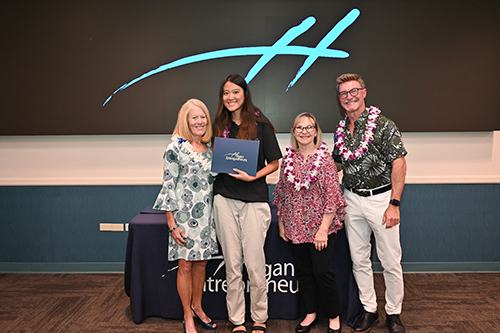
Chaminade President Dr. Lynn Babington, left, and Christine and Glenn Hogan congratulate Faith Chang for her 2023 Hogan Entrepreneurial Program’s Aloha Spirt Award.
Chaminade President Dr. Lynn Babington, left, and Christine and Glenn Hogan congratulate Faith Chang for her 2023 Hogan Entrepreneurial Program’s Aloha Spirit Award.

“Faith was also an intern with Chaminade University’s Economics Education Center for Excellence (EECE) from 2021-2022,” says EECE director and associate professor, Dr. Guanlin Gao. “During her time there, she identified and adapted over 50 lesson plans in economics, personal finance and Hawaiian history for K-12 teachers. In addition, she presented her lesson plans and shared the resource pool she built with over 30 local public school teachers at the EECE 2022 Summer Workshop, which benefited the teachers and ultimately the next generation.”

During her stint with Make-A-Wish Hawai‘i, Chang interned with the Finance and Operations department, where her financial responsibilities included processing donations and payments, paying vendors, ensuring the monthly financial statements are accurate, and preparing for the annual budget, financial audit and Form 990.

“We rely a lot on our interns,” says Shari Young, Make-A-Wish Hawai‘i’s Director of Finance, who supervised Chang during her internship. “Faith had all the qualifications that we require of our interns, including being an active community member, a willingness to grow and learn, and she possessed the heart for our mission.”

A survey by the National Association of Colleges and Employers indicates that the starting salary for college graduates who completed an internship and were employed in a private, for-profit company was $53,521, while those who didn’t complete an internship started with an average of only $38,572. The same study found that 72.2 percent of college graduates with internship experience got a job offer, in contrast to 36.5 percent for those who didn’t complete one. These numbers indicate that pursuing an internship during your college years can add a competitive edge on the side students, increasing their opportunity to get a well-paying job after graduation.

The same held true across industry sectors—nonprofit ($41,876 vs. $31,443), state/local government ($42,693 vs. $32,969), and federal government sectors ($48,750 vs. $42,501).

“I sought the internship to enhance my resume, and gain a better understanding of nonprofit finance operations and expenses,” says Chang who won this year’s Hogan Entrepreneurial Program’s Aloha Spirit Award, which is given to a student who best embodies the spirit of the program. “Another takeaway from this internship was the reward of working with a nonprofit organization, like Make-A-Wish Hawai‘i, which is dedicated to the community, granting wishes and providing little girls and boys a lifetime of joy during a trying stage in their lives.

“I remember this one girl’s wish was to have a playground built in her backyard,” Chang recounts. “And when it was time for the reveal, her reaction and joy made me cry. And I immediately sent the video to my parents. It was just so heartwarming.”

With her expanded skill set, Gao predicts that Chang will continue her journey of making a real-world difference. “She is involved in so many community projects, including Chaminade’s Compassionate Cat Counting project, ‘Inana sustainability program, Earth Day thrift sale, as well as her church service at the Inspire Church conference,” Gao adds. “She has raised funds to sponsor children in Guatemala, as her passion is to make a real-world difference and give back to the community.”

Posted by: University Communications & Marketing Filed Under: Business & Communication, Campus and Community, Catholic, Hogan Entrepreneurial Program, Homepage, Institutional Tagged With: Business Administration, Hogan Entrepreneurs Program, Honors and Awards

Land-based Pedagogical Approach

June 13, 2023

Associate Professor of Arts and Design Junghwa Suh, D.Arch, is throwing caution to the wind and subverting the dominant paradigm. Ever since she took an ʻāina-based education workshop conducted by Cultural Engagement Specialist, Kahoalii Keahi-Wood, the Arts Program Coordinator has questioned her pedagogical style, drawing into particular focus her epistemology of interior design and the entire academic process.

“I was inspired by his teaching,” said Suh of Keahi-Wood. “His workshops were free-flowing and discussions came naturally, especially about respect of place and the ʻāina.”

In collaboration with then-visiting University of Maryland architecture professor, Ming Hu, Suh helped develop a new course themed, “ʻĀina-based Design Solution for Indigenous Communities in Hawaii.” The goal of the new course is to propose, test and validate an integrated ʻāina-based design approach that is intended to serve indigenous communities in Hawai‘i.

“The traditional pedagogical approach is process- and goal-oriented, meaning the structure of a course is linear—going from Point A to Point B,” Suh explained. “And because design education is very structured in the process, we sometimes lose the sight of meaning. Yes, content needs to be delivered, but it needs to be delivered meaningfully and beyond a set of skills.”

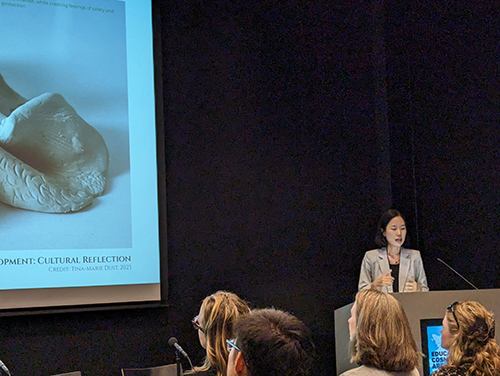
Associate Professor of Arts and Design Junghwa Suh, D.Arch presented her new course, "Āina-based Design Solution for Indigenous Communities in Hawaii," at the Association of Collegiate Schools of Architecture (ACSA) and the European Association for Architectural Education (EAAE) Conference in Reykjavik, Iceland.
Associate Professor of Arts and Design Junghwa Suh, D.Arch presented her new course, “Āina-based Design Solution for Indigenous Communities in Hawaii,” at the Association of Collegiate Schools of Architecture (ACSA) and the European Association for Architectural Education (EAAE) Conference in Reykjavik, Iceland.

While teaching the Studio Commercial course for seniors’ capstone Environmental + Interior Design project, Hu tasked the students to come up with a design to restore the Maunalua Fishpond Heritage Center in East Oahu, keeping true to the natural elements of the environs. Students had to understand the importance of the Center’s Kānewai Spring, which is “where the mountain gives birth to the ocean.” They also had to take into account the many cultural sites surrounding the spring, including the mākāhā (fishpond sluice gate) and kū‘ula (fishing stone shrine) with an upright Kū stone balanced by a low Hina stone where the fishermen of old would have given offerings asking for a plentiful catch.

“In the client briefing, we learned that the Center is dedicated towards passing down the Hawaiian culture to the next generation through education sessions and volunteer opportunities,” said newly-minted graduate, Maria Bernaldez ’23, who presented her design concept to leaders at the Center. “With that in mind, I implemented traditional Hawaiian hale aspects, keeping open entrances with no doors in places for public accessibility and wood slat ceiling and beams to imitate exposed wooden rafters and roofing made of coconut thatching.”

For her Materiality Interior Design Studio course, Suh assigned sophomores the project of re-conceptualizing the space at The Institute for Human Services’ Women’s & Family Shelter, giving the dormitory areas a more welcoming, inviting design, while mindful of the context and the community.

“They got to know the space, especially the sleeping areas,” Suh said. “I appreciated their research into understanding people, and learning how textural and tactile elements interact with the environment in this particular setting.”

The project spawned a discussion among Suh, Hu and E + ID program coordinator Matthew Higgins, and eventually evolved into an innovative research project that will be presented at the Association of Collegiate Schools of Architecture (ACSA) and the European Association for Architectural Education (EAAE) Conference on June 22-24, in Reykjavik, Iceland.

Titled, ‘Āina-based Design of Emergency and Homeless Shelters for Indigenous Communities, the project’s premise is to address the need for a novel design approach and socially-rich data on native Hawai‘i housing to guide future projects, and to avoid mistakes of the past. According to the abstract, the project tests two design principles that have been overlooked in the development of emergency housing initiatives: the integration of Hawaiian values with respect to the land (ʻāina) and people; and community engagement to generate solutions that are informed by local need.

“The beauty of being in an education environment is that it allows you to explore the meaning of an ʻāina-based design,” Suh said. “You get to know the actual place and not just the physical structure on the property. It’s placing the land in a historical and cultural context, and learning its significance; the overall approach to the design is dictated by the ʻāina and not the place.”

Posted by: University Communications & Marketing Filed Under: CIFAL Honolulu, Diversity and Inclusion, Featured Story, Humanities, Arts & Design, Innovation, Institutional Tagged With: Center for Innovation and Strategy, Environmental + Interior Design, Research

Summer Research Opportunities

June 13, 2023

La‘a Gamiao ’25 hopes to get a head start on his master’s degree at Purdue University, where he wants to eventually pursue a doctorate in ecology. His first step toward this goal was to accept an eight-week, Undergraduate Summer Research Program at Purdue’s flagship campus in West Lafayette, Indiana.

Laa Gamiao is participating in a research program at Purdue.
La’a Gamiao was accepted accepted to an eight-week, Undergraduate Summer Research Program at Purdue’s flagship campus in West Lafayette, Indiana.

“I leave on June 2 and I have orientation on June 4,” said Gamiao, who will be among the five student-research participants from across the country. “I’ll be conducting research on Aquatic Ecology, studying predator-and-prey interactions in response to chemicals.”

Gamiao is among a group of Chaminade students who have been able to kick-start their graduate studies, thanks to agreements between Chaminade University and fellow esteemed institutions of higher education.

“Chaminade is a member of The Leadership Alliance, a consortium of 32 academic institutions dedicated to addressing the shortage of diversity in graduate schools and academia,” said Amber Noguchi, Ph.D., Chaminade’s Program Director with the Undergraduate Research & Pre-Professional Programs. “Through the program, we’ve built partnerships with universities that want to admit our students into their summer research programs.”

In the past, Chaminade students have participated in programs at Harvard, Yale, Purdue and UCLA—to name just a few. This early exposure to research is invaluable and greatly enhances a student’s graduate school application, particularly for medical schools.

This summer, Alexandra Boyce and Kaila Frank will both participate in Michigan State University’s Summer Research Opportunities Program (SROP). According to the MSU website, the SROP is a gateway to graduate education at Big Ten Academic Alliance universities. The goal of the program is to increase the number of underrepresented students who pursue graduate study and research careers. SROP also helps prepare undergraduates for graduate study through intensive research experiences with faculty mentors and enrichment activities. Boyce and Frank also plan to take short courses in various subjects prior to the start of the research portion of the program.

“We also have at least one student, Tia Skaggs, who will be participating in the Cancer Research Experience for Undergraduates (CREU) program at the University of Colorado Anschutz,” Noguchi said. “This program is focused on projects related to cancer, whereas Purdue and MSU offer a wide range of disciplines and faculty expertise.”

Amber Noguchi, Chaminade’s Program Director with the Undergraduate Research & Pre-Professional Programs, encourages students to participate in summer research programs at various universities.

CREU’s primary goal is to engage scientific curiosity in the next generation of scientists, challenging qualified college undergraduates to consider a cancer-related career in the future. Only 23 college undergraduate students have been selected to spend 10 weeks in the University of Colorado Anschutz Medical Campus’ laboratories.

“Our office encourages students to apply for experiential opportunities like summer research both here at Chaminade and at other institutions,” Noguchi said. “We also encourage our pre-health students to apply for clinical experiences and also pre-health enrichment programs.”

This summer, two pre-health juniors were accepted to the Summer Health Professions Education Program: Joshua Dumas ’24, a pre-med student, who will be attending the UCLA program; and Alexis Martinez ’24, an aspiring dentist, who has a choice between UCLA and Western University of Health Sciences.

To expose students to clinical experience, Chaminade works with the COPE Health Scholars Program at Adventist Castle. Through COPE, students are able to gain 280 clinical hours by volunteering in various departments at the hospital. Students enrolled in healthcare programs require these hours to demonstrate that they understand the field they plan to pursue, and it also helps them be competitive applicants when they actually apply.

“Many Chaminade students—who have pursued health careers in medicine, dentistry, physical therapy, nursing and others—have participated in COPE,” Noguchi said. “We currently have Kelsey Nakagawa ’23, a nursing major, who started the program last year, and has risen to a leadership position there. We also have Kobe Young ’23, a recent Biochemistry graduate, who will be starting this summer.”

Posted by: University Communications & Marketing Filed Under: CIFAL Honolulu, Diversity and Inclusion, Institutional, Natural Sciences & Mathematics, Nursing & Health Professions, Undergraduate Research & Pre-Professional Programs Tagged With: Office of Health Professions Advising and Undergraduate Research, Research, Undergraduate Research & Pre-Professional Program

  • « Go to Previous Page
  • Page 1
  • Interim pages omitted …
  • Page 15
  • Page 16
  • Page 17
  • Page 18
  • Page 19
  • Interim pages omitted …
  • Page 35
  • Go to Next Page »

Footer

Chaminade University Logo

3140 Waialae Avenue
Honolulu, Hawaii 96816

Contact Us
Phone: (808) 735-4711
Toll-free: (800) 735-3733

facebook twitter instagram youtube linkedin

Visit

  • Plan Your Visit
  • Campus Map (PDF)
  • Events

Resources

  • Campus Security
  • Student Consumer Information
  • Concerns, Feedback, and Reporting
  • Institutional Review Board
  • Title IX / Nondiscrimination Policy
  • Compliance
  • Emergency Information
  • Careers
  • Institutional Statement

People

  • Students
  • Parents
  • Alumni
  • Faculty & Staff

Policy

  • Privacy Policy
  • Terms and Conditions of Use


© Chaminade University of Honolulu