• Skip to primary navigation
  • Skip to main content
  • Skip to footer
Chaminade University of Honolulu

Chaminade University of Honolulu

  • VISIT
  • APPLY
  • GIVE
  • STUDENTS
  • PARENTS
  • ALUMNI
  • FACULTY/STAFF
  • Admissions
    • Admissions Home
    • Undergraduate Students
      • First-Year Students
      • Transfer Students
      • Admitted Students
    • Graduate Students
    • Flex Online Undergraduate Program
    • Military Students
    • Non-Degree/Visiting Students
    • Experiential Honors Program
    • Early College Program
    • New Student Orientation
  • Tuition & Aid
    • Financial Aid Home
    • Tuition & Expenses
    • Federal Updates & Changes
    • Scholarships
    • $5,000 Graduate Scholarship
    • VA Education Benefits
    • Net Price Calculator
  • Academics
    • Academics Home
    • Academic Programs
    • Office of Student Success
      • Academic Advising
      • Records and Registrar
    • Kōkua ʻIke (Support Services)
      • ADA Accommodations
      • Career Services
      • Proctoring Services
      • Tutoring Services
    • Sullivan Family Library
    • Undergraduate Research & Pre-Professional Programs
    • Commencement
  • Campus Life
    • About Campus Life
    • Student Engagement
    • Student Government Association
    • Residence Life and Housing
      • Summer Conference Housing
    • Health Services
    • Marianist Leadership Center
    • Counseling Center
    • Campus Ministry
    • Campus Security
    • Dining Services
    • Bookstore
  • Athletics
  • About
    • Chaminade University News
    • Our Story
    • Leadership
    • Chaminade University Strategic Plan 2024-2030
    • Mission & Rector
    • Association of Marianist Universities
    • Facts & Rankings
    • CIFAL Honolulu
    • Accreditation & Memberships
    • Montessori Laboratory School
Search
×

Search this web site

Humanities, Arts & Design

Designing While Quarantined

May 29, 2020

Over 15 Chaminade alumni attended a virtual event on Saturday, May 16 to gain insider tips for updating their space during stay-at-home orders. The event, Designing Your Space, was hosted by Alumni Relations and featured a panel of four Environmental + Interior Design graduates who shared tricks for updating, organizing and styling home spaces.

Chaminade alumni attended a virtual event to gain insider tips for updating their space during stay-at-home orders

With so many people obeying stay-at-home orders and spending more time in their homes, Nicolle Soriano ‘18, junior interior designer at WCIT Architecture, offered ways to maximize space and feel less confined. Some tips included using furniture to section off spaces, measuring areas to ensure the furniture you use fits appropriately, using neutral colors to make spaces feel more open and using shelving for storage and artwork.

Many people are also finding themselves suddenly working from home. Catherine Valentine ‘18, project designer at Philpots Interiors, offered tips for designing a workspace when you don’t have a home office. The first step is to find a place away from your bedroom, kitchen or typical relaxing area—when you finish work for the day, you don’t want to be reminded of it while you’re cooking, relaxing, trying to sleep or playing with the kids. She also mentioned that lighting and air ventilation can make a big difference in productivity. Ultimately, pay attention to what your work station is like in your office at work and in places where you do your best work, and try to replicate that setup at home.

There are also ways to mitigate noises while you’re trying to work from home. Gerlie Valdez ’17, senior designer at Pyramid Premier Properties, offered both short-term and long-term solutions. If you’re looking for a short-term fix, consider using fabrics and rugs to help reduce noise transmission. You can look for fabrics that have a sound transmission class (STC) rating, or you can simply use fabrics that have double layers, like burlap or velvet. Even blackout curtains help absorb noise. If you’re looking for a more long-term solution, consider adding mass loaded vinyl (MLV) under your carpet, or using decorative acoustic panels on your walls.

It’s also important to consider color. According to Marisa Saito ’17, junior interior designer at AHL, colors can dictate your mood so choose the right colors for the right space. For example, use brighter colors like reds, oranges and yellows to bring in more life and energy. Use blues and greens to create a calm or serene feel. Also, pay attention to color intensity—more vibrant colors can often be distracting and too intense. The best thing to do is to analyze how you want a space to make you feel, and then plan accordingly.

Other tips that the panel shared included:

  • Spend the bulk of your budget on a statement piece—something to draw your eye that you’re proud of and that brings you joy. You’ll get more bang for your buck and it will help make your space more personal.
  • If you’re on a limited budget, consider using things like accent paint, plants, hanging artwork and accessories to bring a space together and make it your own.
  • If you own your home, consider how long you plan to live in it before undergoing a complete remodel. While you want your home to be personal, you also want to maintain its resale value.
  • If you rent your home, work with what you have, and not against it. It’s important to choose the right furniture to fit your space, and you can do small things like change light fixtures or curtain rods, cover floors with rugs and hang artwork to bring it all together.
  • Create separate spaces within your home by decluttering and using a rug to highlight an area, plants to separate places, and accent walls to define spaces.
  • Consider scale and room size before decorating. If you’re working with a small space, avoid bulkier pieces to ensure you have ample space to walk and move around. If you’re working with a larger area, use taller, elongating pieces to maximize space.
  • Don’t forget about the outdoor areas. Utilize your outdoor space and bring the outdoors in with plants and images of nature.

Ultimately, it’s about making your home personal and creating something that you can feel proud of and feel comfortable in. With so many of us staying home, now is as good a time as any to finally turn your house into a home!

Posted by: University Communications & Marketing Filed Under: Alumni, Campus and Community, Featured Story, Humanities, Arts & Design Tagged With: Environmental + Interior Design

Serving Through Science

May 21, 2020

Sometimes, plans change. Sometimes, you enter college knowing exactly what you want to be when you grow up—and then you leave on a completely different track.

Jerlisa Arizala '04

At least that’s what happened to Jerlisa Arizala ‘04.

The Saipan native had always had her eyes on becoming a pediatrician.

Her first step was to get into a good university. But Saipan is fairly isolated, and her parents didn’t want her to travel too far.

Chaminade offered the perfect balance—a high-quality education that was relatively close to home, and an island lifestyle similar to the one she was used to. When she visited, she fell in love with the atmosphere. She felt the academic presence, but knew it would be a place where the community would support her and offer help if she needed it. She also really liked the diversity she saw on campus.

And her experience did not disappoint.

“My college experience was one of the best experiences of my life,” says Arizala. “I think Chaminade was the perfect place to feel comfortable being yourself because it was such a big melting pot. Everyone was so different and had an interesting background. It felt like everyone was accepted.”

One of the things that struck her right away was the diversity. For the first time, she realized just how many ways there were to be an American.

“It stood out so much to me that there were a lot of students from other U.S. Territories who were also American,” she remembers. “It was really nice to see all of the different definitions of American in one place. It wasn’t what a typical mainland experience would have been like.“

She started Chaminade as a biology major on the pre-med track. That’s how she met biology professor Ron Iwamoto. Not only was he her advisor, but he also taught a few of her classes. He noticed right away that she had a talent for writing.

“As my professor, he was able to look at my strengths and communicate what those were to me,” recalls Arizala. “He told me I was a good writer, and I should pursue some sort of writing career. And he told me I could do that within academia.”

It was through his guidance that she was inspired to pursue research instead of medical school. She also decided to add on an English minor. It provided a nice balance to the heavy biology classes, and it helped her develop her writing skills.

When she graduated in 2004, she went on to earn an M.S. in Biological Science from California State University Los Angeles, and a Ph.D. in molecular biology and virology from the City of Hope.

Sometimes she still thinks about becoming a pediatrician, but she never follows through because she really likes where her path has led her. She’s found that her ultimate goal was always to help people, and she can do that through research.

“I’ve learned so much about how to help people,” she says. “I have no regrets about the track I took. I know there are groups that need help, and I can help them through science.”

Arizala is a cell biologist at Kite Pharma, a subsidiary company of Gilead Sciences, Inc., and couldn’t be happier. The research coming out of Gilead represents everything she stands for—she loves how they want to give to the community and make sure everyone has access to drugs they need. Gilead Sciences is known for its antiviral drugs used to treat HIV. They have also made the news lately for their promising COVID-19 treatment that is currently undergoing clinical trials, Remdesivir.

Arizala’s expertise lies in reengineering T cells, a type of lymphocyte, or white blood cell, to attack and kill cancer cells. It’s a developing treatment for certain types of lymphomas and leukemias, and her company was responsible for the first T cell lymphoma treatment product to be approved and released on the market.

Her work is something she holds very dear to her heart. It’s a source of pride, and she finds it very rewarding. “Working for Kite Pharma is a great way to make a direct impact on a cancer patient’s life,” she says. “I help them have a better quality of life by allowing them to live longer and eradicate their cancer.”

Arizala credits both Iwamoto and Chaminade for the impact she’s had on others. If it weren’t for Iwamoto’s guidance, her educational path would have been very different.

In fact, their relationship came full circle right around 2012 or 2013. She was finishing up her Ph.D. at City of Hope, a world-class cancer hospital in Los Angeles. He was there as a lymphoma patient, receiving a transplant.

“We had dinner together and he met my husband,” she recalls. “It was the last time I saw him in person.”

Though they are in different states now, she still keeps in touch with her professor—he sends her updates of his grandchildren, and she sends him updates about her children. He’s also served as a reference, and helped her get into graduate school and get her first job.

Her time at Chaminade not only fostered her passion for science, but it also taught her to recognize her strengths and embrace who she is.

“Going to a school that was very warm and friendly taught me to be that way with others,” says Arizala. “It taught me to be genuine and to keep my morals.”

As a female and as a minority in the sciences, that has come in handy. She recognizes the responsibility she has in paving the way for others and has been able to stay true to herself and always represent where she is from.

“Chaminade prepared me to be a role model,” says Arizala. “Not only in building my passion in science, but also by building my character.”

Posted by: University Communications & Marketing Filed Under: Alumni, Diversity and Inclusion, Featured Story, Humanities, Arts & Design, Natural Sciences & Mathematics Tagged With: Biology, English

Mentorship Goes Beyond Graduation

May 19, 2020

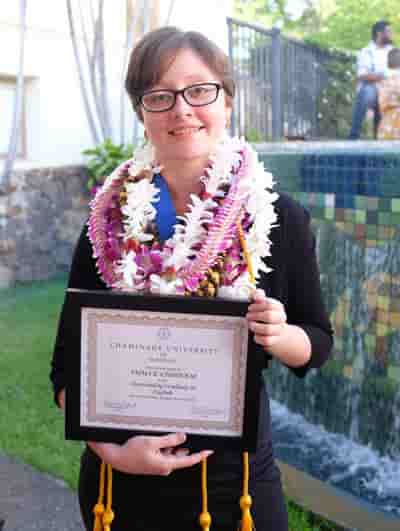
Emma Chisholm never thought she’d be one to go to college. It was such a large initial investment and higher education comes with a lot of bells and whistles. For the public school graduate, it was hard to justify the cost.

Emma Chisholm graduating from Chaminade

So when she graduated from Chaminade University in 2019, thanks to the help of scholarships, it was a big moment. But it was also a scary moment.

“I had no idea who I was and what I actually wanted,” says Chisholm. “I knew what I enjoyed, but I didn’t know who I wanted to be.”

Like so many new graduates, Emma suddenly felt the whole world open up. “The truth is, the road is all over the place and you can go in any direction.”

Chisholm has always had a passion for writing. Upon graduating, the English major did a short stint teaching English online before taking on a few freelance writing jobs. And when she did, it was as though something clicked inside.

“When they decided to hire me, I was extremely happy,” describes Chisholm. “I was thrilled at the prospect of writing professionally. It would be a job where I could call myself a writer.”

Although she didn’t have a clear cut path after graduating, Chisholm took solace in the fact that she found strong mentors in her Chaminade professors.

She initially established a connection with Dr. Allison Paynter after taking one of her classes. She recognized a shared analytical mindset and a sense of enjoyment for reading. She shared the same mindset with other professors as well, but there was something about Dr. Paynter that kept her coming back.

Emma Chisholm

“She thought more about me,” says Chisholm. “It seemed as though there was a developing relationship between us where we could talk easily about our interests and build on that, but she also pays attention to me. She heard me, and she saw me.”

And the feeling was mutual. Dr. Paynter saw a talent in Chisholm that she was excited to help her explore.

“I had told her during the Honors Ceremony at graduation to stay in touch,” says Paynter. “And she was one of those students who actually took me at my word. For probably close to a year I would meet with her every few months.”

The two spoke frequently about Chisholm’s future goal and next steps, and Dr. Paynter’s guidance helped lead Chisholm to explore graduate schools.

“I had a friend at the time who had just gotten her Masters in Fine Arts in poetry,” says Dr. Paynter. “I wanted to share that with Emma to see if that was something that would interest her. We started looking at New York University publishing programs, and in the process Mills College in California started to appeal to her.”

It was partly the location that attracted her. “I don’t feel like I see myself in a state like New York,” says Chisholm. “I’m more in tune with the atmosphere in California. Ultimately, I’m looking for a place where I can establish myself with a career.”

Chisholm has since been accepted to both the MFA in creative writing program at Mills College and the MFA program at the University of San Francisco for this fall and is deciding between the two. She plans to continue freelance writing on the side while pursuing her degree.

Posted by: University Communications & Marketing Filed Under: Alumni, Faculty, Featured Story, Humanities, Arts & Design Tagged With: English

From Soldier to Teacher

May 13, 2020

What do you do when a 20-year military career comes to an end?

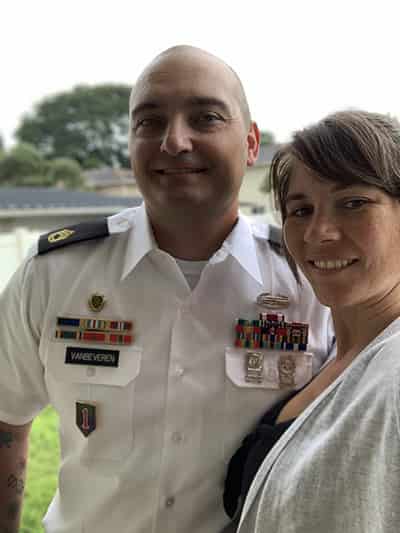
For soon-to-be-retired soldier Kristopher Van Beveren ‘20, the answer is easy—you teach.

Kristopher Van Beveren '20 with his wife

For the first part of Van Beveren’s Army career, he served as a cavalry scout—the eyes and ears of the Army, gathering information on the enemy during battle. Over the course of his career he switched to corrections, working in the military prisons. But his real passion was always teaching.

When he first encountered Chaminade University at the on-base education center in 2005, he had just arrived at Schofield Barracks fresh off a deployment to Iraq. Van Beveren liked that Chaminade was a local school, and he could take classes on base in the evenings. With our presence on base, soldiers can take a combination of on-base and online classes to work toward a bachelor’s degree.

He enrolled as a secondary education major, but his time on-island was short-lived before deploying again to Iraq.

Fast forward to 2017. He returned to Hawai‘i, this time with a wife and young children to support. With his 20-year Army anniversary on the horizon and thoughts of retirement looming, he re-enrolled in Chaminade’s program.

He started again in the secondary education program, but soon he switched to a major in historical and political studies. He had his eye set on teaching high school—the time in his life when teachers were the most influential. Switching majors, he realized, would help him pass the single subject exam for social studies—or, depending on which state he and his family ended up in, would wipe out the extra requirement altogether.

Like most active-duty students, his time at Chaminade was a combination of online and on-base classes. In the beginning, he took classes on base in the evening. The timing provided the flexibility he needed to work full time, and it was easier for him to learn in person.

“I would recommend the evening classes to any of my fellow soldier counterparts,” says Van Beveren. “The professors are really accommodating because they have jobs as well. They don’t severely overload you, but they get enough in to make it challenging.”

Kristopher Van Beveren '20 with his children

Toward the end, evening classes became difficult while raising his family, so he switched to online classes.

“You definitely have to be more disciplined to get it all done online,” confesses Van Beveren. “But I’ve had a really good experience. If you’re self-motivated, online is a great avenue because you can do it all at your own pace. Sometimes the professors will post the whole course online upfront, so if you wanted, you could knock it out in three weeks instead of ten.”

It helped having supportive professors who were adept at teaching online. Dr. Mitch Yamasaki, a history professor, was one who particularly stood out. “I have to say that he is one of the best online professors I have had,” says Van Beveren, commenting on the amount of thought and detail that goes into Yamasaki’s lectures and study guides. “His courses are very thorough and very well put together. I have retained a lot of knowledge by the way the information is presented.”

It’s an emotional time for Van Beveren. He graduates next month, something he’s wanted for a long time.

“I put it off for years because of deployments and training and Army life,” he reminisces. “It was a challenge being a full-time student while having a full-time job, and a family with two young kids, but it was doable. And it feels great to be finishing.”

He’s also retiring from his 20-year Army career and getting ready to leave the island. And as if preparing to finish his degree and transitioning to civilian life wasn’t enough, there’s a global pandemic. One that sent his wife and children to their new home in Florida early, before the widespread lockdowns, and one that means he won’t be able to attend his newly rescheduled graduation ceremony in December. But he knows the move and the transition are the right thing to do.

“Twenty years is a long time,” says Van Beveren about his decision to retire. “But I’m still relatively young and my kids are still small right now. I’m excited to focus on them more.”

Not one to sit idle, Van Beveren already has his next step lined up. He starts a Master’s program at the University of North Florida the day his online classes end next month. He’s joining their Teacher Residency program, where he’ll work in the classroom at a high-needs school and earn his Master of Arts in Teaching at the same time.

He has his eye on the prize—not only will he have a new, rewarding career, but in a few years, he’ll have his summers off. His wife, also a teacher, will too. And for Van Beveren, the thing that matters most is getting to spend more time with his family and being there for his children.

Posted by: University Communications & Marketing Filed Under: Featured Story, Humanities, Arts & Design, Students Tagged With: Historical and Political Studies, Online Undergraduate Program

Continuous Learning in Humanities

May 4, 2020

When Dr. Allison Paynter received the call for one-minute plays from the Dramatists Guild, she immediately got to work. The Chaminade English professor had only a few days to write a microplay consisting of no more than 150 words about the novel coronavirus. If selected, her play would become part of The Coronavirus Plays: A Project Created by the One-Minute Play Festival, America’s largest and longest running grassroots theater company.

Allison Paynter

She was sitting in her office with an older performance poster from Willy Wonka and the Chocolate Factory on her wall when the email came through. “It was the first play my son was in,” says Dr. Paynter. “He played Charlie.” The poster provided the perfect inspiration.

Dr. Paynter’s dark comedy emerged to tell the story of two individuals in the time of coronavirus who meet on a street corner. One is carrying a packet of toilet paper, and when the other tries to grab it, a golden ticket falls out—a ticket for a free trip to South Korea and a stay in a luxury hotel, complete with a bidet.

Her play was selected to be part of the festival that aired on Zoom from April 8-17. “Since I’m a new playwright, I wasn’t certain if I could turn something around so quickly and make it accessible,” says Dr. Paynter. “I was very proud that I was able to be part of this collection.”

Dr. Paynter also wrote a play last summer that was scheduled to be performed at Chaminade in April, but it was cancelled due to COVID-19 restrictions. This summer, she will spend a month participating remotely in a New York University fellowship through the Faculty Resource Network, where she plans to write her first musical.

“I’m a continuous learner,” says Dr. Paynter. “It’s such a joyful process to continue lifelong learning.”

She has that in common with her colleague, Dr. Richard Hill. The associate professor of English at Chaminade University was recently published in the journal Humanities.

Richard Hill

“Research and publishing is just something that I really enjoy and have been quite lucky with,” says Dr. Hill. “I am in a small field and it’s really rich to be able to research and do things people have never done before.”

For his recent publication, “From Braemar to Hollywood: The American Appropriation of Robert Louis Stevenson’s Pirates,” he partnered with Dr. Laura Eidam from University of Virginia to explore how today’s popular culture pirate tropes can be traced back to Robert Louis Stevenson’s 1883 novel, Treasure Island.

“I look at stereotypes and try to trace them back to their source,” says Dr. Hill. “Stereotypes get created through literature, and then that literature gets forgotten and you’re left with the stereotype.” His current research explores how illustrations get turned into movies—specifically, how Stevenson’s illustrations get used to create film images.

For Dr. Hill, this historical lens on literature has been a valuable teaching tool. He enjoys taking common perceptions that his students have and tracing them back to historical literary depictions. “I’m lucky that I get to teach some of what I research, and they both feed into each other,” says Dr. Hill “I can bring [my students] through what they know and back into what I teach them.”
His new project is one that is sure to resonate with his students—it explores how the modern day Incredible Hulk is based on Stevenson’s 1886 novel, Strange Case of Dr. Jekyll and Mr. Hyde.

Posted by: University Communications & Marketing Filed Under: Faculty, Featured Story, Humanities, Arts & Design

Green Roofs & Living Walls

April 27, 2020

Environmental+Interior Design students participate in service-learning project: green roof and living walls

Lots of times, designers create spaces for working and for living that cut us off from nature.

But an exciting initiative underway at Chaminade is aimed at challenging Environmental + Interior Design students to do the opposite by working to model and construct green roofs and living walls.

It’s all part of Chaminade’s Sustainability in Design course, which is aimed at helping students unpack principles of sustainable design by focusing on key environmental issues and then considering how they relate to other areas of society, including economic inequities and social disparities. The idea: Think through how relatively simple environmentally friendly design changes can have a positive impact.

Environmental+Interior Design students participate in service-learning project: green roof and living walls

That’s where green roofs and living walls come in.

For several years, students in the class have participated in a field project in partnership with the University of Hawaii at Manoa’s College of Tropical Agriculture to install the design elements — along the way exploring the potential benefits of adding more greenery to urban landscapes.

In participating in the hands-on project, students learn first-hand how sustainable design can make a significant difference to city life. Green roofs and living walls can cool buildings, be sources of food, offer aesthetic appeal and can improve air and water quality. They can also provide a much-needed space for recreation or reflection — or even for gathering people together to try their hand at gardening.

Environmental+Interior Design students participate in service-learning project: green roof and living walls

Chaminade Environmental Science major Hiilani Fujihara-Nagamine ‘21 participated in the service learning project and said the class learned all about green roofs and living walls before actually working on them in person. “I can see a future in having these two concepts come to life here in Hawaii,” she said. “The islands seem to be the ideal place for green roofs and living walls due to the wonderful weather all year round. Native plants could be planted to increase the native plant population.”

She said her favorite part of the effort was learning about an actual solution — something tangible designers and environmentalists and even regular people could do to make a positive difference. “I want to make sure that the Earth is still around for the next generations to come,” she said.

“This experience will help me find more solutions that can help solve the problems in this world.”

Posted by: University Communications & Marketing Filed Under: Featured Story, Humanities, Arts & Design, Students Tagged With: Environmental + Interior Design, Service Learning

  • « Go to Previous Page
  • Page 1
  • Interim pages omitted …
  • Page 6
  • Page 7
  • Page 8
  • Page 9
  • Page 10
  • Interim pages omitted …
  • Page 15
  • Go to Next Page »

Footer

Chaminade University Logo

3140 Waialae Avenue
Honolulu, Hawaii 96816

Contact Us
Phone: (808) 735-4711
Toll-free: (800) 735-3733

facebook twitter instagram youtube linkedin

Visit

  • Plan Your Visit
  • Campus Map (PDF)
  • Events

Resources

  • Campus Security
  • Student Consumer Information
  • Concerns, Feedback, and Reporting
  • Institutional Review Board
  • Title IX / Nondiscrimination Policy
  • Compliance
  • Emergency Information
  • Careers
  • Institutional Statement

People

  • Students
  • Parents
  • Alumni
  • Faculty & Staff

Policy

  • Privacy Policy
  • Terms and Conditions of Use


© Chaminade University of Honolulu