• Skip to primary navigation
  • Skip to main content
  • Skip to footer
Chaminade University of Honolulu

Chaminade University of Honolulu

  • VISIT
  • APPLY
  • GIVE
  • STUDENTS
  • PARENTS
  • ALUMNI
  • FACULTY/STAFF
  • Admissions
    • Admissions Home
    • Undergraduate Students
      • First-Year Students
      • Transfer Students
      • Admitted Students
    • Graduate Students
    • Flex Online Undergraduate Program
    • Military Students
    • Non-Degree/Visiting Students
    • Experiential Honors Program
    • Early College Program
    • New Student Orientation
  • Tuition & Aid
    • Financial Aid Home
    • Tuition & Expenses
    • Federal Updates & Changes
    • Scholarships
    • $5,000 Graduate Scholarship
    • VA Education Benefits
    • Net Price Calculator
  • Academics
    • Academics Home
    • Academic Programs
    • Office of Student Success
      • Academic Advising
      • Records and Registrar
    • Kōkua ʻIke (Support Services)
      • ADA Accommodations
      • Career Services
      • Proctoring Services
      • Tutoring Services
    • Sullivan Family Library
    • Undergraduate Research & Pre-Professional Programs
    • Commencement
  • Campus Life
    • About Campus Life
    • Student Engagement
    • Student Government Association
    • Residence Life and Housing
      • Summer Conference Housing
    • Health Services
    • Marianist Leadership Center
    • Counseling Center
    • Campus Ministry
    • Campus Security
    • Dining Services
    • Bookstore
  • Athletics
  • About
    • Chaminade University News
    • Our Story
    • Leadership
    • Chaminade University Strategic Plan 2024-2030
    • Mission & Rector
    • Association of Marianist Universities
    • Facts & Rankings
    • CIFAL Honolulu
    • Accreditation & Memberships
    • Montessori Laboratory School
Search
×

Search this web site

Humanities, Arts & Design

Chaminade University Receives Grant from Arthur and Mae Orvis Foundation

December 2, 2020

Chaminade University of Honolulu has received a $15,000 grant from the Arthur and Mae Orvis Foundation to support its Performing Arts Program. The grant will provide professional music training to Performing Arts students participating in Chaminade University’s annual Summer Theatre Festival.

“We are incredibly grateful to the Arthur and Mae Orvis Foundation for this generous donation,” said Chris Patrinos, the new director of Chaminade’s Performing Arts Program. “Though the future for performing arts is uncertain, we are still hoping to hold a festival in the summer of 2021. This gift will allow us to offer the best possible musical support for the student performers and help us to bring first-rate theatre performances to Hawai‘i audiences.”

Chaminade’s Summer Theatre Festival began four years ago to give college students from Hawaiʻi an opportunity to participate in performing arts during the summer. The 2020 festival was cancelled due to COVID-19.

The Arthur and Mae Orvis Foundation was founded in 1967 by talented opera singer, Mae Orvis. Mae created the foundation in memory of her husband, financier and philanthropist, Arthur. The two loved the arts very much, and were each great supporters of the arts in Hawai‘i. Their legacy of generosity lives on through their Foundation.

# # #

Chaminade University of Honolulu provides a collaborative and innovative learning environment that prepares graduate and undergraduate students for life, service and successful careers. Established in 1955, the university is guided by its Catholic, Marianist and liberal arts educational traditions, which include a commitment to serving the Native Hawaiian population. Chaminade offers an inclusive setting where students, faculty and staff collectively pursue a more just and peaceful society.

Posted by: University Communications & Marketing Filed Under: Featured Story, Humanities, Arts & Design, Press Release Tagged With: Grants, Performing Arts

It’s Okay to Not Be Okay

December 1, 2020

With the second wave of the coronavirus pandemic rocking much of the country, mental health is taking a serious toll across the nation. A recent NBC News report found that nearly 1 in 4 individuals reported feeling anxious more than half of the previous seven days, and 1 in 5 reported feeling depressed.

But according to the Buddkyo Dendo Kyokai (BDK)-Fujitani Interfaith Program at Chaminade University, it’s okay to not feel okay right now.

The program, part of the School of Humanities, Arts and Design at Chaminade, recently invited three guest speakers to share tips on how to stay grounded when things are not okay—the virtual workshop was titled “I’m Not Okay, But It’s Okay: Finding a Middle Way.”

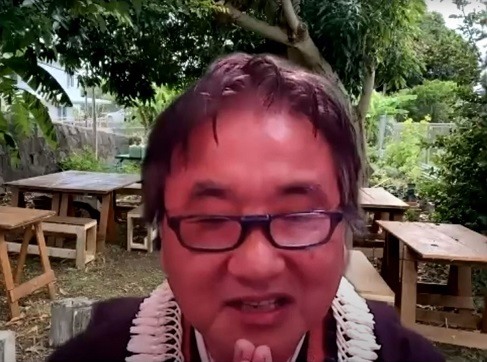
DBK-Fujitani Workshop, Kehaulani Lum

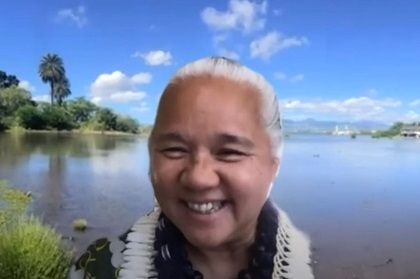
Aunty Kehaulani Lum, president of Ali’i Pauahi Hawaiian Civic Club, began the workshop by sharing the Native Hawaiian perspective of the current coronavirus pandemic.

“Today’s theme, ‘I’m not okay but it’s okay,’ are words that resonate deeply to Native Hawaiian people,” shared Lum. “They speak with wisdom and experience of generations of people who have survived great epidemics in these islands over the course of 200 years or more.”

Lum explained how in 1840, less than a century after British seafarers had landed in Hawai’i, nearly 84% of the Hawaiian population had died from diseases from which they had no immunity.

To Lum, the greatest answers in explaining our current situation come from looking at the source of the coronavirus pandemic. The virus is believed to have originated in bats in Wuhan, China—and ironically, bats are a symbol of health and longevity in Chinese culture. Specifically, says Lum, the virus was from a bat that was taken from a cave and brought to a market where humans coveted it as a delicacy. She believes there is a lesson there.

“We looked to guidance from the Kumulipo and found in the seventh era, just after the birth of the dog and the speckled bird, the springing forth of the bats,” explained Lum. She continued to share that right after the bats, the very last life form to be noted in the Kumulipo, the Hawaiian creation chant, is the man and the woman. “Can it be that by harming our older siblings through the destruction of their habitat and over consumption, we have invited harm upon ourselves?”

Lum believes that the best medicine right now is to commit our hearts and resources to bringing peace and restoration to the natural environment. To her, doing so is “an act of grace, of holiness and total devotion to divinity—not just to ourselves, but to all of our familiar relationships.”

DBK-Fujitani Workshop, Rev. Noriaki Fujimori

Reverend Noriaki Fujimori, the resident minister of Palolo Hongwanji, believes we can use this crisis as an opportunity to change our way of life.

“The Buddhist Master teaches us that encountering adversity is not always a bad thing,” says Fujimori. “It’s a chance to discover a treasure that we never knew we had.”

For Fujimori, anxiety and depression tend to stem from fear, and in most cases, we’re afraid of the unknown. But Buddhism guides people to live their life in the present—right here and right now—rather than worrying about an unknown future.

“The fear I create so easily in my mind is a preoccupation with what is going to happen in the future,” explains Fujimori. “This way of thinking has nothing to do with reality. No one knows what will happen in the future. We must find the joy in living right here and right now.”

He shared Lum’s belief that nature is healing, and explained that working in his garden at home has been very helpful in bringing him back to the present moment and finding joy at home.

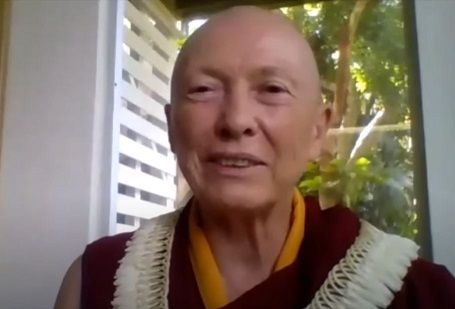
DBK-Fujitani Workshop, Venerable Karma Lekshe Tsomo

Venerable Karma Lekshe Tsomo, a Buddhist nun and professor at University of San Diego, offered several Buddhist truths that may bring comfort during these times of uncertainty. 

The first, said Tsomo, is that life is inherently uncertain. “Life is never satisfactory,” says Tsomo. “Why are we surprised? Whoever said that life was supposed to be a bowl of cherries? It cannot be. But we live in an illusion, we live in a dream world.” The more we can embrace the uncertainty of life, the sooner we will be able to find peace, says Tsomo.

The second truth is that of impermanence. Nothing in life is permanent, yet we continuously grasp for happiness outside of ourselves. We rely on things that are continuously changing, continuously evolving to keep us happy.

Acknowledging impermanence is a very important step to finding happiness, believes Tsomo. “It asks us to acknowledge our own frailty,” she explains. “As human beings, we are actually very fragile. At any moment, it can be ‘poof’ and we’re off to the next life. This body is actually very fragile.”

When we can come to that harsh realization and be honest with ourselves about our own vulnerabilities, it frees us up to rest content in the present moment and set aside all of our fears.

Despite the hardships, there are many silver linings to come out of this pandemic, offers Tsomo.

“It’s a disaster, and it’s especially a disaster for the poor,” says Tsomo. “But it also has the benefit of making us reframe our lives, stepping back and taking a closer look at our priorities. All of the things we’ve been wrapped up in, maybe they’re not as important as we thought. This pandemic can be a teacher.”

Tsomo believes a good first step in shifting priorities is to focus on love.

“Everyone loves to talk about love, now all we have to do is practice it,” says Tsomo. “We may sometimes get so wrapped up in our own pursuits that we forget about the other 7.5 billion human beings out there, not to mention the billions of fish and insects and animals. We can send loving kindness to all of them. This helps us feel love in our hearts, and this love overcomes so much of our anxiety and depression.”

Posted by: University Communications & Marketing Filed Under: Campus and Community, Catholic, Humanities, Arts & Design

The Women Who Shaped Our Nation

November 24, 2020

Chaminade University and Hawaii Council for the Humanities recently teamed up with the New York Historical Society to bring their Women and the American Story initiative to educators in Hawaii.

Women and the American Story Workshop

The initiative connects teachers across the country with a free curriculum and resources to highlight the various ways women have helped shape our nation. The collaboration hosted a virtual workshop on November 7 to introduce Hawaii teachers to the curriculum and help them find ways to incorporate more perspectives and contributions of women in their classrooms.

The free curriculum is broken up into ten chronological units, each one exploring a different period of time in U.S. history. The November workshop focused on two of the ten time periods: Settler Colonialism and the Revolution (1692-1783) and Confidence and Crises (1920-1948).

Led by Mia Nagawiecki, the Vice President of Education at the New York Historical Society, the interactive session walked participants through various resources, including paintings, texts, documents, letters and videos and explored how each depicted women and what they said about the roles that women played during that time. For each, Nagawiecki shared tips and strategies on how to utilize the resource in the classroom to prompt a discussion and encourage critical thinking.

The training began by outlining four core questions for participants to think about during the course of the workshop, including: How did women actively participate in the Revolution? What effect did a woman’s race have on her experiences? And why are women’s stories essential to understanding the events of the American Revolution?

The first half of the workshop examined the lives of colonial women from various geographic regions, including Russia, Alaska, Spanish California, French Louisiana and England’s 13 Colonies. It also explored the lives of women from diverse ethnicities, including Black, White, and Native American, and analyzed how women helped shape the American Revolution.

After, participants joined break out rooms to discuss the four questions posed at the beginning. They also explored how they could utilize the resources in their own classrooms and how they could incorporate more women’s perspectives and contributions into their lesson plans.

The second half of the workshop focused on the Confidence and Crises module and explored the role women played during the Great Depression, the Second World War and the beginning of the Cold War, and how women gained the right to vote. This was a period of overt racism, when African American women lived under “Jim Crow” laws, and Asian, Jewish, Italian and Eastern European women faced racist immigration laws.

For this section, participants were asked to think about the dramatic shifts women experienced in their roles as women and citizens as well as the ways in which the Great Depression and World War II affected the rush toward modernity that was driving the 1920s. At the conclusion of the section, participants once again joined breakout rooms to discuss what they had just learned and how to incorporate the teachings and resources into their classroom.

“We are thrilled to have had the opportunity to collaborate with the Hawaii Council of the Humanities and bring this incredible initiative to Hawaii’s teachers,” says Dr. Cheryl Edelson, dean of the School of Humanities at Chaminade and a speaker at the workshop. “It’s so important that our students see themselves in the stories we teach, and that we introduce them to a broader range of experiences to help them value our nation’s diversity. Through this training and curriculum, the New York Historical Society is helping us do that.”

Settler Colonialism and the Revolution
(1692-1783)
Confidence and Crises
(1920-1948)

Posted by: University Communications & Marketing Filed Under: Campus and Community, Chaminade History Center, Faculty, Featured Story, Humanities, Arts & Design

A Winning Pair

November 19, 2020

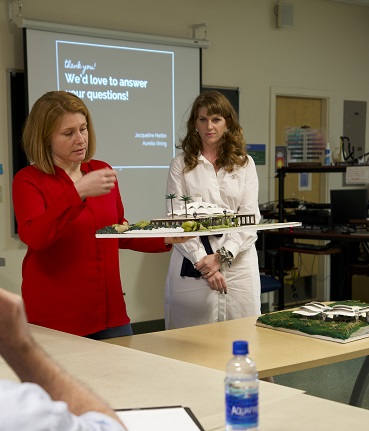
When Aurelia Vining and Jacqueline (Jaci) Harbin met during their first design studio course at Chaminade University, they became fast friends. They had both come from Army backgrounds before joining the Environmental + Interior Design program as transfer students in 2018, and their shared experiences matched with their opposing design approaches quickly proved to be a winning combination.

E+ID students Aurelia Vining and Jacqueline Harbin presenting their MRO project

They worked on a group project together during that first class, and it went so well that it solidified their partnership for much of the last two years. Since then, they’ve collaborated on several extracurricular projects, including working with the Marianist brothers to design a new exterior patio for the Mystical Rose Oratory.

“We had the chance to work on several extra-curricular design projects together, and it became clear that we balanced each other well,” says Harbin. “Things that I struggle with, Aurelia has completely mastered and areas where she might not be so strong, I excel.”

Their synergy recently came to fruition when it won them the 2020 Award of Excellence at the recent American Society of Interior Designers (ASID), Hawaii Chapter virtual award ceremony.

In January, their senior level commercial design studio course comprised a semester-long partner project. The class had chosen to design a boutique hotel—they were all given the footprint of an imaginary hotel in Vancouver, Canada and the pairs were tasked with designing three public spaces: the ground level, the lower level and the penthouse. The final design was due at the end of the semester in May.

“For this project we got to choose our partners so of course I was going to pick my Ace, Jaci Harbin,” says Vining. “She’s a wonderful designer and our styles are completely opposite of one another. I think that aspect of our relationship makes us question each other enough that we make sure our designs are purposeful, intentional and beautiful.”

Harbin and Vining designed The Glacier, an immersive hotel designed to capture the serenity that comes from being in nature. Upon arrival, the design protects guests with an outdoor vestibule positioned specifically to mitigate the northeastern winds. The lobby is darned with curved woods, semi-transparent materials and multi-faceted built-ins that help create a sense of humility and a feeling of being part of something bigger. On the inside, the ground floor included a lounge with a kids play space, a bar and space for casual dining, and outside the designers made space for an outdoor lounge, a rental area and an outdoor ice skating rink.

But the part that really captured the attention of the ASID judges was the outdoor star-gazing balcony in the penthouse. The virtual award ceremony specifically called out this area, with a quote from one of the judges saying “My favorite is the stargazing area. I like that the students thought through every scenario so that visitors would be able to see the constellations and stars day or night and all times of the year.”

The project wasn’t without its challenges—halfway through the semester COVID-19 hit and in-person classes were canceled.

“Zoom presentations are completely different from in-person presentations,” recalls Harbin. “The way you present yourself, how you showcase your work, all of that changes. You cannot have physical material boards because they don’t showcase well on a digital platform but that also means the client cannot touch the materials.”

It helped that the pair was already so close and had such a solid partnership to begin with. “The fact that we were already so comfortable with one another made a huge difference—it would have been very difficult to excel if we had just met one another,” admits Harbin.

But they did excel. Combined, the two put in over 600 hours to perfect the design of The Glacier. And when the project was completed, they submitted it for the ASID award, and won.

“Winning the ASID Hawaii Award of Excellence is a pinnacle moment for Jaci and Aurelia,” says Joan Riggs, the director of the Environmental + Interior Design program and a cherished professor and mentor. “This pair of emerging professionals hit the ground running with wanting to learn everything about design, taking risks with ideas and stretching themselves from day one.”

The two credit a lot of their success to the mentorship they received from both Riggs and their professor, Liza Lockard.

“I don’t think [Professor Lockard] ever told us we couldn’t do something—she just guided our explorations in the design process,” says Vining. “I loved when we’d ask her if we could do something and her response would be ‘I don’t know, can you?’ That was so encouraging and refreshing.”

Though they will both graduate this semester, this is likely just the beginning of the duo’s journey together. 

The day after submitting their final design of The Glacier, they received an email from Joan Riggs saying she had a paid summer project for them if they were interested. The project was to design the tour check-in and retail area for Magnum Helicopter Tours at their Honolulu Airport facility. The space was being constructed, and they were looking to the design students to help them execute their vision.

“It was fascinating to watch a project happen in real time,” says Harbin. “There was a real sense of urgency regarding this project, but they were looking to us as the professionals and trusted our opinions and recommendations.”

Now, with graduation just a few weeks away, Harbin and Vining are trying to work out the logistics of a long-term professional partnership doing real estate development in San Antonio, Texas, where Vining will be moving next summer.

“I think hands down, you have to find someone that you can work with and trust they will put in the same amount of effort,” says Vining. “Jaci and I have been pairing together whenever we can, and have done multiple school projects, service learning and freelance projects together. She is by far the best partner!”

Posted by: University Communications & Marketing Filed Under: Featured Story, Humanities, Arts & Design, Students Tagged With: Environmental + Interior Design

US-China Relations: Duel or Duet

September 21, 2020

“The Chinese government, over the several years, has started to try and change its development model quite substantially, and COVID-19 has put these efforts on steroids,” stated Chaminade Professor Dr. Chris McNally during the opening of The Annual Dr. N.H. Paul Chung Memorial Lecture.

Dr. N.H. Paul Chung Memorial Lecture. Panelists, Dr. Chris McNally along with Professor Charles Booth from the William S. Richardson School of Law at UH Manoa, Senior Instructor Ji Chen from University of Colorado at Denver, and Emeritus Professor Stephen C. Thomas also from the University of Colorado at Denver

The lecture, presented by the Pacific Asian Management Institute and the University of Hawaii Center for Chinese Studies on September 11, consisted of a panel of experts that explored the U.S.’s relations with China. Panelists included McNally along with Professor Charles Booth from the William S. Richardson School of Law at UH Manoa, Senior Instructor Ji Chen from University of Colorado at Denver, and Emeritus Professor Stephen C. Thomas also from the University of Colorado at Denver.

The panel offered a fascinating glimpse into the intricacies and complexities that surround the U.S.’s relationship with China amidst an ongoing trade war and a tumultuous global pandemic. The hour-long discussion briefly touched on a plethora of topics, including the recent change in China’s relationship with Hong Kong, human rights, economic sustainability and development, technology infrastructure, COVID-19 and the upcoming U.S. election.

A large question loomed over whether China would surpass the U.S. as an economic leader in coming years, particularly when it comes to technology and the development of artificial intelligence. “Whether or not they will be ahead of us by 2030 is very difficult to judge,” says McNally. “How much China is able to leapfrog us, that is still really a question for the future.”

But he did concede that China’s economy had fared far better than the U.S.’s during the COVID-19 pandemic. “There is no doubt now that the Chinese have fared a lot better economically during this COVID-19 pandemic than most other large economies,” says McNally. “In terms of manufacturing, the economy has recovered very rapidly. But in terms of consumption the Chinese economy is still lagging.”

According to McNally, that is bad news for the U.S. “That basically portends some rather dire futures for us, because we look at the Chinese as having recovered much more rapidly than other economies, yet their consumption power is still lacking.” says McNally. “So for the U.S. and Europe, this means we will have real difficulties getting our consumption fully back up.”

McNally also warned of the potential long-term damage of the Trump administration’s approach to trade. “It’s not just the Chinese, it’s many other countries and industries that are looking at U.S. supplies and saying ‘Can we trust them in the future?’ and ‘Should we diversify?’” says McNally. “All you’re doing is basically incentivizing the rest of the world to try to become less dependent on the United States.”

For McNally, that could have devastating effects for the U.S. economy and threaten our position as a global economic leader. “The whole idea of decoupling is not so much the U.S. decoupling from China, it’s the rest of the world decoupling from the United States,” says McNally. “And that is not something you want to happen…you don’t even want to put that idea into people’s heads.”

As for the upcoming election, McNally says it’s anyone’s guess who the Chinese would prefer to win. “For the Chinese, another four years of Trump would mean another four years of chaos and another four years of delegitimizing the U.S., which would help China in the long term,” predicts McNally. He believes a Biden administration would mean more stability, and the Chinese value stability. “But a Biden administration is likely to rally allies and try to create a united front to face the Chinese. That would tell the Chinese they need to play by certain rules of the game.”

At the end, the panelists were each asked to give a short summary of what they wanted the biggest takeaway to be, as well as a word or phrase to end on. Most speakers sided with McNally’s political lean. Professor Booth took the opportunity to stress just how important this upcoming election was, while Ji Chen emphasized McNally’s point that decoupling is not the solution. “Historically, China is not the enemy,” says Ji Chen who is originally from China. “The only thing the Chinese want is a better way of life.” McNally took that one step further by declaring that “China is not Russia.”

“Yes, China is a massive challenge to the United States, no doubt,” concluded McNally. “But the Chinese have an enormous stake in keeping the international order intact, at least the parts they like…they’re not intent on destroying it as the Russians are, clearly. And we seem to have, quite deliberately in my opinion, confused that and made China the enemy…And that, as Ji Chen mentioned, is not the case.”


Posted by: University Communications & Marketing Filed Under: Faculty, Featured Story, Humanities, Arts & Design Tagged With: Thought Leadership

Honolulu NAACP Hosts Virtual Town Hall

June 12, 2020

Over 10,000 people took part in a rally at the Hawaii State Capitol on Saturday, June 6, to show solidarity with the black community against systemic racism and police brutality. It was the largest of several peaceful protests that took place across the state in response to the recent killing of George Floyd.

Following the rally, the Honolulu chapter of the National Association for the Advancement of Colored People (NAACP) held a virtual town hall meeting featuring a panel of community leaders, including Chaminade Professor Dr. Allison Paynter. Paynter was joined by the Reverend Dr. Anthony Cook from Trinity Missionary Baptist Church; John McCarthy, the deputy chief of the Honolulu Police Department; Rep. John Mizuno from the Hawaii State Legislature; and Christel Thompson, a family counselor.

Co-host and NAACP Honolulu Branch President Alphonso Briggs began the town hall by explaining that the meeting was designed to be the next step after the march. Now that the rally was over, what could be done to continue discussions and further efforts to address systemic racism?

Hawaii Supreme Court Chief Justice Mark E. Recktenwald helped put the issue of racism into a local context. “I want to make very clear—this is not just an issue for the mainland,” stated Recktenwald. “One study showed here in Hawaii, a person who is black is more than twice as likely to be imprisoned than a person who is white. So we have a lot of work to do.”

John McCarthy, deputy chief of the Honolulu Police Department, opened by immediately calling out the killing of George Floyd. “I’ve been in law enforcement for 44 years with the Honolulu Police Department,” said McCarthy. “I’ve seen a lot of things, but even that was disturbing and appalling and should never have happened, anywhere. It just shouldn’t have gone down that way.”

NAACP's Virtual Town Hall - Dr. Allison Paynter was one of the panelists

Dr. Allison Paynter offered a historical perspective, comparing today’s perceptions of African Americans to a quote from the early 20th century by one of the co-founders of the NAACP, James Weldon Johnson.

The quote reads: “The battle was first waged over the right of the Negro to be classed as a human being with a soul; later, as to whether he had sufficient intellect to master even the rudiments of learning; and today it is being fought out over his social recognition.”

To Paynter, the quote reflects how unfortunate it is that nearly 100 years later, “we are still trying to establish the African American as a viable, just and equitable partner in the citizenship of America.”

The outrage Paynter sees flooding the streets across the nation is not surprising to her. She supports the emotional responses and sees them as a vital component to our wellbeing, but she encouraged protesters to channel their aggression into creative venues. She called on youth to use their words, their social media platforms, their art and their politics to demand effective change.

While Paynter described racism as “the most virulent virus around,” she understands how the current COVID-19 pandemic in conjunction with civil rights protests across the nation has many on edge. As the only higher education representative on the panel, she recognized that parents of college-aged students may be feeling incredibly anxious about a fall return to the classroom given recent events. She described Chaminade’s plan for hybrid learning—combining face-time in the classroom with online lectures and seminars—as one way forward.

“The most important thing a family can do is speak to their institutions and make sure that any concerns they have are answered,” offered Paynter. “I think all of our faculties and administrators across the nation are willing to take part in that discussion.”

Just as she began, Paynter closed her time by putting today’s protests into a historical context. “When we look at protests against slavery and the civil rights movement, we tend to look at them as closed capsules where we only have African Americans fighting for and dying for justice.” Paynter points to examples of that changing now—last week alone there were peaceful rallies in all 50 states standing in solidarity with the Black Lives Matter movement.

With new technologies and new ways of documenting injustices and organizing communities emerging, Paynter sees a growth in global awareness that we are all humans. “There is a media presence today that we didn’t have access to in the ’60s,” says Paynter. “We cannot be silenced, nor should we be silenced.”

She concluded by calling for intergenerational collaboration. “When I look back at some of these protests and protesters, and I see these voices coming forward in our youth, I am heartened,” says Paynter. “I am of one generation, you are of another. We need to come together and make sure there is a pathway for kindness, love and justice in the future.”

The full town hall meeting is available for viewing on the KHON website.

Posted by: University Communications & Marketing Filed Under: Campus and Community, Diversity and Inclusion, Faculty, Featured Story, Humanities, Arts & Design

  • « Go to Previous Page
  • Page 1
  • Interim pages omitted …
  • Page 5
  • Page 6
  • Page 7
  • Page 8
  • Page 9
  • Interim pages omitted …
  • Page 15
  • Go to Next Page »

Footer

Chaminade University Logo

3140 Waialae Avenue
Honolulu, Hawaii 96816

Contact Us
Phone: (808) 735-4711
Toll-free: (800) 735-3733

facebook twitter instagram youtube linkedin

Visit

  • Plan Your Visit
  • Campus Map (PDF)
  • Events

Resources

  • Campus Security
  • Student Consumer Information
  • Concerns, Feedback, and Reporting
  • Institutional Review Board
  • Title IX / Nondiscrimination Policy
  • Compliance
  • Emergency Information
  • Careers
  • Institutional Statement

People

  • Students
  • Parents
  • Alumni
  • Faculty & Staff

Policy

  • Privacy Policy
  • Terms and Conditions of Use


© Chaminade University of Honolulu