• Skip to primary navigation
  • Skip to main content
  • Skip to footer
Chaminade University of Honolulu

Chaminade University of Honolulu

  • VISIT
  • APPLY
  • GIVE
  • STUDENTS
  • PARENTS
  • ALUMNI
  • FACULTY/STAFF
  • Admissions
    • Admissions Home
    • Undergraduate Students
      • First-Year Students
      • Transfer Students
      • Admitted Students
    • Graduate Students
    • Flex Online Undergraduate Program
    • Military Students
    • Non-Degree/Visiting Students
    • Experiential Honors Program
    • Early College Program
    • New Student Orientation
  • Tuition & Aid
    • Financial Aid Home
    • Tuition & Expenses
    • Federal Updates & Changes
    • Scholarships
    • $5,000 Graduate Scholarship
    • VA Education Benefits
    • Net Price Calculator
  • Academics
    • Academics Home
    • Academic Programs
    • Office of Student Success
      • Academic Advising
      • Records and Registrar
    • Kōkua ʻIke (Support Services)
      • ADA Accommodations
      • Career Services
      • Proctoring Services
      • Tutoring Services
    • Sullivan Family Library
    • Undergraduate Research & Pre-Professional Programs
    • Commencement
  • Campus Life
    • About Campus Life
    • Student Engagement
    • Student Government Association
    • Residence Life and Housing
    • Health Services
    • Marianist Leadership Center
    • Counseling Center
    • Campus Ministry
    • Campus Security
    • Dining Services
    • Bookstore
  • Athletics
  • About
    • Chaminade University News
    • Our Story
    • Leadership
    • Chaminade University Strategic Plan 2024-2030
    • Mission & Rector
    • Association of Marianist Universities
    • Facts & Rankings
    • CIFAL Honolulu
    • Accreditation & Memberships
    • Montessori Laboratory School
Search
×

Search this web site

Humanities, Arts & Design

Faculty and Staff Express Themselves in Multidimensions at Art Show

February 16, 2017

Yukio Ozaki, Dale Fryxell, and Walter Takeda

Fine Arts professor, Yukio Ozaki, a renowned ceramist, strung clear line through the frame hooks of artwork that arrived earlier that morning. It was February 14, Valentine’s Day, with the show about to open. Volunteers had been busy setting up the exhibit since the day before. Ozaki worked quickly to hang the new entries. When the call went out for artwork, 28 staff and faculty members responded with an amazing variety of creative expression in unexpected media. Ozaki himself had submitted a pastel abstract that he had made in third grade. Smiling broadly, he shared, “I was so glad that my mother saved it.”

Dave Coleman, the dean of Humanities and Fine Arts, gathered shell lei, placed them on his arm and waited for artists to arrive. This is the second year that his division has sponsored the art show.  Fine Arts professors Walter Takeda and Ozaki continued as chief organizers. Coleman pointed out that it was in alignment with the significance of Humanities and Fine Arts. “The Faculty Staff Art Show is an opportunity to engender a culture of art and art expression on campus and to showcase the multi-dimensions of our colleagues,” he said.

Faculty, staff, students and friends streamed through the exhibit. Takeda, dressed in a swanky black vest and black pants set off by his Valentine-red shirt, greeted everyone and referred to his colleagues as “true renaissance faculty and staff.”

Leslie Loon and Sr. Malia Wong

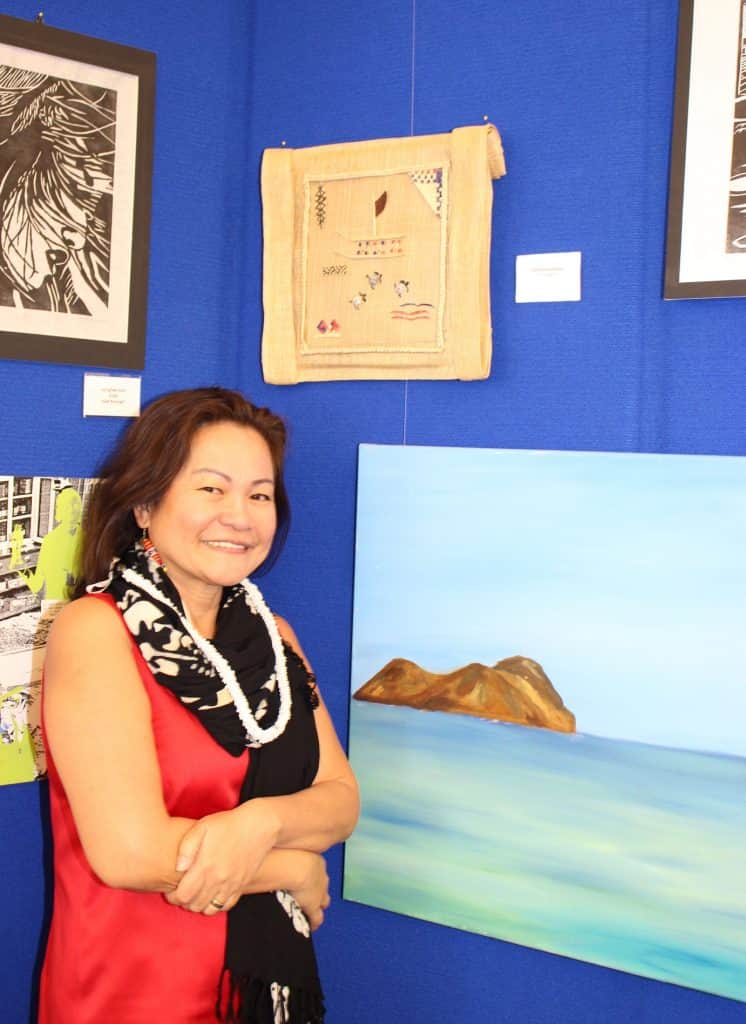
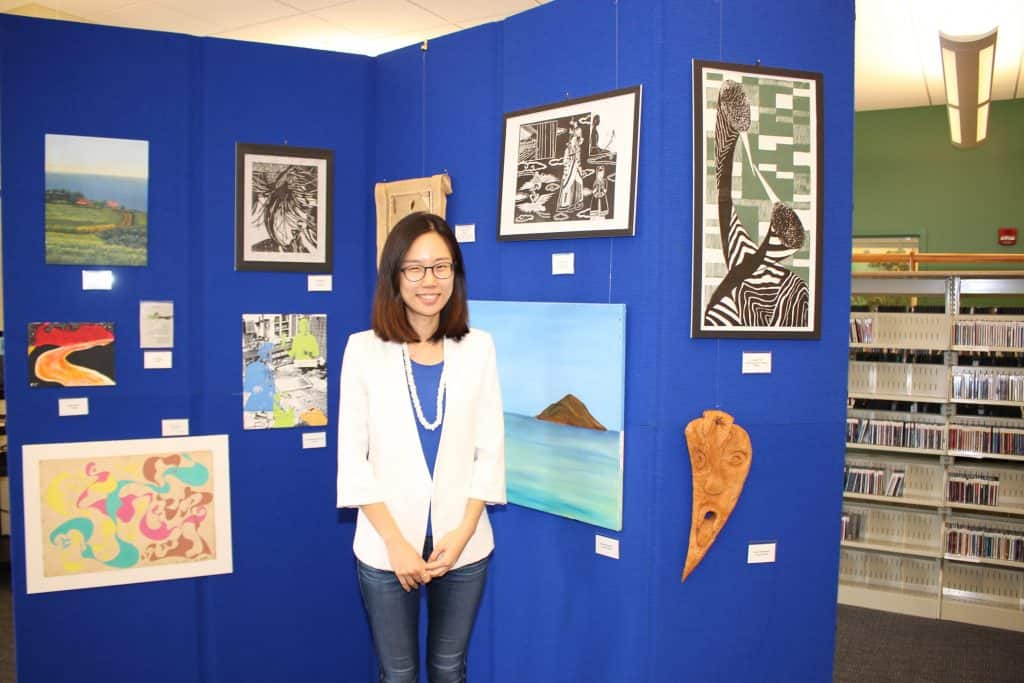
Takeda was right. What variety! There were exquisite religious pieces and a whimsical, playful rendition of Diamond Head.  One dad included his son’s piece as part of his, a reminder of the strong human connections we touch when we create.  One staff worker remembered his mother and his Native American culture as he stood near his displayed piece.

The exhibit included a wooden puppet built by History professor Mitch Yamasaki, graphic designs by Nursing professor Edna Magpantay-Monroe, and a gothic wooden cathedral by Communication professor Cliff Bieberly. From repurposed fiber and bamboo representing Communication professor Eva Washburn-Repollo’s passion for her teaching to a chunk of koa turned into a beacon of light in dark times from Education dean Dale Fryxell, pieces had their stories and deeper meanings. Starfish, jellyfish, photos, landscapes, etchings, video, mosaic, and more added to the buffet of creative endeavors.

Stop by and marvel a little.  Expect to be surprised and pleased. The Faculty Staff Art Show runs through Tuesday, Feb. 28, in the Sullivan Family Library.

Elizabeth Park at Faculty Art Show
Dr. Eva Washburn-Repollo at Faculty Art Exhibit
Dr. Junghwa Suh at Faculty Art Exhibit
Dr. Dale Fryxell's art piece

Posted by: University Communications & Marketing Filed Under: Campus and Community, Faculty, Humanities, Arts & Design

E+ID Professor Honored by Council for Interior Design Accreditation (CIDA)

February 1, 2017

Dr. Junghwa Suh

Junghwa Suh, D. Arch., assistant professor in the Environmental + Interior Design (E+ID) Program, has received an honorable mention in the 2016 CIDA (Council for Interior Design Accreditation) Award for Excellence Competition. Open to faculty members and collaborating teams at CIDA-accredited interior design programs, the competition recognizes outstanding practices in interior design education and honors design educators for their exceptional work.

Dr. Suh’s submission “Learning on the Go: Using Mobile Tools in Design Education” researched opportunities for students to explore and analyze key design elements and principles in various interior spaces. In order to facilitate understanding and application of how the components of lighting design are integrated and designed in various interior spaces, students needed to analyze the components in a physical context. She used mobile technology as a tool to provide students with a way to visit various interior spaces and conduct meaningful visual analyses. Instead of seeking a specific educational mobile application, Suh chose Instagram, a social networking mobile application which her students were already familiar with and constantly using. The activity was successfully introduced and developed in her “Introduction to Lighting Design” class.

In fall 2016, Makana Mattos, Faculty Center instructional designer,  and Tom Galli, Communications senior lecturer, had encouraged Suh to enter the competition. “The research had been already done, so it was a matter of making a video, which was the media format requirement for the award competition,” Suh noted.

Besides Mattos and Galli, two of her students participated in the video. Jenelyn Sison and “Ryan” Zhu Fan had been in her E+ID 325: Intro to Lighting Design class in a previous semester and had participated in her Instagram class activity.

In recognition of her achievement, CIDA will widely publicize her entry in the media, on its website, and through social media. Award winners will also be recognized at the upcoming Interior Design Educator Council’s Annual Conference in Chicago, Illinois this spring. Dr. Suh has also been invited to present her research at the IDEC conference.

Environmental and Interior Design

“Overall, this was indeed an accomplishment in my design education career and E+ID program,” wrote Suh. “I thank Makana, Tom, Jen, and Ryan for helping me to make this wonderful video. This gave me a chance to share my teaching methodology with everyone in the world. I am also thankful for the continuous support from our E+ID director Joan Riggs and from the Chaminade Faculty Center,” she added.

The submitted research video “Learning on the Go: Using Mobile Tools in Design Education” can be found by visiting  https://vimeo.com/183874306

About CIDA 
The Council for Interior Design Accreditation (CIDA) is an independent, non-profit accrediting organization for interior design education programs at colleges and universities in the United States and internationally. For more than 35 years, this knowledge-driven organization has been passionately committed to the ongoing enrichment of the interior design profession through identifying, developing and promoting quality standards for the education of entry-level interior designers, and then encouraging, accrediting and supporting educational programs to aspire to those standards. Through a process of program self-evaluation and peer review, accreditation promotes achievement of high academic standards, while making education more responsive to student and societal needs. The Council engages nearly 200 volunteers, all drawn from interior design practice and education, to carry out its work. More than 150 interior design programs are currently accredited by the Council, serving an estimated 20,000 students. The Council for Interior Design Accreditation is recognized as a reliable authority on interior design education by the Council for Higher Education Accreditation (CHEA). The CHEA-recognized scope of accreditation is professional-level interior design programs that culminate in a bachelor’s or master’s degree located in the United States and internationally.  Chaminade’s E+ID program has been accredited by CIDA since 2013.

About Environmental + Interior Design Program 
Chaminade University offers the only degree-granting Environmental + Interior Design program in the state of Hawaii and is accredited by the Council for Interior Design Accreditation (CIDA), the body that oversees and evaluates academic standards for baccalaureate institutions. Chaminade’s comprehensive Bachelor of Fine Arts (BFA) program prepares students to embark upon a successful career in interior design, environmental design, and other design-related fields. The degree satisfies the educational requirement for professional licensing through the National Council for Interior Design Qualification (NCIDQ), as well as prepare students for post-graduate studies and entry-level positions in the field. The E+ID program is unique from other academic programs, in that it extends beyond the traditional scope of interior design by encompassing the broader aspects of the environment into the design process. The curriculum addresses the symbiotic relationship between the indoor (built) and the outdoor (natural) environments by cultivating a design approach that integrates rather than compartmentalizes the spaces and places humans occupy. 

Posted by: University Communications & Marketing Filed Under: Faculty, Humanities, Arts & Design Tagged With: Environmental + Interior Design, Honors and Awards

Chaminade Professor’s New Book Reveals Robert Louis Stevenson’s Importance in Illustrated Literature

January 26, 2017

Dr. Richard Hill

Congratulations are in order for Richard Hill, Ph.D., assistant professor of English.  His book Robert Louis Stevenson and the Pictorial Text: A Case Study in the Victorian Illustrated Novel has been recently published by Routledge (2017).  The book is a scholarly analysis of the lifetime illustrations to the fiction of Robert Louis Stevenson.  A famous 19th-century writer, Stevenson wrote books such as The Strange Case of Dr. Jekyll and Mr. Hyde and the great pirate novel Treasure Island. Born in Edinburgh, Scotland, Stevenson also spent time in Hawaii as well as traveling through the Pacific.  Over the years, Stevenson has been the subject of much serious critical scholarship. Hill’s book contributes to this scholarship by examining how Stevenson sought illustration for his work and how illustration succeeded or failed according to Stevenson’s opinion.

Dr. Richard Hill Book: Robert Louis Stevenson and the Pictorial Text - A Case Study in the Victorian Illustrated Novel

Hill initially did his doctorate work on Sir Walter Scott, Stevenson’s literary forebear. Hill received his Ph.D. from Edinburgh University, the alma mater of Scott and Stevenson.  After Hill completed his work on Scott, he targeted Stevenson for his next endeavor. “Stevenson became the natural focus of my work,” Hill recalled. “Stevenson was another famous Scottish author but one who had come to the Pacific, like me!  It was a natural fit for my focus of research.”

Hill completed the book through a series of challenges and distractions, including illness, moving from Oahu to Maui, and the birth of two children to whom the book is dedicated. “I’m very proud of the fact that the entirety of the book, from conception to publication, was produced while being a faculty member at Chaminade University,” he added.  “Thanks must go to my department, dean, and the Sullivan Family Library for their support through the process.”

Posted by: University Communications & Marketing Filed Under: Faculty, Humanities, Arts & Design Tagged With: English, Publications

Portfolio Exhibit Celebrated as a Milestone for Environmental + Interior Design Seniors

December 20, 2016

The Environmental + Interior Design (E+ID) program held its Fall 2016 E+ID Senior Portfolio Exhibit on December 9, at Aloha Tower Marketplace.  The exhibit was an opportunity for the E+ID seniors to shine, to show their appreciation to their spouses, families, and friends, and to connect with colleagues.  Attended by about 120 people of which nearly two-thirds were design professionals and allied industry professionals, the event showcased the quality of graduates produced by the E+ID program.

Graduating E+ID seniors, Rosalina Ashe, Kelsey Jones, Derek Tamashiro and Kelsey Williamson, had on display a variety of their physical artifacts, representing the accumulation of their work over the course of four years. The displays demonstrated their work in studio classes and with design projects and included presentation boards, material boards, models, sculptures, 3D renderings and construction documentation. Many of the projects were from service-learning projects dealing with actual clients and providing solutions to real design problems and challenges. In many cases, the work provided design concepts that clients could use to raise awareness and financing, as well as garner community recognition of the E+ID program.

In addition, each student prepared for viewing a senior portfolio book.  The student’s individual portfolio book represented the student’s design thinking and application, his or her best work and evidence of what the student could offer potential employers. The book would make an excellent tool in interviews for graduates seeking professional positions.

“The portfolio exhibit is a recognition and celebration of students achieving their BFA in Environmental + Interior Design. It is a milestone event in our curriculum, ” wrote Joan Riggs, E+ID program director. “It is a thank you to the design community for their support and collaboration, and it is a networking social event for the Chaminade ohana, friends, and family, the design community and the general public.”

Chaminade University’s senior portfolio exhibit has been a tradition with the E+ID program for more than 15 years and is held in the semesters when there are students graduating from the program with their Bachelor of Fine Arts degrees.

Chaminade University offers the only accredited, degree-granting Environmental + Interior Design program in Hawaii. Since its accreditation in 2013, the employment rate for graduates seeking a full-time, entry-level position in an interior design or architectural firm is more than 80 percent and has been increasing every year. Students in the program can be assured that they are getting a high-quality education that prepares them for a successful professional career. Chaminade’s  E+ID program is unique from other academic programs, in that it extends beyond the traditional scope of interior design to encompass the broader aspects of the environment into the design process. This broader environmental perspective helps us to understand our connection not just to the building itself, but also to the land, to the community, and to the planet.

Posted by: University Communications & Marketing Filed Under: Humanities, Arts & Design, Students Tagged With: Environmental + Interior Design

Chaminade’s Caring Crocheters Serve Military Families with Hanks, Skeins and Balls of Yarn

December 16, 2016

Associate professor of Religious Studies, Regina Pfeiffer, DMin, looked over her supply of yarns and crochet needles.  Students participating in the Caring Crocheters service-learning project sorted through the material provided. Many had already wound unending threads into balls from skeins and hanks of yarn.

Students crocheting

Throughout the semester, Pfeiffer taught her students the basics of crocheting and offered continued guidance as they advanced through their projects. It usually took only three to four sessions to master the skill. Once mastered, students were welcome to work independently.

By the end of the fall semester, participants had each completed a baby blanket.  Some students also crocheted booties, scarves and hats. The finished crocheted pieces went to the U.S. Army Garrison Hawaii New Parent Support Program, which assists military families who are expecting a child or have at least one child age zero to three.

Feedback from the agency and the military families that it serves have been quite positive. “Often, enlisted troops are separated from their families. Spouses with new babies may be living alone in a new area, without family or friends for support. We crochet baby blankets, washcloths, hats, scarves, and other items. These become personal, hand-made gifts for new families of enlisted troops,” Pfeiffer explained. “The military families also benefit because they realize that someone they don’t even know cares about the sacrifices they give to our nation.”

Student crocheting

Pfeiffer started the Caring Crocheters service-learning project in fall 2014 and has just finished her fifth semester with the project. She is pleased with how popular it continues to be. Students have reflected on how much they have enjoyed the project and how it has helped them relieve stress. Crocheting provided students with the means to cope with hectic lives, be creative and take risks by trying something that they may never have considered. When students create fabric by interlocking loops of yarn using a simple hook needle, they invest themselves into the pieces that they are creating.

“Our society sustains itself on bought items rather than on creative activities from which they give a part of themselves in terms of time and talent,” Pfeifer commented.

Pfeiffer shared another big takeaway from this service-learning experience. The students are asked to give away their piece anonymously. That piece represents a piece of themselves, and so they experience doing something good and giving themselves without any expectation in return.

Posted by: University Communications & Marketing Filed Under: Campus and Community, Humanities, Arts & Design Tagged With: Religious Studies, Service Learning

Service Project with Kaimuki High School Culminates in a Night of Words

December 9, 2016

Kaimuki student performing his poetryWhen Chaminade held a Poetry Festival this fall, the words of Kaimuki High School students captured the attention of their audience with words arranged like music, punctuating the air with meaning and feelings and insight.  The audience grew to standing-room-only on the lawn of Sullivan Family Library that November evening. All listened intently, fearful of missing one word or one inflection which might change the whole message.

Chaminade students from professor Brooke Carlson’s 102 English class listened more closely than others to the 10th, 11th and 12th graders.  After all, the Chaminade students had worked with these high schoolers for seven shifts of one and a half hours per shift in small groups throughout the semester. The service-learning project had included activities such as vocabulary lessons and practice, teaching the SEE (sentence, example, explanation) paragraph, using a favorite song or a short story, and editing and revising written work.  The Chaminade students had engaged themselves and were vested.

Carlson and Candice Sakuda, the director of Chaminade’s Service-Learning program, have been working together on a service-learning project with Kaimuki High School since 2013. “We’ve linked our English courses’ curricula to service within Kaimuki’s classes, helping high school kids who need help with English and self-expression,” said Sakuda.  “At the start of each term, Carlson’s EN102 students learn about their service-learning project, through which they serve as role models, motivators, and mentors for Mrs. Mary Ann Akamine’s English classes at Kaimuki High School.”

Kaimuki student performing her poetryCarlson explained, “One of the things that drew me to Chaminade was the Service-Learning program. I want my students to take what they learn through my courses out into the real world for life. The more we can build, craft and cultivate with those around us, the better.” He added, “I am blessed in that literature is an expression of being human.  Service-learning provides more space for practicing our humanity.”

This year, twelve Kaimuki High School students read their poems at the festival.  “The performances were fantastic,” said Sakuda. “Through original poetry, the students shared their feelings about friends’ betrayals, about disrespect for the Hawaiian culture, and about family struggles, inner conflict and loss. Tears and long embraces followed so many performances.”

After the performances,  Carlson’s students were filled with “faculty pride” knowing that they had something to do with their students’ success.

Posted by: University Communications & Marketing Filed Under: Humanities, Arts & Design Tagged With: English, Service Learning

  • « Go to Previous Page
  • Page 1
  • Interim pages omitted …
  • Page 12
  • Page 13
  • Page 14

Footer

Chaminade University Logo

3140 Waialae Avenue
Honolulu, Hawaii 96816

Contact Us
Phone: (808) 735-4711
Toll-free: (800) 735-3733

facebook twitter instagram youtube linkedin

Visit

  • Plan Your Visit
  • Campus Map (PDF)
  • Events

Resources

  • Campus Security
  • Student Consumer Information
  • Concerns, Feedback, and Reporting
  • Institutional Review Board
  • Title IX / Nondiscrimination Policy
  • Compliance
  • Emergency Information
  • Careers
  • Institutional Statement

People

  • Students
  • Parents
  • Alumni
  • Faculty & Staff

Policy

  • Privacy Policy
  • Terms and Conditions of Use


© Chaminade University of Honolulu