• Skip to primary navigation
  • Skip to main content
  • Skip to footer
Chaminade University of Honolulu

Chaminade University of Honolulu

  • VISIT
  • APPLY
  • GIVE
  • STUDENTS
  • PARENTS
  • ALUMNI
  • FACULTY/STAFF
  • Admissions
    • Admissions Home
    • Undergraduate Students
      • First-Year Students
      • Transfer Students
      • Admitted Students
    • Graduate Students
    • Flex Online Undergraduate Program
    • Military Students
    • Non-Degree/Visiting Students
    • Experiential Honors Program
    • Early College Program
    • New Student Orientation
  • Tuition & Aid
    • Financial Aid Home
    • Tuition & Expenses
    • Federal Updates & Changes
    • Scholarships
    • $5,000 Graduate Scholarship
    • VA Education Benefits
    • Net Price Calculator
  • Academics
    • Academics Home
    • Academic Programs
    • Office of Student Success
      • Academic Advising
      • Records and Registrar
    • Kōkua ʻIke (Support Services)
      • ADA Accommodations
      • Career Services
      • Proctoring Services
      • Tutoring Services
    • Sullivan Family Library
    • Undergraduate Research & Pre-Professional Programs
    • Commencement
  • Campus Life
    • About Campus Life
    • Student Engagement
    • Student Government Association
    • Residence Life and Housing
    • Health Services
    • Marianist Leadership Center
    • Counseling Center
    • Campus Ministry
    • Campus Security
    • Dining Services
    • Bookstore
  • Athletics
  • About
    • Chaminade University News
    • Our Story
    • Leadership
    • Chaminade University Strategic Plan 2024-2030
    • Mission & Rector
    • Association of Marianist Universities
    • Facts & Rankings
    • CIFAL Honolulu
    • Accreditation & Memberships
    • Montessori Laboratory School
Search
×

Search this web site

Catholic

God’s Mechanics

October 11, 2023

There was time for one more question before the close of the Marianist Lecture. Chaminade student Noelani Tugaoen stood up and politely asked, “How are we able to foster the dialogue of faith and science with those who are younger and don’t have any experience with the religious world?” 

Lecturer Bro. Guy Consolmagno, S. J. half-smiled before laughing and saying, “Boy, I wish I knew the answer to that.”  The audience then joined him in light laughter. 

As the Director of the Vatican Observatory and President of the Vatican Observatory Foundation, Consolmagno clearly knows the answers to most any question that comes his way.  A native of Detroit, Michigan, he earned undergraduate and masters’ degrees from MIT, and a Ph. D. in Planetary Science from the University of Arizona; he was a postdoctoral research fellow at Harvard and MIT, served in the US Peace Corps (Kenya), and taught university physics at Lafayette College before entering the Jesuits in 1989. 

Yet on October 8th in the Mystical Rose Oratory as part of the Marianist  Lecture Series, he humbly replied that he didn’t know the answer to Tugaoen’s question.

His lecture, “God’s Mechanics: How Scientists and Engineers Make Sense of Religion,” however, was packed with answers to lofty questions about science, astronomy, commonalities and differences between different religions, and – ultimately – what “believing in God gets you.” He also delved into ways that “techies” deal with why so many religions exist in our world today. 

He opened his talk by playing a video from the Vatican Observatory, and then he dove head first into how scientists and engineers make sense of religion. His full talk can be viewed here. 

At the Vatican Observatory since 1993, Consolmagno’s research has explored connections between meteorites, asteroids, and the evolution of small solar system bodies, observing Kuiper Belt objects with the Vatican’s 1.8 meter telescope in Arizona, and applying his measure of meteorite physical properties to understanding asteroid origins and structure. 

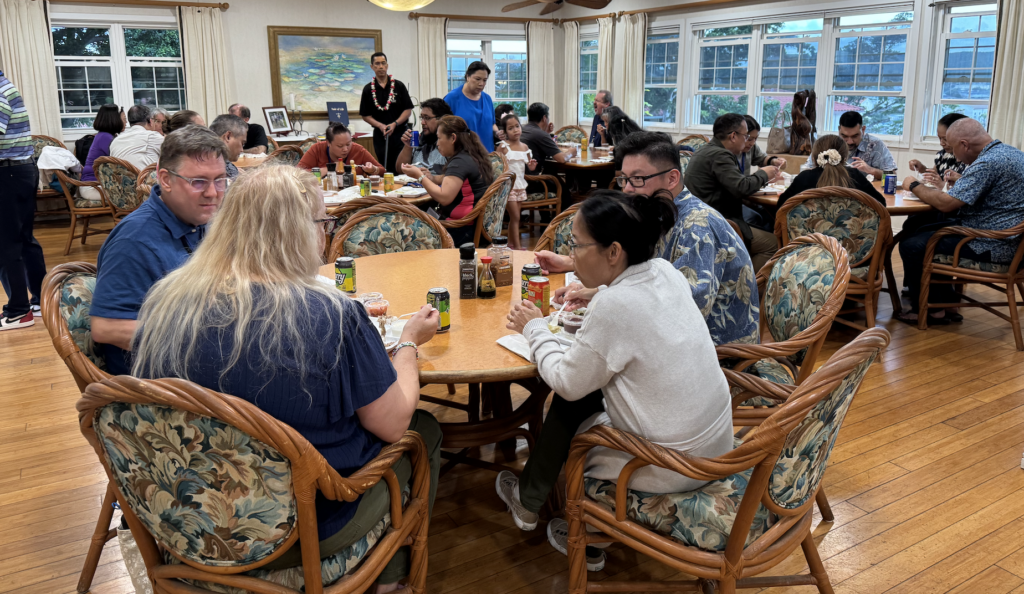
Consolmagno also spoke with Chaminade Scholars on October 6 during lunch. The conversation was lively and insightful with much mutual respect between Consolmagno and the students. At the end of the presentation, Consolmagno was presented with the Mackey Award for Catholic Thought, given to a speaker per year. This award is given to those who help continue the Marianist charism and make a difference in the community.

The Marianist Lecture series is sponsored by Chaminade University, Marianist Center of Hawaii and St. Louis School with the next installment of the series on February 18, 2024 featuring Dr. Steve Neiheisel who will focus on Catholics in the public square during an election year.   

Posted by: University Communications & Marketing Filed Under: Campus and Community, Catholic, Featured Story Tagged With: Campus Event, Guest Speakers, Marianist, Marianist Lecture

Andrew W. Mellon Foundation Grant  

October 6, 2023

New funding will help expand HEP Program

With support from a $750,000, three-year grant from the Andrew W. Mellon Foundation, Chaminade University of Honolulu will now be able to expand its Higher Education in Prison (HEP) program, which aims to be a pathway for participants to leave incarceration with new identities, perspectives and goals to help them thrive in society.  

“At Chaminade, one of our primary Marianist values is to advocate for social justice for transformative change,” said Chaminade President Lynn Babington, Ph.D. “We support a rehabilitation-through-education narrative, which we know is essential to incarcerated individuals finding a pathway to a second chance and a better future.”  

Chaminade’s current HEP program only serves males who are incarcerated at Halawa Correctional Facility. However, moving forward, the University plans to extend its cohort model HEP program to the Women’s Community Correctional Center (WCCC), as well as to those men serving time 3,000 miles from home at the Saguaro Prison in Arizona.  

The goal is to expand degree offerings, starting with the men in Halawa, to include an AA in Liberal Arts that can be extended to a BA in Interdisciplinary Studies. The coursework for the three degree programs will emphasize a humanities and liberal arts curriculum, and will be offered in a culturally responsive and trauma-informed way that will resonate with the overly-represented indigenous prison population.  

Dr. Janet Davidson addresses the new graduates during a Commencement Ceremony at Halawa Correctional Facility.

“If we want safer communities, if we want healthier families, if we want people who are incarcerated to have a chance when they come out, these are the types of rehabilitative programs we should be offering,” said Dr. Janet Davidson, Chaminade’s Vice Provost for Academic Affairs and a leader in criminology. “The idea is to shift the mindset. It will cost society less in the end.”  

Citing racial equity as a primary condition that makes HEP programs urgently necessary, the grant underscores the over-representation of Native Hawaiians in the criminal justice system. According to data collected by the Office of Hawaiian Affairs, Hawaii’s incarceration rate increased by 403 percent from 1978 to 2016, with Native Hawaiians affected disproportionately. Though accounting for only 18 percent of the state’s adult population, Native Hawaiians represent 37 percent of those incarcerated. This statistic includes Native Hawaiian women who make up 44 percent of the incarcerated women in Hawaii.  

While imprisoned women already have access to some college courses, they don’t have degree options. This Mellon grant will change this. “Since women are more likely than men to be the primary caretakers of dependent children prior to incarceration,” Davidson said, “their success after leaving prison will have a positive impact on their children and families, multiplying the effects of a single college degree.”  

Providing education in prison has indeed proven to reduce recidivism rates, and is associated with higher employment rates, which will improve public safety and allow individuals to return home to their communities and contribute to society. Moreover, a 2018 study from the RAND Corporation, funded by the Department of Justice, found that incarcerated individuals who participated in correctional education were 48 percent less likely to return to prison within three years than incarcerated individuals who did not participate in any correctional education programs. RAND also estimated that for every dollar invested in correctional education programs, four to five dollars are saved on three-year, re-incarceration costs.  

“The success of this pilot program—between Chaminade University of Honolulu and the Hawaii Department of Public Safety—demonstrates that partnerships can lead to transformative change,” Davidson said. “With the support and guidance of Chaminade’s distinguished faculty and support staff, and the cooperation and backing of Halawa Correctional Facility, these individuals have embraced the opportunity to redefine their futures. This program is part of Chaminade’s mission to educate for service, justice and peace. We hope that with their newly gained education, these students will have the skills needed to rebuild their lives upon reintegration into society.”        

Posted by: University Communications & Marketing Filed Under: Catholic, Diversity and Inclusion, Homepage, Innovation, Institutional Tagged With: Andrew W. Mellon Foundation Grant, Education in Prison, Transformation

Association of Marianist Universities

September 28, 2023

Advancing Marianist and Catholic values in higher education

In his seminal book, “A New Fulcrum: Marianist Horizons Today,” the late Fr. David Fleming posed: “What Makes University Education ‘Marianist’?” One of the potential answers perhaps lies in the synthesis of faith and reason, a hallmark of Catholic and Marianist education. It’s about fostering a community of learners who not only excel academically, but who also grow spiritually, morally and ethically. It’s about instilling in students a deep sense of social responsibility and a commitment to making the world a better place.

“In terms of the relationship between faith and reason, I adhere to Pope John Paul II’s 1998 Encyclical Letter ‘Fides Et Ratio,'” in which he describes Faith and Reason as two wings on which the human spirit rises to the contemplation of truth,” answered Chaminade President Dr. Lynn Babington, when asked about her understanding of the relationship between faith and reason in an interview with the Association of Catholic Colleges and Universities. “In other words, the Catholic intellectual tradition at the heart of a Catholic university presupposes the harmonious existence between faith and reason. It’s a relationship that is not static because both faith and reason are involved in a mutual search for and reception of meaning and truth.”

Bro. Tom Giardino addresses Flyer alumni during a University of Dayton award ceremony. ©Briana Snyder, Knack Video + Photo

For Association of Marianist Universities (AMU) Executive Director Bro. Thomas Giardino, Fleming’s question could serve as a catalyst for conversations that are needed today in order to develop and advance the mission and identity of Marianist and Catholic higher education.

“Since the Marianist educational tradition is a person-centered charism [gift] with a mission strategy, when this reality is felt by students, staff and faculty then that university education is alive with the Marianist sensibilities,” said Giardino in an email response. “This means that the university community experiences that they individually matter, that relationships matter, that the world matters, and that there is a relationship between their education and their encounter with our world. For this to happen, there needs to be a critical mass of persons who are in the community, not simply for transactional relationships, but for transformational relationships; that is, it touches the meaning and purpose of their identity, what they live for.”

In today’s society, where knowledge is abundant but wisdom is scarce, Catholic and Marianist universities face pressing issues. One such issue is the challenge of maintaining their distinct identity and values in a rapidly changing world. The secularization of higher education and the prevailing culture of individualism pose threats to the unique mission of these universities.

Another pressing issue is the need for inclusivity and diversity. As society becomes more pluralistic, Catholic and Marianist universities must ensure that their campuses are welcoming to people of all backgrounds and faiths. They should strive to create an environment where open dialogue and respectful exchange of ideas can flourish.

AMU plays a crucial role in addressing these challenges. It serves as a platform for collaboration and shared learning among Catholic and Marianist universities. It fosters a sense of solidarity and unity among these institutions, helping them preserve their core values while adapting to the demands of the modern world.

“The Association of Marianist Universities provides a structure for the three Marianist Universities to share ideas and programming to strengthen the Marianist identity of each of the universities,” said Bro. Ed Brink, Chaminade’s Vice President of Mission and Rector. “Through the work of AMU, there are regular meetings (usually via Zoom) of people from each of the universities that have similar jobs.”

In 2005, members from Chaminade University, University of Dayton and St. Mary’s University of San Antonio responded to the call from AMU Board to build a partnership among members of the Society of Mary, the sponsoring religious body. It would invite a cadre of lay collaborators, who would together sustain and renew the mission and identity that was Catholic, and that embodied the Marianist educational tradition.  

Since then, faculty, staff and administrators have been invited each year to deepen their understanding of and their commitment to the traditions and beliefs that make each respective university a Catholic and Marianist community.

Bro. Ed Brink teaches the fundamentals of Marianist values.

“In the summer of 2022, AMU held a symposium during which more than 100 people from the three universities gathered to reflect on the unique contributions that Marianist Universities make within American higher education, and to envision possibilities for the future,” Brink said. “Whenever AMU gathers people from the three universities together, we are reminded that we are part of a bigger mission.  While we all take pride in our own work, we are able to see that we are working on a project that goes well beyond our own institution and campus walls.”

In a world marked by division and polarization, the three Marianist/Catholic universities promote a message of unity and common purpose. They produce graduates who are not only academically competent but also compassionate, ethical and dedicated to making a positive impact on society.

In a world hungry for meaning and purpose, the Association of Marianist Universities serves as a guiding light. It reminds us that education is not just about acquiring knowledge; it’s about becoming better human beings. It underscores the enduring relevance of Catholic and Marianist principles in today’s society, where the search for truth, goodness and justice remains as vital as ever.

“Our faculty and staff already embrace and appreciate the values of providing a quality education, and an education for service, justice, peace, adaptation and change,” Babington said. “They may not necessarily have a religious affiliation, but they do believe in an equal and just society, which is what we impart to our students.”

Posted by: University Communications & Marketing Filed Under: Campus and Community, Catholic, Diversity and Inclusion, Homepage, Institutional Tagged With: Campus Event, Guest Speakers, Marianist

Early College Exposure

September 14, 2023

Sacred Hearts Academy students experience university-level courses

On Mondays, Wednesdays and Fridays, Lindsey Dimaya takes college-level communications and history classes. On Tuesdays and Thursdays, she attends biology lab and expository writing courses. And in between, the 16-year-old Sacred Hearts Academy Lancer still has to juggle the requirements for her high school diploma.  

While the rest of Dimaya’s classmates decided to participate in a dual enrollment program between Sacred Hearts Academy and Chaminade University in early March, the Aiea resident didn’t render her final verdict until mid-summer. For the high school junior, the question of finishing high school and simultaneously earning college credit was one of the toughest decisions she has had to ever make in her 16 years.  

“It was a big decision,” says Dimaya, an inspiring journalist interested in the media industry. “I wasn’t sure if I was ready for the college experience and the added workload.”  

Lindsey Dimaya is glad she enrolled in the dual enrollment program between Sacred Hearts Academy and Chaminade.

Finances, however, also played a major role in Dimaya’s mind. Since she is one half of fraternal twins, her parents would have had to pay for college for two kids at the same time. And that adds up quickly. Earning college credits in high school could reduce the financial barrier to college for many students—and help address the student debt crisis. Indeed, it can be a faster, cheaper way to get a college degree.

“My parents encouraged me to participate in the dual enrollment program because it was a more affordable option,” Dimaya says. “In addition to getting a head start in college, I could also save my parents a lot of money.”  

States—including Hawaii—have prioritized college and career readiness as a key goal of high school, reflecting the reality that most jobs require postsecondary education. The Early College High School Initiative (ECHSI) was established in 2002 by the Bill & Melinda Gates Foundation, along with the Carnegie Corporation of New York, the Ford Foundation, and the W.K. Kellogg Foundation. Over the past two decades, Early Colleges have expanded rapidly nationwide.

In a 2019 American Institutes for Research (AIR) study, researchers found that, over four years, Early Colleges cost about $3,800 more per student than traditional high schools. However, the estimated return on that investment was about $33,709 in increased lifetime earnings for each student. Furthermore, a cost-benefit study by AIR found that Early College programs pay off with lasting benefits for students and the broader population. (Chaminade’s program is separate from this consortium of Early Colleges, which are partnerships among school districts, charter management organizations or high schools, and two- or four-year colleges or universities.)

Also called concurrent enrollment, dual enrollment programs offer many cost-saving benefits, making these types of options popular among high schoolers. But many students, particularly those who are low-income and/or of color, lack access to a well-rounded high school education. Inadequate preparation in high school leaves high school graduates with fewer choices and pathways to postsecondary education. As a result, postsecondary enrollment and completion gaps persist. Early College High Schools focus explicitly on overcoming these challenges.  

“This is really a part of Chaminade’s service-oriented mission, which is to make higher education accessible to all Hawai’i students,” says Janet Davidson, Ph.D., Vice Provost of Academic Affairs and the driving force behind the University’s early college initiatives. “We launched a similar program with Kapaa High School in 2021. But unlike this new early college program, Kapaa participants only had the opportunity to earn high school and college credit at the same time. Sacred Heart students can actually earn their Associate’s degree in Liberal Arts.”  

Since this trend began, AIR researchers have conducted a number of comprehensive studies on their impact, finding overall that Early Colleges show strong and lasting evidence of effectiveness for all students. Promoting postsecondary access and success can be an effective policy strategy for improving postsecondary enrollment and completion rates.  

“Early college exposure is inspiring and formative,” says Kim Baxter, Chaminade’s Early College Director. “Sacred Hearts students will earn their Associates degree in May 2025, and two weeks later, they’ll graduate from high school.”  

Dimaya’s grateful that she opted in this program, which will prepare her to be better equipped when she continues to pursue her bachelor’s degree either at Chaminade or Portland University.  

“At first, I was afraid of the workload, but now I see that I can handle it,” Dimaya says confidently. “I think that this early college exposure has helped me manage my time, as well as taught me to be more independent and disciplined.”  

Read Lindsey’s story in the Sacred Hearts Academy newspaper.

Posted by: University Communications & Marketing Filed Under: Campus and Community, Catholic, Early College, Featured Story, Institutional, Students Tagged With: Communication, Early College Experience, Office of Student Activities and Leadership

Community Service

September 7, 2023

Catholic Charities Hawaii renders aid to Maui residents

A day after the catastrophic Maui wildfire, Tina Andrade was already anticipating a groundswell of pleas for assistance. As the Chief Operations Officer of Catholic Charities Hawai‘i, Andrade is no stranger to emergency crisis. After all, the aftermath of COVID-19 still lingers among some residents who continue to struggle financially, physically and emotionally.

“I am on Maui right now, and we are meeting with families on the west side,” says Andrade, who joined Catholic Charities Hawai‘i in 2003 as its vice president in mission integration and was appointed earlier this year to serve as the nonprofit’s Chief Operations Officer. “We’ve been giving them gift cards and solar lights, which also serve as phone chargers. We’ve distributed food, water and personal items. And we’ve placed families in Airbnb rentals, and will be helping with rental assistance/housing stability. We’ve also had counselors meeting with individuals.”

Serving Hawai‘i since 1947, Catholic Charities Hawai‘i has rendered aid to local residents of all faiths and cultures in previous disasters, including Hurricane Iniki, the recent Kīlauea eruptions, the COVID-19 pandemic and now the worst natural catastrophe in Hawaii’s history.

Tina Andrade has been with Hawaii Catholic Charities since 2003, and is currently the nonprofit's Chief Operations Officer.
Tina Andrade has been with Hawaii Catholic Charities since 2003, and is currently the nonprofit’s Chief Operations Officer.

“We typically serve approximately 40,000 individuals per year,” says Andrade, who engages the local community in Catholic Charities Hawai‘i’s mission through its Social Policy efforts and with the neighboring islands advisory boards. “We provide more than 40 social services and programs, ranging from rental assistance and mental health to immigration and senior advocacy to assist our kūpuna.”

Born and raised in Honolulu, Andrade graduated from Kamehameha Schools, and received her bachelor’s degree in religious studies (2005) and master’s degree (2014) in pastoral theology from Chaminade University.

Prior to joining Catholic Charities Hawai‘i, she was an educator at several Hawai‘i Catholic schools and worked within the Catholic community in the area of religious education and social ministry. Additionally, she has an Executive Certificate in Nonprofit Transformational Leadership from Notre Dame University and a Professional Certificate in Human Resource & Workforce Development & Management from Michigan State University.

“I started with Catholic Charities Hawai‘i years ago as a receptionist until I decided to enroll at Chaminade,” Andrade says. “I really believe in our mission and our values—which are similar to Chaminade’s— that were first established by the Maryknoll Sisters. We seek to help strengthen families in the community and, to do so effectively, we partner with government agencies, hospitals and parishes, and we’re also part of Aloha United Way’s 211 helpline.”

With affordable housing as the number one priority in Hawaii—especially on Maui right now— Andrade has collaborated with community partners in securing $200 million to build affordable housing. As part of Catholic Charities executive team, she helped oversee the distribution of more than $150 million in federal rental assistance to tenants during the pandemic.

“Tina has been a trusted and collaborative member of our executive team for the past 20 years, helping us identify the priorities of our agency’s social policies to address poverty and social justice,” says CEO and President Robert Van Tassell, in a released statement. “With her extensive knowledge of our organization’s history, programs, personnel, partners and future potential, she is a natural fit to run CCH’s day-to-day operations.”

Celebrating its 75th anniversary last year, Catholic Charities Hawai‘i continues to serve as a beacon of hope for the state’s most vulnerable populations. It all started in 1859 when the Catholic Women’s Guild provided food, clothes and medical aid to immigrant plantation workers. The association was later reorganized by Bishop Sweeney as Catholic Charities in 1942. Recognizing that Hawai‘i was in dire need of social services following World War II, Sweeney contacted the Maryknoll Sisters, a group of New York women who exemplified their faith by devoting their lives to others.

“The Maryknoll Sisters’ primary emphasis was putting their faith into action,” Andrade explains. “That faith is what brought me here. It’s what keeps me here. We have one mission—to provide compassionate care—but there are many ways to carry out that mission.”

Posted by: University Communications & Marketing Filed Under: Alumni, Catholic, Featured Story, Homepage, Institutional Tagged With: Alumni, Master of Pastoral Theology

Spiritual Convocation

August 29, 2023

Academic year opens with ‘Red Mass’

Faculty, students and staff filled the seats at the Mystical Rose Oratory to pray for guidance and wisdom at the Votive Mass of the Holy Spirit that traditionally marks the beginning of the academic year.

Presiding over the Fall Spiritual Convocation, Fr. Chris Wittmann S.M. explained the significance of the Mass, also known as “Red Mass,” which is celebrated annually in the Catholic Church for all members of the legal profession, regardless of religious affiliation: judges, lawyers, law school professors, law students and government officials, marking the opening of the judicial year.  

“At the beginning of an academic, legislation or judicial year, it is a longstanding tradition to call upon the Holy Spirit’s guidance, blessing and grace that will be needed for the year ahead,” Wittmann preached. “At a university like Chaminade, we are blessed with an abundance of resources and avenues to knowledge and skills, practical wisdom and application. But even at a university, we don’t have all the answers; and we never will.”  

Chaminade President Dr. Lynn Babington welcomed faculty, staff and students back to campus.

Such is the nature of a Marianist education, which cultivates students’ personal talents, nourishing the desire and acquiring the skills that will equip them to be learners all their lives. “Our faculty and staff already embrace and appreciate the values of providing a quality education, and an education for service, justice, peace, adaptation and change,” said Chaminade President Dr. Lynn Babington. “These are values that define my leadership, and they are consistent with the five pillars of the Marianist charism: faith, Mary, community, mission and inclusivity. We believe in an equal and just society, which is what we impart to our students.”  

During the Convocation, Chaminade’s Vice President of Mission and Rector, Bro. Ed Brink, outlined the genesis of the Marianist Educational Associates program. “In 2005, members from Chaminade University, University of Dayton and St. Mary’s University of San Antonio responded to a call from the Association of Marianist Universities (AMU) Board to build a partnership among members of the Society of Mary, the sponsoring religious body of the three universities,” he said. “It would invite a cadre of lay collaborators, who would together sustain and renew the mission and identity that was Catholic, and that embodied the Marianist educational tradition.”  

This past summer, seven Chaminade faculty and staff members participated in the MEA Formation, a seven-day program consisting of readings, reflections and sharing of insights. Asking them to stand in front of the congregation as he called out their names, Brink invited Drs. Darren Iwamoto, David Carter, Dustyn Ragasa, Frederique Kandel, Janet Davidson and Jennifer Creech, Vice President for Enrollment Management and Student Success, to come forward. (Dr. Tom Buning was unable to attend.)  

“These men and women are members of a community that is intentionally committed to strengthening and developing the Catholic and Marianist identity of this University,” Brink said. “I now ask you to make your commitment as a Marianist Educational Associate.”  

Afterwards, Brink acknowledged the 21 Chaminade staff members and faculty who made their first commitment in previous years, asking them to stand and renew their commitment as Marianist Educational Associates.  

In unison, the 21 MEAs pledged to strengthen, sustain and develop the Catholic and Marianist mission and identity of Chaminade University of Honolulu. They will continue to read, reflect, and collaborate with others to insure the continuation of the programs, processes and behaviors that make Chaminade a Catholic and Marianist University. And they promise to support others in growing in the knowledge and appreciation of the Catholic and Marianist traditions in order to embody and witness to these traditions and their benefit to the world.  

“So to students and other members of the faculty and staff, please, if you have questions about our charism, about the Marianist educational tradition, these people have given some time and energy to studying that,” Brink concluded. “They have thought deeply about how to incorporate that into their work. We’re all, as Fr. Chris said, still learning.”

Posted by: University Communications & Marketing Filed Under: Campus and Community, Catholic, Featured Story, Institutional Tagged With: Catholic, Marianist

  • « Go to Previous Page
  • Page 1
  • Interim pages omitted …
  • Page 3
  • Page 4
  • Page 5
  • Page 6
  • Page 7
  • Interim pages omitted …
  • Page 16
  • Go to Next Page »

Footer

Chaminade University Logo

3140 Waialae Avenue
Honolulu, Hawaii 96816

Contact Us
Phone: (808) 735-4711
Toll-free: (800) 735-3733

facebook twitter instagram youtube linkedin

Visit

  • Plan Your Visit
  • Campus Map (PDF)
  • Events

Resources

  • Campus Security
  • Student Consumer Information
  • Concerns, Feedback, and Reporting
  • Institutional Review Board
  • Title IX / Nondiscrimination Policy
  • Compliance
  • Emergency Information
  • Careers
  • Institutional Statement

People

  • Students
  • Parents
  • Alumni
  • Faculty & Staff

Policy

  • Privacy Policy
  • Terms and Conditions of Use


© Chaminade University of Honolulu