• Skip to primary navigation
  • Skip to main content
  • Skip to footer
Chaminade University of Honolulu

Chaminade University of Honolulu

  • VISIT
  • APPLY
  • GIVE
  • STUDENTS
  • PARENTS
  • ALUMNI
  • FACULTY/STAFF
  • Admissions
    • Admissions Home
    • Undergraduate Students
      • First-Year Students
      • Transfer Students
      • Admitted Students
    • Graduate Students
    • Flex Online Undergraduate Program
    • Military Students
    • Non-Degree/Visiting Students
    • Experiential Honors Program
    • Early College Program
    • New Student Orientation
  • Tuition & Aid
    • Financial Aid Home
    • Tuition & Expenses
    • Federal Updates & Changes
    • Scholarships
    • $5,000 Graduate Scholarship
    • VA Education Benefits
    • Net Price Calculator
  • Academics
    • Academics Home
    • Academic Programs
    • Office of Student Success
      • Academic Advising
      • Records and Registrar
    • Kōkua ʻIke (Support Services)
      • ADA Accommodations
      • Career Services
      • Proctoring Services
      • Tutoring Services
    • Sullivan Family Library
    • Undergraduate Research & Pre-Professional Programs
    • Commencement
  • Campus Life
    • About Campus Life
    • Student Engagement
    • Student Government Association
    • Residence Life and Housing
      • Summer Conference Housing
    • Health Services
    • Marianist Leadership Center
    • Counseling Center
    • Campus Ministry
    • Campus Security
    • Dining Services
    • Bookstore
  • Athletics
  • About
    • Chaminade University News
    • Our Story
    • Leadership
    • Chaminade University Strategic Plan 2024-2030
    • Mission & Rector
    • Association of Marianist Universities
    • Facts & Rankings
    • CIFAL Honolulu
    • Accreditation & Memberships
    • Montessori Laboratory School
Search
×

Search this web site

Guest Speakers

BDK-Fujitani Interfaith Program

May 24, 2023

Discussing ‘Spirit in the Time of Radical Change’

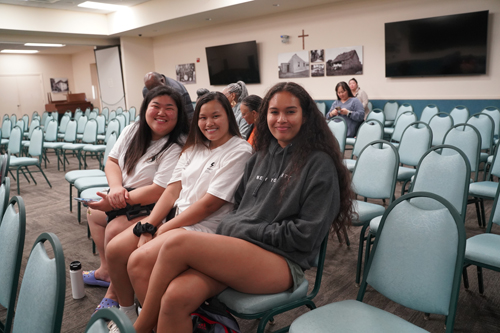
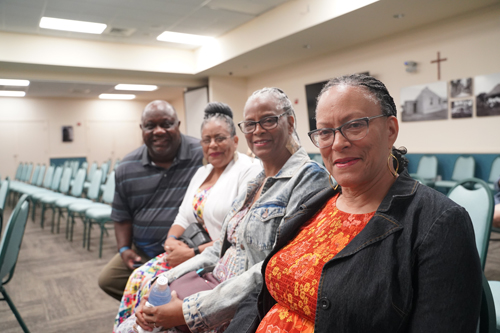
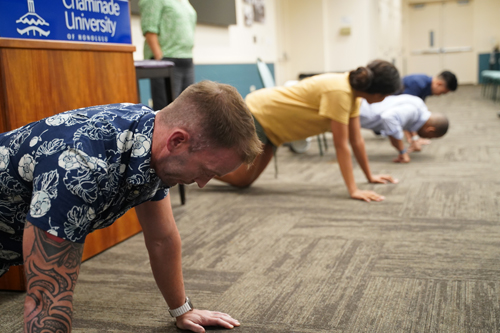
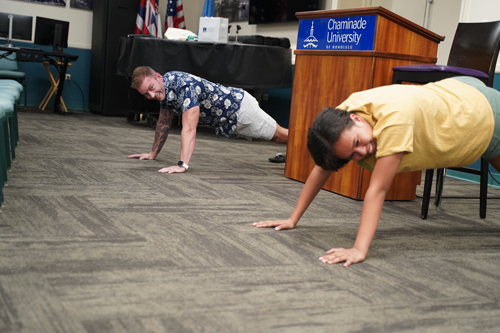
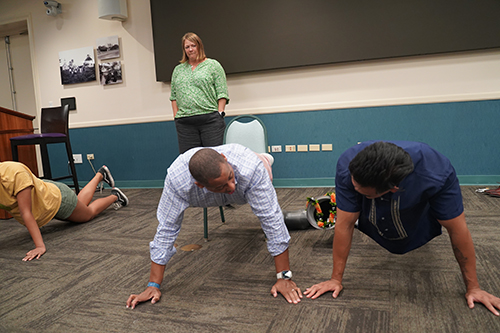
What is faith? What is spirit? And, how do you approach climate change from the different spiritual traditions? These were the three primary questions addressed during a discussion sponsored by the BDK-Fujitani Interfaith Program, which marks its 20th anniversary this year at Chaminade University. Originally named the Bukkyo Dendo Kyokai Reverend Fujitani Interfaith Program, the curriculum’s purpose is to bring together the Buddhist community with all other religious communities in Hawaii to promote interfaith dialogue, and to provide opportunities for understanding and action for peace and justice in our communities.

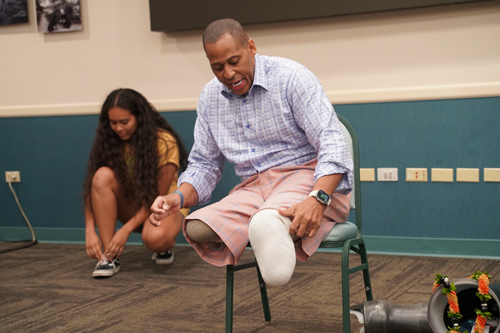
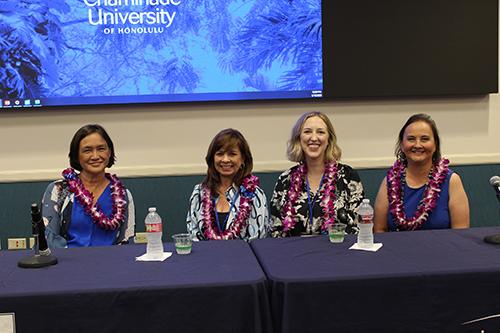
In a conversation themed, “Spirit in the Time of Radical Change,” panelists included Native Hawaiian practitioner Manulani Aluli Meyer, Buddhist David Atcheson, Indian Vedic specialist Akhilesh Tiwari and Mary Anne Magnier of Honolulu Friends Meeting, which is an open and affirming congregation that welcomes everyone.

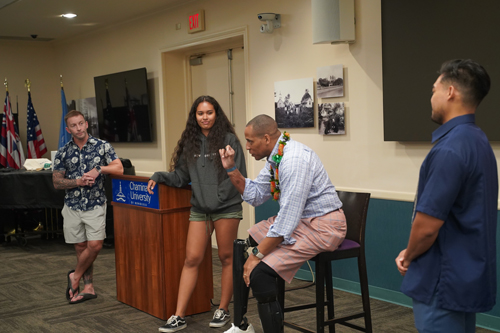
“I’ve never moderated anything in my life,” says Chaminade sophomore La‘a Gamiao ’25, who was tasked to lead the discussions. “I was really nervous, but I knew I had to be myself.”

Chaminade sophmore La’a Gamiao ’25 moderated the discussion themed “Spirit in the Time of Radical Change.”

Established in 2003 and named in honor of Yoshiaki Fujitani, a past president of BDK Hawaii, the program in the past has featured lectures, which were either usually based on a single speaker or based on panel discussions during which each panelist is given the floor to present his/her religious perspectives. The presentations would be followed by discussion among the panelists, and later opened to the audience for a Q&A session. 

“I was involved with the BDK-Fujitani Interfaith program years before Brother Bernie (Ploeger, Chaminade’s fomer President) stopped me in the hallway of Henry Hall and asked me to take over the program,” recalled Sr. Malia Wong, D.Min, Program Director for Chaminade’s BDK-Fujitani Interfaith Program. “He knew of my long involvement with the interfaith community in Hawaii and globally, but I felt I wasn’t ready to assume the position—especially moderating—and I deferred the position to Regina Pfeiffer.

In 2017, Cheryl Edelson, Dean of the School of Humanities, Arts and Design, asked associate professor Pfeiffer, D.Min., to fill the role as the head of Religious Studies. “Thus, I formally became program director of the BDK-Fujitani Interfaith Program, finally fulfilling Bro. Bernie’s wishes,” Wong laughed.

Upon the suggestion of Manulani Meyer, a moderator would be appointed to ask the question to the panelists, who would then be given a chance to respond. Wong explained that this format took a lot more preparation on the back end, not being quite sure how to organize the program so that it flows.

“Thus, I designed it with La‘a as the host and at the helm asking questions, and allowing discussions to grow organically.” Wong said. “The last part of the program included networking and continuing the conversation on the lanai with vegan pupu. It was like being with family and friends with the ease of interaction among guests of the different faith traditions. This will be our new format going forward—open to adaptation and change, a Marianist characteristic of education.”

For someone who has never moderated a discussion, La‘a was grateful that he was chosen as the first student host, despite his initial fears and nervous shakes.

“If you don’t answer, you’ll never know your character,” said Gamiao of agreeing to be the discussion’s moderator. “I put myself out there and the fact that I said yes, I think, says a lot about my character.”

Posted by: University Communications & Marketing Filed Under: Campus and Community, Catholic, Diversity and Inclusion, Institutional Tagged With: BDK-Fujitani Interfaith Program, Guest Speakers, Religious Studies

Commencement Address

May 15, 2023

Kauai Mayor Derek Kawakami ’01 delivers keynote speech

She had him at Chaminade. For many senior high-school students, trying to determine where to attend college depends on several factors: cost, location, size, personal interests, campus life, graduation rates and the potential return on investment. However, for Kauai Mayor Derek Kawakami ’01, the primary reason he chose Chaminade University was simple—he met a girl.

“I know it sounds shallow, but it’s the truth,” said Kawakami, this year’s 65th Commencement keynote speaker. “But knowing what I know now about Chaminade, I would have chosen it 1,000 times over any college in the country.”

The son of the late Charles and Arlene Kawakami, Mayor Kawakami is a third-generation Kaua‘i resident, and is now serving his second term as the Garden Isle’s chief executive officer. Having shepherded the island through a once-in-a-century pandemic and now through recovery, Kawakami does not shy away from the necessary hard work of what he calls, “the people’s business.” The physically fit 46-year-old is a no-nonsense-type of leader who likes to roll up his sleeves, get into his steel-toe-capped boots and don his hard hat at the drop of a dime.

During COVID, he was forced to make a series of difficult—and, at times, unpopular—decisions, including lockdowns, turning public camp sites into Safe Zones to prevent the spread of the virus, enforcing mandatory vaccine mandates and curfews, and instituting strict protocols and safety measures. Yet, through it all, he became widely known, erroneously by the way, as the TikTok mayor. A 30-second clip that he posted went viral on Instagram and not the aforementioned social media site. In the video, he performs an amusing dance and a card trick, then encourages people to wash their hands. It was all an effort, he said, to break the monotony of staying home.

With his wife Monica by his side, Kauai Mayor Derek Kawakami was sworn in for his first term by Kaua‘i Circuit Judge Randal Valenciano. (Photos courtesy County of Kauai)
Mayor Kawakami welcomed 11 new firefighters with the Kauai Fire Department. (Courtesy of County of Kauai)
Mayor Kawakami enjoys meeting and greeting his constituents from across the island. (Photo courtesy of Friends of Derek Kawakami)
The Twitter video that went viral.
Mayor Kawakami knew from a young age that he wanted to serve the people of Kauai. (Photo courtesy of Amanda C. Gregg)
Members of Mayor Kawakami’s cabinet.
Mayor Derek Kawakami during a groundbreaking ceremony.
Mayor Derek Kawakami during a groundbreaking ceremony. (Photo courtesy of Friends of Derek Kawakami)
Monica and Derek Kawakami enjoy participating in community events, including the long-running Taste of Hawaii.

“I have to say my wife put me up to it and my daughter instigated it,” Kawakami chuckled. “We just wanted to help people get through some tough times, we wanted to do it together, and at the end of the day, we wanted people to feel like they mattered and that we cared about them.”

He attributes this empathy as one of the values he learned while completing his bachelor’s degree at Chaminade, where his now-wife, Monica nee DeBusca Lizama, also graduated with an undergraduate degree in 2001 and a master’s in education in 2003. A self-described average “C” student, Kawakami evoked the memory of several Chaminade professors, who made an impact in his life, during his commencement address.

One such individual was the late Marlene Baker, who enjoyed a 45-year career in the Students Success and Records office. Kawakami said he would bring Kauai cookies to her so that she would build him a favorable schedule, quipping that was probably his first sign of being a politician. Henry Gomes, or “Uncle Henry” as Kawakami affectionately refers to the late revered professor, would talk to him about “country-kine things,” and made him feel like it was perfectly OK to just be him. Then there was recently retired Yukio Ozaki, who opted not to cancel an art class, even though enrollment plummeted from 15-20 students to a lone Kawakami overnight.

“Now that I have 20/20 hindsight vision, what I’m about to say is the last thing my professors would want to hear,” Kawakami said. “As the sands of time have passed, some of the knowledge, some of the details of the countless hours of classroom lessons, lectures and knowledge have faded. But what has remained is how the power of the human element can change the trajectory of one person’s life. All it takes is just one person. One person that believes in someone and is willing to invest time, effort and kindness can uplift a community.”

It’s with this indomitable spirit that helps inform Kawakami’s leadership. He cited three principles that he follows: 1) Act in good faith, which helps build trust; 2) always act with the community’s best interest; and 3) establish a sound, prudent process of decision making.

“Not everyone will agree, but I can defend my position,” Kawakami asserted. “Compromise is an art, and by compromise, I don’t mean consensus, which, when I hear, often tells me that things are not going to move forward.”

Life for Kawakami has certainly had a forward momentum. When he graduated from Chaminade, his first job was a grocery clerk for Longs Drugs Kaimuki. The pay was $200 per week, and his duties included sweeping the floors, stocking the shelves and racks with those familiar yellow books, and whatever needed to be done.

“I had to put my business degree to work,” Kawakami said. “I started at the entry level, but that’s how I thought it would work. Just because I had a degree didn’t mean I was going to start at a higher level. My degree was supposed to give me the tools to get to that next level, and it did.”

One day, he received a call from his dad, asking him to come home to help out in their own grocery store. His dad told him If he could work at Longs, then certainly he can work at the family’s own enterprise. However, there was one problem: Monica was pursuing her master’s, and she wasn’t about to quit and return to Kauai. So, she proposed an ultimatum: He had to marry her.

“I went to Kahala Mall and applied for a loan, which was my first loan ever,” Kawakami recalled. “I qualified for $9,000—which was big bucks back then for me who was making $200 a week—and I went upstairs to a diamond specialist, and chose an engagement ring.”

Married now to Monica for 20 years, the couple has two children, Hailee and Christopher. A dedicated family man, Kawakami praises his family for their support throughout his two terms as Kauai’s Mayor, as well as his years of service on the State Legislature. He also credits his experience at Chaminade as helping shape his style of leadership.

“I have a lot of clear memories of my time at Chaminade, and the people who made an impact on my life; the faculty and staff truly cared for us,” Kawakami said. “I gained a worldly view of different cultures, and how to appreciate our differences.”

And despite all the pressures of governing, Kawakami said, from a pressure standpoint, being the Commencement keynote speaker was a big one.

“If I were to go back to my 20- or 21-year-old self, and be told that I was going to be the Commencement speaker at Chaminade one day, I would have said ‘Get out of here!’” Kawakami said. “I never imagined a picture in which I would be in a position speaking to the graduating class and their families. I’m grateful for this opportunity to come back around and to be part of this Commencement.”

Kauai Mayor Derek Kawakami ’01 shared his memories of Chaminade while a student majoring in business administration.

Posted by: University Communications & Marketing Filed Under: Alumni, Campus and Community, Diversity and Inclusion, Featured Story, Homepage, Institutional Tagged With: Campus Event, Commencement, Guest Speakers

Congratulations to the Class of 2023

May 10, 2023

Inspiring words from Dr. Lynn Babington, Kauai Mayor Derek Kawakami and Selected Student Speakers

In his opening remarks to graduating students, Kauai Mayor Derek Kawakami ’01, reflected on his time on campus with his wife Monica and his own commencement. “As I look out into the sea of graduates, I see my own reflection in you,” said the 2001 Chaminade alumnus. “It makes me realize how quickly time goes by. But time is just a measurement, until it is filled with very special people who make tremendous impacts in our lives. And today, on this beautiful occasion, as you generously give me your time, each of you becomes a part of my life as well.”

The Commencement ceremony began with a special invocation from Fr. Martin Solma, Chaplain and Special Assistant to the President at Chaminade. President Dr. Lynn Babington then addressed graduates, acknowledging their accomplishments and sacrifices—especially in the face of global uncertainty.

Chaminade President Dr. Lynn Babington addresses graduates at Commencement.

“One of the distinguishing features of a Marianist education is a focus on adaptation and change—skills critically important in today’s challenging world,” Babington exhorted. “You have certainly become more comfortable with navigating the unknown. The ability to work with ambiguity means you’ll be able to face uncertainties, adapt to change and be flexible as the mysteries of life unfold.”

For many graduates, the ceremony is a time of reflection, pride and perseverance, especially with this particular graduating class, which endured a once-in-a-century pandemic, Covid protocols and restrictions, social distancing and a pivot to an online schedule before transitioning to a hybrid model.

“We’re all here today together, making it across that finish line,” said undergraduate speaker Eri Leong. “Through fears and failures, exams and assignments, break-ups and breakdowns, even through a global pandemic, no hurdle was high enough to keep us from walking this stage. Instead, we emerged triumphant over every adversity under the sun. And we’ll carry that unwavering resolve into the abundant opportunities that lie ahead.”

In Simon Bronner’s 1990 book “Piled Higher and Deeper: The Folklore of Student Life,” a chapter devoted to graduation explores how commencement has been celebrated across campuses and throughout the years.

According to the book, some colleges host 100-day countdowns to commencement, with a number of graduation-themed activities. At other schools, graduating seniors leave wills to underclassmen. Some institutions celebrate graduation with a balloon launch to symbolize students moving upward, while others have held ceremonial bonfires where seniors burn course materials or early drafts of their senior theses. 

However, even with variation from campus to campus, the commencement ceremony itself remains very much a traditional event, a punctuation point to the collegiate experience with many customs deeply rooted in history, including the caps and gowns, university mace, and guest and student speakers.

“Commencements are a time to join as a community to celebrate the work of our faculty and staff who have supported you throughout your years of study with us, and we celebrate new beginnings,” Babington said in in her address to students. “You are leaving Chaminade University to go out and engage in the world as professionals, as neighbors, as citizens.”

Graduating with a Master of Arts in Teaching, Todd Sibley was selected by his peers to be the evening’s graduate speaker. Immediately preceding the pandemic, the native Californian worked as a social worker for a Hawaii nonprofit organization. When COVID spread across the islands, Sibley lost his job, and he decided to pursue his master’s in teaching social studies in secondary schools.

“Graduates, we have proven ourselves to be resilient, resourceful and resistant to giving up,” Sibley asserted. “The global pandemic would have been an easy excuse to have quit on ourselves and our dreams, but we didn’t. We persevered no matter the obstacle because that’s what we faced—obstacles not barriers.”

As Kauai Mayor during the pandemic, Kawakami confronted his own difficult decisions, turning camp grounds into Safe Zones, ordering shut downs and unpopular vaccine mandates. And through it all, he thought only of his constituents, responding to their needs in the most dire of times.

“What I got most out of my time at Chaminade wasn’t the correct way to structure a sentence or what I gained out of my statistics class; it wasn’t what I gained out of a book,” Kawakami said.  “It was the importance of the human element, and the power that simple random acts of kindness can shape the future of one person’s life. That although certain things will fade overtime, the people who cared, the ones that shared, the ones that believed, and made you believe in yourself, will remain with you.

“I feel incredibly grateful to witness this commencement of your next step,” he concluded. “Fair winds and following seas, always be caring and always be trustworthy. Congratulations to this beautiful graduating class of Chaminade University!”

Dr. Lynn Babington presents diploma to graduating student
Student Athlete
Graduating Students
Father Chaminade
Sarah Robertson is all smiles, even with crutches
Janine Abad posed with her family and friends.
MBA graduate Jeremiah Bautista poses with family and friends.
Provost Dr. Lance Askildson
Keynote speaker Kauai Mayor Derek Kawakami
Graduate speaker Todd Sibley
Undergraduate student speaker Eri Leong
A promising message on a mortarboard
Emcee Kaipo Leopoldino
All smiles and laughs
BSN graduates with Student Athlete
Graduates' family and friends attended the Chaminade Commencement at the Waikiki Shell on May 6.
Graduates’ family and friends attended the Chaminade Commencement at the Waikiki Shell on May 6.

Posted by: University Communications & Marketing Filed Under: Alumni, Campus and Community, Diversity and Inclusion, Featured Story, Homepage, Institutional Tagged With: Alumni, Campus Event, Guest Speakers

Hogan’s Hero

April 21, 2023

Haelee Tallett ’18 Champions Entrepreneurial Program

Before ceding the room to Haelee Tallett —or Haels, as she prefers to be called— Hogan Entrepreneurial Leadership Program director, Dr. Roy Panzarella quipped that the Hogan Speaker Series is setting a new Guinness World Record tonight by inviting the youngest guest speaker ever.

“Don’t worry, I’ll get to that,” Tallett joked about her age. “I’m not mysterious and I don’t put on any façades. I’m an open book with a story to tell and I’m glad to tell it.”

Tallett’s entrepreneurial achievements certainly belie her youthful age of 26. Owner and CEO of Ocean Creations, a custom jewelry company inspired by her love for the ocean, the Hogan Entrepreneurial Program ’16 and Chaminade ’18 Business Administration graduate began her now-thriving business as a hobby when she was a young 16-year-old teenager.

“I just learned that when Haels was a freshman at Chaminade, she already wanted to enter the Hogan program, which wasn’t possible because entry requires students to be juniors, seniors or graduate students, but she was determined,” Panzarella told attendees. “It’s powerful what she has been able to achieve, and is now giving back to the community.”

Entrepreneur Haelee Tallet discussed her business, Ocean Creations, during the Hogan Speaker Series.

The point wasn’t lost among attendees and Tallett’s support network of 10 employees and close friends, including her former Chaminade classmate, Brandon Espiritu, ’16. “She has always worked hard so I’m here to support her,” he said. “It’s nice to see Haels achieve so many milestones and I’m super proud of her.”

Tallett’s modest beginnings started with her brother’s passion for diving and bringing home shells of all shapes and sizes. Initially, she would turn the shells into whimsical jewelry for herself, but she would eventually give them as gifts in hopes of saving money. Then the compliments and requests came in.

“I wanted to make jewelry that was affordable and made young women feel good,” says Tallett, who recently expanded Ocean Creations with a second location at Ala Moana Center. “I wanted to empower young women to be the best of themselves.”

Tallett credits Chaminade for shaping her as an entrepreneur, and teaching her what she calls the necessary “soft skills” to run a business. “The professors here taught me confidence building and effective communicating,” said Tallett, who opened her first brick-and-mortar shop at Ka Makana Ali‘i in Kapolei. “They told me about challenges that an entrepreneur will face and how to meet them.”

Haels, though, isn’t the first generation of Talletts to attend Chaminade, Panzarella pointed out. “I believe her grandfather came here [Willibrord “Willie” K. Tallett ’61] and also her aunt [Theresa (Tallett) Edwards ‘89].”

“I’ve always been super interested in Chaminade because of my grandpa,” the younger Tallett said. “And I’ve always wanted to be in the Hogan Program. My relationship with the faculty still stands out as very special because my professors were so committed to helping us along the way. They would always go the extra mile, and my classmates and I knew we could count on them to help us, even if it wasn’t directly related to our classwork.”

As for the future, Tallett hopes to grow her business and to continue to have the opportunity to support young women. Standing in front of the class, the young entrepreneur encouraged the budding MBA students to pursue their dreams.

“When I was in your position I had no idea I would have two stores in two of Hawai‘i’s largest malls,” she said. “I wake up sometimes and I feel like I have impostor syndrome, and I ask myself, ‘How did I get here?’”

Posted by: University Communications & Marketing Filed Under: Hogan Entrepreneurial Program Tagged With: Alumni, Guest Speakers, Hogan Entrepreneurs Program, Honors and Awards

Words of Wisdom

March 10, 2023

Villanova scholar offers strategies during her ‘A Life Worth Loving’ lecture 

Two college students. Two different experiences. And one identical outcome: Brooke and Sophia (pseudonyms for two Villanova roommates) ended up, on separate occasions and during their same senior fall semester, in Dr. Anna Moreland’s office—in tears.

During her freshmen year, Brooke developed paralyzing anxiety about her future, which resulted in weekly therapy sessions. In her sophomore year, she decided to isolate herself, alienating her entire group of friends, and only talking to her boyfriend. The 18-year-old also chose to keep herself extremely busy, thinking that it would alleviate her angst.

“It didn’t work; it just made things worse,” read Moreland, sharing Brooke’s letter with attendees during her “A Life Worth Loving” lecture on Feb. 19. “It did help me fill my resume, and I thought it would help guarantee me a job. Now I’ve got what all my friends want: a well-paying job at a top bank. But, I wasn’t sure this is what I wanted. I felt backed in this career because it was something practical and prestigious.”

Dr. Anna Bonta Moreland received the Mackey Award for Catholic Thought.

In Sophia’s case, the then-freshman did not want to repeat what she felt in high school—burnout and competition. So, she decided that her college experience would be focused on what she wanted to learn, which was anthropology. However, in her senior year she had no idea on how she was going to go “from courses she loves to a life she loves and to a professional life that she actually wants to do,” according to Moreland, whose discussion centered around her third forthcoming book, “Daring to Live: A Guide to a Meaningful Life,” co-authored with former colleague Dr. Thomas Smith from Catholic University of America.

“This is a book that I almost randomly wrote,” Moreland recounted. “But I wrote it after 17 years of listening to my students and being concerned about them. I wanted to give them a wider vocabulary and a wider vision for a good life.”

Moreland offered three challenges that confront young adults in today’s world: the meaning of work; the meaning of leisure—which she quipped—they don’t even know how to spell; and loving relationships.

“Young men and women really suffer from choice paralysis,” Moreland said. “We need to help them move through this. We need to help them think more broadly, more ambitiously and more fully about the lives that they are building.”

During her lecture, Moreland asserted that Brooke and Sophia treated high school like a race with a clear end marker—college. They had won the race. And now that they were in college, they were again treating the experience like another marathon.

Lecture attendees listened to Moreland's "A Life Worth Loving."
Lecture attendees listened to Moreland’s “A Life Worth Loving.”

“But college is not a marathon,” Moreland said. “It’s a big confusing supermarket—think of Costco or Sam’s Club.

“Brooke races through the aisles, throws things in her cart, and races to the cashier,” Moreland added. “Sophia ends up being paralyzed in one of those overwhelming Costco aisles, unable to move or commit to the 84 rolls of toilet paper.”

They both suffer from choice paralysis. They’re both hungry, but they don’t know for what.

The Villanova Department of Humanities professor later spoke to Brooke and Sophia about four ingredients that would help them move through those aisles: 1) to rehabilitate their imagination; 2) to move away from pro-and-con lists and from right and wrong, and towards goods versus goods or rights versus rights; 3) to not think about what they’re good at, but to think about what they want to become good at; and, 4) to encourage them to seek companions.

The latter point is of great concern to Moreland, who said that young adults don’t know how to form long, loving relationships because of their fear of failure and rejection.

“The hook-up culture is not the problem,” Moreland said. “It’s actually the epidemic of loneliness.”

Dr. Moreland discusses the challenges that college students face today on campus.

It starts with technology, and being enslaved to our phones and, for some students, alcohol.

“Marry the two and it ends up being an exhausting social life and a toxic combination for leisure time,” Moreland explained. “How you spend your leisure time shapes you, molds you and changes you, just as much as how you spend your work time.”

Moreland believes we need to reclaim our free time, and redefine how we choose to spend that time.

“There’s an epidemic of loneliness on campuses across the country, and it is heartbreaking to me,” the religious scholar said. “And if they’re lonely, there’s no way to develop a great leisure life because friendship is at the heart of leisure practices. Loving is at the heart of human life, and friendship, loving relationships are at the heart of how we should spend our leisure time.”

In conclusion, Moreland ended with a hopeful story about a group of Villanova students who bonded through a shared passion for playing The Settlers of Catan and service.

Reciting a junior student’s letter aloud, Moreland read: During one night of heavy drinking, we all admitted to each other that we loved playing The Settlers of Catan with our friends and families growing up. We started jostling with each other about who could build the largest settlement.

By the end of the night, the group decided to start playing regularly, getting together once a week to play Catan, which eventually expanded to include other games.

“It was the first time in college that I had done any fun type of activity that was planned other than drinking,” the student wrote. “We became really close, and they’re still some of my best friends today. I actually met my boyfriend through Catan nights. This is my favorite memory of college.”

Posted by: University Communications & Marketing Filed Under: Catholic Tagged With: Campus Event, Guest Speakers, Marianist

Chaminade Hosts Virtual Forum with Medical Team Who Performed the First Pig-Heart Transplant

June 24, 2022

In January 2022, 57-year-old David Bennett, Sr., was suffering from terminal heart disease when he made history—and grabbed headlines—as the first person to receive a genetically modified pig’s heart. The groundbreaking operation inspired millions and heralded a new frontier in transplant science.

Bennett, Sr., lived for two months with his donor heart before his condition deteriorated and he was administered palliative care when it was clear he would not recover. David Bennett, Jr., said his father will be remembered for his humor, his kindness, and his ardent belief in the power of education.

It was that legacy that helped make a rare opportunity a reality for the Silversword community.

On the afternoon of May 31, about 100 Chaminade faculty members and students gathered for “Advances in Porcine Xenotransplantation,” a virtual forum with Bennett, Sr.’s, medical team and his son. The event was an opportunity for attendees to unpack the latest on the first-of-its-kind transplant, while also learning more about David Bennett, Sr., the “goofy” patient and beloved father and grandfather.

“It’s an honor and privilege to do this for my dad, who helped to advance science,” David Bennett, Jr., told participants. “He was always generous with his time and he always reminded me how proud he was of me. My dad was somebody who had lots of friends and who got along with people very well.”

Dr. Bartley Griffith

Dr. Bartley Griffith, the world-renowned cardiothoracic surgeon who performed the surgery at the University of Maryland Medical Center, said Bennett, Sr., was a “terrible candidate” for the operation “in the truest sense of the word.” His overall health was poor and his ability to fight infections low.

“He would be classified as almost untreatable by transplantation standards,” Griffith said.

He was also deemed ineligible for a traditional heart transplant.

“The only thing about Dave that made him a great candidate was his toughness,” Griffith told participants, adding genetically modified pig hearts had only ever before been transplanted into non-human primates. “We didn’t know if the pig heart would work for two minutes, two days, two months or two years. The testing of this was just done in animals and they have a different immune system.”

Dr. Genevieve Griffiths, Dr. Claire Wright and Dr. Sandra Bourgette-Henry, of Chaminade, moderated the conversation and presented questions gathered in advance from students and members of the faculty.

Wright, an associate professor of Biology, called the forum a great opportunity to learn about the scientific and human aspects of a massive medical innovation. “This was a human who meant so much to his family and friends and now leaves us with this wonderful legacy,” she said.

Griffith, the surgeon, agreed. “We are doing exactly what Dave Bennett, Jr., requested of us, which is to learn something and to spread that learning to those who are interested,” he said. Griffith added there is still much to discover about the transplant itself and about Bennett, Sr.’s, cause of death.

“We are still working with tissues to take a deep dive on what really happened,” Griffith said.

Dr. Kapil Saharia

Dr. Kapil Saharia, an assistant professor of Medicine at UMMC’s Institute of Human Virology and Bennett’s infectious disease specialist, said the transplant underscores just how far transplant science has come in the last decade alone. “I think this is setting the stage for really bigger steps,” he said.

Dr. Alison Grazioli, UMMC medical director and the head of the Cardiac Surgery Intensive Care Unit, added Bennett, Sr.’s, transplant was “in many regards a success. We learned so much from Mr. Bennett and will continue to do so. It is everybody’s great hope that xenotransplantation will continue to improve.”

Dr. Aison Grazioli

Grazioli spent long days—for months—caring for Bennett, Sr., and said she built strong relationships with him and his family along the way. “The greatest thing we got out of it was getting to know Dave Bennett, Jr., and his family,” she told attendees. “All of those unexpected things and all the hurdles that we had to overcome, it was made so much easier that we developed relationships with such great people.”

In response to a question about what’s next for animal organ transplants, Grazioli said more breakthroughs are around the corner. “There’s talk of clinical trials where we can, in a rigorous way … really get to define who should get these transplants and save the most lives,” she said.

“Mr. Bennett energized the science and I think you’re going to hear a lot more about it.”

Posted by: University Communications & Marketing Filed Under: Campus and Community, Featured Story, Natural Sciences & Mathematics, Nursing & Health Professions Tagged With: Guest Speakers

  • « Go to Previous Page
  • Page 1
  • Page 2
  • Page 3
  • Page 4
  • Page 5
  • Page 6
  • Interim pages omitted …
  • Page 9
  • Go to Next Page »

Footer

Chaminade University Logo

3140 Waialae Avenue
Honolulu, Hawaii 96816

Contact Us
Phone: (808) 735-4711
Toll-free: (800) 735-3733

facebook twitter instagram youtube linkedin

Visit

  • Plan Your Visit
  • Campus Map (PDF)
  • Events

Resources

  • Campus Security
  • Student Consumer Information
  • Concerns, Feedback, and Reporting
  • Institutional Review Board
  • Title IX / Nondiscrimination Policy
  • Compliance
  • Emergency Information
  • Careers
  • Institutional Statement

People

  • Students
  • Parents
  • Alumni
  • Faculty & Staff

Policy

  • Privacy Policy
  • Terms and Conditions of Use


© Chaminade University of Honolulu