• Skip to primary navigation
  • Skip to main content
  • Skip to footer
Chaminade University of Honolulu

Chaminade University of Honolulu

  • VISIT
  • APPLY
  • GIVE
  • STUDENTS
  • PARENTS
  • ALUMNI
  • FACULTY/STAFF
  • Admissions
    • Admissions Home
    • Undergraduate Students
      • First-Year Students
      • Transfer Students
      • Admitted Students
    • Graduate Students
    • Flex Online Undergraduate Program
    • Military Students
    • Non-Degree/Visiting Students
    • Experiential Honors Program
    • Early College Program
    • New Student Orientation
  • Tuition & Aid
    • Financial Aid Home
    • Tuition & Expenses
    • Federal Updates & Changes
    • Scholarships
    • $5,000 Graduate Scholarship
    • VA Education Benefits
    • Net Price Calculator
  • Academics
    • Academics Home
    • Academic Programs
    • Office of Student Success
      • Academic Advising
      • Records and Registrar
    • Kōkua ʻIke (Support Services)
      • ADA Accommodations
      • Career Services
      • Proctoring Services
      • Tutoring Services
    • Sullivan Family Library
    • Undergraduate Research & Pre-Professional Programs
    • Commencement
  • Campus Life
    • About Campus Life
    • Student Engagement
    • Student Government Association
    • Residence Life and Housing
      • Summer Conference Housing
    • Health Services
    • Marianist Leadership Center
    • Counseling Center
    • Campus Ministry
    • Campus Security
    • Dining Services
    • Bookstore
  • Athletics
  • About
    • Chaminade University News
    • Our Story
    • Leadership
    • Chaminade University Strategic Plan 2024-2030
    • Mission & Rector
    • Association of Marianist Universities
    • Facts & Rankings
    • CIFAL Honolulu
    • Accreditation & Memberships
    • Montessori Laboratory School
Search
×

Search this web site

Education

Artificial Intelligence

January 18, 2024

Embracing the use of AI in education

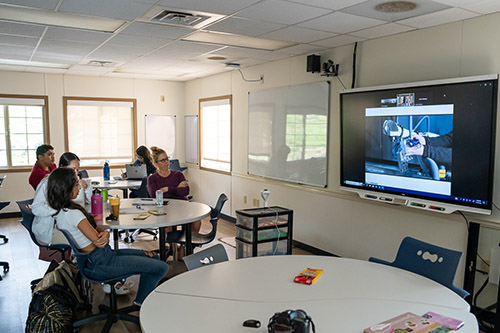
Dr. Denise Dugan believes that AI will only continue to progress and evolve as new data flows in.
Dr. Denise Dugan believes that AI will only continue to progress and evolve as new data sets flows in.

Long before it was reduced to an uppercase two-letter acronym, artificial intelligence (AI) was already present in education with early systems focused on using simple algorithms to automate certain educational tasks. In the 1970s, the emergence of Intelligent Tutoring Systems (ITS) was designed to provide personalized instruction based on individual student needs, more commonly known today as Individual Educational Plans. These days, OpenAI dominates the conversation and headlines.

“AI has been in education in some iteration for decades now,” says Denise Dugan, Ph.D., Assistant Professor of Special Education and Elementary Education. “The danger of AI these days is that current students have too much reliance on it, rather than simply using it as another available resource.”

In an op-ed to the “Chicago Tribune,” Chaminade Provost Lance Askildson opines that recent advances in artificial intelligence have given rise to hyperbolic predictions of the decline of many human roles and professions.

“In fact, purported AI platforms such as ChatGPT will never be meaningful replacements for writers, educators or people in general,” Askildson writes. “To understand why this is true, it is critical to remind ourselves of what ChatGPT is and how its architecture and capabilities relate to the science of human learning and the arts of writing and teaching, respectively.”

The conversation around AI didn’t just begin in 2023. The U.S. Department of Education initiated a project exploring the use of generative AI in 2020, partnering with Digital Promise to collect information and insights. Recently, the outcomes of that work were released by the U.S. Department of Education Office of Educational Technology. Titled “Artificial Intelligence and the Future of Teaching and Learning: Insights and Recommendations,” the new report addresses the clear need for sharing knowledge, engaging educators, and refining technology plans and policies for artificial intelligence (AI) use in education.

The report further describes AI as a rapidly-advancing set of technologies for recognizing patterns in data and automating actions, and guides educators in understanding what these emerging technologies can do to advance educational goals—while evaluating and limiting key risks. This paper also explains AI in education and gives a pros-and-cons summary, and suggests districts develop a policy defining parameters for AI use in education.

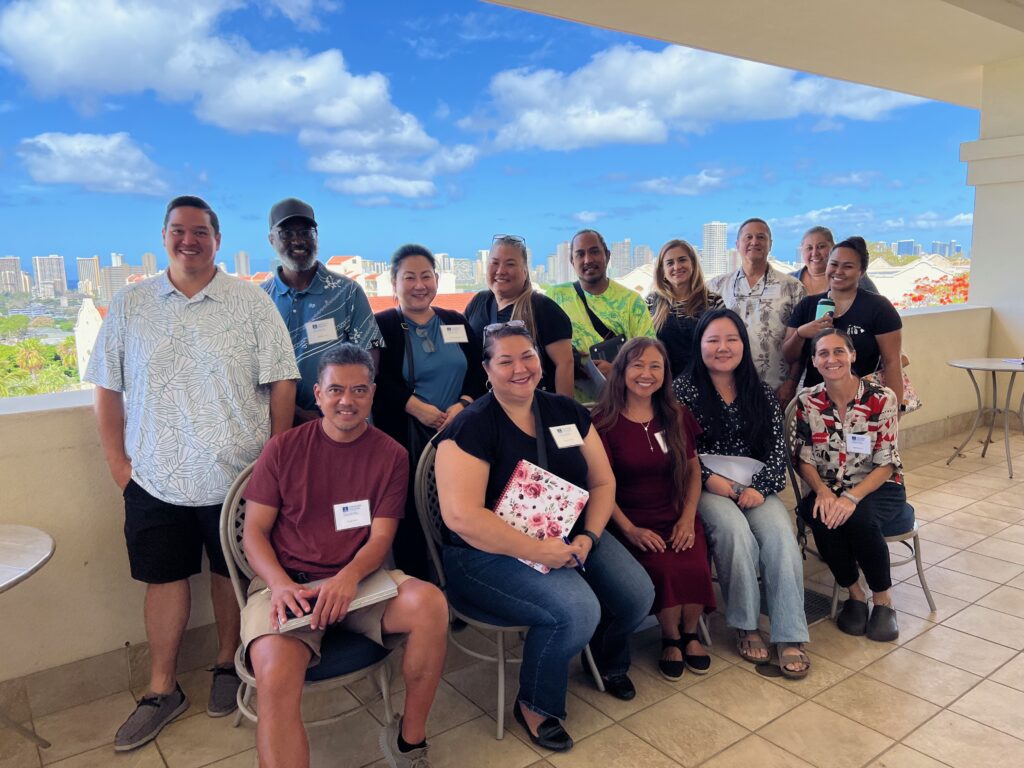
During an educator workshop hosted by Hawaii Education Association, Dugan and Chaminade students Abigail Eli ’23 Gabe Zapata-Berrios ’24 were among the attendees who discussed not only the ethical dimensions of AI, but also its legal ramifications.

“I can see how AI is having an impact on educators and students,” says Eli, who is pursuing her master’s in counseling psychology at Chaminade and is one of three Community Homeless Concerns liaisons with the Hawaii Department of Education in the Nanakuli-Waianae Complex Area. “I think it could be beneficial for our Waianae students who struggle with the concept of writing. I think they can learn from seeing something that’s well written.”

Starting his student teaching in Kailua, Zapata-Berrios has experimented with AI in his own studies, using it, for example, to create lesson plans, which typically take a lot of time.

“AI will write a complete lesson plan in less than 10 seconds,” Zapata-Berrios says. “This lesson plan is typically pretty good as a first draft. If I want I can ask the AI to revise it for me or I can just take that draft and revise it myself. I would always recommend revising it yourself because AI is not perfect.”

Abigail Eli '23 is now pursuing her master’s in counseling psychology at Chaminade.
Abigail Eli ’23 is now pursuing her master’s in counseling psychology at Chaminade.

While academic dishonesty tops the list of educators’ concerns about AI in education, teachers also worry that increased use of AI may mean learners receive less human contact. It’s a valid point that Askildson succinctly affirms in his letter to the editor, noting that “the science of human learning has shown us that students learn not only through their abilities of reasoning, interpretation and creative expression—which ChatGPT lacks— but also with the help of teachers who engage them in a two-way dialogue accompanied by feedback that is adjusted to their understanding and overall needs.”

From a student’s perspective, the use of AI in education comes with both benefits and potential pitfalls. Some view AI-powered tools as a way to provide additional support to students with diverse learning abilities, making education more inclusive. It can then assist in addressing specific challenges students may face.

Others are skeptical about its accuracy and its susceptibility to spread misinformation and disinformation. It’s also biased since AI can only be as smart or effective as the quality of data it is provided, and algorithms can be manipulated and skewed.

“Some of the teachers we heard from said they wanted to stay away from AI all together, that it was too controversial,” Dugan says. “They were afraid of plagiarism and cheating, and not being able to detect it. But I say AI is here to stay; it’s not going to go away and it will only progress.”

“AI is going to keep growing and infiltrating more parts of our lives,” adds Zapata-Berrios. “It’s already all over the place and constantly analyzing and improving. It will become more prevalent in classrooms, however, I don’t think it will become something that the students use to outsource their thinking. I think it’ll be present without the students knowing it’s there.”

Posted by: University Communications & Marketing Filed Under: Education, Faculty, Homepage, Innovation, Institutional, Student Life Tagged With: Elementary Education, Master of Arts in Teaching, Secondary Education

True Calling

December 18, 2023

As a Zoo Camp instructor, Sara Aliza Sahagon finally found her true passion—to teach.

Sara Aliza Sahagon ’24 holds down two jobs: her regular day job as a long-term substitute teacher at Kauai High School and what she defines as her “heart job,” which is taking care of her community service programs, a passion she has maintained since she was a young Chamorro in Guam.

“I wanted to become a social worker when I was younger,” says Sahagon, who will walk in the May 2025 Commencement Ceremony. “I was volunteering with Youth for Youth LIVE! Guam, which is a non-profit community-based, youth-centered, youth-driven drug prevention program for teens between the ages of 11 and 17. This is what I thought I was going to do for the rest of my life.”

Sara Aliza Sahagon serves as the head advisor with Kauai High School's Key Club, which focuses on community service.
Sara Aliza Sahagon serves as the head advisor with Kauai High School’s Key Club, which focuses on community service.

Her mom, Stacey Coletta, had other plans for her daughter. Although accepted into Stanford, Coletta was restrained from attending the private research university due to tuition and board costs. Understandably, she wanted Sara and her older sister, Hanna, to move off island, and to explore and experience the world through another lens.

In her senior year at Notre Dame in Talo’fo’fo’, Sahagon applied to the University of Hawaii–Manoa and Hawaii Pacific University (HPU). Unfortunately, she admittedly missed the Chaminade University application deadline.

“I wanted to find an open world,” Sahagon says. “I wanted to meet new people who weren’t related to me. I wanted to experience new things, but I still wasn’t ready to leave the island lifestyle all behind, like my older sister did when she went to school in San Diego. So, Oahu was perfect for me.”

Accepted to HPU, Sahagon was excited to go to college … until she got there. The classrooms, she says, felt like they were closing in on her and doubts of her academic knowledge crept in, incapacitating her from thinking and constantly intimidated by her fellow classmates. It was a shock to Sahagon because she had always been at the top of her class back in Guam, earning As and merits for her work.

“I couldn’t deal with traditional college,” Sahagon says. “I felt dumber than everyone in the room, and it really brought me down. So, I dropped out after my first year.”

After bouncing from job to job, from Kate Spade to Bath & Body Works, Sahagon landed an instructor position with the Honolulu Zoo’s “Zoo Camp.” After years of searching, the 23 year old finally found her true calling. She flourished, and learned and absorbed everything she could about zoology—from the various species to their different habitats.

“I worked at the Zoo for three years until COVID hit,” Sahagon laments. “I loved teaching and I knew that’s what I wanted to do. I did find another position with After-School All-Stars Hawaii, which provides school-based, after-school and summer programs for underserved communities and students. I ran my own site.”

As fruitful and satisfying as the experience was at After-School All-Stars Hawaii, constantly nagging in the back of Sahagon’s mind was college. By now, her mom—a lifetime educator and the current vice principal (Academy of Human Services) at Kauai High School—had moved to the Garden Isle, and they would frequently speak of Sahagon returning to college. Sahagon, though, was trapped in that circuitous 9-5 cycle on Oahu. She would constantly tell herself that she was going to be a teacher and no one was going to stop her—except herself.

Sara Aliza Sahagon's experience as a Zoo Camp instructor led her to finally find her true calling.
Sara Aliza Sahagon’s experience as a Zoo Camp instructor led her to finally find her true calling—to teach.

Although Coletta initially discouraged her two daughters from becoming teachers—only because she knew how hard it is to be a teacher— having been one herself for years—she was now supporting Sara’s dream. It was now or never.

“My mom told me that if I wanted to become a teacher, now was the time because there’s a shortage of teachers every where,” Sahagon recalls. “She had one stipulation: I had to move to Kauai. She said to me, ‘You’re going to get it done and you’re going to do great things.'”

It was enough of a push to motivate Sahagon to move with her mom and stepdad. She began researching various programs and colleges, and looked into the online programs at University of Phoenix. In the end, Chaminade’s Flex option won her over.

“I chose Chaminade because it keeps spirituality at the forefront, which helps keep me grounded,” asserts Sahagon, now the head adviser of the high school’s Key Club, which focuses on community service. “I also hold the same Marianist-Catholic values. I know that everything I do has a purpose; every exam, every activity and every paper has meaning.”

Now in her second year of the Flex program, Sahagon’s Chaminade experience is the antipode of HPU. These days, it’s just her in the competition, and she feels she has “strong support” from the University’s faculty and staff. Sahagon says, with her Chaminade education, she will be well prepared to have her own classroom. She has already applied concepts that she has learned in her classes with her students. And she has learned different teaching strategies that are effective. 

“I wish I had applied to Chaminade earlier,” Sahagon says. “It’s been a very positive experience and I love being a Silversword. I feel truly blessed to be able to finish my college degree at Chaminade.”

Posted by: University Communications & Marketing Filed Under: Education, Featured Story, Institutional, Student Life Tagged With: FLEX Program, Secondary Education

Early Childhood Education

November 30, 2023

Flex program allowed Sienna Delano to work in a classroom and as a fairytale character

She has been Snow White. She has dressed up as Belle. And Sienna Delano ’23 has even donned on the wings of Tinkerbell. Her ultimate princess fairytale, though, came true in May when she slipped into her blue gown and sashayed across the stage to receive her Chaminade University bachelor’s degree at the Waikiki Shell. But, it has not always been an animated Disney fantasy world for the Kapolei resident.

“When I was in high school, I was dealing with health issues that impeded me from actually attending school,” says Delano, who received a B.S. in Early Childhood Education. “The underlying problem was gastritis, which caused me to pass out a lot, and I was throwing up everything I ate. I really hit rock bottom, but I used my mind to heal myself.”

And it worked with the help of her parents, Ken and Jacqueline, who are both psychologists. Delano ended up getting her high school degree online with Penn Foster. And when she finished her last class at 10 p.m., she recalled waking her parents up and screaming “I just finished.” She was only 16 years old, but this self-described “hustler” has always been somewhat of a wunderkind.

Chaminade University president, Dr. Lynn Babington, presented Sienna Delano with her bachelors degree.

“Even though I got better, I was already enrolled in Chaminade’s Flex program, and I decided to stay with it,” Delano says. “Plus, I didn’t have my driver’s license then, and even though I do have my license now, I still don’t really like to drive.”

Chaminade’s Early Childhood Education (ECE) bachelor’s degree is aligned with state requirements and National Association for the Education of Young Children standards. The ECE major is flexible, and is offered through online courses that allow students to fit instruction into a busy schedule.

“We did some surveys and early childhood educators indicated that their life situations don’t allow them to take in-person courses,” says Dr. Elizabeth Park, associate professor and director of the Early Childhood and Montessori programs. “So what we did was really spend the energy and time to design robust online courses, so that we could really meet the needs of our educators.”

Delano understands the importance of early childhood education, and how it lays the groundwork for a child’s lifelong learning journey, contributing to their intellectual, social and emotional development. The positive experiences and skills acquired during these formative years create a strong foundation for success in school and in life.

“I started the Flex program in 2020 and my goal was to become an early childhood educator in a couple of years,” Delano says. “I really liked Chaminade’s online modules, which allowed me to set my own pace.”

Delano decided she wanted to become a second or third grade teacher because she enjoys reading to kids, a skill that she cultivated and strengthened while working at Storybook Entertainment Hawaii, which primarily provides character entertainment for private parties.

“I’ve always loved reading,” Delano says. “When I was young, I would read with my dad in a green chair that was designated for reading. I’ve probably read six to seven books this year alone.”  

Delano’s parents have always stressed to her and her three sisters the importance of the mind and how to best use it to their advantage. She believes in the importance of using one’s mind lies in its transformative impact on personal development, cognitive abilities, emotional well-being and the overall quality of life.

“Even though I didn’t have the in-person campus experience, I was still able to create  a lot of memories online,” says Delano, who will finish her student-teaching requirement at Kapolei Elementary School in December. “We would have ‘Session Rooms’ and ‘Workspaces” where we could post our ideas and have peer interaction.

“Sr. Malia Wong even had us submit videos of ourselves so it felt like we knew each other,” Delano adds. “She made me cry … in a good way. She called me an inspiration and said to me ‘Maybe I’ll see you as a princess.’”

Posted by: University Communications & Marketing Filed Under: Alumni, Education, Homepage, Institutional Tagged With: Alumni, Early Education, Elementary Education

I Go 2 College

November 17, 2023

Fifth graders experience campus life for a day

Trying to explain Pope Francis’s Laudato Si’ (“Praise be to you,” a quotation from St. Francis of Assisi’s “Canticle of the Creatures”) to 12-year-old kids in a university environment is no easy task. Yet, Bro. Ed Brink, S.M. comfortably stood in front of a group of Sacred Hearts Academy, and St. Theresa and St. Elizabeth students and started his discussion with a simple question: have you ever received a birthday card in the mail? 

Raising her hand, Charlie Yim screamed out “from my auntie.” Sitting next to Yim, fellow Lancer, Camryn Abe, echoed the same response. In fact, every student had received a card, either from an auntie or a grandparent. Some even said they had received letters, which was the perfect segue for Brink to ask his second question: Why do we send cards and letters?

Surely enough, students answered with “to let us know they care for us and they love us.” It was a response that could not have been any better scripted than if Brink had pre-written the answer himself. After all, the Pope’s 184-page encyclical letter—Laudato Si’— focuses on care for the natural environment and all people, as well as broader questions of the relationship among God, humans and the Earth. The encyclical’s subtitle, “Care for Our Common Home,” reinforces these key themes.

Bro. Ed Brink teaches fifth graders about Laudato Si.

“Pope Francis’ encyclicals are letters to the people,” said Brink, Vice President of Mission and Rector. “They are letters to show his care and love for the people. Earth is God’s gift to us, and it belongs to everyone, but it needs our protection and immediate attention.”

After shuffling slides of a PowerPoint presentation, Brink handed out sheets of a word search puzzle that contained vocabulary that directly pertained to the environment and sustainability. Working together in groups of seven, students eagerly searched for words in the puzzle, circling “recycle” along a diagonal path and “earth” along a vertical column.

The exercise wasn’t lost on the students who were part of a cohort of 166 fifth graders who visited campus to experience college life. Now in its second year, “I Go 2 College” is a partnership between Chaminade University and Hawaii Catholic Schools.

“The I Go 2 College event exceeded my expectations,” said Llewellyn Young, Ph.D., superintendent of Hawaii Catholic Schools. “Our preliminary surveys showed that all stakeholders including teachers, parents and students were very satisfied with the experience.  

“Anecdotally, several parents called my office when we did our first event last spring to tell me that they thought the program was brilliant and inspiring,” Young continued. “Parents spoke with such enthusiasm. One parent told me that her son talked about it for a few weeks. He never mentioned college before the experience, but now he can’t wait to go.”

St. Theresa students, Heaven Lee and Katelin Nitta, and Sacred Hearts’s Lauren Schofield and Kiara Cruz all plan to attend university, and Chaminade may be their choice. The four fifth graders said this college experience was “fun—even with all the up-and-down hikes.” 

Attending for a second year, St. Theresa fifth-grade teacher Alyssa Yabes said last year’s students “really enjoyed it a lot.” “They kept talking that they loved going to college,” she said. “All the hiking, they told me, was worth it.”  

Started approximately 16 years ago, the “I Go To College” program aims to introduce 9-12-year-old students to higher education, even before they step onto a middle school campus. “The purpose of this program is to expose the students to college life at an early age and to provide them with a day that is fun and eye-opening,” said Kim Baxter, Director of Early College programs at Chaminade. “Additionally, one benefit to offering visit opportunities for younger students is that when they return as juniors or seniors, the students will be better prepared to participate in traditional campus visit programs.”

Posted by: University Communications & Marketing Filed Under: Campus and Community, Catholic, Early College, Education, Homepage, Institutional Tagged With: Campus Event, Early College Experience, Early Education

Educator Award

October 31, 2023

Chaminade Alumna named West Hawai‘i Teacher of the Year

One of 16 finalists for the 2024 Hawaiʻi State Teacher of the Year recognition, Jennifer Ilaban ’05 said she actually had no desire to become an educator when she was younger. But a volunteer experience while she was a college student changed her career trajectory.

“In my early college years, I began pursuing a degree in business and travel industry management,” said the Kahakai Elementary English Language Arts teacher. “I had internships with Sheraton, and I also worked during the winter and summer break at Four Seasons. While those were fun experiences, I did not have much fulfillment in making a difference.”

As a stipulation of one of her scholarships, Ilaban was committed to do volunteer work for the Pauahi Scholarship and volunteered at Ala Wai Elementary school in its afterschool program, where she tutored students. She also volunteered at a preschool where she found a sense of purpose that she could help people rather than serve tourists. After earning a BS in Hawaiian Language, Ilaban applied to Chaminade to pursue her Masters of Education in early childhood education and her teacher licensure.

Chaminade Director of Early Childhood and Montessori Programs, Dr. Elizabeth Park remembers Ilaban well. She was one of her very first student teachers, and Park knew even then that Ilaban would make a great teacher.

West Hawai‘i Teacher of the Year Award recipient, Jennifer Ilaban, has her photo taken with, from left, Hawaii State Board of Education Chairman Warren Haruki, Superintendent Keith Hayashi, Gov. Josh Green, First Lady Jaime Kanani Green, Kahakai Elementary Principal Kori Takaki and ​Complex Area Superintendent Janette Snelling.

“I still have the books she created with the children that I use as examples of good literacy practice,” said Park, who was invited by Ilaban to attend the 2024 Hawaiʻi State Teacher of the Year ceremony at Washington Place. “So, I am not surprised that she received the West Hawai‘i Teacher of the Year Award.”

The annual Hawaiʻi State Teacher of the Year honor is presented annually to a classroom teacher selected from more than 13,000 Hawaiʻi State Department of Education (HIDOE) educators. The winner goes on to represent Hawaiʻi in the National Teacher of the Year program, which provides a new cohort of State Teachers of the Year with a yearlong, one-of-a-kind professional learning and development experience.

“We’re excited to be here today to honor 16 finalists from our public and charter schools statewide,” said Superintendent Keith Hayashi during the live-streamed ceremony. “It’s important that we pause and take the time to recognize and appreciate the outstanding work that all of our 13,000 teachers do every day. You are prime examples of how a teacher’s influence on a student can transcend beyond the classroom and beyond the K-12 timeline.”

Today’s Teacher of the Year ceremony included monetary awards to each Complex Area and Public Charter School Teacher of the Year by The Polynesian Cultural Center—the Teacher of the Year program’s corporate sponsor for over 30 years—and an additional $1,000 award to the State Teacher of the Year.

“We’re grateful that you’re the role models for our children,” Gov. Josh Green told the finalists. “I appreciate your heart because we all know the sacrifices teachers make. It’s a great challenge and you’re making Hawaii a more extraordinary place.”

Ilaban teaches pre-school through grade three students, and now also coaches teachers and students as a curricular coordinator for Kahakai Elementary. She is the only National Board Certified teacher on campus and consistently applies the board-certified framework in her approach to mentoring fellow teachers.

“I have had the pleasure of witnessing Jennifer’s exceptional teaching abilities and unwavering commitment to students, colleagues and the success of our school,” wrote Kahakai Elementary School Principal Kori Takaki in her nomination letter to the Teacher of the Year Selection Committee. “I can attest to her exceptional skills, dedication and passion for education.

“Jennifer is an excellent teacher who consistently goes above and beyond to ensure the success of students,” Takaki added. “She is not only knowledgeable and skilled in her subject matter, but she also possesses a unique ability to connect with students on a personal level. And I am confident that she will continue to make a significant impact at our school and in the field of education.”

Asked what it means for her to be named the West Hawai‘i Teacher of the Year, Ilaban was quick to respond: “This award represents the power of public education,” adding that she was born and raised in Kona, attended public school as a student, and spent most of her career teaching in public education.

“I am proud to send my own children to public school,” Ilaban said. “It is full circle for me to represent the district that I came from.” 

Posted by: University Communications & Marketing Filed Under: Alumni, Education, Homepage Tagged With: Honors and Awards, Teacher of the Year

Online Education

October 16, 2023

Angie Cabreira enrolls in Flex to become an ECE teacher

As a 17-year-old senior in high school, Angela “Angie” Cabreira ’16 started to panic whenever she was asked about her college plans. Admittedly, she didn’t have any. So rather than attend university, she decided instead to move from Idaho to Molokai to be with her sister, the late Julie Marie Pierson Place.

“Two years later, in 1988, I relocated to Hilo on the Big Island where I have lived ever since,” said Cabreira during a phone interview. “All I wanted at that time was to get married, have 12 kids, bake, garden and take care of all the neighbors’ kids.”  

Dreams of obtaining a bachelor’s degree quickly faded, and Cabreira became more impassioned about motherhood, eventually having three of her own kids and raising a hānai daughter, now between ages 22 and 38. She deliberately chose to be a stay-at-home mom “for a long time,” raising her keiki and establishing a childcare service for local families.

“I love being around kids,” Cabreira said. “So I got a job at Waiakea Elementary School, where I worked for 13 years, mostly as a student activity coordinator and for a few years I was with the Parent-Community Networking Center.”

Cabreira, though, wanted more. She began taking early childhood education (ECE) classes at Hawaii Community College while serving as a teaching assistant with Keiki Steps. She then started a new full-time position with Tūtū and Me, and continued to take ECE classes at Hawaii Community College while now also taking online courses at Chaminade University to obtain her Associate in Science (AS) degree in ECE.

“When I began working full time for Kamehameha Preschools in 2015, I transferred to Chaminade’s online program so that I would have the ability to work full time and still go to school,” Cabreira recalled. “This was not an option at Hawaii Community College since they didn’t offer evening classes nor online classes for the degree I was seeking. Chaminade was ideal because I didn’t have to be in a classroom at a certain time and that was what I needed.”

Angie and Albert Cabreira pose for a selfie.
Laura is one of two Cabreira daughters.
A hānai daughter, Laura Tanaka is the eldest of Angie Cabreira’s kids.
Dustin is one of three kids.
Dustin Toma is 32 years old.
Nichelle is the youngest Cabreira daughter.
Nichelle Toma is Angie Cabreira’s youngest birth daughter.
Trevor is the youngest Cabreira son.
Trevor is the youngest Toma son.

When Cabreira entered college in 2011, online courses and degrees were just beginning to gain popularity and become viable options for working adults. Today, advancements in technology, course design and high-speed internet availability are moving online learning forward.  

Chaminade’s Flex Online Undergraduate program is WSCUC-accredited (WASC Senior College and University Commission) and has a broad range of study disciplines, including business administration, criminology and criminal justice, historical and political studies, education and psychology. It is designed with working adults in mind, distancing itself from rigid term schedules and due dates to give students the flexibility they need to achieve a work-life-school balance and make progress toward reaching their goals.  

“I love the Flex program because there are no deadlines,” Cabreira said. “It’s the reason I decided to pursue my bachelor’s degree at Chaminade.”  

In fall 2022, Cabreira enrolled in the University’s early Early Childhood Education bachelor’s program, which is aligned with state requirements and National Association for the Education of Young Children standards, and was ranked by Best Colleges as #8 Best Online Early Childhood Education Programs of 2023.  

“I want to be a positive voice for kids and parents,” Cabreira said. “I thought I was satisfied supporting teachers and families. But if I could be a lead kumu, I could make more of an impact.”  

As she started the program, her sister, Julie, was diagnosed with a blockage in an artery that supplied blood and oxygen to her intestines. Treatment included 11 surgeries, but it was too late. Her intestines had shut down.

“When she passed, I was sad, depressed and unmotivated to do my homework,” Cabreira said. “During this time, Bro. Allen Pacquing encouraged me to keep going, and gave me time to grieve. All my other professors didn’t give up on me, either, and I knew that my sister would not have wanted me to quit.”  

This past September, Cabreira took a single course. In October, she enrolled in four courses. And in February 2024, she will take another four classes. By July, she hopes to be doing her practicum. However, because of her age, she can’t simply skim readings like her younger peers, and she has to watch every assigned video.  

“It takes me longer,” admitted Cabreira, 57. “I want to pass with all As, but my daughter—who earned a BA in Psychology from UC Irvine—reminds me that Bs also get degrees.”  

Cabreira may not have been able to birth 12 kids, but now she has 20—in her classroom.  

“I can’t be a lead kumu without my bachelors degree, and that’s the goal,” Cabreira said. “The plan is to graduate in January 2025. Yes, it will take a very long time, but I’m determined.”        

Posted by: University Communications & Marketing Filed Under: Alumni, Education, Featured Story, Innovation, Institutional Tagged With: Center for Teaching and Learning, Early Education

  • « Go to Previous Page
  • Page 1
  • Interim pages omitted …
  • Page 3
  • Page 4
  • Page 5
  • Page 6
  • Page 7
  • Interim pages omitted …
  • Page 16
  • Go to Next Page »

Footer

Chaminade University Logo

3140 Waialae Avenue
Honolulu, Hawaii 96816

Contact Us
Phone: (808) 735-4711
Toll-free: (800) 735-3733

facebook twitter instagram youtube linkedin

Visit

  • Plan Your Visit
  • Campus Map (PDF)
  • Events

Resources

  • Campus Security
  • Student Consumer Information
  • Concerns, Feedback, and Reporting
  • Institutional Review Board
  • Title IX / Nondiscrimination Policy
  • Compliance
  • Emergency Information
  • Careers
  • Institutional Statement

People

  • Students
  • Parents
  • Alumni
  • Faculty & Staff

Policy

  • Privacy Policy
  • Terms and Conditions of Use


© Chaminade University of Honolulu