• Skip to primary navigation
  • Skip to main content
  • Skip to footer
Chaminade University of Honolulu

Chaminade University of Honolulu

  • VISIT
  • APPLY
  • GIVE
  • STUDENTS
  • PARENTS
  • ALUMNI
  • FACULTY/STAFF
  • Admissions
    • Admissions Home
    • Undergraduate Students
      • First-Year Students
      • Transfer Students
      • Admitted Students
    • Graduate Students
    • Flex Online Undergraduate Program
    • Military Students
    • Non-Degree/Visiting Students
    • Experiential Honors Program
    • Early College Program
    • New Student Orientation
  • Tuition & Aid
    • Financial Aid Home
    • Tuition & Expenses
    • Federal Updates & Changes
    • Scholarships
    • $5,000 Graduate Scholarship
    • VA Education Benefits
    • Net Price Calculator
  • Academics
    • Academics Home
    • Academic Programs
    • Office of Student Success
      • Academic Advising
      • Records and Registrar
    • Kōkua ʻIke (Support Services)
      • ADA Accommodations
      • Career Services
      • Proctoring Services
      • Tutoring Services
    • Sullivan Family Library
    • Undergraduate Research & Pre-Professional Programs
    • Commencement
  • Campus Life
    • About Campus Life
    • Student Engagement
    • Student Government Association
    • Residence Life and Housing
      • Summer Conference Housing
    • Health Services
    • Marianist Leadership Center
    • Counseling Center
    • Campus Ministry
    • Campus Security
    • Dining Services
    • Bookstore
  • Athletics
  • About
    • Chaminade University News
    • Our Story
    • Leadership
    • Chaminade University Strategic Plan 2024-2030
    • Mission & Rector
    • Association of Marianist Universities
    • Facts & Rankings
    • CIFAL Honolulu
    • Accreditation & Memberships
    • Montessori Laboratory School
Search
×

Search this web site

Campus Event

Scholarly Research

April 9, 2024

Students present their thought-provoking research findings

Psychology major juniors Leila-Jayne Casison and Clara Slate-Liu are on their way to the National Conference of Undergraduate Research (NCUR) in California. But before presenting their findings on a national stage, the two Silversword athletes presented their research at the annual Na Liko Na‘auao Symposium, allowing them to fine tune their presentation and to anticipate any questions they may have to field.

“I think today was a good trial run for us in terms of getting used to discussing our study with others, especially those who we’ve never met before,” Casison said. “I also think we’re getting better with having meaningful conversations with those who find interest in our study on our athletes.”
Titled “The Sleep of University Student-Athletes,” Casison’s and Liu’s study looked at sleep patterns of fellow Swords, and they concluded that soccer players have the worst sleeping habits of all the athletes.

“Their practices start at 6 in the morning and they go to bed late,” Casison and Slate-Liu said. “So, of course, they’re going to experience daytime fatigue. It should be an issue that our coaches and athletic director are made aware of.”
A Silversword tennis player, Sydney Danielson was tireless in her pursuit of learning about avian malaria and avian pox effects on Hawaiian birds, such as the ‘amakihi, apapane and ‘i‘wi. A passionate naturalist, the Minnesota native looked at the two diseases and their impact on native birds’ population.

“Symptoms include swollen, tumor-like lesions on unfeathered parts of a bird’s body, such as the feet, legs, eyes and base of the bill,” Danielson explained of avian pox. “Both diseases are very difficult to manage, and the continued viability of our native forest birds depends on the preservation of their habitat.”

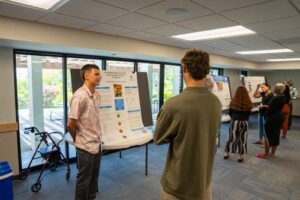
Sarah Carroll explains her research to Fr. Martin Solma during the Na Liko Na'auao Symposium.
Sarah Carroll explains her research to Fr. Martin Solma during the Na Liko Na’auao Symposium.
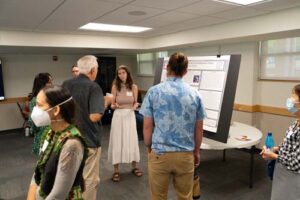
Professor Tracy Trevorrow, Ph.D., discusses the research findings of Clara Slate-Liu, left, and Leila-Jayne Casison.
Brittany Johnson commented on Brandon Koskie's research project on Kalauhaihai Fishpond and Kanewai Spring.
Brittany Johnson commented on Brandon Koskie’s research project on Kalauhaihai Fishpond and Kanewai Spring.
Lindsey Dimaya, left, a junior at Sacred Hearts Academy and a participant in Chaminade’s early college program, presented her findings to Joleigh Ballesteros-Magdaro.
Brandon Koskie, right, discusses his research findings on two fishponds with Anson Ekau, who developed a dashboard for the Maunalua Fishpond Heritage Center.
Katelyn Salcedo's hypotheses posed the question: Is Literacy Affected by the Home Environment.
Katelyn Salcedo’s hypotheses posed the question: Is Literacy Affected by the Home Environment.
Sydney Danielson explains the effects of avian malaria and avian pox to attendees at the Na Liko Na'auao Symposium.
Sydney Danielson explains the effects of avian malaria and avian pox to attendees at the Na Liko Na’auao Symposium.
Dr. Lynn Babington listened to what Kole Nagai had to say about his research findings during the 22nd Annual Na Liko Na'auao Symposium.
Dr. Lynn Babington listened to what Kole Nagai had to say about his research findings during the 22nd Annual Na Liko Na’auao Symposium.
Leila-Jayne Casison, left, and Clara Slate-Liu, studied the sleeping patterns of Silversword athletes.

For the past 22 years, student scholars have presented their yearlong work during this annual Symposium, allowing them to explain their research and answer questions from faculty, peers and at-large community members. In the past, students’ presentations have focused on mental health—especially the impact of COVID—physical health problems, substance abuse and even “climate monstrosities.”

According to Amber Noguchi, Ph.D., Undergraduate Research and Pre-Professional Programs director, undergraduate and graduate research experience can look like a number of things. It can range from formal and clinical studies to data analysis, and creative works and beyond.

“All of these presentations stem from research projects that have been collaborations between the student researchers and their faculty mentors,” Noguchi explains. “This undergraduate conference celebrates student scholars from across all academic disciplines.”

For the past several months, Lindsey Dimaya has locked herself in her room, unwilling to share with her parents the project that she was working on for the Na Liko Na‘auao Symposium. An avid reader, the 17-year-old teenager chose to do research on adult literacy and its impact on mental health.

Pointing to her presentation, dad Don Dimaya quipped that Lindsey finally explained why she isolated herself in her bedroom for all those hours. “Now it makes sense,” he said with a laugh. “Instead of getting her driver’s license last summer, she was busy with this.”

“I looked at the correlation between adult literacy and mental health,” said Dimaya, a junior at Sacred Hearts Academy and a participant in Chaminade’s early college program. “One of the reasons I was interested in this research was because of a story I had heard about a mother who wanted to bake her daughter a birthday cake, but she couldn’t because she didn’t know how to read.”

Dimaya’s research yielded some interesting findings, including a connection between improved reading skills and better mental health, and regaining childhood memories that emerged as a result of enhanced literacy.

“The breadth and depths of these projects have blown me away,” said President Lynn Babington, Ph.D., in her closing remarks at the Symposium. “I have been truly impressed walking around the room, and listening to your presentations and your interests.”

In his oral presentation, Anson Ekau ’25 demonstrated a beta dashboard that he developed for the Maunalua Fishpond Heritage Center, helping the nonprofit to monitor the health of the pond and its inhabitants.

“This fishpond once stretched all the way to Mauanlua Bay,” Ekau said. “Now you can walk around it in two minutes. However, fishponds are crucial to the survival of native species, and they also allow us to promote and preserve Native Hawaiian culture.”
The Symposium concluded with a presentation of the President Sue Wesselkamper Award, which acknowledges a student who has demonstrated extensive community and university service. In order to qualify for the prize, a student must have a minimum 3.5 GPA, show scholarship beyond classroom requirements by undertaking their own independent research or study, and must have presented their work both on and off campus. This year’s award went to Victoria Francois ’25, who gave a presentation on chronic pain among young adults and the effects of mindfulness.

“I would do this again in a heartbeat,” said Francois of her research. “In doing research, I found that the world is your oyster, and that everything is open to you.”

Posted by: University Communications & Marketing Filed Under: Behavioral Sciences, Campus and Community, Diversity and Inclusion, Faculty, Featured Story, Institutional Tagged With: Campus Event, Honors and Awards, Scholarship

Provost Speaker Series

April 2, 2024

Kupu co-founder founder John Leong shares his entrepreneurial journey

After finishing his degree at the Wharton School of the University of Pennsylvania, John Leong had three options: to accept a job offer in New York City, to enter seminary school or to return to Hawaii. He chose the latter, deciding that he wanted to come home to lead conservation efforts. And that was 25 years ago.

As the guest speaker of the Provost Speakers Series, Leong shared his arduous journey that started when he and his wife, Julianna, established Pono Pacific in 2000. The company had a sole mission to assist conservation managers and landowners with the monumental task of protecting Hawaii’s natural resources. It would eventually lead him to co-find Kupu, now one of the most impactful environmental leadership organizations in the Pacific.

“My call to return to Hawaii was strong,” Leong said. “If you’re created to do something, and if you don’t follow that calling, the world loses out.”
Hawaii certainly would have had Leong not adhered to his vision, one of three primary tenets that  he cited as being pivotal to his journey. The other two are character and moral fortitude. Growing up in one of the most isolated archipelagos in the world, Leong didn’t fully appreciate Hawaii’s environmental vulnerabilities. It was not until he participated in Chaminade adjunct professor Althine Clark’s youth conservation program—which provided an opportunity for Hawaii’s youth to make positive change and contribute to our islands’ long-term sustainability—did he see Hawaii’s environmental perils.”

John Leong shared his entrepreneurial journey that led him to establish Pono Pacific and Kupu.

“It gave me a sense of Hawaii’s challenges with the environment and our endangered species,” Leong said. “It gave me a sense of my kuleana to care for Hawaii’s natural resources, which was work that was under-resourced and an uphill battle at that time.”
With Pono Pacific, the Leongs sought to provide cost-effective natural resource management services, working with private and government land owners to activate working lands, create sustainable food systems, restore sensitive ecosystems, protect both endemic and indigenous species, protect vital watersheds, manage conservation lands, and repair, construct nature trails.

“We charged like $15 an hour, which yielded more like $2 in profit,” Leong said laughingly. “It cost more to do the work, but this was our responsibility. I remember once builidng a conservation fence line around a Big Island trail, hauling large jugs of water for miles, waking up early and finishing late; it was hard work for sure. I would get calls from my Wharton classmates—some of whom were working at JP Morgan—and they would ask me: “What is it that you are now doing?”

It was during that time on the Big Island that Leong came across the kupukupu, an endemic sword fern that would sow the seed for his next nonprofit enterprise with his spouse Julianna and best friend Matt Bauer. Together, the trio started Kupu in 2007, a local 501(c)3 nonprofit organization with a mission “to empower youth to serve their communities through character-building, service-learning and environmental stewardship opportunities that encourage pono (integrity) with ke Akua (God), self and others.”

“When you do things of consequence, there are consequences,” Leong said. “But if you don’t do anything, then it’s inconsequential. Change doesn’t happen overnight nor is it linear, and you have to have the tenacity to move forward, to be the light.”

For four years, Kupu strove to establish what is now known as the Harry and Jeanette Weinberg Hoʻokupu Center in Kewalo Basin. Seeking the support of community board members and approval from government officials, Leong and his team spent hours on end to secure land rights to a valuable piece of waterfront property. It would certainly be difficult and almost defeating.

“But I look back now and think, what would have happened had we just quit and given up?” said Leong of all the work and effort that was put into the Kakaako community center. “What if we had not listened to that little voice inside that kept saying ‘just keep at it,’ and instead listened to our anxieties and fears?”

Today, the center is also home to the Kupu Community Program, which prepares under-resourced youth for the workforce by providing them with life skills training, green jobs, volunteer opportunities and encouragement to consequentially impact their local communities through service. To date, the yearlong program has served thousands of Hawaii’s youth, who participate in significant and demanding work to rehabilitate Hawaii’s ecosystems and increase the sustainability of the ʻāina.

“We give them an ʻāina-based model upon which to build a common community,” Leong said. “We give these under-privileged youth a purpose and a pathway to lead a meaningful life.”

In the final minutes of his talk, Leong spoke of the importance of being selected as an Obama Foundation Fellow, and having the opportunity to spend time with Barack and Michelle Obama, who taught him that character is shaped by adversity, and to surround yourself by supportive people who push you “to become a better version of yourself.”

“The last lesson I want to share is this: that we’re just one part of a bigger body,” Leong concluded. “You have to have humility. We can only do our part, but it’s important that we do that part.”

Posted by: University Communications & Marketing Filed Under: Campus and Community, Diversity and Inclusion, Featured Story, Institutional, Service Learning Tagged With: Campus Event, Environmental Studies, Guest Speakers

Gala Benefit Dinner

February 28, 2024

An evening to honor donors and announce two new Hall of Fame inductees

Chaminade President Dr. Lynn Babington gave the opening remarks before the Hall-of-Fame announcement of inductees.
Athletics Director Tom Buning and Chaminade President Dr. Lynn Babington flank Hall of Fame inductees, Chico Furtado '80 and Teri Chong '92.
Athletics Director Tom Buning and Chaminade President Dr. Lynn Babington flank Hall of Fame inductees, Chico Furtado ’80 and Teri Chong ’92.
Elegant table setting
Athletics Director Tom Buning and Chaminade President Dr. Lynn Babington pose next to Hall of Fame inductee, Chico Furtado '80.
Athletics Director Tom Buning and Chaminade President Dr. Lynn Babington pose next to Hall of Fame inductee, Chico Furtado ’80.
Teri Chong '92 accepts her Hall of Fame award from Chaminade President Dr. Lynn Babington and Athletics Director Tom Buning.
Teri Chong ’92 accepts her Hall of Fame award from Chaminade President Dr. Lynn Babington and Athletics Director Tom Buning.
Guests were treated to an evening of fine wines and delectable food.
Guests smiled and talked story.
Chaminade President Dr. Lynn Babington mingled with guests throughout the night.
Guests enjoyed each other's company.
Guests enjoyed each other’s company.
Musician Nick La'a serenaded the crowd.
Musician Nick La’a serenaded the crowd.
Enjoying the evening conversations.
Gala attendees got to see the impact of their donations.
Chico Furtada, left, and Bill Villa engage in a conversation.
The evening's menu featured a three-course dinner by MW Restaurant.
The evening’s menu featured a three-course dinner by MW Restaurant.
Guests enjoying themselves.
Cathy Ching listens to Dr. Lynn Babington's opening remarks.
Cathy Ching listens to Dr. Lynn Babington’s opening remarks.
A group of longtime friends.
Chaminade's Director of Development, Heidi Bow, shares a laugh with guests.
Chaminade’s Director of Development, Heidi Bow, shares a laugh with guests.
Attendees mingled outside Ching Hall during the cocktail reception.
Fr. Chris Wittman talks with Dr. Lynn Babington and her husband Dr. Randy Carpenter, and Tertia Freas.
Enjoying a cocktail before dinner outside of Ching Hall.
MW Restaurant's executive chefs Wade Ueoka and Michelle Karr-Ueoka developed a creative menu.
MW Restaurant’s executive chefs Wade Ueoka and Michelle Karr-Ueoka developed a creative menu.
Tables were elegantly set with a floral arrangement as the centerpiece.
The three-course menu was a delight for the senses.

The mood was buoyant as guests arrived and mingled before the start of the Silverswords Gala, a benefit dinner for student and athletic scholarships. However, beyond the laughter and good cheer, the gathering served a deeper purpose—a purpose woven into the fabric of education and opportunity.

“Through your generosity, we can provide scholarship support for many students at Chaminade to help them achieve their academic goals and set them up for successful careers in their communities,” said Chaminade President Lynn Babington, Ph.D., in her opening remarks. “We are very grateful to you all for believing in and supporting our mission.”

In a video presentation, Chaminade senior Audrey Pilar ’24 described how she cried for an hour after learning that she received a scholarship. “These scholarships are way more than just a financial burden lifted off someone’s shoulders,” the forensics major said. “It’s way more than just money to a person because to me, I think you’re giving someone hope and you’re giving someone a chance.”

A sophomore Communications major, Easton DelaCruz ’26 said nothing would be possible without the scholarships, without all the financial aid that he has been able to receive. “When you think of college, the next thing you think about is the financial burden that it puts on everybody,” he said. “And with these scholarships, it helps relieve the financial burden for myself and my parents.”

In this landscape of financial uncertainty, scholarships emerge as powerful catalysts for change. These financial awards, often based on academic merit, financial need, or a combination of both, play a pivotal role in dismantling barriers to higher education. By providing financial assistance, scholarships enable deserving students to access resources, facilities and opportunities that would otherwise remain beyond their grasp.

In addition to thanking donors for their support, the Gala served a secondary purpose: the opportunity to grow the Silversword Hall of Fame with two new inductees: Thomas “Chico” Furtado ’80, an outstanding basketball player who still ranks as the third best all-time assists leader with 486; and Teri (Bertulfo) Chong ’92, who holds Chaminade Volleyball’s all-time career kills at 1,487.

“Tonight, we get a chance to recognize two former Chaminade student-athletes who made their sport matter for their teams,” said Athletic Director Tom Buning, before inviting Chong and Furtado to the stage to join him.

“These esteemed inductees into our Athletic Hall of Fame are individuals whose remarkable achievements serve as a beacon of inspiration for generations to come,” added Kahala Kabalis Hoke ’05’ MS ’07, the Women’s Volleyball coach and the evening’s emcee.

Among the sponsors were KemperSports Management, Kitty and Buzz Wo, The Queen’s Health Systems, Saint Louis School, Aramark, Becker Communications, CKW Financial Group, Edward Enterprises, Marianist Center of Hawaii, Maryknoll School, Sacred Hearts Academy and Saint Francis Healthcare.

“Education transforms lives,” Babington said. “Our students set out to change the world—they are making a difference.”

Posted by: University Communications & Marketing Filed Under: Alumni, Athletics, Campus and Community, Featured Story, Institutional Tagged With: Alumni, Campus Event, Honors and Awards

Dean’s Speaker Series

February 26, 2024

Dr. Crissy Gayagas discusses sustainability for good

Citing the words of the late American comedian, actor, author, television host and artist, Jonathan Winters, Col. Christine “Crissy” Gayagas (Ret.), Ed.D., told attendees that, “If your ship doesn’t come in, swim out to meet it!” In other words, don’t become apathetic. Take action.

As Regional Program Lead (RPL) for the Indo-Pacific, which is part of the Advising and Consulting (A&C) Division at the Institute for Security Governance (ISG), the self-described Army brat plays an important role in engaging partners in the vital Indo-Pacific Region.

“Eighty percent of goods are transited by water and 60 percent of that goes through the Indo-Pacific Region,” said Gayagas, Chaminade Board of Governors chair. “If conflict broke out in that region, it would create instability, and you probably wouldn’t receive that Amazon order you placed.”

As part of the School of Business & Communication Dean’s Speaker Series, Gayagas’s discussion focused on Sustainable Business for Good and the U.S.’s strategy for and paradigm shift in the Indo-Pacific region. In recent years, the Biden-Harris Administration has made historic strides to restore American leadership in the Indo-Pacific and adapt its role for the 21st century. A few years ago, the United States modernized its longstanding alliances, strengthened emerging partnerships, and forged innovative links among them to meet urgent challenges, from competition with China to climate change to the pandemic.

As part of the School of Business & Communication Dean's Speaker Series, Dr. Crissy Gayagas’s discussion focused on Sustainable Business for Good and the U.S.’s strategy for and paradigm shift in the Indo-Pacific region.
As part of the School of Business & Communication Dean’s Speaker Series, Dr. Crissy Gayagas’s discussion focused on Sustainable Business for Good and the U.S.’s strategy for and paradigm shift in the Indo-Pacific region.

Stretching from the Pacific coastline to the Indian Ocean, the area is home to more than half of the world’s people, nearly two-thirds of the world’s economy and seven of the world’s largest militaries. And in the years ahead, as the region drives as much as two-thirds of global economic growth, its influence will only grow—as will its importance to the United States.

“In a 2021 address during the East Asia Summit, President Biden said he envisions an Indo-Pacific that is open, connected, prosperous, resilient and secure,” Gayagas quoted to attendees. “We want to build our collective capacity with partner nations throughout the region. The more people who are empowered, the better we are for it.”

With a military career that spans across 24 years and three deployments, Gayagas became the only battalion commander who was a mother when she saw action in Iraq. She considers her service in the Army as the first phase of her life. The second phase was exploratory, and the third and current phase are convergent, allowing her two initial stages to come together to form a new whole.

“Within these three phases, I was always guided by five elements: passion, people, persistence, priority and pivot,” Gayagas explained. “Identify your passion and keep chipping away until you’re ready to take a deep dive. In the Army, we have a saying: Mission First, People Always. Seek out a support system. Persist and do what works for you. Assess your position and ask if it’s moving your North Star. Be ready to recognize diminishing returns and be open to pivot.”

After multiple Army command and staff positions around the United States (101st Airborne Division and 25th Infantry Division) and in Germany (8th Infantry Division), and operational and strategic experience in the Army’s Human Resources Command and with the 13th Sustainment Command (Expeditionary) in Texas and in Iraq, Gayagas retired in 2008 and started her own consulting firm MMGT Consulting, LLC.

“I wanted to create space for my daughter,” said Gayagas, citing the reason for her retirement from the Army. “In this third phase of my life, I am going to pivot and enjoy full-time retirement or a quarter retirement so I can create more lunch space with my parents (gesturing to her dad Ed and mom Norma Gayagas who were seated in the front row), and pursue more hobbies.”

Opening the floor to questions, John Barayuga ’25 asked Gayagas if her passions evolved over time or did it remain the same. “I really appreciated her answer about how her passion stayed relatively the same but with a few tweaks over time,” said Barayuga, an Accounting major with minors in Hawaiian Studies and Business Administration. “It reassured me of how our paths are a constant adventure of self-discovery.

“My biggest take-away was the five P’s [principles] that Dr. Gayagas shared,” Barayuga added. “I feel the lecture exceeded what I was expecting from it. And I am looking forward to future events!”

Posted by: University Communications & Marketing Filed Under: Business & Communication, Diversity and Inclusion, Featured Story, Institutional Tagged With: Campus Event, Guest Speakers

Office of Student Success

February 22, 2024

The emergence and significance of universities’ Offices of Student Success

Trachelle Iwamoto ’26 wasn’t quite sure what to expect when she arrived on campus from Kapa‘a, Kauai. Nor did Kryzandreah Español ’26 and Easton DelaCruz ’26. As freshmen, Iwamoto, Español and Dela Cruz felt anxious about the transition from high school to university, uncertain about the rigors of academia and their own self expectations.

Dani Masuda provides some academic advice.

However, it’s not uncommon for freshman to feel nervous when experiencing what many consider a rite of passage from the teen years to early adulthood. In response, universities have undergone significant transformations in recent years, marked by an increased focus on student success.

“In 2020, we re-evaluated our support services and designed a one-stop center—Office of Student Success—that includes academic advising, career development, tutoring and learning services, military student benefits, registrar and records, and study abroad,” says Jennifer Creech, Vice President for Enrollment Management and Student Success. “We’re committed to providing comprehensive support and resources to ensure that students not only excel academically, but also thrive in their overall collegiate experience.”

The concept of student success has evolved from a narrow focus on academic achievement to a more holistic approach, which encompasses personal growth, career readiness and well-being. Historically, universities primarily concentrated on instructional and administrative functions, with less emphasis on proactive student support. The changing dynamics of higher education, including shifting demographics, technological advancements and an increased awareness of the diverse needs of students, prompted the establishment of dedicated offices to address these challenges.

“If I have a question or experience any difficulty, I’ll go to the Student Success Office,” says Español, who is studying to be a nurse and aspires to become a cardiothoracic surgeon. “I feel truly supported in every aspect of my academic journey here. Chaminade has created a supportive environment that extends beyond just academic assistance, making me feel connected and valued.”

Before the start of their freshman year, Español, Iwamoto and Dela Cruz all attended the Apo Haumana Retreat, a program introduced in 2021 as a faculty-led initiative to help first-year students transition to Chaminade through building connections with faculty and peers outside of the classroom.

“It gave me a foothold into the university,” Iwamoto says. “I met a lot of other students, mentors, staff and faculty who were all welcoming and personable. I felt like they wanted to know who I was as a person.”

Chaminade President Dr. Lynn Babington welcomes incoming freshmen during the New Student Orientation.

Now a peer advisor with the Apo Haumana program, DelaCruz works closely with the Office of Student Success to create helpful workshops for first-year students. He also assists program participants with different obstacles they may face throughout their first year.

“Having been a member of the program during my first year, I felt that it benefited me as I transitioned from high school to college,” says DelaCruz, who has ambitions to run for the Governor’s office when he returns to Saipan. “This is my way of giving back to Chaminade since I’ve personally received so much support in my academic journey.”

Many institutions offer programs specifically designed to support students during their first year, helping them smoothly shift into the university environment. At Chaminade, that support is tailored to each student. Unlike the past, according to Creech, interactions between advisers and students seemed transactional; students were being told what classes to take and what to do as opposed to the student owning his/her own educational journey.

“We’re here to help them navigate that journey,” Creech says. “Everything is tailored; it’s not one size fits all. We triage and assess the problem to make sure that our Chaminade students succeed. We complement what the faculty are already doing—mentoring, advising and counseling. The Office simply adds another layer of support.”

Research has shown a positive correlation between the presence of robust student success initiatives, and improved retention and graduation rates. By addressing challenges early, providing targeted interventions, and cultivating a supportive community, the Office of Student Success plays a crucial role in ensuring that students persist through their academic journeys and successfully attain their degrees.

“When we re-structured the office, we leveraged technology and we updated our student portal,” Creech explains. “Today, we use predictive analysis to identify students who may be at risk and we intervene before they drop out. Our fall 2023–spring 2024 retention rate is 88.3 percent, and our enrollment numbers for undergraduate FTE (full-time equivalency” is up by eight percent. All positive news.”

Posted by: University Communications & Marketing Filed Under: Campus and Community, Diversity and Inclusion, Featured Story, Institutional, Student Life Tagged With: Campus Event, Student Success

Heritage Awards

January 30, 2024

Honoring those who personify the Marianist Values

Overcome by emotion, tears cascaded down the cheeks of Victoria DelaCruz ’24 as Bro. Ed Brink named her as this year’s Founders’ Award winner, describing her traits of selflessness, commitment, hospitality, graciousness, faith and her family. A Chaminade Scholar majoring in Data Science, Analytics and Visualization (DSAV), DelaCruz ’24 exemplifies the Marianist education and values.

“Faith has been a part of her journey before coming to Chaminade,” said Brink, Vice-President of Mission and Rector. “This year, she joined the new Student Ministry Team and made a suggestion about having a praise and worship evening at the end of one of the meetings. Although it was one of the last ideas talked about at the meeting, it was one of the first events to move from an idea to an actual event. And that was because of Victoria’s commitment to it.”

Every year during Founders’ Week, the Rector’s office presents the Chaminade Award, the Marianist Award and Founders’ Award to a faculty member, supporting staff member and student, respectively, who embodies the Marianist values.

His voice crackling at times while reading the achievements of the winners of the Heritage Awards, Brink announced the other two honorees: Chaminade Award recipient Dr. Janet Davidson, Vice Provost and professor of criminology, who was described by one of her nominators as resilient, reliable and consistent; and Amy Takiguchi, Director of Financial Aid, Marianist Award, whose efforts to help students go beyond and above a simple answer.

“It was a chicken-skin moment when Dr. Babington informed me of the award,” said Takiguchi ’02, an alumna who started her career at Chaminade as a student worker with Human Resources and has since moved up the ranks. “I have a great team and that’s what makes working here such a rewarding experience.”

For Davidson, the Chaminade Award is not an individual feat, but one that belongs to her team. “I am honored and humbled, but I don’t like the attention,” she said. “But I could have never done it alone. The accolades and attention I receive are because of a great supportive team that works collaboratively to accomplish a lot.”

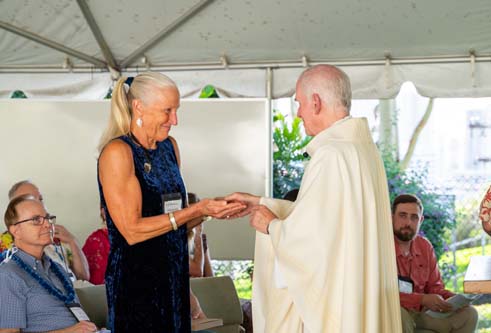
In his presentation during a special mass ceremony to celebrate Founders’ Week, Brink said these awards are meant to remind all of us of the mission of this University, and the importance of trying to live out that mission on a daily basis. “We gather today to be inspired and to hopefully recommit ourselves to being the best member of this community that we can be,” he added. “Fr. Chaminade wanted those who got caught up in the work that he inspired to be ‘a spectacle’—to give witness to others of how a life based in faith and service could make a difference in the world.”

Posted by: University Communications & Marketing Filed Under: Campus and Community, Catholic, Homepage, Institutional Tagged With: Campus Event, Honors and Awards, Marianist

  • « Go to Previous Page
  • Page 1
  • Interim pages omitted …
  • Page 6
  • Page 7
  • Page 8
  • Page 9
  • Page 10
  • Interim pages omitted …
  • Page 18
  • Go to Next Page »

Footer

Chaminade University Logo

3140 Waialae Avenue
Honolulu, Hawaii 96816

Contact Us
Phone: (808) 735-4711
Toll-free: (800) 735-3733

facebook twitter instagram youtube linkedin

Visit

  • Plan Your Visit
  • Campus Map (PDF)
  • Events

Resources

  • Campus Security
  • Student Consumer Information
  • Concerns, Feedback, and Reporting
  • Institutional Review Board
  • Title IX / Nondiscrimination Policy
  • Compliance
  • Emergency Information
  • Careers
  • Institutional Statement

People

  • Students
  • Parents
  • Alumni
  • Faculty & Staff

Policy

  • Privacy Policy
  • Terms and Conditions of Use


© Chaminade University of Honolulu