• Skip to primary navigation
  • Skip to main content
  • Skip to footer
Chaminade University of Honolulu

Chaminade University of Honolulu

  • VISIT
  • APPLY
  • GIVE
  • STUDENTS
  • PARENTS
  • ALUMNI
  • FACULTY/STAFF
  • Admissions
    • Admissions Home
    • Undergraduate Students
      • First-Year Students
      • Transfer Students
      • Admitted Students
    • Graduate Students
    • Flex Online Undergraduate Program
    • Military Students
    • Non-Degree/Visiting Students
    • Experiential Honors Program
    • Early College Program
    • New Student Orientation
  • Tuition & Aid
    • Financial Aid Home
    • Tuition & Expenses
    • Federal Updates & Changes
    • Scholarships
    • $5,000 Graduate Scholarship
    • VA Education Benefits
    • Net Price Calculator
  • Academics
    • Academics Home
    • Academic Programs
    • Office of Student Success
      • Academic Advising
      • Records and Registrar
    • Kōkua ʻIke (Support Services)
      • ADA Accommodations
      • Career Services
      • Proctoring Services
      • Tutoring Services
    • Sullivan Family Library
    • Undergraduate Research & Pre-Professional Programs
    • Commencement
  • Campus Life
    • About Campus Life
    • Student Engagement
    • Student Government Association
    • Residence Life and Housing
      • Summer Conference Housing
    • Health Services
    • Marianist Leadership Center
    • Counseling Center
    • Campus Ministry
    • Campus Security
    • Dining Services
    • Bookstore
  • Athletics
  • About
    • Chaminade University News
    • Our Story
    • Leadership
    • Chaminade University Strategic Plan 2024-2030
    • Mission & Rector
    • Association of Marianist Universities
    • Facts & Rankings
    • CIFAL Honolulu
    • Accreditation & Memberships
    • Montessori Laboratory School
Search
×

Search this web site

Natural Sciences & Mathematics

Summer Research Program Brings Experiential Learning Opportunities

September 7, 2019

While many of their peers were hitting the beach this summer, Chaminade students Christian Crisolongo and Donna Cottrell were getting intensive instruction and career coaching as part of a rigorous UCLA program designed to help underrepresented students pursue careers in medicine.

The two were among just 80 students from across the country to be selected for UCLA’s 2019 Summer Health Professions Education Program. In recent interviews, both said the experience not only helped them grow as learners but allowed them to see themselves as future doctors.

“My biggest takeaway is that I can do it. Before coming to this program, I had a little doubt,” said Cottrell, ‘22, a biology major who wants to become a pediatrician. “After coming out of this program it left me with a lot of hope and motivation — and inspired me to do more.”
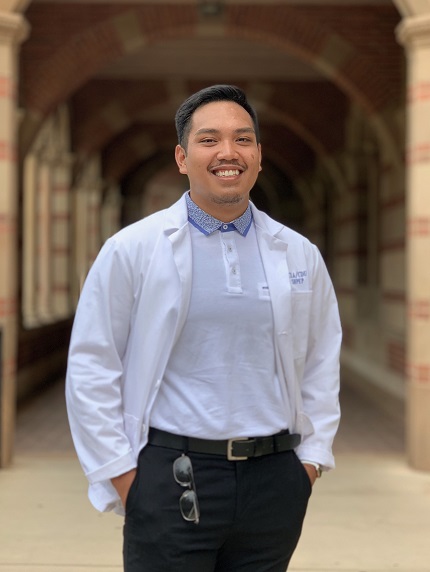
Christian Crisolongo at UCLA doing summer research

Crisolongo, ’21, added that he realized at the enrichment program that “I’m not alone.”

“It’s just awesome to see that it’s not just me that has these struggles,” he said.

The rigorous summer program, funded with grants, offers participants a host of experiential learning opportunities. Cottrell and Crisolongo said during their very full days of learning — from 9 a.m. to 5 p.m. — they were able to get a taste of different specialties in medicine.

Over the course of six weeks, students participated in a slew of hands-on learning exercises, working with mannequins that “breathed” and even with one that simulated childbirth, tackling tough clinical cases in small groups and making molds of teeth in a dental lab.

Importantly, the program also includes key instruction on life skills, helping students think through how they’ll go about applying for and paying for a graduate degree, handle the stress involved in pursuing a career in health care, and figure out how to strike a school-life balance.

Crisolongo said one of his favorite parts of the program was problem-solving with his peers. “We all see from different perspectives,” he said. “It was refreshing to see another person’s point of view. I didn’t think of it that way, but then when they say it, I was like, ‘Oh wow.’”

In addition to helping students get hands-on experience, the program also stresses a greater understanding of disparities in the health care system. Crisolongo said those disparities were eye-opening. He and his team members, for example, decided to look at how minorities are significantly over-represented among the population in Alabama with diabetes.

The group, he said, challenged themselves to consider possible solutions and interventions.

And while the days were chock full of learning, Cottrell said she was also able to squeeze in a little summertime fun alongside her fellow program participants. They were able to explore Los Angeles, sightsee in Beverly Hills and Hollywood, and make it to a few amusement parks.

“The whole experience is just so amazing,” she said. “People came from everywhere, from Guam, California, Mississippi. It’s really interesting to see how their experiences shaped them and why they want to be in the medical field. It was basically like a whole community.”

Posted by: University Communications & Marketing Filed Under: Featured Story, Natural Sciences & Mathematics, Students

A Doctor in the Making

August 9, 2019

Growing up in a big family, Hi‘ilei Ishii-Chaves developed a knack for taking care of people. 

A Doctor in the Making | Hi'ilei Ishii-Chaves

“I’ve had to take care of a lot of my siblings,” says Ishii-Chaves. “And I’m good at taking care of children.”

The fourth-year biology major from Hilo has known for a long time that she wants to become a doctor. And because of her background, she’s most interested in family medicine and pediatrics. 

“Doctors come from the mainland and they serve people in Hawaii, but it’s rare that you find Native Hawaiian doctors in the medical field,” says Ishii-Chaves. “If I can become a doctor, then I can help children and better inform them. I feel like it’s my job to give back by educating my community.”

When her advisor and professor at Chaminade, Dr. Cogbill, sent her a list of summer research projects on the mainland, she jumped at the opportunity. She was quickly partnered with a Jamaican doctor at the Burnham National Institute of Health in Bethesda, Maryland, who specializes in pediatric internal medicine. 

Hi‘ilei Ishii-Chaves Summer Research

“I liked that my mentor was working on diabetes in children,” explains Ishii-Chaves. “I’ve always been interested in health disparities. I also really liked that my mentor is of a minority as well.”

Ishii-Chaves is spending the summer researching type 2 diabetes in children. She’s particularly looking at dyslipidemia, or abnormally elevated levels of cholesterol and fats found in the blood, in children with type 2 diabetes to see how it compares to adults with the same disease. Her team hopes the research will lead to early detection, and even prevention of the increasingly common childhood disease. 

But perhaps the most attractive part of the program was the hands-on experience. Several times a week, she shadows her mentor and accompanies her on patient visits. “I take patients to do blood tests, MRI scans and echocardiograms, and I sit in on their evaluations or wait in the waiting room with them,” she says. And every two weeks, they go into the children’s hospital in Washington D.C. to spend a full day visiting patients. 

Ishii-Chaves has found the experience to be particularly timely for her right now. “I’m actually applying to medical school right now for the 2020 cycle through Chaminade’s articulation agreement,” says Ishii-Chavez.

She hopes the invaluable experience and connections she gains this summer will stay with her throughout her journey of becoming a doctor.

Posted by: University Communications & Marketing Filed Under: Featured Story, Natural Sciences & Mathematics, Students Tagged With: Biology

Crime Scene Investigation Camp

August 9, 2019

Over the summer, Chaminade Forensic Sciences Professor David Carter and colleague Carlos Gutierrez led a group of high schoolers in a not-so-typical hands-on activity. After some intensive instruction, the teens spent hours poring over a mock crime scene to find “human remains.”

CSI camp in Maui - in the field

While the crime scene and remains weren’t real, the learning absolutely was.

And Carter believes the experience is also an innovative recruitment tool, helping students envision themselves in a forensic science career. “It’s neat for these students,” Carter said, “the hands-on activity, the experience with teamwork and documenting observations.”

The innovative exercise was part of the Maui Police Department’s 2019 CSI Camp, a unique week-long program of events aimed at giving high schoolers a taste for the work that criminal investigators do every day, from crime scene photography to blood stain pattern analysis.  

Chaminade’s Forensic Sciences department has been participating in the camp for four years alongside representatives from the FBI, the Bureau of Alcohol, Tobacco, Firearms and Explosives, the Maui Police Department’s Criminal Investigation Division, and Maui’s Medical Examiner.

Tony Earles, an MPD crime scene investigator and evidence specialist, runs the program annually. He said students have come from across Hawaii and even the mainland to attend.

CSI camp in Maui - in the classroom

This year’s camp had 12 students selected after a competitive application process. Students submitted essays explaining their interest in the program and were required to submit letters of recommendation. And before the week even begins, the students go through training online.

“With the effect of CSI television shows, there’s a lot of interest in crime scene investigation careers,” Earles said, in an interview. “Of course, you can’t have kids in an actual crime scene.”

The CSI Camp is the next best thing.

“We try to cover everything – from what happens when the call is dispatched to 911, the investigation by the detective, beginning to end,” Earles said. “By the end of the week, the thing they always say is they would like to make it longer. They always say, ‘I learned so much.’”

Hands-on activities, like the one that Carter and Gutierrez lead, are particularly popular.

Maui Police Chief Tivoli Faaumu called this year’s CSI Camp, which ran from June 17 to 21, a “tremendous success” and said Chaminade’s presentation and hands-on activity triggered lots of questions and interest from students. “It is through collaborative efforts such as this Camp that we continue to inspire our youth to dedicate themselves to careers which support our community,” he said, in a letter to Chaminade Provost Dr. Lance Askildson.

Carter said he uses the camp to clue students in on what they need to do to pursue a career in forensic sciences. He also helps them understand the related offerings at Chaminade. But he’s quick to note that the University’s participation in the camp isn’t merely a recruitment tool.

It’s an opportunity to give back. “The camp is a really important community service,” he said. “It’s not at a high school or college campus, but a forensic science facility. And students participate in actual investigative work and experience being a scientist in the field.”

Posted by: University Communications & Marketing Filed Under: Faculty, Featured Story, Natural Sciences & Mathematics Tagged With: Forensic Sciences

Data Science Summer Institute

July 1, 2019

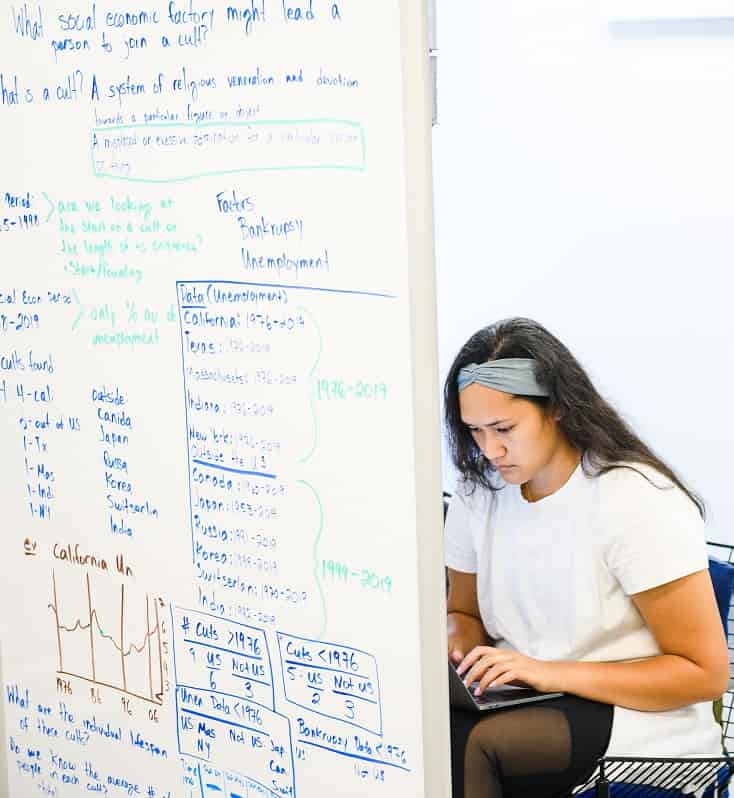
Data science program summer institute, student doing research

What factors influence opioid addiction? Are fish ponds sustainable? What is the public opinion of Hawaii’s homeless population?

Twenty one Chaminade students spent a month this summer trying to answer these questions and more. Their quest was part of the Supporting Pacific Indigenous Computing Excellence (SPICE) Summer Institute in Data Science Program, a partnership between Chaminade University and the Texas Advanced Computing Center held on campus from May 20 to June 14.

The students, all from diverse majors and backgrounds, joined together for four weeks to explore the field of data science and how it can be used to solve some of our most pressing problems.

They spent the first week choosing a topic to investigate—anything from social, political, environmental, economic and health issues. Choosing a good topic was essential.

Data science program summer institute, students doing research

“One month is a long program, and we didn’t want the students to burn out,” says Dr. Rylan Chong ’10, data scientist and postdoctoral researcher at Chaminade University. “We wanted to make sure they were passionate about what they were doing, and that they believed in their project.”

During the second week, the students collected their datasets. They learned to access publicly available data, using sources like the Department of Education, the National Oceanic and Atmospheric Administration and the U.S. Census Bureau, among others.

Week 3 was spent interpreting the data and piecing together their story. And in week 4, they learned to present their data and turn it into graphical visualizations, easy for a lay person to understand.

Data science program summer institute, students doing research

The summer program served as a launchpad for the new data science major at Chaminade University, starting this fall. Upon completion of the month-long institute, several of the students are exploring adding a minor or certificate in data science, and some are even working with outside entities to continue their projects.

“Data science provides the tools to do things on a broader, bigger scale,” says Dr. Chong. “I’m excited to see how far these students take their projects, and to see the new projects that come out of the first cohort of students in the new data science program.”

To learn more about the new major in data science, the first of its kind at a Hawaii university, visit chaminade.edu/nsm/data-science.

Posted by: University Communications & Marketing Filed Under: Campus and Community, Featured Story, Natural Sciences & Mathematics, Students

Pre-Term Birth Research takes Professor and Students to Paris

May 17, 2019

Nainoa Ing '21, associate professor Dr. Claire Wright, Dr. Chelsea Saito Reis '12 and Justin Padron
Nainoa Ing ’21, associate professor Dr. Claire Wright, Dr. Chelsea Saito Reis ’12 and Justin Padron

In March, sophomore Nainoa Norman Ing presented the research he’s been doing at Chaminade on the placental membranes at an international conference in Paris, France.

He was the only undergraduate to do so.

Norman Ing, a biochemistry major, made the trip to the annual Society for Reproductive Investigation conference with two other team members at Chaminade’s Placental Membranes Integrity Lab along with the professor who leads it: Dr. Claire Wright.

The laboratory is focused on figuring out how placental membranes works in regular pregnancies, and what goes wrong when it fails—leading to premature births.

In a recent interview, Norman Ing joked that he learned more during the week-long Paris conference than during a semester of courses.

Listening to experts in the field discuss their research is “a little eye-opening,” he said.

“You can hear in the way that they talk that they’ve thought about the subject a lot,” Norman Ing said, during a recent interview at the lab. “There’s a huge amount of time behind what they say. So even if they just ask a simple question, it has deeper meaning.”

The trip also reinvigorated the lab’s team members as they tackle big research questions.

Last year, Wright received a three-year, $438,000 National Institutes of Health grant aimed at funding scientific projects to better understand how placental membranes works in the body.

The placental membranes surrounds the fetus during pregnancy. And in normal pregnancies, it naturally fails after nine months, and a woman’s “water breaks.”

Wright, an associate professor of biology at Chaminade, said problems with placental membranes are among the biggest causes of pre-term births. Studying how the tissue operates normally is a vital first step in understanding what happens when things go wrong.

The research is especially significant in the islands.

Hawaii has among the nation’s highest rates of preterm births, and the rate is even higher among populations with greater health disparities, including Asians and Pacific Islanders.

And the impacts of prematurity can last a lifetime. Preterm babies, or those born earlier than 37 weeks, can face physical and cognitive issues into adulthood.

“So when you’re thinking about this as a health disparity and a social injustice, that’s a really important thing,” Wright said, speaking in her lab on a recent day. “It’s impacting people all the way into their adult life and impacting their quality of life.”

Justin Padron, a graduate student at the University of Hawaii, also works at the lab and presented his research at the Paris conference.

And the newest addition to the team—Dr. Chelsea Saito Reis—also traveled to France. She came on in January as a post-doctoral researcher, and saw the Paris conference as a chance to better understand the cutting-edge projects underway in the field of reproductive studies. Reis completed her undergraduate degree at Chaminade in 2012, before going on to get her doctoral degree at the University of New Mexico.

She said research into placental membranes is of emerging interest, but is still nascent. “For something that’s such a normal process, there is still a lot that is unknown.”

Saito Reis and Norman Ing are the first to admit that the Paris trip wasn’t all work, though. The two said they got their fill of French cuisine and took in as many of the sights that they could.

Saito Reis called it an “adventure.” And by the way, she added, the Mona Lisa is actually quite small in person.

While the group was there, they also saw the Yellow Vest demonstrations—which closed thoroughfares in the heart of the city—and described them as something out of a movie.

It was the architecture of Paris, though, that really spoke to Norman Ing.

“Paris is a city of inspiration,” Norman Ing said. “Staying in such a place has reminded me that life is so much more than the mundane routine. Goals exist which one should strive for.”

Posted by: University Communications & Marketing Filed Under: Faculty, Featured Story, Natural Sciences & Mathematics, Students Tagged With: Research

Dr. Kate Perrault receives 2020 Satinder Ahuja Award

May 6, 2019

Katelynn Perrault

Congratulations to Assistant Professor Dr. Kate Perrault for receiving the 2020 Satinder Ahuja Award for Young Investigators in Separation Science.

Professor Perrault is known for her work as a forensic scientist and odor scientist. Her research analyzes the chemicals and compounds released by odors, specifically the odors that law enforcement canines use to find dead bodies.

According to the award selection committee, “Perrault’s application is founded on extraordinary contributions to innovating GC separations as well as separations approaches and fundamental processes of legally supportive confirmatory analyses that are significant to advancing forensics.”

This award is given annually by the American Chemical Society’s Analytical Division Subdivision of Chromatography and Separations Chemistry to recognize outstanding contributions to the fields of analytical chemistry. In the 16 years this award has been presented, Dr. Perrault is the first female to receive the honor.

“It is such an honor to be recognized for my contributions to analytical chemistry at this early stage in my career,” says Dr. Perrault. “I hope to continue making valuable contributions to this field as my career progresses, and to be able to guide the next generation of women chemists and underserved minorities to serve society through the application of chemical disciplines.”

Posted by: University Communications & Marketing Filed Under: Natural Sciences & Mathematics Tagged With: Honors and Awards

  • « Go to Previous Page
  • Page 1
  • Interim pages omitted …
  • Page 12
  • Page 13
  • Page 14
  • Page 15
  • Page 16
  • Interim pages omitted …
  • Page 21
  • Go to Next Page »

Footer

Chaminade University Logo

3140 Waialae Avenue
Honolulu, Hawaii 96816

Contact Us
Phone: (808) 735-4711
Toll-free: (800) 735-3733

facebook twitter instagram youtube linkedin

Visit

  • Plan Your Visit
  • Campus Map (PDF)
  • Events

Resources

  • Campus Security
  • Student Consumer Information
  • Concerns, Feedback, and Reporting
  • Institutional Review Board
  • Title IX / Nondiscrimination Policy
  • Compliance
  • Emergency Information
  • Careers
  • Institutional Statement

People

  • Students
  • Parents
  • Alumni
  • Faculty & Staff

Policy

  • Privacy Policy
  • Terms and Conditions of Use


© Chaminade University of Honolulu