• Skip to primary navigation
  • Skip to main content
  • Skip to footer
Chaminade University of Honolulu

Chaminade University of Honolulu

  • VISIT
  • APPLY
  • GIVE
  • STUDENTS
  • PARENTS
  • ALUMNI
  • FACULTY/STAFF
  • Admissions
    • Admissions Home
    • Undergraduate Students
      • First-Year Students
      • Transfer Students
      • Admitted Students
    • Graduate Students
    • Flex Online Undergraduate Program
    • Military Students
    • Non-Degree/Visiting Students
    • Experiential Honors Program
    • Early College Program
    • New Student Orientation
  • Tuition & Aid
    • Financial Aid Home
    • Tuition & Expenses
    • Federal Updates & Changes
    • Scholarships
    • $5,000 Graduate Scholarship
    • VA Education Benefits
    • Net Price Calculator
  • Academics
    • Academics Home
    • Academic Programs
    • Office of Student Success
      • Academic Advising
      • Records and Registrar
    • Kōkua ʻIke (Support Services)
      • ADA Accommodations
      • Career Services
      • Proctoring Services
      • Tutoring Services
    • Sullivan Family Library
    • Undergraduate Research & Pre-Professional Programs
    • Commencement
  • Campus Life
    • About Campus Life
    • Student Engagement
    • Student Government Association
    • Residence Life and Housing
      • Summer Conference Housing
    • Health Services
    • Marianist Leadership Center
    • Counseling Center
    • Campus Ministry
    • Campus Security
    • Dining Services
    • Bookstore
  • Athletics
  • About
    • Chaminade University News
    • Our Story
    • Leadership
    • Chaminade University Strategic Plan 2024-2030
    • Mission & Rector
    • Association of Marianist Universities
    • Facts & Rankings
    • CIFAL Honolulu
    • Accreditation & Memberships
    • Montessori Laboratory School
Search
×

Search this web site

Homepage

Environmental Science

January 25, 2024

After earning her bachelor’s, Casidhe Mahuka joins CRAG in American Samoa

In recent years, scientists, world leaders, politicians and environmentalists have been warning us about a dire existential threat, noting that climate change poses a grave risk that needs to be urgently addressed and mitigated. As an invasive species coordinator (ISC) at the Coral Reef Advisory Group (CRAG) in American Samoa, Casidhe Mahuka ’22 is doing her part in monitoring and protecting the waters encircling the small U.S. territory.

Since graduating with a BS in Environmental Sciences, the American Samoa native has used her Chaminade education to make an impact in her community. As the ISC for CRAG, Mahuka collects ocean data and implements bi-monthly phytoplankton monitoring in association with the National Oceanic and Atmospheric Administration’s National Phytoplankton Monitoring Network (PMN), which is a community-based network of volunteers who monitor marine phytoplankton and harmful algal blooms (HABs).

Mahuka explains that she has three overarching goals: 1) Integrate community-based methods to restore village-level ecosystems using ridge-to-reef approach in Aua and Fagasa; 2) increase invasive species management policy and activity coordination in and among local and regional organizations; and 3) bolster invasive species management in other priority sites.

“Other priorities include monitoring ballast water, biofouling, reef flats, and testing the water’s salinity, turbidity and overall quality,” Mahuka further describes. “I also work with the US Coast Guard to stay informed on stony coral tissue loss disease, the Vessel Incidental Discharge Act (VIDA) and other regional biosecurity issues.”

Covering more than 70 percent of our planet, the world’s oceans play a crucial role in regulating climate and supporting diverse ecosystems. However, the alarming rise in ocean temperatures due to climate change is threatening marine life, particularly the delicate balance of coral reefs.

Casidhe Mahuka prepares to tie an Anchor Bend knot.
In the summer of 2018, Casidhe Mahuka participated in the SEA Semester, which is Boston University’s Study Abroad Program. The ship traveled from Tahiti to the Hawaii islands.

Primarily driven by human activities such as the burning of fossil fuels and deforestation, climate change has led to a significant increase in global temperatures. As a result, the world’s oceans are also experiencing warming trends, the consequences of which are far-reaching and affect marine ecosystems in various ways.

“Our ecosystems are fragile,” Mahuka says. “Although they cover only a small fraction of the ocean floor, coral reefs support about 25 percent of all marine species. The intricate structures of reefs provide habitats and food for a vast array of marine life, including fish, invertebrates and microorganisms.”

Furthermore, coral reefs act as natural barriers that protect coastlines from the impacts of storms, hurricanes and erosion. The complex structures of coral reefs also dissipate wave energy, reducing the intensity of waves that reach the shore.

Mahuka has had a passion for ocean science ever since she visited the National Marine Sanctuary of American Samoa in the 7th grade. It was the first time that she discovered that she could not only breathe underwater, but she could also breathe underwater for a living.

“That was it; I was totally hooked,” Mahuka says. “I was determined to be an ocean scientist because I have always loved being in the water. And to get paid for it, I was all in.”

As a member of the first cohort of students who majored in Environmental Science at Chaminade, Mahuka mirrors a growing trend among students who are pursuing their degrees in this field, marking a 24 percent increase in degrees awarded since 2016. Data from the U.S. Department of Education shows a steady uptick over five years. In the 2017–2018 academic year—the most recent year for which aggregate data is available—a total of 6,697 students earned bachelor’s degrees in environmental science. That means 1,155 more graduates earned such degrees than did five years earlier.

The trend is illustrated by Chaminade’s School of Natural Science and Mathematics’s introduction of an Environmental Science major four years ago. While a major in Environmental Studies has existed since 2000, the decision to focus on hard sciences was a natural progression for such programs.

While there is an overlap that exists between the two majors, Environmental Science is an interdisciplinary science-based major, which combines biological, ecological, chemical, geological and mathematical principles often used to solve environmental challenges or manage natural resources. Conversely, Environmental Studies is an interdisciplinary social science and humanities-based major. It focuses on the human relationship with the environment, and how environmental challenges intersect with politics, economics, society and culture. 

For 10 days in November, Mahuka was aboard the Exploration Vessel Nautilus surveying previously unmapped seafloor in U.S. waters south of the Hawaiian Islands. She was selected as a Seafloor Mapping Intern by Ocean Exploration Trust (OET), an organization that works to explore the ocean, seeking out new discoveries, while pushing the boundaries of STEAM education (Science, Technology, Engineering, the Arts, and Math) and technological innovation.

“It was a great experience after I found my sea legs,” Mahuka says. “I definitely chose the right career because marine science allows you to travel around the world, where you get to meet and learn from amazing and intellectual people who have the exact same passion as you do!”

Posted by: University Communications & Marketing Filed Under: Alumni, Diversity and Inclusion, Homepage, Innovation, Natural Sciences & Mathematics Tagged With: CIFAL, CIFAL Center, Environmental Studies

Artificial Intelligence

January 18, 2024

Embracing the use of AI in education

Dr. Denise Dugan believes that AI will only continue to progress and evolve as new data flows in.
Dr. Denise Dugan believes that AI will only continue to progress and evolve as new data sets flows in.

Long before it was reduced to an uppercase two-letter acronym, artificial intelligence (AI) was already present in education with early systems focused on using simple algorithms to automate certain educational tasks. In the 1970s, the emergence of Intelligent Tutoring Systems (ITS) was designed to provide personalized instruction based on individual student needs, more commonly known today as Individual Educational Plans. These days, OpenAI dominates the conversation and headlines.

“AI has been in education in some iteration for decades now,” says Denise Dugan, Ph.D., Assistant Professor of Special Education and Elementary Education. “The danger of AI these days is that current students have too much reliance on it, rather than simply using it as another available resource.”

In an op-ed to the “Chicago Tribune,” Chaminade Provost Lance Askildson opines that recent advances in artificial intelligence have given rise to hyperbolic predictions of the decline of many human roles and professions.

“In fact, purported AI platforms such as ChatGPT will never be meaningful replacements for writers, educators or people in general,” Askildson writes. “To understand why this is true, it is critical to remind ourselves of what ChatGPT is and how its architecture and capabilities relate to the science of human learning and the arts of writing and teaching, respectively.”

The conversation around AI didn’t just begin in 2023. The U.S. Department of Education initiated a project exploring the use of generative AI in 2020, partnering with Digital Promise to collect information and insights. Recently, the outcomes of that work were released by the U.S. Department of Education Office of Educational Technology. Titled “Artificial Intelligence and the Future of Teaching and Learning: Insights and Recommendations,” the new report addresses the clear need for sharing knowledge, engaging educators, and refining technology plans and policies for artificial intelligence (AI) use in education.

The report further describes AI as a rapidly-advancing set of technologies for recognizing patterns in data and automating actions, and guides educators in understanding what these emerging technologies can do to advance educational goals—while evaluating and limiting key risks. This paper also explains AI in education and gives a pros-and-cons summary, and suggests districts develop a policy defining parameters for AI use in education.

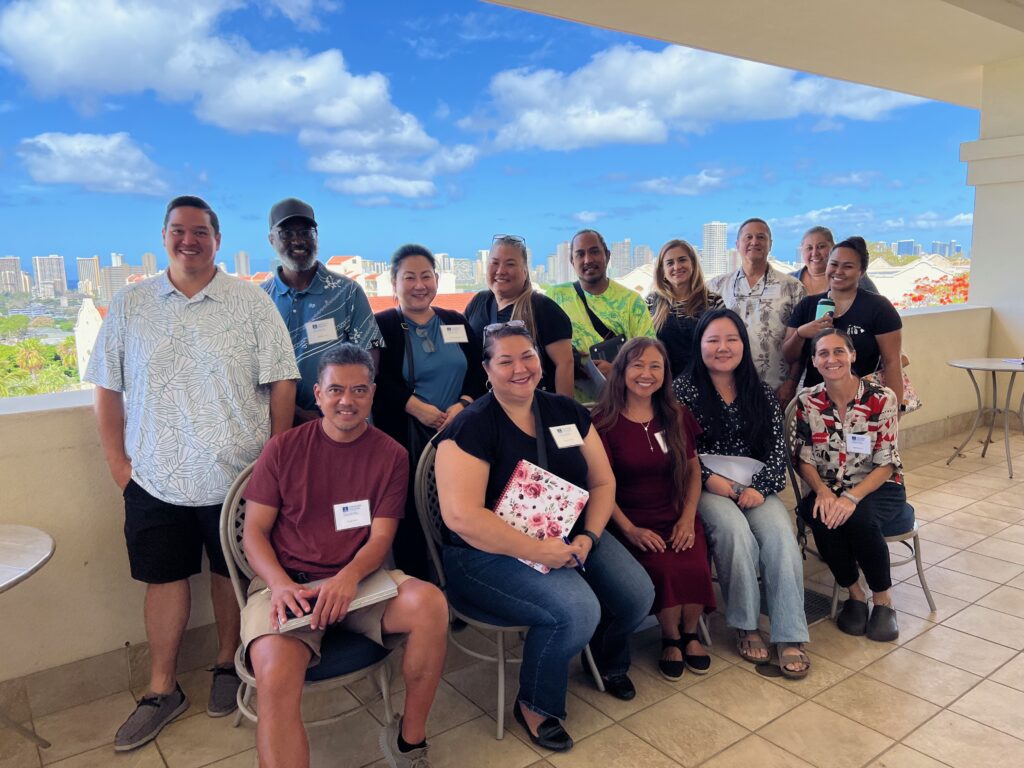
During an educator workshop hosted by Hawaii Education Association, Dugan and Chaminade students Abigail Eli ’23 Gabe Zapata-Berrios ’24 were among the attendees who discussed not only the ethical dimensions of AI, but also its legal ramifications.

“I can see how AI is having an impact on educators and students,” says Eli, who is pursuing her master’s in counseling psychology at Chaminade and is one of three Community Homeless Concerns liaisons with the Hawaii Department of Education in the Nanakuli-Waianae Complex Area. “I think it could be beneficial for our Waianae students who struggle with the concept of writing. I think they can learn from seeing something that’s well written.”

Starting his student teaching in Kailua, Zapata-Berrios has experimented with AI in his own studies, using it, for example, to create lesson plans, which typically take a lot of time.

“AI will write a complete lesson plan in less than 10 seconds,” Zapata-Berrios says. “This lesson plan is typically pretty good as a first draft. If I want I can ask the AI to revise it for me or I can just take that draft and revise it myself. I would always recommend revising it yourself because AI is not perfect.”

Abigail Eli '23 is now pursuing her master’s in counseling psychology at Chaminade.
Abigail Eli ’23 is now pursuing her master’s in counseling psychology at Chaminade.

While academic dishonesty tops the list of educators’ concerns about AI in education, teachers also worry that increased use of AI may mean learners receive less human contact. It’s a valid point that Askildson succinctly affirms in his letter to the editor, noting that “the science of human learning has shown us that students learn not only through their abilities of reasoning, interpretation and creative expression—which ChatGPT lacks— but also with the help of teachers who engage them in a two-way dialogue accompanied by feedback that is adjusted to their understanding and overall needs.”

From a student’s perspective, the use of AI in education comes with both benefits and potential pitfalls. Some view AI-powered tools as a way to provide additional support to students with diverse learning abilities, making education more inclusive. It can then assist in addressing specific challenges students may face.

Others are skeptical about its accuracy and its susceptibility to spread misinformation and disinformation. It’s also biased since AI can only be as smart or effective as the quality of data it is provided, and algorithms can be manipulated and skewed.

“Some of the teachers we heard from said they wanted to stay away from AI all together, that it was too controversial,” Dugan says. “They were afraid of plagiarism and cheating, and not being able to detect it. But I say AI is here to stay; it’s not going to go away and it will only progress.”

“AI is going to keep growing and infiltrating more parts of our lives,” adds Zapata-Berrios. “It’s already all over the place and constantly analyzing and improving. It will become more prevalent in classrooms, however, I don’t think it will become something that the students use to outsource their thinking. I think it’ll be present without the students knowing it’s there.”

Posted by: University Communications & Marketing Filed Under: Education, Faculty, Homepage, Innovation, Institutional, Student Life Tagged With: Elementary Education, Master of Arts in Teaching, Secondary Education

Medical School Journey

January 17, 2024

Rachel Arakawa enters her final year at George Washington

She’s more accustomed to dispensing medicine than she is advice. So, when asked what she would advise students to expect when they’re in medical school, Rachel Arakawa ’20 offered this simple suggestion: “Keep focus on your goals. And remember, you are just as qualified as anyone there.”

During a casual information session with students enrolled in Dr. Amber Noguchi’s HP 390 class–Advanced Topics in Health Professions Preparation—Arakawa shared her journey to George Washington University’s School of Medicine and Health Sciences. Like many freshmen who entered college amid a global pandemic in 2020, the former Silversword soccer and tennis player had to decide whether to stay home or move to Washington D.C.

“Even though all my courses were going to be online, I decided anyway to move to D.C.,” said Arakawa, who hopes to do her residency either in the Maryland–Virginia area or on the west coast. “That first year was really tough because it was my first time being away from home, and I had six to eight hours of online lectures every day, and then another two to three hours of reviewing the previous day’s content. We covered everything I learned as an undergraduate in two months.”

Chaminade President Dr. Lynn Babington welcomed Rachel Arakawa '20 back to campus this month for an informal discussion with students.
Chaminade President Dr. Lynn Babington welcomed Rachel Arakawa ’20 back to campus this month for an informal discussion with students.

Discipline and academic rigor, though, weren’t new to Arakawa. At the beginning of her sophomore year, the Kaneohe native decided to formally enter into an Articulation Agreement between Chaminade and George Washington University’s School of Medicine and Health Sciences.

At its essence, an articulation agreement document is a formal arrangement between two colleges or universities, outlining a structured transfer plan for specific program offerings. Depending on the program and degree, students have the opportunity to initiate their path towards advanced studies as undergraduates. This involves building a robust academic record and fulfilling prerequisites during their time at Chaminade. The agreement benefits students by guaranteeing the transfer of all completed classes (credits) and providing a clear pathway for ongoing academic progression.

Students who want to take advantage of participating in an articulation agreement, for example with George Washington University, should apply in January of their sophomore year. “This timeline avoids any gap year between undergraduate and graduate programs,” Noguchi noted. “Applicants are required to have spent two years (four semesters) in an undergraduate program of the contractual college and to have completed approximately 60 semester hours of course work by the end of the semester during which they apply.”

Articulation agreements streamline the transfer process for everyone involved. This will help alleviate the stress surrounding the application process, the credit transfer process, and several other issues students might encounter when applying to a graduate program. By simplifying this process with transfer agreements, it is beneficial to all parties involved.

Third year bio-medical major, Joshua Dumas ’25, plans to go to med school even though he didn’t pursue an articulation agreement. The aspiring physician’s decision was based on his preference to attend a school on the west coast so he can be closer to Hawaii and family.

“I was studying all winter break for the MCATs, but I decided to wait until I was better prepared,” said Dumas, a Regent Scholarship awardee and COPE Health Scholar with Adventist Health Castle. “It was inspiring to hear how her Chaminade experience helped her in med school, as I am sure it will help me.”

Now in her fourth year and two of three medical licensing exams behind her, Arakawa has applied to various residency programs and received 20 interviews. Her choice of post-graduate training will be in emergency medicine, a specific area that she has been interested in ever since she started her academic track in the health field.

“I did a lot of event medicine, like at concerts and marathons, and I really enjoyed it,” Arakawa told the students. “I get to look at trauma, but it’s not for everyone. You’ll have to find your own passion and specialty.”

Asked by sophomore Ku‘ulei Koko ’26 if she ever experienced the impostor syndrome, Arakawa unhesitatingly answered yes. “I am a first-generation medical student and the only Hawaiian–Japanese in my class,” Arakawa added. “Some of the other students were also more familiar with the social cues and mores of the medical field since they weren’t first gen. But, I overcame impostor syndrome by not comparing myself with others, and got involved with activities that I liked.”

Healthcare is indeed the perfect complement to Chaminade University’s mission. As a Marianist institution, faculty members educate their students to embrace adaptation and change, family values and community service, which are all core components of our healthcare system. And as a liberal arts school, Chaminade ensures that graduates have a wide breadth of knowledge and are able to think critically across a range of disciplines.

“I learned a lot during my years at Chaminade years—inside and outside of the classroom,” Arakawa said. “The small class sizes and the supportive faculty helped shaped my belief in serving the community and being an empathetic individual that can make a transformational impact.”  

Posted by: University Communications & Marketing Filed Under: Alumni, Homepage, Institutional, Natural Sciences & Mathematics, Undergraduate Research & Pre-Professional Programs Tagged With: Alumni, Guest Speakers, Transformation

‘Native Voices’

January 4, 2024

Traveling exhibit makes its first Hawaii stop at Sullivan Family Library

Among medical librarians, the “Native Voices: Native Peoples Concepts of Health and Illness” art exhibit is its own version of Taylor Swift’s “The Era Tours,” having traveled across the U.S. for more than a decade now. Officially opened at the U.S. National Library of Medicine (NLM) on October 5, 2011, the multi-media interactive exhibition explores the interconnectedness of wellness, illness and cultural life for Native Americans, Alaska Natives and Native Hawaiians.

With a keen and long-held desire to help improve public understanding of Native American health challenges and honor the culture, tradition and healing ways of Native Peoples, Donald A.B. Lindberg M.D. (National Library of Medicine’s director from 1984-2015) interviewed more than 80 Native American health and community leaders, resulting in over 250 video clips, the largest such collection of Native American videos known to exist.

While the exhibition’s usual iPad stands didn’t make the trip to Hawaii, you can still watch the videos online. The traveling exhibition that’s on display at Sullivan comprises six free-standing banners: the title banner introduces the exhibition; and each of the other five banners focuses on one of the main themes of Individual, Community, Nature, Tradition and Healing. The categories touch upon such topics as Native views and definitions of health and illness, Native views of land, food, community, the earth/nature, and Spirituality as they relate to Native health and illness, and contemporary and historical roles of traditional healing in Native Hawaiian, Alaska Native and Native American cultures.

Krystal Kakimoto stands in front of the free-standing panels that make up “Native Voices: Native Peoples Concepts of Health and Illness.”

“I think this exhibit will resonate with Chaminade students, and the community in general, because they might see parts of themselves reflected back to them in the panels of the exhibit,” says Krystal Kakimoto, ’22 (MBA), Sullivan Family Library’s liaison librarian and director of library technical services. “For too long, Native knowledge surrounding health has been dismissed. This exhibit gives viewers a chance to reflect and critically think about health and wellness while learning about the resilience and adaptation to change inherit to Native communities.”

Stories drawn from both the past and the present examine how the determinants of health for Native Hawaiians, Alaska Natives and American Indians are tied to community, the land and spirit. Through personal interviews, Native Peoples describe how individual and community wellness were affected by the political and cultural events of the 19th and 20th centuries. Individual reflections show the impact of epidemics, federal legislation, the loss of land and the inhibition of culture on the health of Native individuals and communities today. Collectively, these stories convey how Native people use both traditional and Western methods to enhance wellness, ultimately presenting an inspiring account of renaissance, recovery and self-determination.

Indeed, indigenous art often serves as a powerful medium for expressing cultural values, beliefs and experiences related to health and illness. Many indigenous cultures also hold holistic views of health that encompass physical, mental, spiritual and community well-being. “Native Voices” lays bare these interconnected aspects, emphasizing the importance of balance and harmony.

“I think the special twist on the Native part is that it’s so embedded in the land,” says one of the exhibit’s early key collaborators Marjorie Mau, M.D., physician and Chair of the Department of Native Hawaiian Health at the John A. Burns School of Medicine, in one of the 250 video clips. “It’s like if the land is abused or misused or not cared for, the people are reflected by that. Hopefully, future generations will understand at least when Native people are talking about who they are, and how they can take ownership of their wellness, that they’ll understand their wellness can spring from their homeland and from where they come from.”

“Native Voices: Native Peoples Concepts of Health and Illness” will be on display at the Sullivan Family Library until January 19.

“Chaminade University connects academic learning with the local community, environment and culture, creating a unique college experience for our students,” says Kakimoto, chairwoman of the Hawaii-Pacific Chapter of the Medical Library Association, an organization of consisting of professional librarians, individuals and institutions in health sciences libraries. “This philosophy takes learning beyond the traditional classroom and aims to make learning more relevant, engaging and applicable to the real world. I hope this exhibit continues our tradition of place-based learning to contextualize health in relation to the ʻāina.”

Posted by: University Communications & Marketing Filed Under: Alumni, Campus and Community, Homepage, Institutional, Nursing & Health Professions Tagged With: Art Exhibit, Campus Event, Office of Health Professions Advising and Undergraduate Research

Budget Analyst

December 19, 2023

Carol An Nacario ’23 to start new position with the Legislature

He had her at pizza. While walking past a classroom at Kieffer Hall, Carol An Nacario was swayed by School of Business and Communication assistant dean, Asoke Datta, Ed.D., to come in for some lunch. Not one to turn down free food — what college student does — Nacario willingly ambled through the door. Only then did she realize that she had just been recruited to enter the Silversword Business Competition.

“I only came in for the pizza,” laughs Nacario ’23, a business administration major. “I knew about the competition, but I had no intention of entering.”

Not only did she enter the competition, but on Nov. 16, she and her team members, Kelsey Sablan ’23, Epifania “Epi” Petelo ’23 and Elizabeth “Liz” Devine ’23, walked away with the grand prize of $1,500 for their “Re-Thread” entrepreneurial concept, which “sews new life into unused fabrics and transforms them into stylish and sustainable pouches.”

“Carol has been a highly driven student who values self-learning and entrepreneurial opportunities for growth in the world of business,” says Assistant Professor and MBA Director Eddie Merc. “This business plan competition event was an ideal opportunity to showcase her passion for teamwork and giving back to the community through service and sustainability efforts. I’m very proud of Carol and her team to represent School of Business and Communication so well at this important entrepreneurial venue.”

Re-Thread members (Elizabeth “Liz” Devine ’23 is missing) from left, Carol An Nacario, Kelsey Sablan and Epifania ‘Epi’ Petelo, won the $1,500 grand prize. The competition’s judges included, from left, David Oyadomari, Dr. Gail Grabowsky, Eric Fujimoto, Sharon Weiner and Hogan program director Dr. Roy Panzarella.

This was just the first victory for Nacario, who will end her collegiate experience on a winning streak. The second has even greater consequences. After seeing a flyer advertising that “The Hawaii State Senate is HIRING,” the Guam native decided to apply for one of the openings.

“I got a call asking me to choose an interview date,” Nacario says. “I chose Nov. 2 and a couple of weeks later, I found out I was hired, and I received an offer letter signed by Hawaii State Senator Donovan Dela Cruz, the Chair of the Senate Committee on Ways and Means.”

Starting in January, Nacario will be a budget analyst with the powerful Senate Committee on Ways and Means (WAM), which oversees programs relating to overall state financing policies, including revenue enhancement, taxation, other revenues, and cash and debt management; statewide implementation of planning, programming, budgeting and evaluation; and government structure and finance.

“The day before the interview, I approached Dr. Merc for some advice about what to expect,” Nacario recounts. “He told me to relax, and to be prepared to be asked about my strengths and weaknesses.”

Nacario also summoned the STAR method—a lesson that she had learned from visiting assistant professor, Pamela Estell, Ph.D.—which is an interview technique that gives interviewees a straightforward format they can use to tell a story by laying out the Situation, Task, Action and Result.

“I was very nervous at first,” Nacario says. “They asked me a lot of questions about budgets and if I had ever worked on government budgeting. I had mentioned VLOOKUP, which is an Excel function that I learned from Shari Young (Director of Finance & Operations for Make-A-Wish Hawaii) during my internship, and they were impressed.”

For the 21-year-old Chamorro, the opportunities afforded to her by Chaminade almost never happened. She was initially enrolled to attend the University of Guam until a close friend convinced her to apply to Chaminade. Two weeks before the start of classes in Guam, Nacario finally received an acceptance letter from Chaminade University.

“For some reason, the letter was delayed and it was never delivered when it should have been,” Nacario recalls. “It was the year of COVID and I had to quickly make a decision.”

She made the right one. As she finishes her final exams and celebrates her 22nd birthday on Dec. 16, Nacario reflects back on her four years at Chaminade with a wide smile on her face.

“When I came to Hawaii, I had never been to any other mainland state,” Nacario says. “I don’t think I would have grown in Guam, like I have here. I was an introvert and intimidated with titles, but now I am able to work in a professional environment, like the State Legislature.”

Posted by: University Communications & Marketing Filed Under: Business & Communication, Hogan Entrepreneurial Program, Homepage, Institutional Tagged With: Business Administration, Hogan Entrepreneurs Program, School of Business and Communication

Iceland Beer Spa

December 11, 2023

E+ID students enter International Architecture/Design Contest

E+ID students' presentation board for the Iceland Beer Spa International Architecture/Design Competition.
E+ID students’ presentation board for the Iceland Beer Spa International Architecture/Design Competition.
E+ID students' presentation board for the Iceland Beer Spa International Architecture/Design Competition.
E+ID students’ presentation board for the Iceland Beer Spa International Architecture/Design Competition.
E+ID students' presentation board for the Iceland Beer Spa International Architecture/Design Competition.
E+ID students’ presentation board for the Iceland Beer Spa International Architecture/Design Competition.
E+ID students' presentation board for the Iceland Beer Spa International Architecture/Design Competition.
E+ID students’ presentation board for the Iceland Beer Spa International Architecture/Design Competition.

After electronically submitting their final design concept to the Iceland Beer Spa International Architecture Competition, Katherine Liu ’26, Farrah Dinh ’25, Jazlynne Williamson ’25 and Soraya Ortiz ’25 were finally able to breathe a sigh of relief. For the past several weeks, the Chaminade Environmental + Interior Design majors were busy conceptualizing an eco-friendly space that would include a brewery, café snack bar, souvenir shop and full-service day spa facility.

“I asked them if they wanted to enter the competition, and they jumped at the chance,” says associate professor of Arts and Design Junghwa Suh, D.Arch, of the four students in her EID 384 class that focuses on sustainability in design. “It’s really impressive what they’ve been able to come up with in such a short amount of time.”

The overall competition was to replace an existing building on the property of the Sel Hotel, a family-run establishment, which is situated right in the Lake Myvatn area next to the legendary Skutustaoagigar craters, offering a prime location for a groundbreaking multi-purpose facility.  The competition sought to create a landmark destination that reflects the spirit of the region and provides an unforgettable experience for both tourists and locals alike.

Katherine Liu ’26, Farrah Dinh ’25, Jazlynne Williamson ’25, Soraya Ortiz ’25 and Dr. Junghwa Suh take a selfie before submitting their final design concept to the Iceland Beer Spa International Architecture Competition.

“Dr. Suh informed us that during her trip to Iceland, a tour guide explained how horses huddle and have formations to maintain warmth,” explains Liu, who initially wanted to pursue a degree in industrial engineering. “We wanted to integrate this idea into our design somehow since Icelandic culture values horses a great deal, and our project was strongly based off of organic forms and the idea of ‘life emulating nature.’

“The showers and bathrooms, for example, represent a cell or ecosystem within the organic crater shape of the building,” Liu adds. “Since we needed a modular element in our design, we decided to have our terrace furniture mimic the horse formations, showing the different groupings, which could be easily rearranged.” 

According to organizers, the competition was a rare opportunity to contribute to the evolution of hospitality and wellness in one of Iceland’s most enchanting regions. Designs had to be innovative and environmentally sensitive with the potential of making a lasting impact on the Myvatn Lake area and the world of architecture and design.

“This was the first time that Chaminade design students entered an international competition of this magnitude,” Suh says. “They’ve worked really hard and I’m proud of the final presentation.”

Praising Dinh, Williamson and Ortiz for their contributions, Liu says there was a lot of trust among them. “Jaz even let me take her laptop home because mine didn’t have some of the functions I needed to edit the design,” adds Liu, a student representative with the American Society of Interior Designers and a former intern with G70, a Honolulu architecture firm. “I even had her remotely take over my computer so we could finish this project on time.”

The finished design, “Da Crater Spa’t” creates a cohesive, functional and inviting space that caters to the various needs of guests. More importantly, the final product harmoniously incorporates the environs of Lake Myvatn, featuring basalt lava rock, natural ventilation, and eco-friendly finishes and materials that balance the serene beauty of the environment with the functional requirements of the project.

“They were super motivated and ambitious,” Suh says. “For three juniors and one sophomore, the level of their work is beyond impressive, and I hope they win.”

However, Liu, Dinh, Williamson and Ortiz acknowledge it’s going to be a difficult path. The competition, after all, is open to international licensed architects and designers who have years of experience in their respective fields. Still, the four Siverswords remain optimistic.

“If we win, we get to go to Iceland,” says Liu who plans on participating in a study abroad program in Florence, Italy next year. “After completing this project, my biggest takeaway was understanding the balance of adhering to a competition project timeline while continuously evolving design concepts through rigorous collaborative efforts.”

Posted by: University Communications & Marketing Filed Under: CIFAL Honolulu, Homepage, Humanities, Arts & Design, Institutional, Student Life Tagged With: Environmental + Interior Design, Honors and Awards

  • « Go to Previous Page
  • Page 1
  • Interim pages omitted …
  • Page 27
  • Page 28
  • Page 29
  • Page 30
  • Page 31
  • Interim pages omitted …
  • Page 37
  • Go to Next Page »

Footer

Chaminade University Logo

3140 Waialae Avenue
Honolulu, Hawaii 96816

Contact Us
Phone: (808) 735-4711
Toll-free: (800) 735-3733

facebook twitter instagram youtube linkedin

Visit

  • Plan Your Visit
  • Campus Map (PDF)
  • Events

Resources

  • Campus Security
  • Student Consumer Information
  • Concerns, Feedback, and Reporting
  • Institutional Review Board
  • Title IX / Nondiscrimination Policy
  • Compliance
  • Emergency Information
  • Careers
  • Institutional Statement

People

  • Students
  • Parents
  • Alumni
  • Faculty & Staff

Policy

  • Privacy Policy
  • Terms and Conditions of Use


© Chaminade University of Honolulu