• Skip to primary navigation
  • Skip to main content
  • Skip to footer
Chaminade University of Honolulu

Chaminade University of Honolulu

  • VISIT
  • APPLY
  • GIVE
  • STUDENTS
  • PARENTS
  • ALUMNI
  • FACULTY/STAFF
  • Admissions
    • Admissions Home
    • Undergraduate Students
      • First-Year Students
      • Transfer Students
      • Admitted Students
    • Graduate Students
    • Flex Online Undergraduate Program
    • Military Students
    • Non-Degree/Visiting Students
    • Experiential Honors Program
    • Early College Program
    • New Student Orientation
  • Tuition & Aid
    • Financial Aid Home
    • Tuition & Expenses
    • Federal Updates & Changes
    • Scholarships
    • $5,000 Graduate Scholarship
    • VA Education Benefits
    • Net Price Calculator
  • Academics
    • Academics Home
    • Academic Programs
    • Office of Student Success
      • Academic Advising
      • Records and Registrar
    • Kōkua ʻIke (Support Services)
      • ADA Accommodations
      • Career Services
      • Proctoring Services
      • Tutoring Services
    • Sullivan Family Library
    • Undergraduate Research & Pre-Professional Programs
    • Commencement
  • Campus Life
    • About Campus Life
    • Student Engagement
    • Student Government Association
    • Residence Life and Housing
      • Summer Conference Housing
    • Health Services
    • Marianist Leadership Center
    • Counseling Center
    • Campus Ministry
    • Campus Security
    • Dining Services
    • Bookstore
  • Athletics
  • About
    • Chaminade University News
    • Our Story
    • Leadership
    • Chaminade University Strategic Plan 2024-2030
    • Mission & Rector
    • Association of Marianist Universities
    • Facts & Rankings
    • CIFAL Honolulu
    • Accreditation & Memberships
    • Montessori Laboratory School
Search
×

Search this web site

Featured Story

Kapaa High School Students Earn College Credit Through Partnership

October 7, 2022

Chaminade University is taking its early college initiative to new levels, forging a cutting-edge partnership with Kapaa High to connect rural Kauai students to hands-on, online instruction created exclusively for them.

The idea grew out of the need for robust remote learning options during the pandemic, explained Chaminade Vice Provost for Academic Affairs Dr. Janet Davidson. Shortly after many campuses went fully to distance learning, Chaminade delivered a “train-the-trainer” workshop for Kauai teachers on best practices in online instruction. From there, a relationship was formed—and grew.
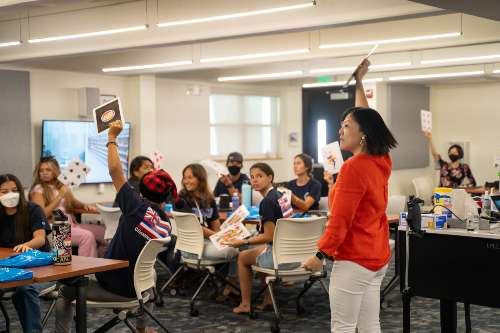
Kapaa High School students in Chaminade class

And roughly a year later, those same partners with the Hawaii Department of Education (DOE) on Kauai approached Davidson with an idea: would you be interested, they asked, in helping us stand up a dual credit college program exclusively for students at Kapaa High? The answer: a resounding yes.

So Chaminade and the DOE started developing a program and seeking financial support for it.

The inaugural cohort was launched in Fall 2021, giving participants—both juniors and seniors—the opportunity to earn high school and college credit at the same time. The program was designed around Kapaa High School’s bell schedule and online courses are delivered live by Chaminade faculty members.

Davidson said students take the courses on Kapaa High School’s campus with a teacher on hand to offer assistance. Chaminade also provides supports to participants, including advising and educational tech.
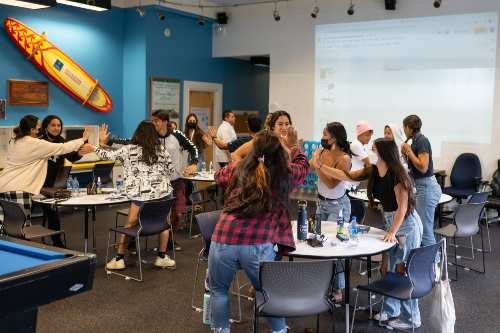
Kapaa High School students in Chaminade class

That first term, students were able to enroll in Human Nutrition and English 101: Introduction to Expository Writing. In Spring 2022, Chaminade offered College Algebra and PSY 101: Intro to Psychology.

Davidson said a junior entering the program has the chance to earn 24 college credits in all.

“The students who are participating have all different types of interests and are at different levels,” Davidson said. “This is really about expanding opportunities—and helping students imagine themselves going to college after graduating from high school. We want to help strengthen that pipeline.”

Students even participate in labs remotely.

Davidson said 23 students took courses through the program in the 2021–2022 academic year.

Of those, all 11 seniors graduated from high school and applied for college.

Kapaa High School students on a trolley at Chaminade

With 31 students at Kapaa High School in the program this Fall Term, Davidson is proud about how quickly the program has matured and is excited about the potential for future expansion. “We do want to expand—with the right partner,” Davidson said. “The biggest factor for the success of this program is mutual trust. Together, our goal is to make a positive difference in the lives of these high schoolers.”

Davidson added student mentoring is a critical element of the program.

Members of the inaugural cohort, for example, were invited to spend a weekend at Chaminade for intensive workshops on everything from how to finance college to how to succeed in higher education.

“We had an opportunity to engage the students and they were universally very appreciative of the experience,” Davidson said. “The faculty is what made all the difference. They also felt very supported.”
Posted by: University Communications & Marketing Filed Under: Early College, Featured Story, Institutional

Alumna’s Endowed Scholarship Creates Opportunities and a Better Future for Chaminade Students

October 6, 2022

Jan Seymour ‘76 is proud of the endowed scholarship she helped establish at Chaminade University.

Yet she is quick to deflect any suggestion that she is worthy of  praise or high esteem.

“I’m not noble,” Seymour said, while chatting with Chaminade Magazine. “Don’t make me sound like a saint.” The scholarship, she said, is about putting her dollars to work for a better future—and that’s in everyone’s interest. “I wanted my money to go to something that was beneficial,” Seymour said.

“I want my money to create the greatest impact.”

She also wanted to help students who don’t always qualify for aid.

That’s why the Fumiko Kanazawa Endowed Scholarship, named after Seymour’s aunt, is open to students with a grade-point-average of 2.5 and above. “It’s for the B- or C-average students who probably need a little more help,” she said, adding that’s the category she fell into as an undergraduate.

Preference for the scholarship is also given to those who are of mixed Japanese descent.

“That’s because of me, too. I’m hapa,” she said.

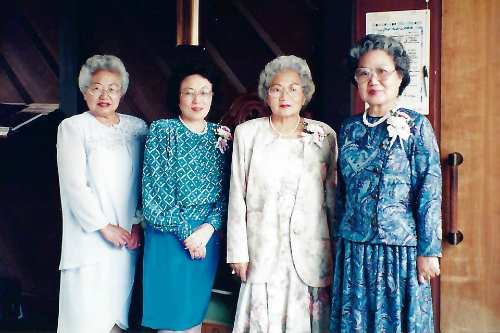
Kanazawa sisters (June 1994)
Kanazawa sisters (left to right): Annie Sueda, Toshe Rose, Rukie Harris, Fumiko Kanazawa

Several of Seymour’s relatives have also contributed to the endowment fund. In addition to the scholarship, which was established in 2011, both Seymour and her mother have made estate planned giving pledges to Chaminade. For Seymour, it was an easy decision to make.

“The scholarship is essentially me. It’s about establishing an identity of oneself,” she said.

Seymour grew up in Southern California, and said she always wanted to come to the islands. She remembers pestering her mother relentlessly about it. And so after Seymour finished two years at a small Catholic university in Los Angeles, her mother suggested she go to Hawaii to attend Chaminade University.

“She said go to Hawaii and get it out of your system,” Seymour said.

She did but Hawaii always remains in her heart.

One of the first things Seymour noticed in Hawaii was the diversity. “Being in Hawaii and being at Chaminade, that was the first time it felt like I was really home,” she said. “Being half-Japanese, even in California, I still dealt with prejudice. But in Hawaii, I didn’t see that. 

Nobody gave you a second look.”

She added, “It was nothing but people who looked like me.”

That’s another reason the scholarship gives preference to those of mixed Japanese descent. Seymour said she wanted to celebrate what she saw in Hawaii—a melting pot of people, from different ethnicities, cultures and backgrounds, who collectively embrace inclusivity and acceptance.

At Chaminade, Seymour lived in the residence halls and majored in International Studies.

Almost immediately, she struck up lasting friendships.

“There was a group of four of us. We were all the same age, but because of our different paths, we were all in different years. I still have precious memories of our time together,” she said, adding that one member of the group sadly passed away in the 1990s. “These were lifelong friendships.”

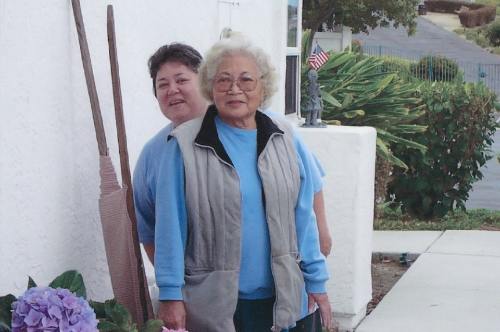
Jan Seymour and her mom, Rukie Harris
Jan Seymour ’76 and her mom, Rukie Harris

After graduating from Chaminade, Seymour went to graduate school in Arizona and pursued a successful career in banking. Eventually, her work included installing operating systems at credit unions around the country. Seymour said that she established the endowed scholarship at a time when she was incredibly busy with her career. “I was traveling so much I was visiting my house,” she quipped.

While now retired, Seymour said her calendar is still very full.

She makes time to visit Chaminade regularly to support the mission—and meet some of the students her family’s endowed scholarship has helped. Because of the pandemic, she hasn’t been able to make it to campus since 2019, but she’s looking forward to returning soon.

“I know this scholarship helps, especially those students who may not get help from elsewhere,” Seymour said. The minimum GPA requirement, she added, acknowledges that some students are juggling multiple obligations. “Holding down two jobs and trying to study, tell me when you’re going to have time to be an A-student,” she said. “This is about supporting education and opportunities.”

That is something Seymour thinks her aunt Fumiko Kanazawa, the scholarship’s namesake, would appreciate. Kanazawa was a high school history teacher in Los Angeles for many years. “This scholarship is just me. Not selfless, but just me,” she said. “It’s a commitment to help the future. That’s all.”

Posted by: University Communications & Marketing Filed Under: Alumni, Diversity and Inclusion, Featured Story Tagged With: Scholarship

Finding Your Passion and Getting Out of Your Comfort Zone

October 4, 2022

Brittany Johnson ’24 had a lot of life under her belt when she applied to Chaminade University.

She’d already served in the Air Force, after enrolling right out of high school. She’d earned her first degree—a bachelor’s in Community and Public Health from the University of South Carolina. She’d gone back into military service, joining the Army and shipping off to Hawaii’s Schofield Barracks.

Her experiences helped her grow—and drove her to realize something: she thrived on helping others.

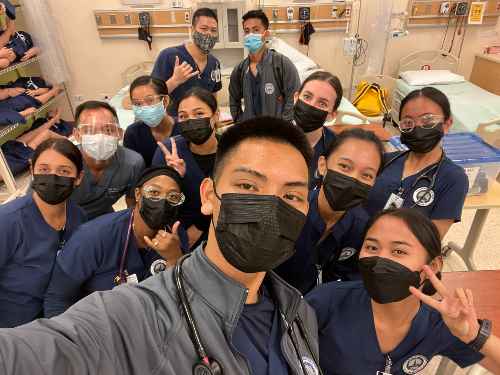
Nursing students

So she decided to turn her talents to Nursing and applied to several universities as she prepared to complete her Army obligations. She was packing up, anticipating she would have to move back to the mainland, when she got word from Chaminade that she’d been accepted. “I ended up at Chaminade, was awarded scholarships to help and never looked back,” she said. “I am so happy that I did.”

In the Nursing program and across campus, Johnson said, she found a community that offered supportive encouragement and a warm atmosphere. They celebrated her unique perspective. And they connected her with a host of opportunities that helped her put her learning into action.

“There was a time in my life when I didn’t know the value of people. I didn’t know how to ask for or receive help,” she said. “But at Chaminade, I’ve always felt like part of the family. I could not have done what I have done without the people around me, my professors and mentors and my peers.”

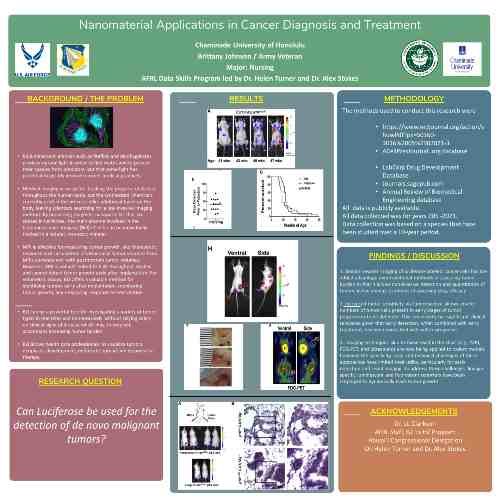
It was helping hands at Chaminade that got her connected to a cutting-edge internship with the Air Force Research Laboratory, where she pored over research into nanomaterials. She focused on luciferase, a light-producing enzyme found in fireflies that can be used in x-ray machines.

Brittany Johnson's Luciferase poster

The evolving technology could be a safer option, especially for those who require multiple x-rays.

Johnson analyzed the available literature to put together an in-depth poster on the potential opportunities and limitations with the nanomaterial. She then delivered a presentation to the board of directors for the program. The Air Force could now end up pursuing further research into luciferase.

For Johnson, the internship wasn’t just exciting, it was challenging. “Five years ago, I could not have projected I would be doing this kind of work,” Johnson said. “It truly took a team of people to do that.”

She liked the experience so much, she opted to extend it. This fall, she’s interested in researching nanomaterials that could help physicians detect cancer earlier, leading to better patient outcomes.

And that’s not the only internship that’s been keeping Johnson busy.

Chaminade also connected her with an internship for Summer 2022 with the National Hemophilia Foundation’s Hawaii chapter. She jumped at the chance to work closer with patients and their families while helping to raise awareness for a condition that not many people fully understand.

“Over the course of the summer, I did everything from help to plan events to assist with fundraising efforts,” she said. “But the highlight was attending a summer camp for kids with hemophilia. These kids feel ostracized a lot of the time, but at camp with their peers they got to really enjoy themselves.”

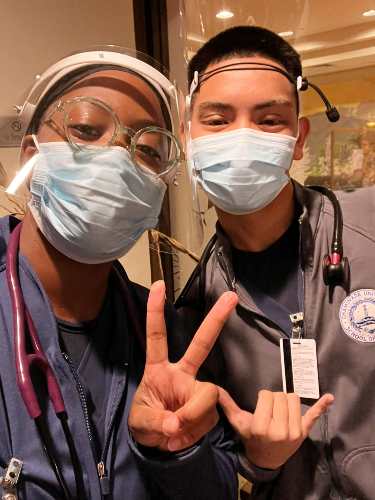
Brittany Johnson '24 and friend

Kids with hemophilia often can’t participate in the same activities because their blood doesn’t clot properly, meaning even relatively small injuries can be dangerous. Hearing from families about how they manage the disease, Johnson said, helped her gain important perspective as a nurse in training.

“It was so fulfilling,” she said. “And it helped me put a spotlight on people whose voices we don’t oftentimes hear. I didn’t know these people are right next door to me. They’re in our community.”

As she makes progress toward graduation, Johnson said she is especially grateful to the Career Development team at Chaminade—especially career advisor Diane Yang. Johnson said the internships Yang and her team connected her with have helped her grow as a learner and a leader.

“It’s not easy to get out of your comfort zone,” she said, “but there’s no better way to learn.”

Posted by: University Communications & Marketing Filed Under: Featured Story, Nursing & Health Professions, Students Tagged With: Internship, Nursing

Chaminade University Receives $50,000 Grant from the McInerny Foundation

September 27, 2022

Chaminade University of Honolulu recently received a $50,000 grant from the McInerny Foundation to support the school’s Economic Education Center for Excellence. The grant will fund financial literacy programs at the center for the 2022-2023 school year.

The Chaminade Economic Education Center for Excellence (EECE) promotes economic empowerment for families and communities in Hawaii and the US-affiliated Pacific through accessible and sustained economic and personal financial literacy training that is culturally responsive. The research projects improve understanding of barriers to economic empowerment which shed light on policies and practical interventions to overcome these barriers in Hawaii and beyond. 

The McInerny Foundation grant aims to serve approximately 30 public school teachers with professional development workshops in how to incorporate financial literacy into the K-12 classroom, and 20 high school students with age appropriate coursework in economics and personal finance. Chaminade students also benefit from the programs as EECE workshop teaching assistants.

# # #

Chaminade University of Honolulu believes in the power of education to drive positive change, broaden perspectives and deepen our understanding of one another. With an emphasis on transformative service-learning experiences, we prepare students to serve as tomorrow’s leaders, inspiring and challenging them to use their minds and their hearts to help build stronger and more just communities. We are proud to serve as Hawai‘i’s only Marianist university, and rely on these values to guide us in delivering a high-quality education with an individualized approach and a focus on excellence, innovation and change. Established in 1955, we offer more than 30 undergraduate and graduate programs, including doctoral degrees in education, psychology and nursing practice. Learn more at chaminade.edu.

Posted by: University Communications & Marketing Filed Under: Business & Communication, Featured Story, Press Release Tagged With: Economic Education Center for Excellence, Grants

Using AI and Machine Learning in Healthcare

September 26, 2022

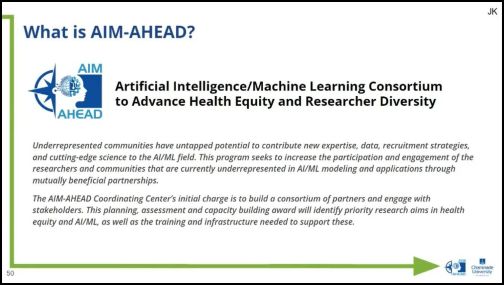
AIM-HEAD symposium slide

Algorithms are increasingly being used to make big decisions in healthcare, and there’s a common misconception that they’re unbiased. The truth is: they’re as biased as the humans that create them and a group of researchers—including several at Chaminade University—are trying to spotlight what that means.

In partnership with a federal consortium looking at the issue—dubbed AIM-AHEAD—Chaminade hosted a special virtual symposium in August aimed at better understanding the uses of artificial intelligence (AI) and machine learning in health and what changes are needed to improve health equity in the Pacific.

Dr. Claire Wright, an associate professor at Biology at Chaminade, said the symposium was about beginning a conversation—and ensuring Pacific voices are part of it. “We wanted to engage the community and understand some of the things that are really important to them,” she said.

“We think it’s kind of science fiction but there are many elements of health sciences that machine learning is already used, like diagnostics, surgery, prognosis, and driving health plans. But the data used to run those algorithms is not representative of our population in Hawaii.”

So is that a problem? And if so, how much of a problem?

That was the question tackled during the event—and the topics covered could help guide the development of best practices and ethical guidelines nationally. AIM-AHEAD, which organized the symposium with Chaminade, is funded by the National Institutes of Health and focused on increasing diversity among AI and machine learning researchers to ultimately improve the technologies in health applications, starting with electronic health records. The initiative’s acronym stands for the Artificial Intelligence/Machine Learning Consortium to Advance Health Equity and Researcher Diversity.

Chaminade Data Science Director Dr. Rylan Chong delivered the opening keynote at the symposium, urging attendees to consider how bias makes its way into algorithms and machine learning programs at various points in the process—from the bias that researchers bring to biases baked into “norm studies.”

Dr. Melissa McCradden, who is a bioethicist at the Hospital for Sick Children (affiliated with the University of Toronto), built on those themes in her keynote. She said the conversation happening around algorithmic bias, including in healthcare, is ultimately about “doing better science.”

“One of the major misperceptions is because AI uses so much data … that it’s ultimately leading us toward a place where we’re modeling objective truths about the world,” she said. “But we need to be really, really cautious about assuming that more data can get us closer to objectivity.”

Instead, she said, communities need to work together to make “values-based choices.”

And then, McCradden added, those choices need to be evaluated for their impacts.

Importantly, the symposium also included listening sessions so participants could weigh in on where inequities are now—and how technology might help to address them—rather than make them worse.

“These tools are already being used, but we don’t know the power of them for our communities,” Wright said. “Before we go too far down the line, we want to make sure that some of the folks who are underrepresented have the opportunity to be involved in the conversation.”

She added, “Let’s direct the quality of our own healthcare. Let’s tailor it to fit our needs.”  

Posted by: University Communications & Marketing Filed Under: Campus and Community, Diversity and Inclusion, Featured Story, Innovation, Natural Sciences & Mathematics

Alumna Continues Her Dream to Medical School Through Articulation Agreement

September 23, 2022

Growing up in Waianae, Donna Cottrell ‘22 says she felt the sting of healthcare inequality firsthand.

It wasn’t just that care was difficult to access.

Donna Cottrell '22
Donna Cottrell ’22 (right)

“It was that a lot of times, our voices weren’t heard,” she said.

The experience (and her drive to change it) is what drew her to the field of osteopathic medicine and a career where she could consider the whole patient—mind, body, and spirit. And this summer, she moved to Arizona to pursue her dream at A.T. Still University’s Kirksville College of Osteopathic Medicine.

The Biology major said she took advantage of Chaminade’s articulation agreement with A.T. Still University to secure early admission to the prestigious program. She was also awarded a merit-based Native Hawaiian Health Scholarship for her studies, which will cover all four years of her medicine program’s tuition.

Needless to say, she’s a little excited.

“The day they called me to say I’d gotten in, I was over the moon,” Cottrell said. “I just ran to my grandma’s room and was just screaming, ‘I got in! I got in!’ This was my biggest dream and I got it.”

Finding community

Cottrell and her siblings were raised by their father, a fish diver.

“He didn’t graduate from high school,” said Cottrell, but instilled a strong love for education in his children. Cottrell said she felt inspired to succeed so she could strike out on her own and attend college.

She also knew what she wanted in a university: small class sizes, a strong sense of community, and opportunities to connect with professors and mentors. She found all that at Chaminade, she said, and enrolled after graduating from Wai‘anae High School. After a search of Chaminade’s website, she also applied for—and received—the Ho’oulu STEM Scholarship to cover four years of tuition and other costs.

“It’s not just a scholarship, it’s a community,” said Cottrell, of the Ho’oulu program, which offers participants career development, paid internships and culturally informed service-learning projects.

“The Hooulu program has been a huge help.”

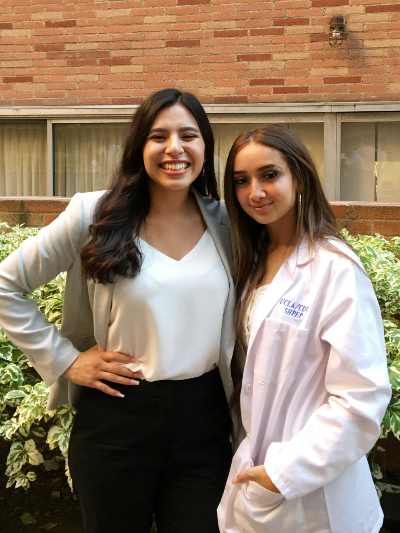
Donna Cottrell '22 at UCLA
Donna Cottrell ’22 at UCLA summer health professions program

As she participated in Ho’oulu offerings, Cottrell also made progress on her academic goals and embraced her newfound independence. She moved into the dorms. She started making friends. And she juggled a busy schedule. “It made me stand on my own two feet,” she said.

And after wrapping up her freshman year, she got a summer experience that would solidify her dream of going into healthcare. Through Chaminade, she applied for and got a spot in a summer health professions program at UCLA for students from underrepresented communities.

During the program, she shadowed doctors and learned from her peers.

She also gained something else: Confidence.

‘I want to be able to help’
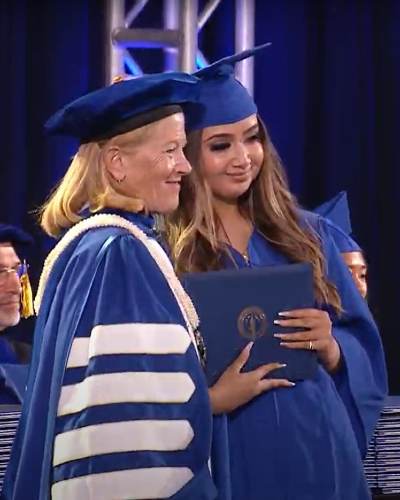
Donna Cottrell '22 graduation

Cottrell realized she really did have an opportunity to make a difference—and to help her own community and places like it. She was also inspired by a more personal experience: her younger brother was born with a serious heart condition and required treatment on the mainland. She remembers watching the doctors and nurses and arriving at this thought: “They could do something.”

“That kind of drew me in. I want to be able to help,” she said, adding her brother is now doing great.

In her sophomore and junior years, Cottrell started working with her advisors and mentors at Chaminade. She said the university’s articulation agreement was a perfect way to prepare for a big challenge—and a big opportunity. It meant a guaranteed interview with the graduate program of her dreams. “It took the stress off so I was able to focus on my grades and on succeeding,” she said.

Cottrell said one of the reasons she chose A.T. Still University’s School of Osteopathic Medicine is because the program puts a special emphasis on health disparities. During her junior year, she was also given the chance to shadow a pediatrician for six months at Waianae Coast Comprehensive Health Center to get a taste for what it’s actually like to serve the community where she grew up.

It got her excited about the future. But right now, she’s a little more focused on the present—and thriving in medical school. In May, after receiving her Chaminade diploma, she became a first generation college graduate. The next box she’s going to tick in life: “I’m going to be the first doctor in my family.”

Posted by: University Communications & Marketing Filed Under: Alumni, Diversity and Inclusion, Featured Story, Natural Sciences & Mathematics, Undergraduate Research & Pre-Professional Programs Tagged With: Alumni, Articulation Agreements, Biology

  • « Go to Previous Page
  • Page 1
  • Interim pages omitted …
  • Page 47
  • Page 48
  • Page 49
  • Page 50
  • Page 51
  • Interim pages omitted …
  • Page 92
  • Go to Next Page »

Footer

Chaminade University Logo

3140 Waialae Avenue
Honolulu, Hawaii 96816

Contact Us
Phone: (808) 735-4711
Toll-free: (800) 735-3733

facebook twitter instagram youtube linkedin

Visit

  • Plan Your Visit
  • Campus Map (PDF)
  • Events

Resources

  • Campus Security
  • Student Consumer Information
  • Concerns, Feedback, and Reporting
  • Institutional Review Board
  • Title IX / Nondiscrimination Policy
  • Compliance
  • Emergency Information
  • Careers
  • Institutional Statement

People

  • Students
  • Parents
  • Alumni
  • Faculty & Staff

Policy

  • Privacy Policy
  • Terms and Conditions of Use


© Chaminade University of Honolulu