• Skip to primary navigation
  • Skip to main content
  • Skip to footer
Chaminade University of Honolulu

Chaminade University of Honolulu

  • VISIT
  • APPLY
  • GIVE
  • STUDENTS
  • PARENTS
  • ALUMNI
  • FACULTY/STAFF
  • Admissions
    • Admissions Home
    • Undergraduate Students
      • First-Year Students
      • Transfer Students
      • Admitted Students
    • Graduate Students
    • Flex Online Undergraduate Program
    • Military Students
    • Non-Degree/Visiting Students
    • Experiential Honors Program
    • Early College Program
    • New Student Orientation
  • Tuition & Aid
    • Financial Aid Home
    • Tuition & Expenses
    • Federal Updates & Changes
    • Scholarships
    • $5,000 Graduate Scholarship
    • VA Education Benefits
    • Net Price Calculator
  • Academics
    • Academics Home
    • Academic Programs
    • Office of Student Success
      • Academic Advising
      • Records and Registrar
    • Kōkua ʻIke (Support Services)
      • ADA Accommodations
      • Career Services
      • Proctoring Services
      • Tutoring Services
    • Sullivan Family Library
    • Undergraduate Research & Pre-Professional Programs
    • Commencement
  • Campus Life
    • About Campus Life
    • Student Engagement
    • Student Government Association
    • Residence Life and Housing
      • Summer Conference Housing
    • Health Services
    • Marianist Leadership Center
    • Counseling Center
    • Campus Ministry
    • Campus Security
    • Dining Services
    • Bookstore
  • Athletics
  • About
    • Chaminade University News
    • Our Story
    • Leadership
    • Chaminade University Strategic Plan 2024-2030
    • Mission & Rector
    • Association of Marianist Universities
    • Facts & Rankings
    • CIFAL Honolulu
    • Accreditation & Memberships
    • Montessori Laboratory School
Search
×

Search this web site

Education

Upstream Battle

April 6, 2023

Freshmen students help in Palolo Stream cleanup

Empty bottles and cans. Cartons and styrofoam containers. A neon pink plastic ball. These were just some of the debris littered along the banks of Palolo Stream. Huddled below a large banyan tree above the flotsam and jetsam, John Watase and Hideki Kimukai said they’ve seen worse—even in just the past couple of days.

Pointing to a group of Dr. Lupita Ruiz-Jones’s ENV 100 students as they climbed down a slope to reach the banks of the stream, Kimukai said, “they have no choice,” referring to students’ responsibility of being good stewards of the aina.

“They represent the future,” said Kimukai, an Education Specialist + Japanese Education Program Lead with Sustainable Coastlines. “They’re the ones inheriting this earth. They’ll be the ones to fight for climate change, and they’ll be the ones affecting and writing policies.”

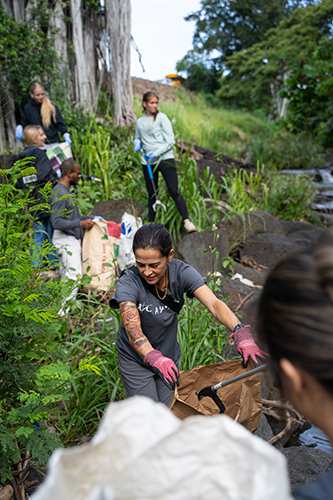
Dr. Lupita Ruiz-Jones and her ENV100 students help with the cleanup efforts along Palolo Stream.
Dr. Lupita Ruiz-Jones and her ENV 100 students help with the cleanup efforts along Palolo Stream.

An environmental teacher with Saint Louis School, Watase is urgently sounding the alarm bells, not only about the stream but the state of the environment. “I don’t know what people are thinking when they’re tossing their trash,” said Watase, who graduated from Saint Louis in 2006. “I’ve seen so much waste that’s simply inexcusable.”

Before setting off along a wooden path that Watase helped build, Ruiz-Jones instructed her students to grab some gloves and trash pickers, warning them of the challenges they might encounter during the hour-long cleanup, including large pieces of debris and the foul stench.

“In this short amount of time, you can make a difference,” said Ruiz-Jones, encouraging her students to participate in other cleanups around the island. “It’s not easy work; it’s hard, but you’re contributing to the solution, and helping to prevent rubbish from making its journey to the ocean.”

A 10-year service member and veteran of the Army, LaVelle White ’26 quickly filled his bag with plastic bottles, aluminum cans and other rubbish even before he reached the banks. “I’ve volunteered on a couple of cleanups around the island,” said White, a freshman who is using the GI Bill to earn a Chaminade degree. “And I’ve also participated in cleanups in Oklahoma and San Antonio. It’s my way of contributing to the community, wherever that may be at the time.”

In her ENV 100 class, Ruiz-Jones introduces students to rudimentary environmental issues, providing them theory in the classroom and practicum outside the campus with such experiential opportunities as the Palolo Stream Cleanup, a Beach Cleanup in Waimanalo and internships with nonprofit organizations.

“At the Maunalua Fishpond Heritage Center, for example, students are collecting data and using their findings to help restore the fishpond,” explained Ruiz-Jones, whose passion for the environment was sparked when she attended a Bioneers Conference in Northern California when she was in high school. “This is what service learning looks like. It connects student learning in the classroom with real-world experiences in the community.”

At Saint Louis, Watase teaches his students all about composting, from permaculture to vermicompost. It’s a matter that’s close to his heart since he runs his own farm in Waialua. The Palolo Stream is also spiritual for him, which is the reason he leads his students on regular cleanups along the banks.

“The ultimate goal is to restore the path and manage the debris in the stream,” Watase says. “We’re also trying to rid of the invasive fish to give ‘o‘opu (the Hawaiian word for fish in the goby family) a chance to thrive. The last fish cleanup we did in the stream, we caught 1,700 fish in a few hours. And of the 1,700, only four were ‘o‘opu and the rest were tilapia, small-mouth bass and lots of catfish—all invasive.”

As students scaled back to the top of the embankment, Kimukai commented that he wants to teach students “to re-learn what they’ve learned.” “I enjoy talking story with students of all ages, from K to K—keiki to kapuna,” he said. “We try to inspire the kids and be inspired by them. They can change the future, as long as they have the mindset.”

Posted by: University Communications & Marketing Filed Under: Alumni, Campus and Community, CIFAL Honolulu, Education, Featured Story, Homepage Tagged With: Environmental Studies, Environmental Studies Minor

History in the Making

March 9, 2023

Students from middle to high schools show off their historical projects

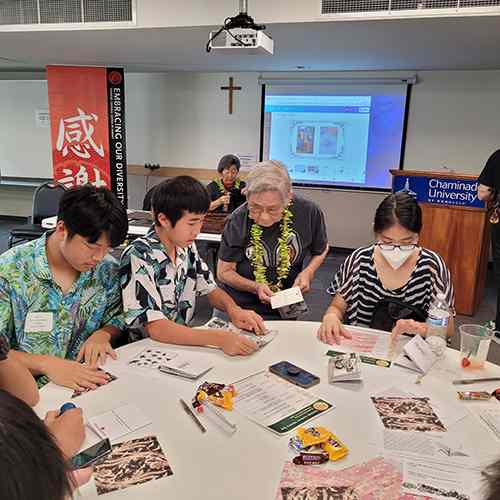
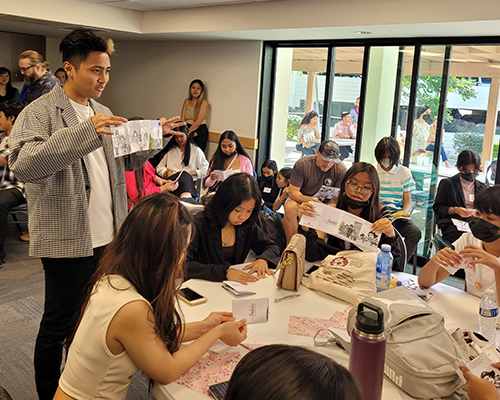
Participants work on an origami project with the guidance of members from the Japanese Cultural Center of Hawaii.

With easing COVID restrictions, this year’s Honolulu District History Day Fair was not held virtually for the first time since the pandemic. The hybrid format allowed students to attend in-person at Chaminade University’s Hale Hoaloha. In total, 114 students—from middle to high schools—registered from eight schools, including some ʻōlelo Hawaiʻi students; 65 projects were submitted; and 10 teachers acted as mentors.

“The Chaminade School of Humanities has a longstanding relationship with Hawaii History Day,” says Cheryl Edelson, Chaminade’s Dean of School of Humanities, Arts and Design. “In fact, Chaminade Professor of History, Dr. Mitch Yamasaki, is one of the founding members of Hawaii History Day—a program that since 1990 has brought together K-12 teachers, students and community members to research and create projects on the importance of history.”

Hawaii History Day coincides with the National History Day® (NHD), an educational nonprofit organization that engages teachers and students in historical research. The mission of NHD is to improve the teaching and learning of history in middle and high school through an innovative framework of historical inquiry and research. Students learn history by selecting topics of interest, launching into year-long research projects, and presenting their findings through creative approaches and media.

“The scope of projects and the innovative approaches presented by students is always exciting and impressive,” Edelson says. “In 2021, Hawaii History Day participant Keilani Kajiyama Tinkham of Laie Elementary School earned first place honors in the National Junior Division in Performance for her project The Rhythm of Resilience: Communication through the Bon Dance.” 

Social Studies teacher Jaimy Valerio helps students with their project.

Students can choose from one of five different project formats: Exhibit, Performance, Documentary, Essay and Website. On Hawaii Island, students can also enter their projects in ʻŌlelo Hawaiʻi. This year’s narrative theme was “Frontiers in History: People, Places, Ideas.”

“Hawaiʻi History Day is about community, connection, and the exchange of knowledge through storytelling, connecting our histories to our everyday lives and sparking inspiration for the future,”  says Shannon Cristobal, Director of Hawaiʻi History Day. “These community connections and storytelling exchanges have been particularly crucial for our students as they endured constant schedule changes and profound isolation during online learning through the COVID pandemic, which has really hit our educational community hard.”

Winners will go on to compete at the state competition at a later date. Their projects capture the human experience, showcasing the complex historical contexts that have led to the ideas, which have become so ingrained in our everyday lives.

“When students participate in History Day, they become expert detectives, writers, artists and storytellers,” says Devin Makizuru, Hawaii History Day Assistant Coordinator. “They find bits and pieces of a story, and bring them together to create a different one. This story they tell has a part of them in it, so it is special in that way. We may hear the same stories over the years, but the voices telling them are different. And sometimes, something very special happens…and someone tells a story that no one has ever heard before.”

Posted by: University Communications & Marketing Filed Under: Campus and Community, Diversity and Inclusion, Education, Homepage Tagged With: Campus Event

Counselor of the Year

March 9, 2023

Chaminade alumna recognized for her work and contributions

In a teary emotional speech she gave after returning from Washington, D.C. as the 2023  Hawai‘i School Counselor of the Year, Brittnie Caraulia thanked her Helemano Elementary School colleagues, expressing her gratitude for their support and all the work that they do for the keiki.

“This is the highest honor,” said Caraulia, MSCP ’15, on being honored with the 2023 Hawai‘i School Counselor of the Year by the American School Counselor Association (ASCA) during its annual National School Counselor of the Year ceremonies in the nation’s capital. “This brings me the greatest joy in life, and I’m proud of everything that we do together.”

The ASCA School Counselor of the Year award honors professionals who devote their careers to advocating for the nation’s students and addressing their academic and social-emotional development, and college and career readiness needs. Honorees were judged based on their ability to create systemic change within the school counseling profession.

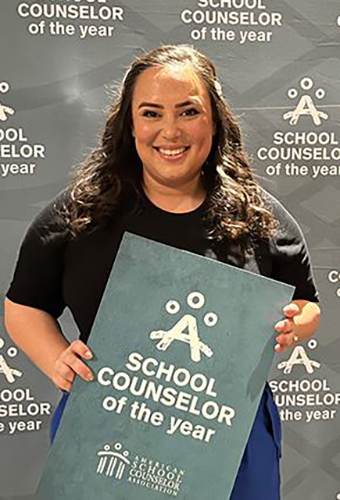
Brittnie Caraulia was recognized as Hawaii’s School Counselor of the Year.

“The role of our school counselors are so integral to the success of our students,” said Hawai‘i Department of Education Superintendent, Keith Hayashi, in a news release. “Now more than ever, we rely on their expertise and guidance in creating positive and innovative ways to enhance the academic and social-emotional needs of our students. The Department is grateful to have counselors like Ms. Caraulia in our schools, every day, working tirelessly to advocate for and support student success. She is a shining example of Helemano’s efforts to grow a ‘leaderful’ organization.”

A school counselor for grades 3-5 at Helemano Elementary since 2019 and a Hawai‘i State Department of Education school counselor since 2015, one of Caraulia’s greatest accomplishments has been establishing a data-driven Multi-Tiered System of Support (MTSS) program within her school. The program takes a systemic approach to monitoring student success, creating school-wide, social-emotional learning (SEL) initiatives that focus on quality teacher-student relationships. As a result of implementing this program, students’ perception of overall school safety improved from 56 percent to over 90 percent. 

Caraulia also helped to establish a Helemano School Counseling Program, where she conducts quarterly training for staff on SEL interventions and classroom management, collaborates with teachers to incorporate SEL into their core curriculum, creates biweekly SEL lessons for all grade levels, and has designed a referral system to make data-informed decisions for all students. The school counseling program now serves as a foundation for student social-emotional, behavioral and academic success. Caraulia regularly trains staff on the program and has even shared the success of this program with other elementary schools across the state.

“Ms. Caraulia is an indispensable resource to our school—providing an excellent counseling program, a fierce devotion to students and teachers, and an innovative method of vastly advancing the social and emotional needs of our students,” Helemano Elementary Principal Ernest Muh said. “She advocates vigorously for all students at our school by collaborating with parents and teachers to determine the most beneficial course of action to assist each individual student.”

Caraulia’s passion in serving her school community is felt individually and collectively throughout the school by both teachers and students. In addition to helping the students, Caraulia has cultivated a nurturing environment for teachers, focusing on their mental health and wellness needs. She has an open-door policy for any staff needing to share personal or professional concerns and has spearheaded activities that promote and prioritize staff well-being. 

 “My proudest accomplishment during my time as a school counselor at Helemano Elementary has been establishing a data-driven MTSS and school counseling program,” Caraulia said. “What I find most rewarding about being a school counselor is the relationships I build with my students, staff and families.”

Posted by: University Communications & Marketing Filed Under: Alumni, Education, Innovation Tagged With: Honors and Awards

Economic Education

March 9, 2023

Including indigenous cultures and values into education is not about making the Indigenous populations stronger. They are already strong. It’s about changing the way the world perceives that strength.”

Guanlin Gao, Ph.D., adapted from G.D. Anderson’s famous quote about feminism

Economics professor promotes financial literacy

Guanlin Gao, Ph.D., likes to play games. And during the recent National Association of Economic Education (NAEE) Conference at the Federal Reserve Bank of St. Louis, the Chaminade Economics associate professor and Director of Economic Education Center for Excellence devoted part of her presentation playing the Public Goods Game (PGG), in which players are given tokens—in this case Kona coffee beans—and given the opportunity to anonymously allocate them in either private or public funds.

“The purpose of the game is to let participants experience the indigenous culture through a hands-on game,” Gao explains. “The game is also related to the shared natural resources and land management of ahupua‘a, where people have shared responsibility and contribute to the common good with their expertise.”

This fundamental economic game has become a classic laboratory environment for studying collective group decisions in which participants decide how much to contribute to a common pool. The countervailing effect, however, is that there is an incentive for group members to “free-ride” on individuals who contribute positive amounts to the common pool. 

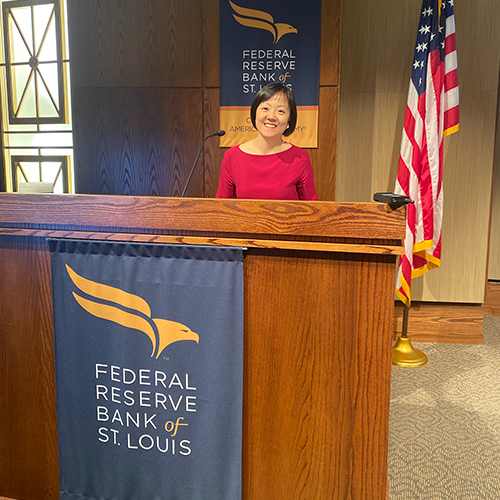
Guanlin Gao presents at the National Association of Economic Education Spring Conference at the Federal Reserve Bank of St. Louis

Those who invested in the private fund could keep the funds, and divide the shares among its members. However, for those who invested in the public fund, they could either share the return among all the groups or simply keep the yield within their own group.

“On the East Coast, players would largely invest in private funds,” Gao says. “But in Hawaii, most players contribute to public funds, which evenly distributes the return among all members. We have a more inclusive culture in Hawaii, as opposed to individualism.”

The NAEE’s three-day Spring Professional Development Conference was attended by economic educators at the state and federal level, as well as educational institutions that house the equivalent to Chaminade’s Economic Education for Excellence. One of NAEE’s primary missions is to provide professional development programs and training for educators to promote economics, personal finance and entrepreneurial education in the classroom.

“Right now, the country is having a movement about economic literacy, and it starts at an early age,” Gao says. “We want the younger generation to have a foundational understanding of personal finance and economics. We want to provide them the tools they need to make informed financial decisions, and create a better life for themselves and for those around them.”

The overall goal of the three-day conference was to promote economic and personal financial education from K-12 through college. Various departments of education around the country already stipulate that students take an economics or personal financial class in order to graduate. Gao is working on this with Hawaii Department of Education but, in the meantime, she’s sharing her knowledge with other teachers.

“I wanted the participants to walk away knowing more about the unique, yet diverse cultures, in this country, and promote economics and personal finance education in a way that relates and speaks to the populations we serve,” Gao notes. “I also talked about the traditions of sharing, not owning in Hawaii (for example, abundance means we have a lot to share, not how much we own), and why the conventional economic assumptions of ‘everyone is self-interested’ and ‘the only goal for a firm is to maximize profit’ do not resonate with our students’ identities and beliefs.”

Consider the Facts*

Many young people lack the basic financial knowledge and skills to prosper in life. Like many educators, the Council for Economic Education cares about equipping students with the knowledge they need to improve their futures.

40% of Americans have less than $300 in savings
24%
of Millennials demonstrate basic financial literacy
50%
of America’s youth will earn less than their parents

2 Million+
Students reached by CEE programs and teachers
Over 50,000
Teachers reached worldwide
1,000+
Lessons, guides & activities for teachers

*Council for Economic Education

Posted by: University Communications & Marketing Filed Under: Business & Communication, Diversity and Inclusion, Education, Faculty, Homepage Tagged With: Business Administration, Economic Education Center for Excellence

HPA Board Appointments

March 9, 2023

Psychology faculty members gain HPA board seats

The Hawai‘i Psychological Association (HPA) members have elected several Chaminade University faculty to its 2023-2024 Board. Sean Scanlan, Ph.D., becomes the society’s next president-elect. Also appointed to the HPA Board are Lianne Philhower as Secretary, Katie Chun as Clinical Division Representative and student representative Kendyl Oshiro.

Dr. Scanlan is currently an Associate Professor of Clinical Psychology and is the Director of the Hawai‘i School of Professional Psychology. He earned his Ph.D. in Clinical Psychology from the University of Hawai‘i at Manoa, and is licensed as a clinical psychologist in Hawai‘i. He has held several psychology-related administrative positions since 2000 and has served as the program’s director since 2014. His interests are in child and adolescent psychopathology, assessment and treatment. For more than 20 years, Scanlan has worked with hundreds of Hawai‘i’s children and adolescents as a therapist, behavioral consultant, parent trainer, treatment program director, teacher and coach. His specialty is in autism spectrum disorder and externalizing behavior disorders.

Dr. Philhower, Psy.D., M.P.H., is an Associate Professor and licensed clinical psychologist. Her diverse professional background includes working in public health environments, outpatient community mental health programs, private practice, school consultation and education. She utilizes a developmentally-informed, Cognitive Behavioral perspective that is highly compatible with Health Service Provider in Psychology’s (HSPP) aim to educate and train students employing a practitioner-scholar model. As a scholar, Philhower has provided community trainings, consultation and presentations, and has supported the research projects of countless students. She continues her own education and scholarship by pursuing a Ph.D. in Integrative Medicine.

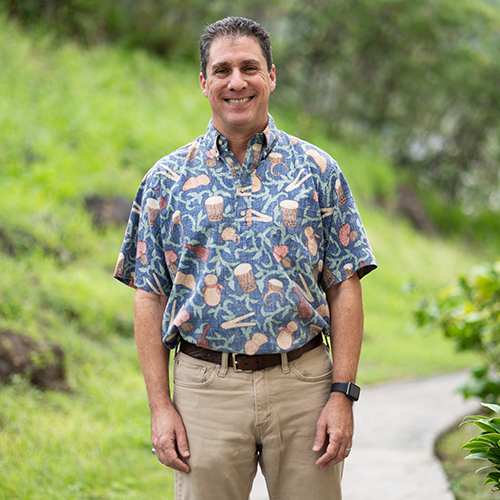
Jeff Stern, Ph.D. has been appointed to the State Board of Psychology.

Dr. Chun is an Associate Professor who earned her Ph.D. in Clinical Psychology at the California School of Professional Psychology at Alliant International University, San Francisco Bay campus. Upon returning to Hawai‘i, she worked in child maltreatment and family trauma as a Hawai‘i-licensed clinical psychologist. After working at a nonprofit community mental health center, she went into private practice, providing assessment and therapy services to children, adolescents and adults in individual, Parent-Child Interaction Therapy and family therapy, as well as emotional and behavioral consultation. She also worked as the psychological evaluator at a K-12 independent school. Chun is a member of the American Psychological Association (APA), the APA Division 5, and HPA.

As the leading resource for psychological health, research and policy in the state, HPA’s mission is to enhance the quality of life for the people of Hawai’i by encouraging, integrating, applying and communicating the contributions of Psychology in all its branches. The organization also seeks to strengthen public relations, advocate for a psychologically healthy community, develop solutions for mental health care, be responsive to the multiple cultures in Hawai’ i, promote the highest standards of professional ethics, and to diffuse psychological knowledge through meetings, conventions and publications.

In other faculty news, Dr. Jeffrey Stern was recently appointed to the State Board of Psychology, which oversees licensing laws and professional conduct among other issues. Stern received his Ph.D. from the University of Hawaiʻi at Manoa and has been a licensed psychologist in Hawaii for more than 15 years. He is a past president of the Hawaiʻi Psychological Association and has been an HPA board member for more than a decade. Besides maintaining a clinical practice and teaching full time, Stern is the clinical director of the Hawaiʻi MCHLEND (Maternal Child Health – Leadership Education in Neurodevelopmental Disabilities) program, supported by a Federal training grant. He has served as an expert witness in due process hearings, frequently writes testimony as a member of the HPA Legislative Action Committe, and chaired the committee that drafted the continuing education statute for psychologists in the state. His research interests and current activities are focused on children with neurodevelopmental disabilities, and their families and workplace well-being.

Posted by: University Communications & Marketing Filed Under: Alumni, Behavioral Sciences, Education, Faculty Tagged With: Psychology

Scholarship Luncheon

February 10, 2023

Students thank donors for their continued support

More than 80 donors, students and staff attended this year’s Mahalo Scholarship Luncheon on February 9, 2023, in-person and online. Dr. Lynn M. Babington, President of Chaminade University of Honolulu addressed the audience and expressed her gratitude for the support of our students. Dr. Babington shared how Chaminade offers more than 100 scholarships that have been generously established by individual donors and foundations. Many of them are endowed, and several are renewable investments that are replenished each year. This year alone, students received nearly $2.3 million in donor-funded scholarships.

“This is a wonderful opportunity for our students to thank and to let donors know how much their support has made a difference in their educational journey,” said Jimmy Tran, Stewardship and Scholarships Manager in the Office of Advancement. “Our donors see how their support helps fulfill our students’ dreams of obtaining a quality college education and to go on to successful careers.”

Chaminade juniors Caitlin Bocobo and Aleeyah Lemons shared their appreciation for their scholarship. “Words are not enough to express how grateful we are for your gifts that made our scholarships possible. I am here today to offer my sincerest gratitude and appreciation to you all,” said Bocobo ’24.

“Donors allow students, like me, to get the most out of their college experience—to grow, mature and make a difference in this world,” said Lemons ’24. “The Silversword ‘ohana is grateful to have you all. I am grateful to have your support and faith.”

Dani Masuda, Assistant Vice President for Student Success shared with the gathering how the scholarships can be the difference between attending college or not. “Scholarships contribute to a student’s wellness and the reach goes far beyond just the individual student. Mahalo nui loa to our donors for your continued generosity, commitment, and investment in our students,” said Masuda.

If you would like to support a student attending Chaminade University, contact Jimmy Tran at [email protected]

Dr. Lynn Babington Address Scholarship Luncheon Attendees

Donors, faculty, staff and students gathered for the annual Scholarship Luncheon.

Posted by: University Communications & Marketing Filed Under: Alumni, Campus and Community, Donor Profiles, Education, Faculty, Homepage, Institutional, Students Tagged With: Campus Event, Scholarship

  • « Go to Previous Page
  • Page 1
  • Interim pages omitted …
  • Page 7
  • Page 8
  • Page 9
  • Page 10
  • Page 11
  • Interim pages omitted …
  • Page 17
  • Go to Next Page »

Footer

Chaminade University Logo

3140 Waialae Avenue
Honolulu, Hawaii 96816

Contact Us
Phone: (808) 735-4711
Toll-free: (800) 735-3733

facebook twitter instagram youtube linkedin

Visit

  • Plan Your Visit
  • Campus Map (PDF)
  • Events

Resources

  • Campus Security
  • Student Consumer Information
  • Concerns, Feedback, and Reporting
  • Institutional Review Board
  • Title IX / Nondiscrimination Policy
  • Compliance
  • Emergency Information
  • Careers
  • Institutional Statement

People

  • Students
  • Parents
  • Alumni
  • Faculty & Staff

Policy

  • Privacy Policy
  • Terms and Conditions of Use


© Chaminade University of Honolulu