• Skip to primary navigation
  • Skip to main content
  • Skip to footer
Chaminade University of Honolulu

Chaminade University of Honolulu

  • VISIT
  • APPLY
  • GIVE
  • STUDENTS
  • PARENTS
  • ALUMNI
  • FACULTY/STAFF
  • Admissions
    • Admissions Home
    • Undergraduate Students
      • First-Year Students
      • Transfer Students
      • Admitted Students
    • Graduate Students
    • Flex Online Undergraduate Program
    • Military Students
    • Non-Degree/Visiting Students
    • Experiential Honors Program
    • Early College Program
    • New Student Orientation
  • Tuition & Aid
    • Financial Aid Home
    • Tuition & Expenses
    • Federal Updates & Changes
    • Scholarships
    • $5,000 Graduate Scholarship
    • VA Education Benefits
    • Net Price Calculator
  • Academics
    • Academics Home
    • Academic Programs
    • Office of Student Success
      • Academic Advising
      • Records and Registrar
    • Kōkua ʻIke (Support Services)
      • ADA Accommodations
      • Career Services
      • Proctoring Services
      • Tutoring Services
    • Sullivan Family Library
    • Undergraduate Research & Pre-Professional Programs
    • Commencement
  • Campus Life
    • About Campus Life
    • Student Engagement
    • Student Government Association
    • Residence Life and Housing
      • Summer Conference Housing
    • Health Services
    • Marianist Leadership Center
    • Counseling Center
    • Campus Ministry
    • Campus Security
    • Dining Services
    • Bookstore
  • Athletics
  • About
    • Chaminade University News
    • Our Story
    • Leadership
    • Chaminade University Strategic Plan 2024-2030
    • Mission & Rector
    • Association of Marianist Universities
    • Facts & Rankings
    • CIFAL Honolulu
    • Accreditation & Memberships
    • Montessori Laboratory School
Search
×

Search this web site

Nursing & Health Professions

Pivoting During a Pandemic

July 8, 2020

In early March, Alyssa Nagai was living a good life. The 2015 Chaminade alumna would work her nursing shifts at Maui Memorial Medical Center, and always enjoyed coming home to her little dog who would jump on her as soon as she walked through the door. She loved living on Maui, and it was an easy and short flight to see her family back home in Oahu.

She felt comfortable at her job. Her time at Chaminade had prepared her well, and had given her the skills and knowledge she needed to be successful.

But nothing could have prepared her for what came next.

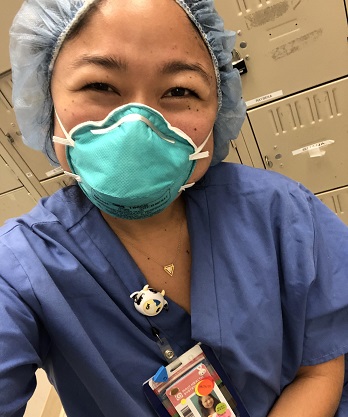
Alyssa Nagai in her face mask

“The nursing and the schooling part of Chaminade definitely prepared me to be a nurse,” says Nagai. “But I don’t know if anyone was really ready for a pandemic to hit.”

When COVID-19 made its way to the Islands, overnight her days became longer and her job became a lot scarier.

Her hospital floor was quickly turned into a COVID unit, and chaos ensued. Policies and procedures kept changing—no one really knew what to expect or what to do. The disease was still so new and unpredictable. 

“It was really scary,” says Nagai. “I think every day, or sometimes every hour, things were changing when it came to PPE, or just everything. Policies kept changing and it was really frustrating.”

Her unit converted into a closed unit, meaning team members weren’t allowed to come and go from the floor. It also meant nurses were doing total care for their patients, without help from nurse aides and patient care specialists.

It made for really long, emotionally draining days.

“You see what people are going through, and it’s scary on their end too,” says Nagai. “It was hard emotionally, for everyone.”

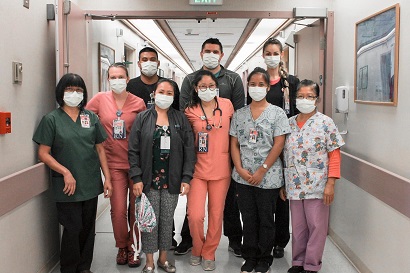
Alyssa Nagai and her co-workers

It was particularly hard when she saw her coworkers fall ill. “We all kind of saw this coming, we knew that we had the risk of getting sick,” says Nagai. “But it’s scary because you see these people every day and you can’t really help it.”

It was also lonely. For Nagai, the hardest part was staying away from the people she loved and cared about.

“I’d be afraid to hang out with people, and I knew they were afraid to see me too, because no one knew if they had it.”

When she would return home from her shift, she’d immediately shower off and try to stay away from people as much as possible. “I’d try to shower before my little dog would jump on me,” recalls Nagai. “You just feel dirty coming out of there.”

Nagai felt good about what she was doing. She knew she was helping. But she wasn’t sure other people saw it that way. Fears and anxieties were high all around the Island. It didn’t help hearing stories of how people were treating other healthcare professionals, like the story she heard about a nurse who went to the grocery store and had things thrown at her.

Now that COVID numbers have begun to slow down in Hawaii, Nagai’s unit is mostly back to normal. “There are still some changes in place, like the break rooms are different. We can’t be around a bunch of people anymore.”

Nagai has a positive outlook on what the future brings. She’s hopeful there won’t be too much of a second wave, and she’s enjoying the new teamwork and collaboration that has come out of the hospital. Everyone seems to have a new perspective and appreciation for everyone else now.

“When we were doing total care for our patients, I gained a whole new perspective on what nurse aides do,” admits Nagai. “It feels really good to be back to normal (or the “new normal).”

Posted by: University Communications & Marketing Filed Under: Alumni, Featured Story, Nursing & Health Professions Tagged With: Nursing

Called Into Darkness

June 29, 2020

When the coronavirus pandemic hit the mainland U.S. in March, the hospital in El Paso, Texas where Shannon Wright ‘15 worked as a nurse was already experiencing troubles. But when elective procedures were canceled, the hospital began laying people off.

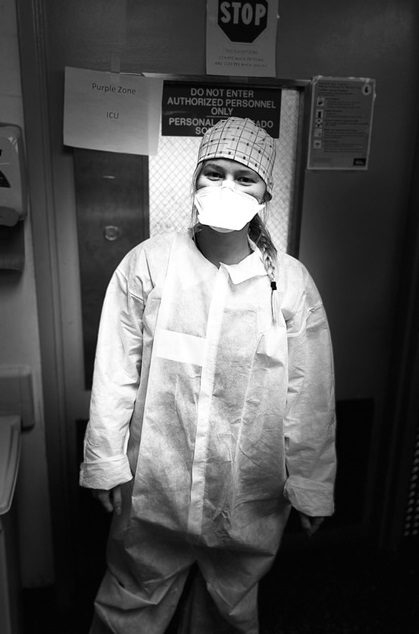
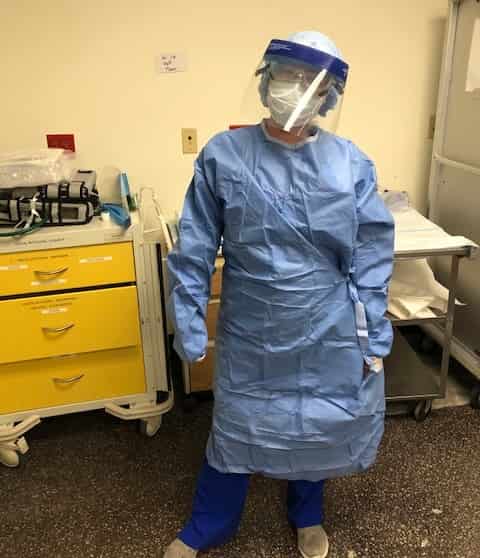
Shannon Wright '15 in her PPE

It was a weird feeling—Wright kept hearing about the nationwide shortage of healthcare professionals elsewhere, but she couldn’t get hours at her hospital.

“At the time, I was working in a facility that just kept calling me off and I wasn’t getting hours,” says Wright. “I kept seeing on the news that everyone needed help, and I kept getting called off. I really wanted to help the people who needed me most.”

So on Saturday, April 4, she hopped on the phone with a FEMA recruiter. They were recruiting healthcare professionals from around the U.S. to help the nation’s hardest-hit city, New York.

“The recruiter said ‘we need you and we need you to get here on Monday if you’re doing it,’” remembers Wright. “It only left me two days to make a decision.”

By April 6, she was on an empty plane to New York City.

Her parents and her boyfriend didn’t want her to go. The disease was so unknown, and stories of medical professionals getting sick and dying were flooding the airwaves.

“Everyone was like, ‘you should just write your will now,’” says Wright. “I was super freaked out signing up, and I cried the whole way to New York. I kept wondering if I was making the wrong decision,” says Wright. She was one of only three people on the flight from Texas to New York. It was an eerie feeling. But she was driven by her desire to serve those who needed her the most.

When she landed at the empty airport, she immediately grabbed a taxi to her hotel in Times Square.

“The cab ride through the city was beautiful—I had never been to New York before,” says the California native. “I started to feel much better. But then we got to Times Square which was completely empty and I got really scared again.”

The hotel was reserved for other FEMA healthcare professionals and there were strict safety restrictions in place. Residents weren’t allowed to socialize or have people in their rooms, and other than a cleaning crew once a week and one person at the front desk, there was no hotel staff. The kitchen was also closed, so Wright used delivery services for most of her meals.

Right away she went to an orientation where she met a few other new arrivals. They formed a text message chain, and throughout their time regularly texted each other to check in on one another.

Wright was assigned to a hospital in the Bronx. Every day, a bus would come to pick up her and the other nurses and drop them off at the hospital.

Her first day was eye-opening, and set the tone for what was to come. She was immediately placed on a team that was tasked with creating a brand new ICU unit.

Shannon Wright '15 in her PPE

“They had an overflow unit connected to their emergency room, so my team and I had to create a coronavirus ICU unit,” describes Wright. “We made a whole ICU unit from scratch within a day.”

They worked quickly to get the extra basement space ready and gather all necessary supplies, but they couldn’t work fast enough. Halfway through the day, before the unit was ready, hospital staff started wheeling in patients. They had run out of room in other parts of the hospital and were desperately trying to find places to put people.

“They were wheeling in patients while we were trying to get set up, and we were realizing things that we didn’t have, all at the same time. Patients were coding on us, and we didn’t have the right supplies.” Wright’s voice goes soft as she describes what it was like to have patients who suddenly couldn’t breathe while she and her colleagues frantically tried to find the right equipment to respond.

Supplies were scarce throughout the city—not just at her hospital. One of her friends worked at a hospital that completely ran out of oxygen, which was in high demand. Sometimes they just couldn’t get what they needed and had to figure out how to make do with what they had. In Wright’s unit, they were putting patients on really old ventilators that should have been retired, because the new ones were already being used.

Personal protective equipment (PPE) also quickly became a scarce commodity.

“At the start, we had amazing PPE and they were letting us change out our N95 respirators every day,” says Wright. “But halfway through the contract, things changed and they were making us reuse N95s and weren’t letting us use hair covers. They wanted us to use the same gown for 5 days. They made a full switch, and all of a sudden we didn’t have what we needed any more.”

It was up to each individual to figure out how to make it work.

Wright had signed a contract to work 12-hour shifts, seven days a week for 21 days. The long days without a break were exhausting.

“The whole time you can’t really breathe, and you can’t really talk,” says Wright. “You have a surgical mask over your N95, and you’re using tape around the edges to seal it off, and you’re breathing in your own CO2 and getting really really bad headaches for 12-hours straight.”

During the days, adrenaline would kick in and Wright was focused on her patients. But at the end of the day, when she’d go back to her quiet hotel room, the fatigue would come crashing down and the anxiety hit hard.

“When I got home every single night I would scrub my body nonstop,” says Wright. “I felt like I was dying, I thought I was dying. I would call my family all the time. I think I was just exhausted and run down.”

The physical exhaustion was real, but it was the emotional drain that was really taking a toll on Wright’s wellbeing.

In the month of April, the death toll in New York was six times higher than its average for that time of year. Wright’s first week at the hospital was the deadliest week on record. News stories of patients being turned away from hospitals, doctors making unthinkable life and death decisions and refrigerated trucks being called in to store bodies shocked households across the nation.

Wright had worked in a level 1 trauma center before but had never seen anything like what she saw in New York.

“I would go to lunch and leave the hospital, and outside I’d see the refrigerated trucks because the morgues were so overwhelmed,” she recalls.

She did her best to be a calming presence for her patients, all the while feeling anything but calm.

“They would wheel a patient in and sometimes they would be really scared,” said Wright. “You’d be talking to them and they’d be fine, and within that same minute all of a sudden you had to intubate them because they couldn’t breathe. And you’re wondering if you’re going to be the last face they see.”

For Wright, the hardest part was watching patients suffer alone, without having their families by their sides. She would try to set up FaceTime calls for her patients so families could see their loved ones.

“Just sitting there knowing these are people, you feel hopeless,” describes Wright, her voice shaking audibly over the phone. “You’re doing everything you can, but you don’t know enough about this disease yet to know if they’re going to come out of it.”

When asked about her mental health, Wright admits it’s taken a toll.

“Chaminade prepared me to be a nurse, but I don’t think anything could have prepared me for seeing that many people die at once,” she says. “You just see people nonstop who were there one second, and alive, and then gone the next. You’re body-bagging so many people who you were just caring for. It’s definitely traumatic.”

But Wright persisted. And when her 21-day contract was over, she agreed to stay another week. Because in between all the darkness, Wright was able to find moments of beauty.

Like when a patient recovered and had their ventilator removed.

“When we extubated a patient, they’d play a fight song over the hospital PA system so everyone knew there was good news, and we would all start crying.”

Her hospital was also one of the first to participate in antibody plasma trials, where patients who were on ventilators received donated plasma from individuals who had already recovered from COVID-19 and had antibodies. She noticed a drastic improvement in the patients who received the trial treatment.

“There were patients who had been on the ventilators for a month and weren’t showing any signs of improvements,” she says. “But then we gave them the blood and within a week everything started to look like it was improving.”

When her time in New York had come to a close, Wright initially struggled to find a flight home—everything was canceled. But she ultimately found an airline who let her fly for free as a first responder. When she got back to El Paso, she booked a vacation rental to quarantine herself for two weeks and recuperate before returning home and seeing her boyfriend.

She had given up her job at the hospital, so after spending some time at home she ventured out to visit her family in California. At the time of her interview in June, she had been with them for three weeks, relaxing and recovering, and making sure they wore their masks.

“I’m more scared of getting coronavirus in public now because I’ve seen how bad it can get—and it wasn’t just elderly people or immunocompromised people. It was healthy, young people.”

While she is no longer afraid of caring for a coronavirus patient, she is much more cautious about being in public. Wright acknowledges that things have gotten better and healthcare professionals have a better idea of what they’re doing now, but the illness is still very unpredictable.

As for her career, she doesn’t know what will come next. She’s slowly starting the job hunt, but she’s also just trying to take time to process everything she felt and witnessed in New York. Part of her wants a slower-paced job now, but long term she knows that she would miss the thrill of the emergency room.

In the meantime, life definitely feels more precious now and she’s just trying to spend time with her family.

“A lot of it was a blur and I have trouble expressing exactly how it was,” shares Wright. “But I am beyond glad that I went. It was one of the most rewarding experiences I’ve ever had in my life. I met some amazing nurses and people that I will remember for the rest of my life.”

Posted by: University Communications & Marketing Filed Under: Alumni, Featured Story, Nursing & Health Professions

Caring for Caregivers

June 16, 2020

As a nursing major, Rosemarie Maltezo was excited for her junior year. It’s when she was going to get to work hands-on in a clinical setting and put into practice some of what she had learned about patient care in the last two years in the classroom and simulation lab.

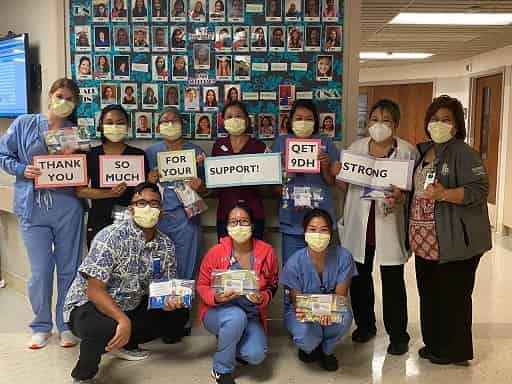
Queen's Medical Center's nurses and staff saying thank you to the HOSA Club for the care package donation
Queen’s Medical Center Punchbowl unit nurses thanking the HOSA Club for the care packages

Maltezo was assigned to the 9th floor of the Diamond Head Tower at Queen’s Medical Center, and spent her time shadowing and assisting the unit’s nurses. But a week after her clinical coursework ended, COVID-19 hit and she received a message from her professor saying that the whole 9th floor had been turned into a COVID unit.

That hit home. The nurses Maltezo had been working alongside were now on the front lines of combating a still very mysterious and unpredictable global disease outbreak.

Maltezo wanted to help. She was the president and founder of the Chaminade Health Occupational Schools for America (HOSA) Future Health Professionals Club, and they were slated to do a community service project with the Boy Scouts and Girl Scouts of America in April. When that event was canceled, Maltezo saw it as an opportunity to get down to the core of who they were and what they believed in.

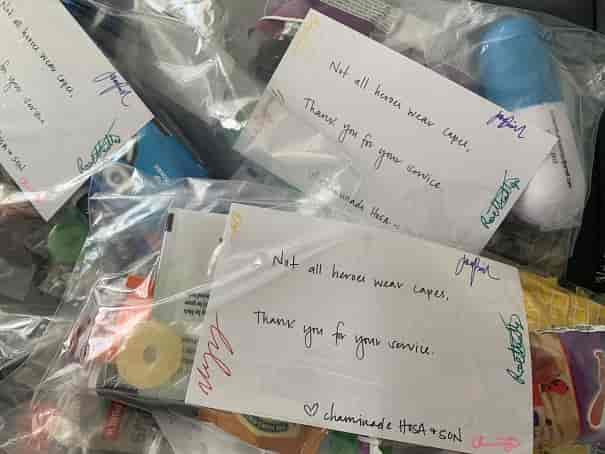
Chaminade's HOSA Club's care pacakges
HOSA Club’s care packages

HOSA Club members are all aspiring healthcare employees, and throughout their time in clinicals they had come to realize just how much of a sacrifice nurses make every day. The global pandemic brought that sacrifice to a whole new level.

“Going through clinicals, we noticed that nurses do so much for us that sometimes they forget to take care of themselves,” says Maltezo. “Their number one priority is being an advocate for their patients, but sometimes they neglect their own health to keep us alive and running.”

With funding and supplies donated by Chaminade’s School of Nursing and Health Professions and two of their club advisers and professors, Denise Cooper and Dr. Edna Magpantay-Monroe, the HOSA club members put together 128 care packages to donate to nurses on the front lines at Queen’s Medical Center Punchbowl and Queen’s Medical Center West Oahu.

Each care package included a stress ball shaped like a pill with the label “chill pill”, face masks, deodorant and some power snacks. The packages also included mouthwash and gum, because as Maltezo realized during her clinical rotations, “they’re in their masks all day and honestly it’s so hard to be in a mask and smell your own breath all day.”

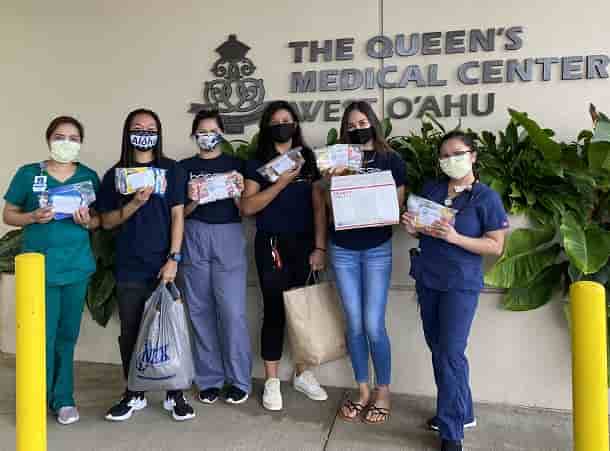
Chaminade's HOSA Club delivering care packages to Queen's Medical Center
Delivering care packages to Queen’s Medical Center West Oahu: Rose Alika Maltezo, Jasmine Pineda, Alisha Chavez, Elanie Sua’ava and alumna Brandy Dela Cruz

Maltezo founded the HOSA club in the spring of 2018. The Chaminade club is part of the international HOSA organization which empowers future healthcare leaders. Member clubs participate in community service, leadership opportunities, networking events and competitions.

The students and their advisors chose to deliver the packages at the end of May, once COVID-19 was starting to slow down so that they wouldn’t be a bother at the hospital and interrupt the busy workflow of the nurses. They dropped off packages at Queen’s Punchbowl on May 15 and Queen’s West on May 26, and were met by Chaminade alums Edlene Vanessa Coloma, Kate Chamberlain and Brandy dela Cruz who came out to receive them.

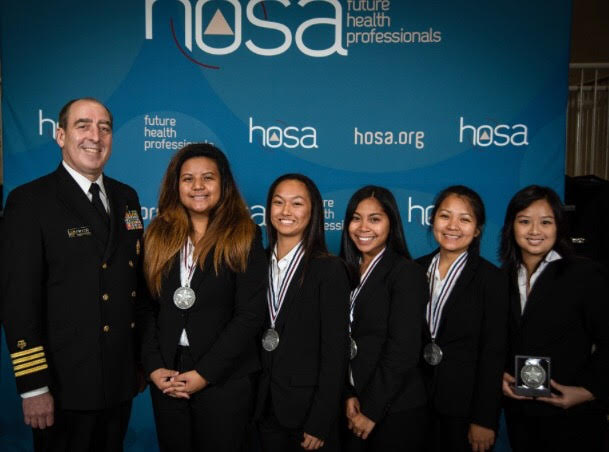
Maltezo had participated in a HOSA club at her high school, and knew she wanted to bring the club to Chaminade. So her freshman year, she recruited a few upperclassmen to help her create a Chaminade chapter, and by summer 2018 they had already won second place in their first international competition in Dallas, Texas. They repeated that accomplishment again in summer 2019, winning second place in the international competition in Orlando, Florida.

HOSA Club at a competition
HOSA Club at a competition, winning second place

Maltezo is stepping down as president this coming year to focus on finishing her fourth year as a nursing student. The club has selected sophomore Kelvin Manganaan to take over as president, and Maltezo will serve as his vice president to help get him settled into the new role. 

“This coming year we want to participate in the Hawaii State Leadership Conference again, and hopefully send at least 10 people to the international competition,” says Maltezo. “We also want to be more involved in the community.”

Posted by: University Communications & Marketing Filed Under: Campus and Community, Featured Story, Nursing & Health Professions, Students

Nursing Seniors’ Virtual Celebration

May 20, 2020

With this year’s graduation ceremony postponed to December due to COVID-19, Chaminade faculty and staff have found new ways to celebrate and recognize graduating seniors.

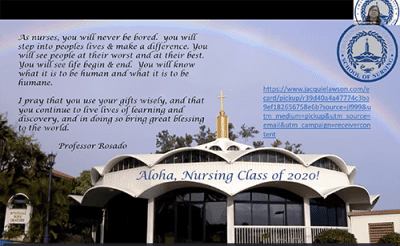
On Saturday, May 9, for instance, the School of Nursing and Health Professions held a zoom celebration to honor the 65 students who were graduating this term.

Chaminade alumni attended a virtual event to gain insider tips for updating their space during stay-at-home orders

“We wanted to do something really special for them,” says Dr. Edna Monroe-Magpantay, professor in the School of Nursing and Health Professions and the event host. “They are dedicating their entire careers to caring for others. They are the ones who are going to be on the frontlines of this pandemic, keeping our communities safe and healthy. They deserve to be recognized.”

The event was a much-needed release for the students after a long final week of virtual mock interviews, standardized testing and virtual NCLEX exam preparation. All of the graduates are certified nurse aides, and as soon as testing centers open in their respective states, they will be able to take the nursing licensure exam to earn their nursing certification.

The event began with a prayer and an opening message from Dr. Haley.

“We’re here to celebrate your accomplishments and we’re very proud of you,” began Dr. Haley. “You’re joining a worldwide professional family of nurses. We’re known for our compassion, our expertise and our trustworthy service to others. It’s a tough time to come into nursing and you couldn’t be needed more.”

Before reading the names of all of the graduates, the annual senior awards were announced to outstanding students. Upon those who received awards were Meghan Chilton, Micaela Mariano, Spencer Lee, Ofa-Helotu Koka, Vivianne Verceluz and Kaleiui Hosaka.

The inaugural DAISY Faculty Award, a recognition established by The DAISY Foundation to honor nursing faculty members for their commitment to and inspirational influence on their students, was presented to Dr. Jeremy Creekmore. The DAISY Award for Extraordinary Nursing Student went to Spencer Lee.

At the end of the celebration, the graduates followed classmate Micaela Mariano in reciting the Nightingale Pledge. Created in honor of Florence Nightingale, the founder of modern nursing, the Nightingale Pledge is a statement of ethics and principles taken by nurses in the United States.

“In full knowledge of the obligations I am undertaking,” repeated the graduates, “I promise to care for the sick with all the skill and understanding I possess, without regard to race, creed, color, politics, or social status, sparing no effort to conserve life, to alleviate suffering and to promote health.”

Congratulations to the Class of 2020–we wish you the best of luck on your NCLEX exams and we can’t wait to see what the future holds. We look forward to officially celebrating you in December!

Posted by: University Communications & Marketing Filed Under: Featured Story, Nursing & Health Professions, Students

A Leader of Leaders

April 30, 2020

Whether it’s treating a Chaminade alumnus to lunch, spending her own time tutoring students for the nursing certification exam or serving as a faculty advisor to a student club, Chaminade professor of nursing Edna Magpantay-Monroe is notorious for going the extra mile.

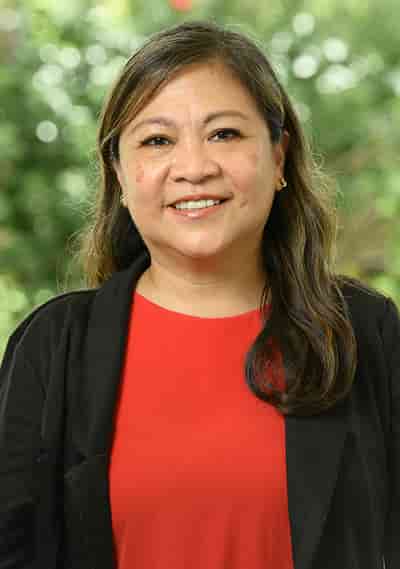
Edna Magpantay-Monroe

“Once Dr. Monroe knows who you are,” says fourth-year nursing student Spencer Lee, “she won’t forget you…[she] often sacrifices her own time and money to provide services for students that better their education.”

That’s why he nominated her for the 2020 Weingarten Leader of Leaders Award. Each year, the National Student Nurses Association presents the award to a dean, faculty member or state consultant who goes above and beyond to support nursing students. Having worked with Professor Monroe as the president for Hawaii State Student Nurses Association and a former the Chaminade Student Nurses’ Association, Lee knew she was the perfect example of a Leader of Leaders.

“She was a key figure in revamping the Hawai‘i Student Nurses’ Association years ago, and since then has served as a faculty consultant and has mentored many future leaders in healthcare,” says Lee. “She has fostered the professional and academic development of all of the students she has interacted with.”

Professor Monroe was beyond touched when she learned she had won the award. “I was ecstatic when I opened my email congratulating me on this award,” says Monroe. “The nomination means a lot because it came from students.”

The award was to be presented at the annual National Student Nurses’ Association convention this month, but the gathering was canceled due to COVID-19 restrictions. The Hawai‘i Student Nurses’ Association, for which Dr. Monroe serves as the faculty consultant, also won both the national Newsletter Contest and the State Excellence Award.

 won in our category of schools for both the Newsletter and State Excellence

“Seven years ago, when a group of students asked me to help rejuvenate the state’s Student Nurses Association, I said yes but I did not have a clue what laid ahead,” said Monroe. “I have ended up loving this role as a faculty consultant and advisor. I feel proud as I see the students grow in front of me.”

Dr. Monroe serves as the president of the Sigma Theta Tau International Gamma Psi-at-Large Chapter, co-adviser of the Chaminade Health Occupations Schools of America (HOSA) club, and co-adviser of The Filipino Club at Chaminade University. Additionally, she was recently a co-author of an abstract publication, “Student Perceptions of Just Culture in Nursing Education Programs: A Multi-Site Study,” that received the 2020 Generating Evidence for Nursing Education Practice Award presented by Sigma and the National League for Nursing.

Posted by: University Communications & Marketing Filed Under: Faculty, Featured Story, Nursing & Health Professions Tagged With: Honors and Awards

Alumna Travels to Samoa for Humanitarian Mission

February 14, 2020

In late 2019, a team of more than 60 Hawaii healthcare professionals traveled to Samoa with Lt. Gov. Josh Green to assist with a measles crisis that had killed dozens of people, mostly children.

Chelsea McKee ’14 was among the 55 nurses who volunteered for the humanitarian mission, putting their own lives on hold to help with the massive vaccination and public health effort.

“I felt this was an opportunity to help others in need,” said the Chaminade Nursing graduate, an oncology nurse at the Queen’s Medical Center and clinical adjunct at the University.

McKee said while she traveled to Samoa to give her time and medical expertise, what she didn’t expect is just how much she’d gain in return.

“On our daily vaccination visits, people welcomed us with hugs, laughter and a lot of food,” she said.

The group from Hawaii was charged with vaccinating tens of thousands of Samoa residents in hopes of stopping the spread of the preventable disease.

McKee said doctors and nurses hit the ground running.

They started their days early in the morning, heading out to neighborhoods with vaccines and supplies. “A local nurse, a co-worker and I vaccinated over 360 people on our first day there,” said McKee.

“The nurses made an assembly line in the van to prepare the syringes and gauze, draw up the vaccination, and the other to administer. Just as fast as you could imagine vaccinating 10 people we would go onto the next house and the next until the evening.”

McKee is no stranger to public health nursing.

In fact, she had her first experiences serving the community with healthcare needs as a student at Chaminade. When she was seeking her degree at the University, she was able to travel to the Philippines and the Big Island on public health missions.

“In the Philippines I had the opportunity to work in the hospital setting, live with a family in a rural mountain community where we performed health screenings, learned about alternative medicine and much more,” McKee said.

“These experiences I gained from the nursing program exposed me to public health. By volunteering, I gain so much more than I can give.”

McKee was on the Samoa trip with another Chaminade Nursing graduate: Chandler Arce ‘16, a psychiatric nurse at the Queen’s Medical Center.

Speaking recently, McKee said she’d jump at the chance to help more families in Samoa.

“I still remember on the drive back to the airport thinking, I only hope we made a difference,” she said. “We hope we made an impact and prevented more deaths.”

Posted by: University Communications & Marketing Filed Under: Alumni, Featured Story, Nursing & Health Professions

  • « Go to Previous Page
  • Page 1
  • Interim pages omitted …
  • Page 8
  • Page 9
  • Page 10
  • Page 11
  • Page 12
  • Interim pages omitted …
  • Page 15
  • Go to Next Page »

Footer

Chaminade University Logo

3140 Waialae Avenue
Honolulu, Hawaii 96816

Contact Us
Phone: (808) 735-4711
Toll-free: (800) 735-3733

facebook twitter instagram youtube linkedin

Visit

  • Plan Your Visit
  • Campus Map (PDF)
  • Events

Resources

  • Campus Security
  • Student Consumer Information
  • Concerns, Feedback, and Reporting
  • Institutional Review Board
  • Title IX / Nondiscrimination Policy
  • Compliance
  • Emergency Information
  • Careers
  • Institutional Statement

People

  • Students
  • Parents
  • Alumni
  • Faculty & Staff

Policy

  • Privacy Policy
  • Terms and Conditions of Use


© Chaminade University of Honolulu