
A years-in-the-making partnership of science and faith culminated this Monday at the offices of Chaminade University’s Forensic Sciences Unit.
Father Damien of Molokaʻi, canonized in 2009, is the revered saint who sacrificed his life to care for Hansen’s disease patients at the Kaulapapa leper colony in the late 1800s. By his side stood Sister Marianne Cope, who was canonized as a saint by Pope Benedict XVI in 2011.
Some remains of Saint Marianne and Saint Damien–tiny bone fragments painstakingly collected from their graves–will now be laid to rest and venerated as holy relics at Catholic churches throughout Hawaiʻi thanks to the meticulous work of Chaminade University forensic scientists and forensic science students.
On November 10, Sister Davilyn Ah Chick of the Diocese of Honolulu stopped by campus to claim 52 relics prepared by Dr. Carlos A. Gutiérrez Ayala, Department Chair and Assistant Professor of Forensic Science.
Of the relics, 32 contain bone fragments of Saint Damien of Molokaʻi. The other 20 hold the remains of Saint Marianne, secured by Chaminade forensic scientists in a project that began at the start of the year.
“We started in January, early January this year, and now we’re in November, finishing the first round of the first batch of relics,” Gutiérrez said. “We never knew if we’d be able to do all of these.”
The effort at Chaminade’s Forensic Sciences Unit to sort and secure bone fragments from Saint Marianne’s grave for use in holy relics marks the first time that a university forensic sciences department has been enlisted by the Catholic Church for such work. Chaminade carried out this work for the Church on a pro bono basis, in keeping with the university’s Marianist tradition of service to the community.
Given the unprecedented nature of the effort, Gutiérrez prepared a procedures manual for other universities to follow should the Church ask for their support in securing the remains of other saints in the future. This procedural and protocol manual can be used by any university forensics department throughout the world, Gutiérrez said.
“I developed a methodology which didn’t exist for this,” he explained. “So now in the future, if other forensic scientists or the Catholic Church need to do this, at least now we have a protocol.”
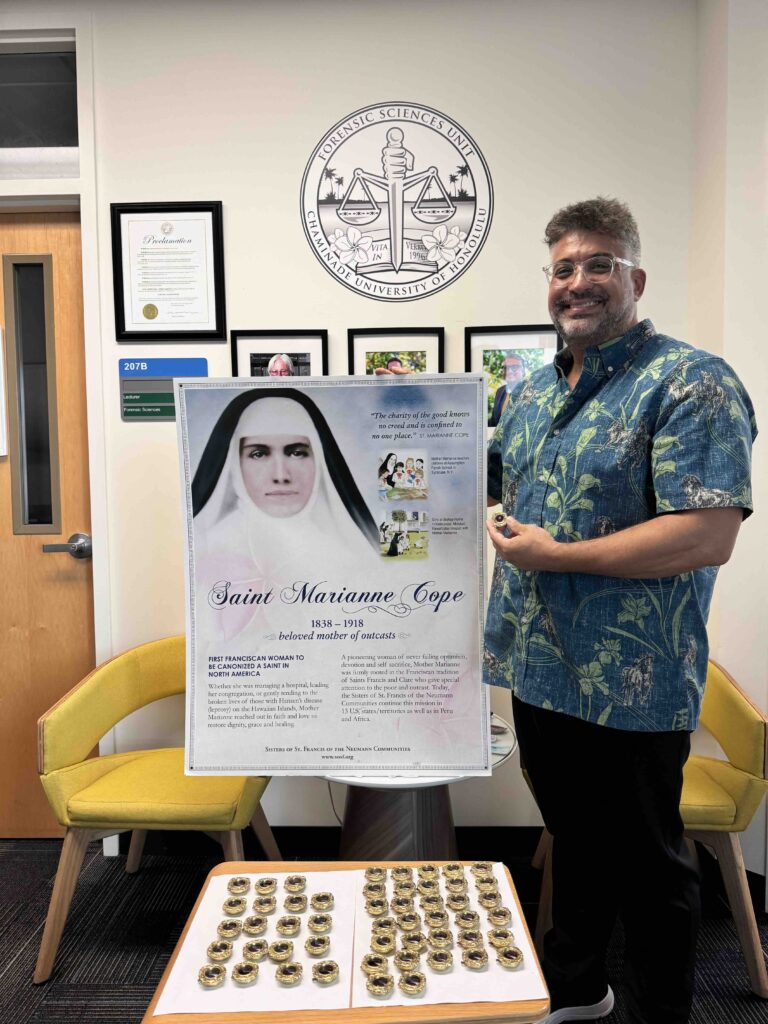
He said this experience has proven to be a once-in-a-lifetime opportunity for his career.
“I never did something like this before, and I don’t know if other forensic scientists have done something like this before ever,” Gutiérrez said. “I’m privileged, and all of us are privileged here.”
Gutiérrez will present the entire project and experience at an international forensic science conference happening in Orlando, Florida early next year.
Sister Davilyn described the opportunity to enlist Chaminade University’s forensic sciences lab for assistance with securing the remains and producing the relics as “providential.”
“Chaminade University has been very generous to allow us to use it,” she said.
Sister Davilyn said they will make more relics from Saint Marianne’s remaining bone fragments. She will provide the relic encasements, while Gutiérrez will ensure that remaining bone fragments are properly placed and secured using a special adhesive that takes 24 hours to cure.
The relics will then be distributed throughout the islands for each church to display and venerate as they see fit.
“Each of the vicariates we have in the diocese will be getting this at the convocation,” she explained.
Gutiérrez said his experience helping the Church with this important project has been a welcome respite from the usually dark nature of forensic sciences work.
“Usually you work on cases helping victims in terrible situations, but doing this type of job brings some light,” he said.
“It’s a unique situation where faith and science go together and bond.”