
The scenes were gruesome.
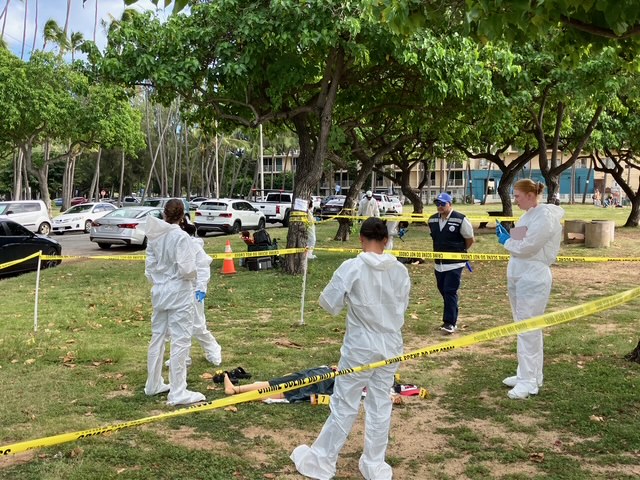
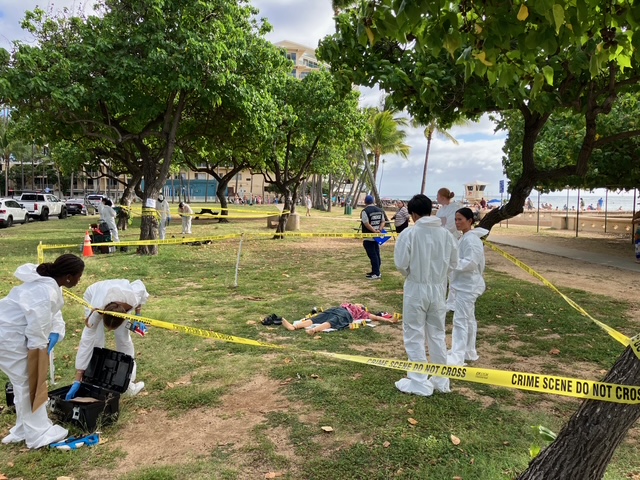
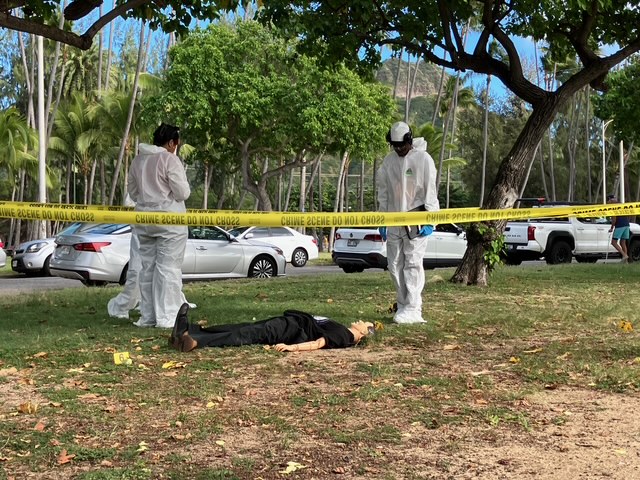
Two victims lay sprawled on the sand and grass at a section of Kaimana Beach Park in Waikīkī, a popular recreation spot. Police tape cordoned off the areas, keeping gawking tourists at bay lest they contaminate the evidence.
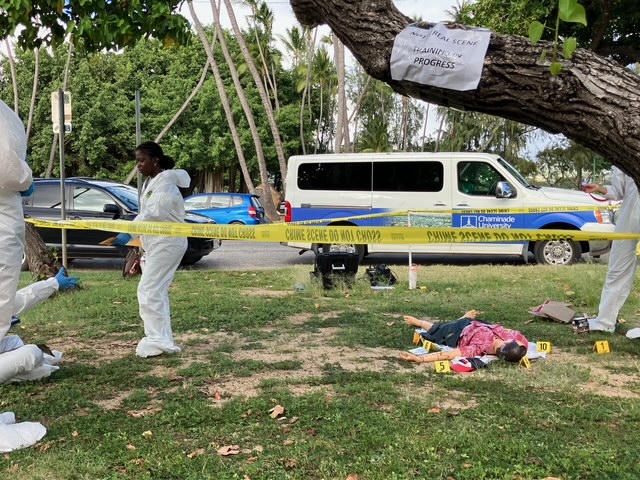
Inside the taped-off areas, crime scene investigators in sterile white coveralls and booties took photos and meticulously inspected the bodies and grounds next to the victims.
Luckily, these two scenes were entirely fictional, an annual rite Chaminade University forensic science students must complete as they advance in the program. The ‘victims’ were dummies, and signs posted at the sites sought to reassure onlookers that this was all just an exercise, though a very important one.
Carlos Gutiérrez Ayala, Ph.D., Assistant Professor of Forensic Sciences and Director of the program, said that aside from the props, the two mock crime scenes were designed to be as real as possible.
“The only difference here is the dummies and the blood; of course, we use synthetic blood, not real blood, and the firearms are kind of toys,” he said. “Probably in a real scenario you will see more police officers around, but this is similar.”
Simulated crime scene investigations by Chaminade forensic science students normally happen on campus at the Crime Scene House. There, in controlled conditions, students are instructed on how to record incident scenes and gather evidence to aid in crime solving.
For added realism, every year the forensic science professors obtain permits from the Honolulu Department of Parks and Recreation to recreate realistic crime scenes at Kaimana Beach, setting up scenarios that future forensic scientists will encounter in their careers.
This week, Gutiérrez and his colleagues set up two separate crime scenes at the park, dividing the class into two groups, each led by one lead investigator.
The field investigations are tied to lab work that the class already underwent, Gutiérrez explained. The class assignment is to try to find links between the lab investigations and the crime scenes. Ultimately, the goal is to solve the crimes.
“They are processing right now,” he said. “Collect all the evidence to get to their own hypothesis, and then they have next week to figure it out and try to link them, to see if they’re both related or totally different scenes.”
Loro Gambi ’28, a forensic science major leading one group of investigators, was cagey about what he and his team had discovered at the mock crime scene they were assigned to. The caution is deliberate; in the real world, crime scene investigators are often approached by reporters, and investigators must be careful about what they say to ensure investigations aren’t biased or corrupted in any way.
“I don’t want to give out facts way too early,” Gambi said. “We definitely have to wait for a lab report and actually analyze that and compare that because this is a second scene. It’s not our actual primary scene.”
“What I can say is we have two dead suspects, both involving wounds from a gunshot,” he added. “And that’s as far as I’ll say right now.”
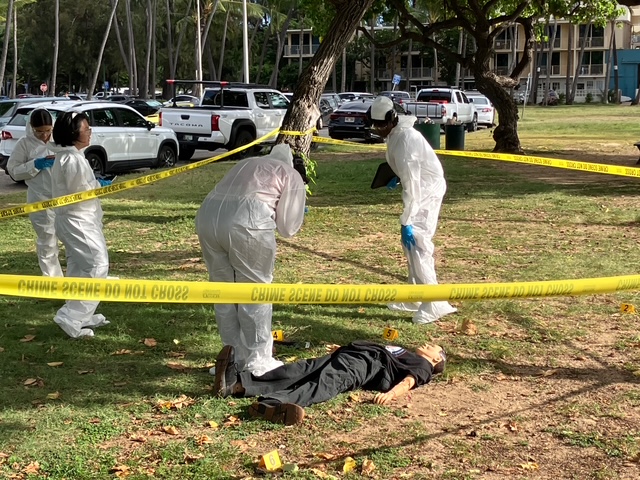
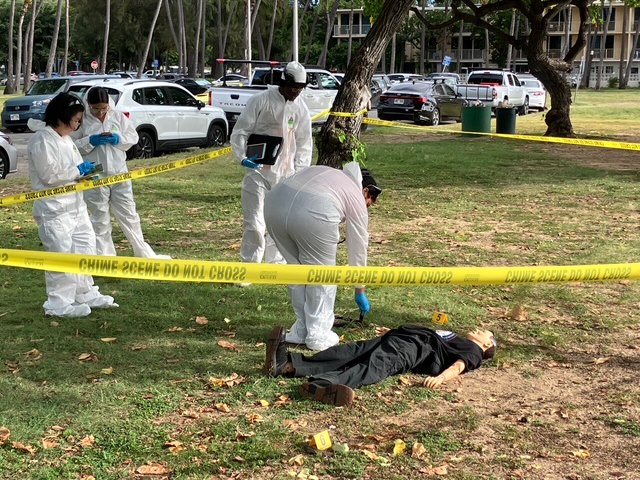
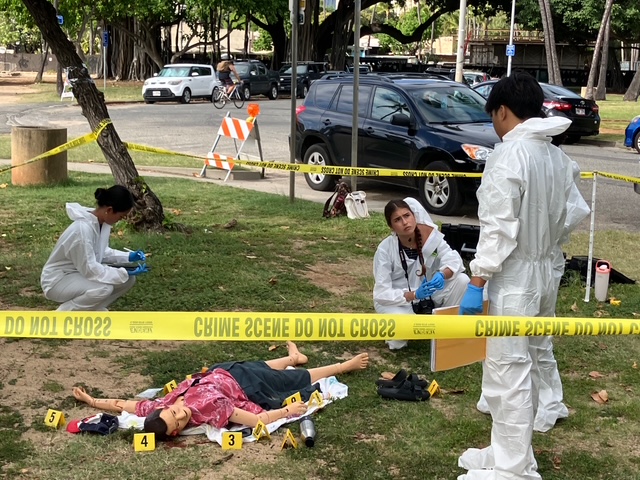
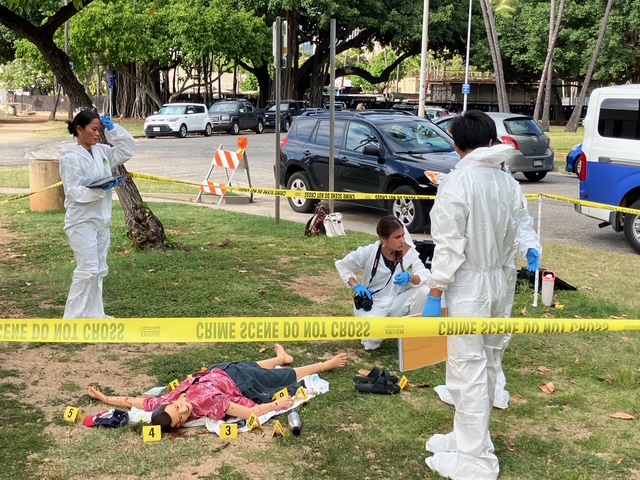
Sanoe Nakasone-Kalani ’29, a forensic science major and leader of the second investigative group, was also tight-lipped when pressed about what she thought had happened.
“I would say he seems to have a gunshot wound in his head, and we know that he was taking some sort of drugs, and that’s all we know at the time,” she said. “Once we collect all the evidence, we’ll take it up to the lab and then do lab testing.”
The fieldwork had to be broken up into two segments, one on Monday and the other on Wednesday, given the number of forensic science students.
Gutiérrez said the students’ role-playing is far from over.
“They need to solve the crime,” he said. “They will be testifying in court based on whatever they did during the day today, and they need to because they are writing reports as well. So they need to defend their own reports in a simulated court.”
Both lead field investigators said the move out of Crime Scene House to the beach at Waikīkī adds an element of realism that inspires students to take these assignments very seriously.
“This is definitely what you come and join Chaminade for,” Gambi said. “Especially the forensics program, to actually get that hands-on experience outside of just regular lectures.”