Re-Use Hawai‘i has been serving the community on Oahu for 20-plus years.
The innovative nonprofit is a living, breathing example of the circular economy put to good use. Describing itself as an “employment social enterprise dedicated to reducing waste and expanding green job opportunities,” Re-Use Hawai‘i creates meaningful jobs and community good will by rescuing abandoned construction materials from work sites or demolition projects to resell them at bargain prices for do-it-yourself handytypes across the island.
They’re “turning Hawai‘i’s waste into reusable materials and green jobs” as they say on their website, but Re-Use Hawai‘i recently ran into a problem: their newest store front wasn’t generating the kind of foot traffic they were hoping for. That’s where Chaminate University marketing students came in.
Chaminade marketing professor Wera Panow-Loui recently issued a challenge to her students: create a marketing strategy and presentation that can help Re-Use Hawai‘i re-introduce itself and its newest location to the community – revive a business model that’s been proven successful for two decades.
Her students more than met the challenge.
“I believe it was a standout student project for Re-Use Hawai‘i highlighting experiential learning, community impact, and our students’ excellence in their work,”Panow-Loui said.
Chaminade students Christopher Cody, Cory Alfred, Kyla Castro, Madelynne Knowd, and Tessa Stanley joined forces to see if they could aid Re-Use Hawai‘i using the skills they learned in Professor Panow-Loui’s class.
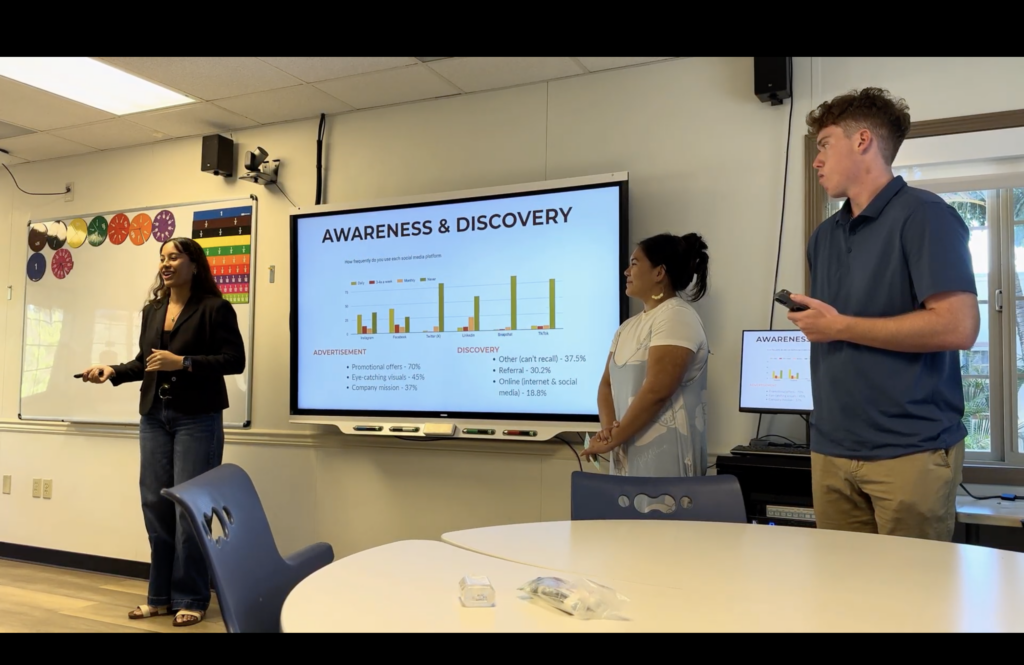
After talking with the nonprofit’s staff, conducting some research, quizzing store patrons, and assessing the situation, the five marketing students devised a strategy that they felt could help Re-Use Hawai‘i solve their conundrum. Re-Use is now using their presentation and training for future business planning.
First, they had to identify the problem. This was fairly straightforward: as their final presentation notes, the nonprofit was contending with “low foot traffic at the new Re-Use Hawai‘i Salt Lake location.”
The goal? Bring the customers back, and improve the experience of the customers who were visiting the new site. So, the students put their market research skills to work.
They surveyed 97 customers to the new site, quizzing the visitors about what was working and what wasn’t. They broke the survey respondents down along demographic lines, noting gender identities, ages, and where they came from. They then asked them a set of questions designed to measure how familiar they were with Re-Use Hawai‘i, how often they relied on the nonprofit for their do-it-yourself projects, and what they thought of the newest storefront.
The research proved invaluable to Re-Use.
Overall, respondents said they were satisfied with their shopping experience. But there were issues that could use some attention, the students soon discovered.
“Many customers said the new store location took some getting used to,” they reported. That’s not all. Survey participants told them, frankly, that the parking and new store layout was somewhat difficult for them to navigate. They complained about a lack of tools on hand to use at the new store location. “Even long-time customers mentioned it took several visits to feel comfortable,” they reported.
The students’ presentation lays out in detail what the customers themselves were saying, thus informing Re-Use Hawai‘i of the likely reasons for the fall in foot traffic. In short, the 20-year old standard bearer of Hawai‘i’s circular economy had become something of a stranger to the island’s residents again.
The solution? Reintroduce themselves to the DIY crowd, a community in need of a centralized home or hub, one that Re-Use is well positioned to become.
Having identified the problem, Christopher, Cory, Kyla, Madelynne, and Tessa were in a good position to identify good solutions, as Professor Panow-Loui explained.
Her students were assigned “to help the client identify effective promotional strategies to increase foot traffic at a newly opened retail location, using data-driven insights to inform strategic marketing decisions,” she explained.
Their presentation lays out in careful detail proposed strategies that Re-Use should adopt.
They proposed Google Ads, a relatively inexpensive way to improve local customer engagement and re-establish their brand. They also recommended targeted marketing focused on those parts of the island where most of their customer base seems to be located, in particular Kaneohe, Kailua, and Honolulu.
Their boldest recommendation was that Re-Use Hawai‘i create a specialized Facebook page designed to organize the island’s community of DIY enthusiasts. Currently, there isn’t one. Thus, Re-Use Hawai‘i is in a unique position to organize that community and support it through the nonprofit business model that it’s already pioneering, the students discovered.
“It became evident that there were not very many DIY Hawaii Facebook groups despite demand,” the student marketing team noted. “Creating a Facebook group would allow Re-Use Hawai‘i to connect with the DIY community.”
Panow-Loui says that the five students’ market research and consulting initiative has become far more than just a class project. Re-Use is putting their recommendations into practice.
“The client indicated that their leadership team is using the report to actively guide their current marketing decisions,” she said.
The students’ marketing research results are professional, insightful, impressive, and useful.
Re-Use Hawai‘i has been creating jobs and saving Hawai‘i residents money for over 20 years, and thanks to Chaminade University students, they’ll continue their important work for many years to come.
As Panow-Loui put it, her students “completed a professional-grade marketing research project for a real community client, applying strategic marketing and consumer research methods,” and the client and Hawai‘i are grateful for their hard work.