
“I hate everything I write, but I write anyway.”
Those were just some of the unexpected words of encouragement author and English professor Kristiana Kahakauwila offered to Chaminade University freshmen earlier this week.
She meant that aspiring writers should write as much as possible, even if they worry that their prose or storytelling isn’t particularly good. It’s not meant to be perfect the first time, she said. The point is to pour your thoughts out–perferably on paper the first time, she recommended–and later craft the language more carefully. Over time, this exercise will hone one’s writing skills.
Prof. Kahakauwila was the featured speaker for the inaugural CUH 100 guest lecture series. She spoke in front of a packed, standing-room only audience of mostly freshmen students enrolled in the CUH 100 course.
CUH 100 is a single-credit course open only to first-year students. The class is designed to be a general introduction to college life oriented toward helping students develop better academic skills.
Currently the director of UH Mānoa’s Creative Writing Program, Kahakauwila is the author of two books: This is Paradise: Stories (Hogarth 2013) and Clairboyance (HarperCollins 2024). The latter title is about a young girl who gains the power to hear what boys are thinking.
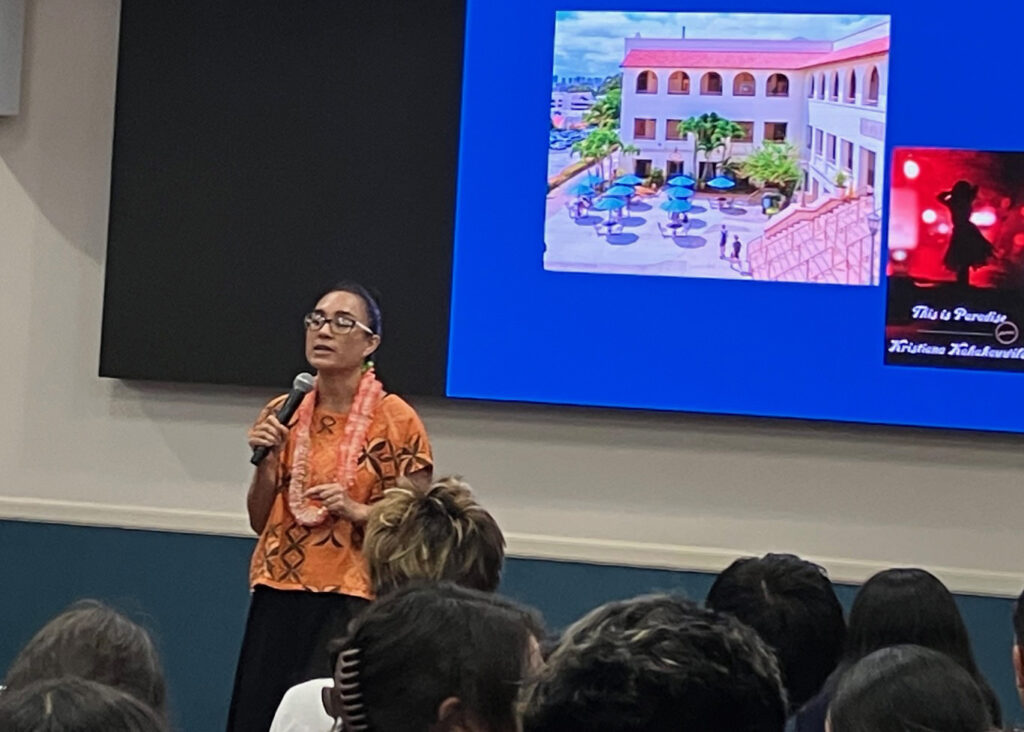
Kahakauwila covered a lot of ground. In her lecture, titled ‘Ways of Seeing: Becoming a Scholar,” Kahakauwila retold stories of her time in Maui, Long Beach, California, and at Chaminade.
She noted how her career trajectory involved a series of twists and turns, at times working as a bar tender, other times teaching as an adjunct. She went on to study literature at Princeton University and creative writing at the University of Michigan.
Kahakauwila seemed to particularly enjoy recounting tales of her time taking The Bus back and forth across the island between jobs. She told the student audience that they should all try to take the bus to the North Shore and all around Oahu at least once. “It will take you all day,” she admitted, but she argued that it would be worth it for the chance to meet some interesting characters who would tell them fascinating stories during the ride.
On the larger theme of her talk and the CUH 100 course, what it means to be a scholar, Kahakauwila said students should strive toward achieving Makawalu, ‘eight eyes’.
She explained that Makawalu is a traditional Hawaiian expression that means people should aspire to broaden their horizons, learn to see things differently, and gain new perspectives on their journeys through life.
“The liberal arts education is one aimed at giving you more ways of seeing,” Kahakauwila explained.
In other words, you chose to become a scholar “so you can grow more eyes.”
“I added a lot of new eyes during my time at Chaminade,” she recalled.
However, aspiring for Makawalu should not end at graduation from Chaminade, Kahakauwila cautioned.
“If all you do is leave with Makawalu you haven’t done enough”