Growing up, Nathaniel Leomite ’26 used American Sign Language (ASL) to communicate with his grandparents, who were both deaf. It was a skill that he always appreciated having, but that he never really thought would apply to his chosen career in community and public health. That is, until he volunteered with Chaminade’s Parish Health program in his junior year.
Leomite says one afternoon, he was wrapping up a day of service at Saint John the Baptist Catholic Church in Kalihi when he spotted a man who appeared in need but unsure how to ask for help. When Leomite approached, he realized the man’s hesitancy: He was deaf.
Leomite switched to ASL and watched as the man’s expression of concern switched to one of joy.
“It was this full circle moment for me,” says Leomite, who offered the man a box of healthy food options to take home to his children and encouraged him to get a blood pressure check before he left. “He was the only deaf person and I was fortunate enough to help him. It felt really good.”
The interaction may have been a small one, but it meant so much to the parishioner and to Leomite. And that, says Chaminade School of Nursing and Health Professions Associate Professor Sandra Bourgette-Henry, DNP, APRN-Rx, is exactly what the Parish Health Program is all about.
“It’s a win-win for the community and for the school,” she says.
Years of Service
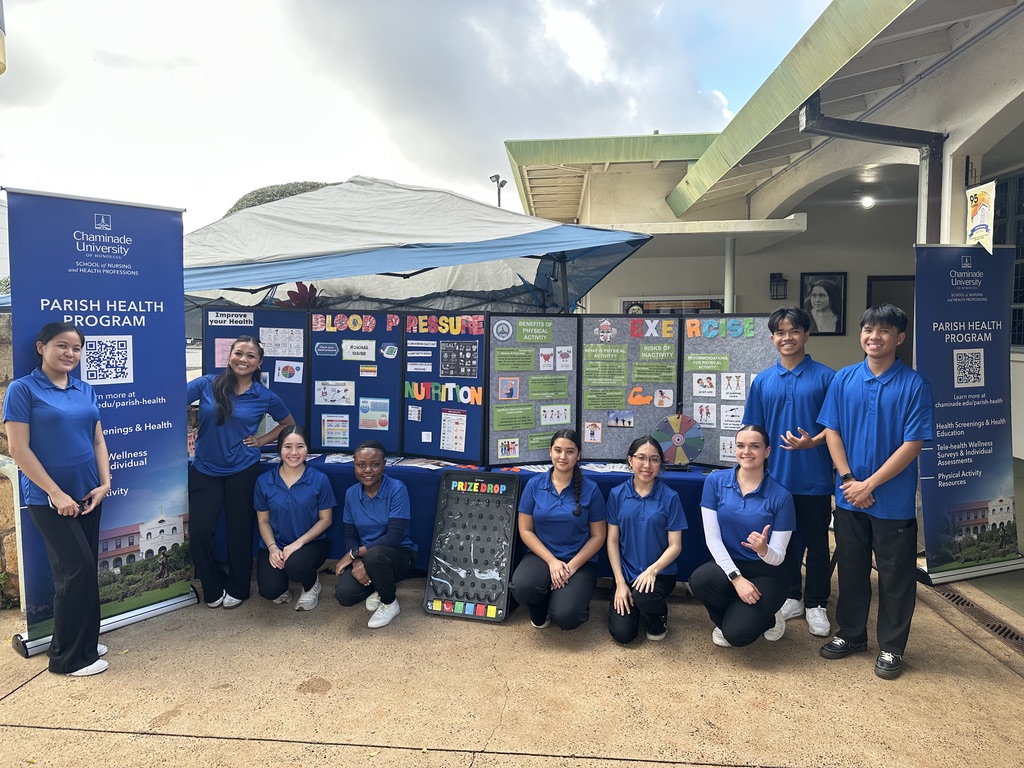
The Parish Health Program, celebrating its fifth anniversary this year, gives students pursuing healthcare professions valuable in-person experience in health education while improving health equity. Students administer blood pressure checks, offer parishioners tips for eating healthy or preventing disease, and talk about medication management, exercise and much more.
Bourgette-Henry says the program, now offered at four Oʻahu parishes, allows nursing and public health students to better understand the unique health challenges of diverse communities and see the benefits of preventive health and chronic disease management first-hand. The program has also partnered with nonprofits so students can work directly with community leaders.
Since the program began, students have conducted outreach to more than 62,000 parishioners.
“We see people of all ages, little children all the way to elderly,” Bourgette-Henry says. “Students are teaching the patient and teaching the family. And you can’t be a shy person and be a nurse. This program really gets students out of their shell as they work one-on-one with parishioners.”
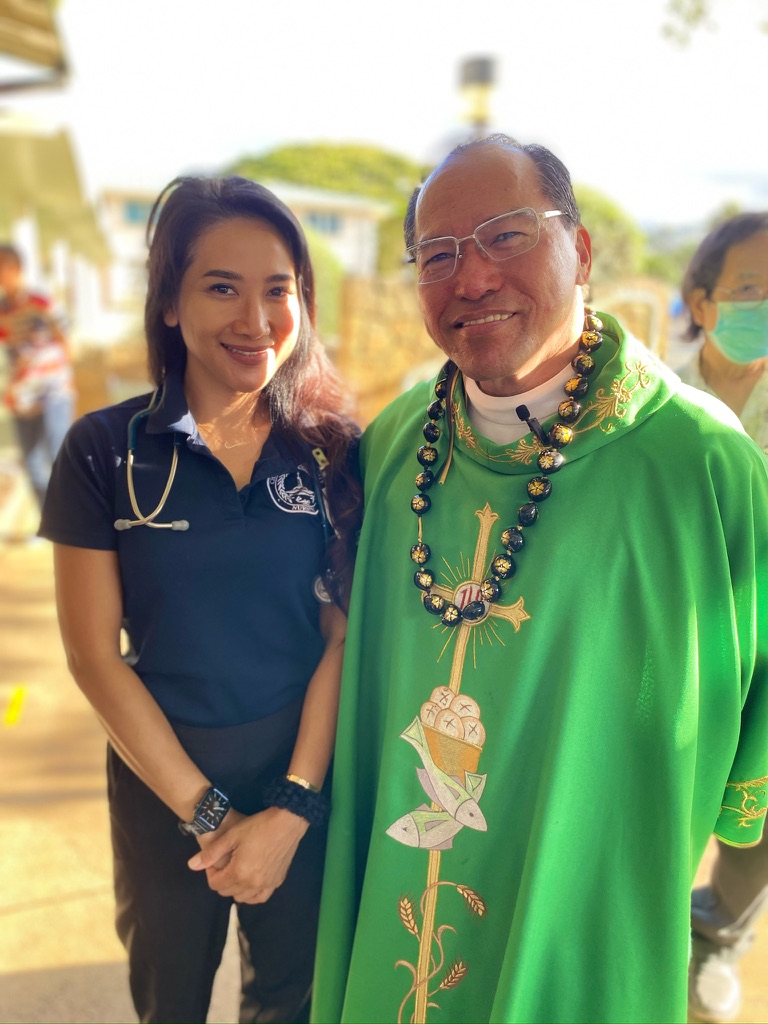
Father Jaroslaw Skrzypek, of Saint John the Baptist Catholic Church, says the parish health program has transformed his church “into a place where both spiritual and physical health are nurtured side-by-side.” The health screenings and education, he says, are encouraging parishioners to take proactive steps to care for their well-being. And he’s been amazed to see student participants grow through the program, too, as they deliver compassionate care.
“By interacting with our diverse parish family, the students develop the empathy and communication skills needed to be truly holistic healthcare providers,” Skrzypek says. “The fact that so many parishioners, even those without specific health concerns, line up just to check their vitals shows how much the community trusts and values this service.”
And while he’s seen many “wins” through the program, one story stands out. He says a parish family began visiting the Chaminade students weekly for blood pressure checks and one of the family members was flagged for dangerously high readings. That parishioner followed students’ advice to see a doctor, Skrzypek says, and now is on necessary blood pressure medication.
“Our parishioners are very happy to have these young students among us; they even feel a sense of pride in ‘helping’ the students learn,” Skrzypek says, adding the program is a blueprint for holistic parish ministry. “It’s a beautiful exchange where everyone feels comfortable and cared for.”
Catholic Marianist Mission of Service
Reign Morales ’25, DNP ’28 worked with the Parish Health program in spring 2025. She says the experience inspired her to pursue a graduate degree at Chaminade to become a nurse practitioner. “This program taught me a lot about connecting and making a difference within a community instead of just the individual, and the importance of preventative services,” she says.
She says during one interaction through the program, she met a mother with her children and encouraged her to participate in a free blood pressure screening. The woman’s reading was very high, which the woman had been unaware of, and Morales and her peers educated her on the risk of uncontrolled high blood pressure and how she could improve it with diet and exercise.
It was during that exchange the woman explained she’d been adding lots of salt to her meals to gain a little weight, not realizing how detrimental that could be to her health. “A few weeks later, she returned for a follow-up blood pressure check, which showed a significant improvement,” Morales says. “She also reported making dietary changes, including eating less fast food.”
Morales says serving parishioners where they are is about healing people and communities.
“This program aligns with Chaminade’s mission of service since as Catholics, we learn to be disciples of Christ and I feel as if we are doing God’s work to show up for our fellow brothers and sisters,” she says. “As nurses, it is crucial to immerse yourself in the community you serve to be an advocate for patient needs. It is important to understand why people come into the hospital and how preventative services and early intervention can completely change a health trajectory.”
Morales adds she hopes Chaminade continues to expand the program so students destined for healthcare professionals understand how they can make a difference, beyond the hospital and the classroom. “This may inspire some students to pursue community-focused work,” she says.
Bourgette-Henry says that’s certainly a goal.
“High blood pressure, they call it the silent killer. I always thought, ‘Why wait for people to come in before we treat them?’” Bourgette-Henry says, adding that during most of her career before joining Chaminade she worked with patients who had advanced heart disease.
“That’s why I wanted to gear toward preventing diseases,” she says.
Preventive care through the parish program is also focused on kidney health as untreated hypertension is a leading cause of kidney failure in the islands. “Curing kidney disease is not about building more outpatient dialysis centers,” she says. “It’s about preventing disease, including doing more blood pressure screenings. Most people don’t know they have hypertension.”
Additionally, the program has partnered with several local organizations, including the American Heart Association, which provided students with food vouchers that they could give to parishioners who were struggling to afford healthy, fresh food options.
Bourgette-Henry says one of the things that she truly loves about the program is the care and creativity that Chaminade students bring to every interaction. In addition to one-on-one screenings, students put together fun games and interactive presentations.
“Students are pulling everything they’ve learned together to reach the community,” she says.
That’s what Leomite, the Public Health major, did. He says his training in cultural competency at Chaminade proved particularly useful as he worked with parishioners from all different backgrounds. And in addition to using ASL, he also switched over to Samoan.
For Leomite, it was all in a day’s work.
The California native says his family came from American Samoa, and so it hit home when he helped parishioners “who looked like me” and were struggling to afford food. “It made me want to stay and help out more,” he says. “In my culture, service is big, especially to our elders.”
Leomite says on reflection, he was especially grateful to the Parish Health program for helping him “be of service while keeping my faith strong. There’s a lot of rough roads that we can walk, but I believe God is always going to provide the shoes we need to walk those roads.”
For Leomite, the program even proved pivotal in helping him determine his future career path. After graduation, he says, he plans to pursue a future in social work and community health. “I want to serve less fortunate communities,” he says, “and hopefully, be part of the solution.”
This story appeared in Chaminade Magazine, Spring 2026.