
Chaminade University takes great pride in maintaining Marianist educational traditions in the face of modern change, and arguably no modern invention has challenged this mission more than artificial intelligence or AI.
Just a few years ago, OpenAI launched the first version of ChatGPT. The impact has been tremendous. College students are now using AI tools to cheat on tests and generate entire term papers. Professors have tried to keep up by using specialized detection software, but it’s proving to be a losing battle.
AI is the topic dominating conversations at campuses throughout the United States. Administrators and faculty members at Chaminade and elsewhere are struggling to comprehend AI technologies and how they’ve transformed higher education and learning in a very short amount of time.
Chaminade University Provost and Vice President for Academic Affairs Lance Askildson characterizes the current state of affairs as a tech battle where students and AI companies hold the upper hand. Combating AI overuse in education will require adopting different tactics, not different technologies, he says.
“I think we felt like we were in an arms race, but at this point, the technology of those armaments have far exceeded any of our technologies to combat it, and so now we’re in sort of a battle of wits,” he said.
A recent survey by the American Association of Colleges and University and Elon University showed faculty hold overwhelmingly negative views about AI. 83 percent of respondents said they believe the technology will worsen students’ attention spans. 95 percent predict students will come to rely too heavily on AI tools over time–there’s fear students will let the machines do the thinking for them. Whatever the concerns may be, 86 percent of American university faculty members polled agree that AI will completely transform how teaching must be conducted.
In a wide-ranging conversation on the impact of AI on higher education, Provost Askildson said he’s adopted a much more nuanced and at times optimistic stance.
A renowned linguistics expert, Askildson penned an opinion piece in the Chicago Tribune three years ago arguing that ChatGPT is no replacement for human educators. He stands by this assessment, though he admits the technology has become more advanced and, in many ways, more threatening since that letter was published. “I do not think that AI is fundamentally changing what a college education is, but it’s challenging us to ask that question anew,” he said.
Provost Askildson is advising Chaminade’s faculty to stop trying to fight AI with detection tools—it’s an arms race they’ll lose. Rather, he’s advising them to retool the way they deliver curriculum, emphasizing that the end goal for a university education isn’t good grades or a diploma, but rather students demonstrating that they’ve acquired new knowledge and critical thinking skills to empower them in an increasingly competitive and complicated world.
Below, we share some of the fascinating conversation we had with Provost Lance Askildson on the impact of AI on Chaminade University and academia.
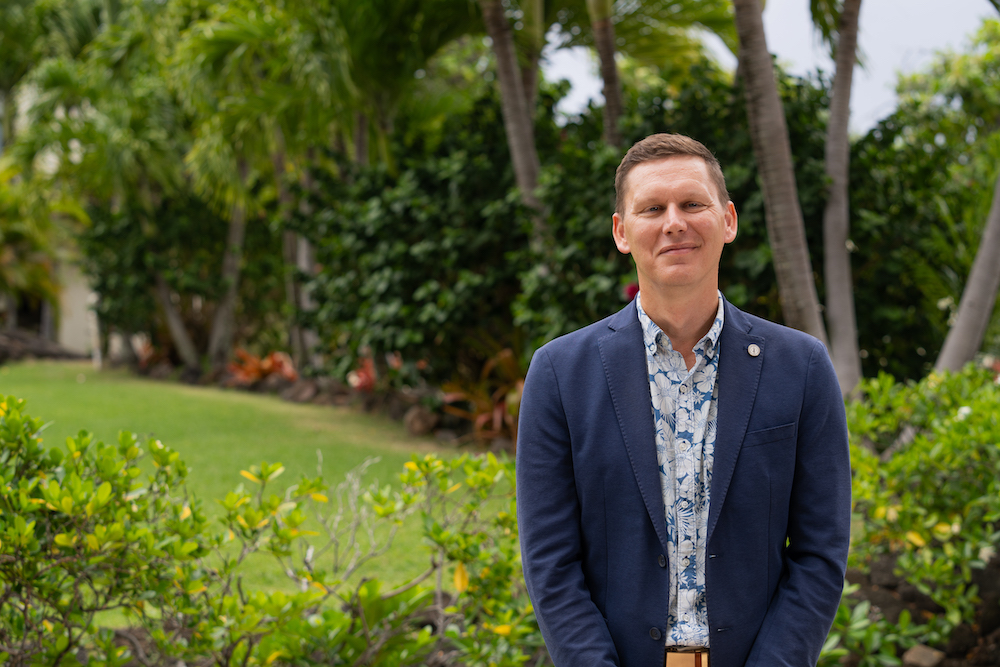
Q: What are the implications of AI in higher education today compared to when this technology first came out?
Provost Askildson: The state of large language models and generative AI has changed quite a bit.
The implications for higher ed are significant in that the tools that we had at the beginning of this journey two and a half, maybe three years ago, were pretty consistent in helping us identify when students were using AI—and so they’re called AI detectors, or there were a few different monikers for them. But basically, the technology to detect AI was about as strong as the technology to produce some of this generative language that was pretty polished. And really in the last eight to 12 months, that’s changed considerably.
The AI detector technology has fallen behind the sophistication and diversification of prompts and responses that the average user can get. And so, I think if you looked at the higher ed press two years ago, there was general acknowledgement that we need to recognize the value of AI for educational purposes, find ways to integrate it into the curriculum. And we’ve been having those conversations here at Chaminade since the beginning.
Q: Does Chaminade University currently have an official AI policy?
Provost Askildson: We do, but it’s baked into our academic integrity policy as a whole. We are working on a more explicit AI use policy so it’s less about the cheating with AI and more about what are the range of potential uses of AI that faculty and students should be considering. It’s going to be more of a heuristic rather than a policy. Does that make sense?
Q: The messaging will be, of course, academic integrity must be upheld. Then, you’ll provide more guidance for faculty while giving them the discretion to determine how to manage this technology in their classrooms.
Provost Askildson: Correct.
I also want it to be written in a way that students can understand that their faculty have true discretion. Some faculty might choose no AI use in their course for particular pedagogical reasons. Others might ask students to actually use AI explicitly as a part of the process and then explain what prompts they used in order to produce certain outcomes, and then critique that. So that might be the assignment.
We just want to acknowledge that there are going to be a range of uses for AI, but that all of the use of AI needs to be explicitly addressed either in the syllabus or in the assignment, or ideally both. And that’s some of the guidance we’ll be providing to faculty.
Q: What can professors do now to adjust their curriculum delivery strategies to sort of mitigate against students’ overreliance on AI?
Provost Askildson: Right now, faculty, when they suspect use of AI, they cannot rely on the detectors because there’s so much concern about construct validity. We just don’t know that the detectors are actually giving us accurate information.
Instead, faculty are returning to the old approach of asking students to basically defend their writing.
They’re saying “can you explain to me why you made this point?” and they’ll read something from the text. And based on the student’s oral response–it’s a bit of an oral interview–they will make a judgement about whether or not the student has used AI.
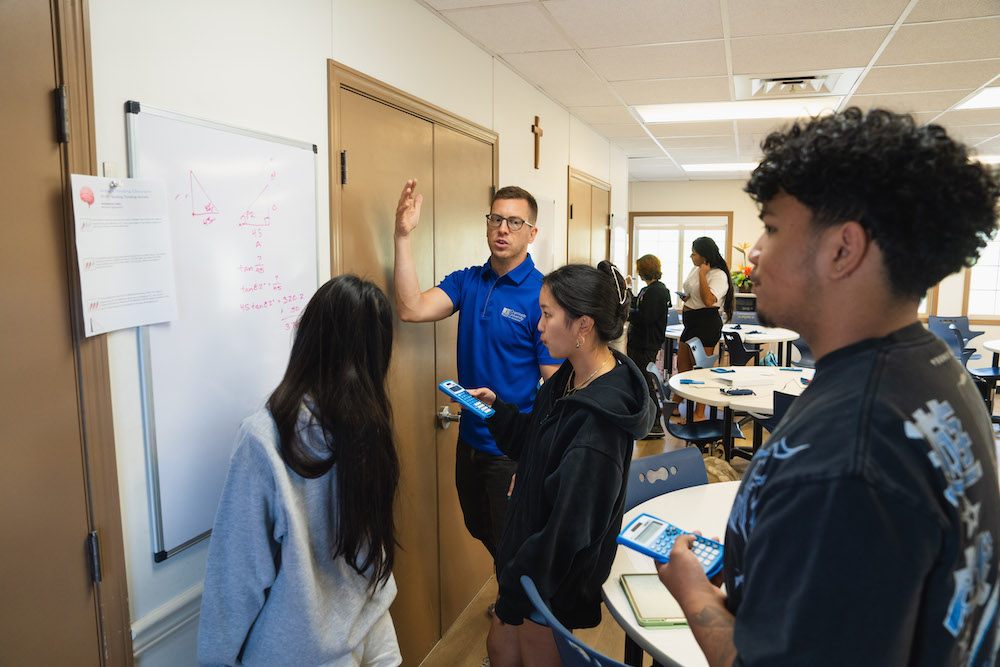
It’s not about catching the student’s use of AI. It’s about whether the student has mastered the learning that the faculty member has set out for them to learn sufficiently in the judgement of the professor.
The professor doesn’t need to accuse the student of using AI. They can simply say: “Well, you know, it seems to me that you haven’t fully grasped the content of this assignment. You’re not able to explain your reasoning. I’m not suggesting that you have done this fraudulently, but I’d like some additional evidence of mastery.” And so, they can give them additional assignments, they can have them do some alternative work to show mastery of that learning.
Q: How do you see Chaminade and academia in general moving forward?
Provost Askildson: The way we move forward is by keeping our humanity at the center of everything we’re doing. That means focusing on the human element rather than all of this noise about technology. And it also means recognizing that this is more than just intellectual development we’re aspiring to. It’s character development, it’s whole person development.
At the center of combatting the threats that these new technologies pose, whether it’s AI or some new technology that might be on the horizon, it’s about making sure that the teachers, the faculty, are prepared to approach these new challenges thoughtfully, not in a reactionary way. This is a Father Chaminade quote: “New times call for new methods.” Which is a really prophetic quote from an 18th Century–19th Century priest.