
Doctor of Marriage & Family Therapy
Advanced practice with a lasting impact.
Jump to
Transforming care at the highest level.
Designed for clinically active professionals, Hawai‘i’s only Doctor of Marriage and Family Therapy (DMFT) program prepares therapists to lead with expertise, insight, and compassion. Grounded in evidence-based practice and ethical leadership, the DMFT equips you to transform clinical practice, influence mental health systems, and create meaningful, lasting change for individuals, couples, families, and communities.
Our DMFT is designed to build upon your expertise and prepare you for leadership roles and career opportunities, including:
Terms & Deadlines
Online Accelerated Fall Term Begins: October 5, 2026
Final Application Deadline: August 21, 2026

Watch our HI Now segment and learn more about our DMFT program.

Dr. Blendine Hawkins talks about the importance of MFT on Hawaii News Now’s Muthaship podcast.
A program built around you.
Designed to fit your professional schedule and life responsibilities, the DMFT program blends academic rigor with clinical practice—allowing you to immediately apply what you learn in real-world settings. Through advanced coursework, applied research, and close faculty mentorship, you’ll strengthen your role as a clinical leader while contributing to the growth of the profession and the well-being of families across Hawai‘i and beyond.
Program Details
Mission Statement for Doctorate in Marriage and Family Therapy
Chaminade University offers its students an education in a collaborative learning environment that prepares them for life, service and successful careers. Guided by its Catholic, Marianist and liberal arts educational traditions, Chaminade encourages the development of moral character, personal competencies, and a commitment to build a just and peaceful society. The University offers both the civic and church communities of the Pacific region its academic and intellectual resources in the pursuit of common aims.
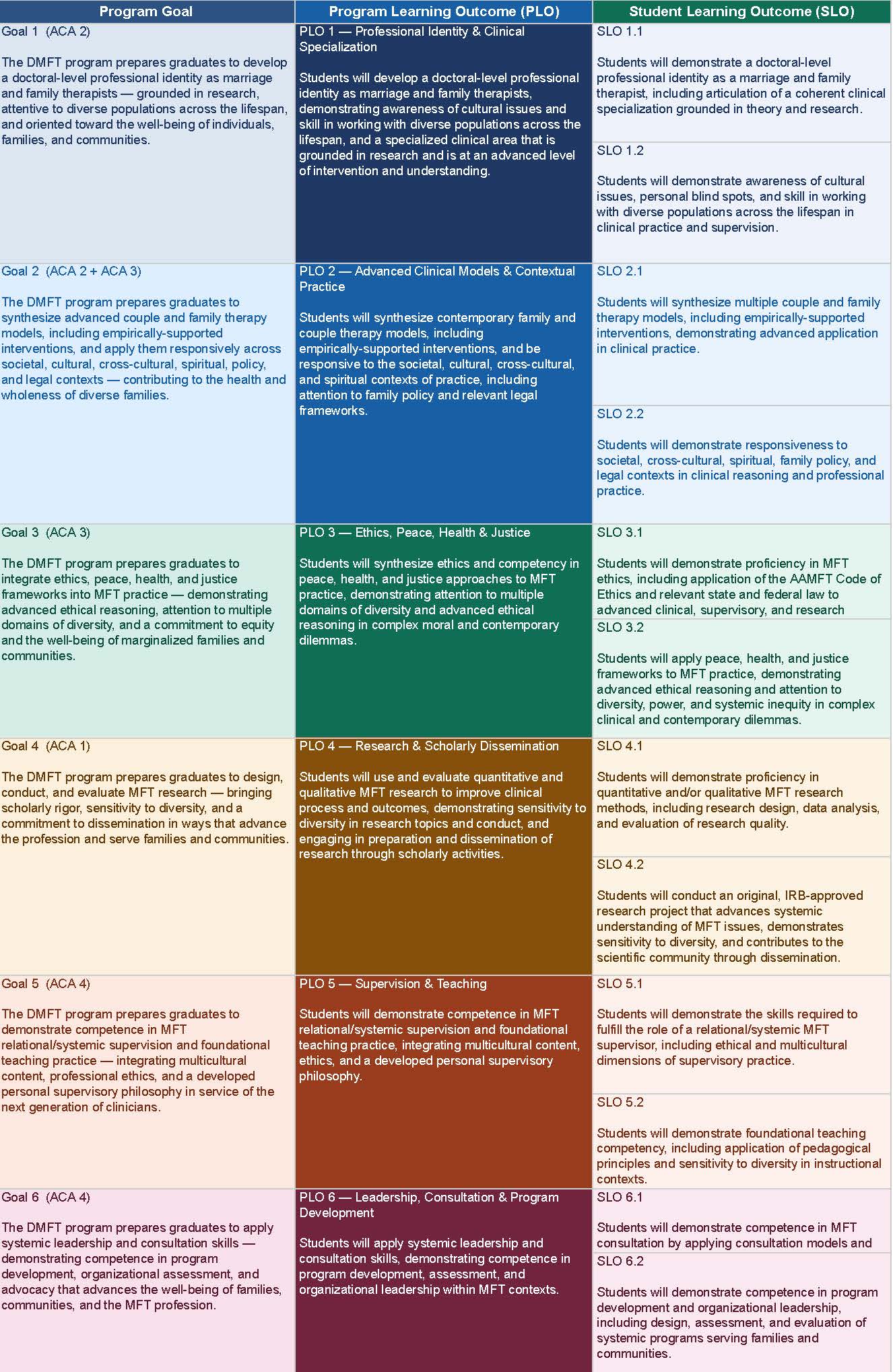
Derived from our mission, the program has identified the following Program Goals:
DMFT Courses (62 credits)
General Admission Requirements
Visit the Graduate Admissions website for more information.
Cost of Attendance
Please visit the Graduate Cost of Attendance webpage for tuition rates and fees.
Additional Resources
Non-Discrimination
The Doctor of Marriage and Family Therapy (DMFT) Program at Chaminade University of Honolulu is committed to fostering an inclusive, respectful, and safe learning environment for all students, faculty, staff, and community members. In alignment with Chaminade University’s broader Nondiscrimination/Anti-harassment Policy and Grievance Procedures, the DMFT Program affirms that discrimination, harassment, sexual misconduct, and any form of physical or psychological abuse will not be tolerated.
Chaminade University does not discriminate on the basis of race, color, ethnicity, national origin, ancestry, religion or religious/spiritual affiliation, sex, gender, gender identity or expression, sexual orientation, age, disability (mental or physical), health status, genetic information, socioeconomic status, pregnancy or pregnancy-related conditions, marital or parenting status, arrest or court record status, National Guard participation, victim of domestic or sexual violence status, breastfeeding, or any other status protected by applicable local, state, or federal law.
The DMFT Program recognizes the inherent dignity and worth of all individuals and promotes respect, equity, and inclusion in all academic, clinical, supervisory, and community-based activities. Students, faculty, supervisors, and professional staff are expected to uphold the highest standards of professionalism, ethical conduct, and cultural sensitivity consistent with the values of the marriage and family therapy profession and the mission of Chaminade University.
Diversity & Inclusion
The Doctor of Marriage and Family Therapy (DMFT) program at Chaminade University of Honolulu is deeply committed to fostering a diverse, inclusive, and culturally responsive learning environment. Grounded in Marianist values of service, justice, peace, family spirit, and adaptation to change, we affirm the inherent worth and dignity of all individuals.
We recognize Hawai‘i’s unique cultural landscape and honor the histories, traditions, and healing practices of Native Hawaiians, Pacific Islanders, and other Indigenous peoples. Our program embraces cultural humility, equity, and social justice as essential to ethical practice, scholarship, supervision, and leadership.
We are committed to cultivating a community where all students, faculty, and staff feel welcomed, respected, and empowered to fully participate and thrive. We honor and embrace the full range of human diversity, including but not limited to race, ethnicity, culture, national origin, language, faith and spiritual traditions, gender identity and expression, sexual orientation, age, ability and disability status, socioeconomic background, family structure, veteran status, and immigration experience. We also recognize the importance of lived experiences, perspectives, and ways of knowing that shape how individuals engage, learn, and contribute within our community.
In alignment with COAMFTE standards, our program prepares doctoral-level clinicians and leaders to systemically address mental health disparities, to evaluate and apply evidence-informed practices in ways that honor diverse cultural contexts, and to promote peace, wellness, and justice at individual, family, and community levels.
Through continuous self-reflection, collaborative learning, and service, the DMFT program actively works to dismantle barriers to equity and inclusion, ensuring that our graduates are prepared to lead with compassion, cultural safety, and a systemic vision for change.
Transfer of Courses from Another Academic Program
The DMFT program considers transfer requests on a case-by-case basis. Students who have completed doctoral-level, clinical graduate courses at another accredited university within the past three (3) years, and earned a grade of “B” or better, may be eligible to transfer up to two (2) courses into the Doctor of Marriage and Family Therapy program. Applicants must submit official transcripts, syllabi, and relevant documentation for review during the application process. The Program Director and faculty will evaluate whether prior coursework meets the academic rigor, clinical standards, and curricular alignment of the DMFT program. Transfer credit is not guaranteed and will only be awarded when it is clear that prior learning outcomes are equivalent to those of the DMFT curriculum. All transfer approvals will follow university policy and accreditation requirements. Exceptions – All exceptions to the Doctor of Marriage and Family Therapy Program Policies, and Procedures will be addressed on an individual basis by the Doctor of Marriage and Family Therapy Program Director.
Portability of Licensure/Degree Acknowledgement
The Doctor of Marriage and Family Therapy (DMFT) program at Chaminade University of Honolulu is an advanced clinical degree designed to prepare graduates for leadership, supervision, education, program development, and advanced practice within the field of marriage and family therapy. This program does not grant initial licensure eligibility, does not guarantee portability of licensure across jurisdictions, and is not intended to satisfy educational requirements for licensure. Students are responsible for understanding the licensure laws and requirements in their state or jurisdiction of practice. The DMFT program does not provide verification or assurance that its degree meets educational requirements for licensure portability in any state.
DMFT Student Recruitment
The Doctor of Marriage and Family Therapy (DMFT) at Chaminade University is designed for master’s-level clinicians who are ready to advance their careers as supervisors, educators, researchers, and leaders. We seek applicants who want to deepen their systemic expertise and serve communities with compassion, justice, and cultural humility.
We especially welcome:
DMFT Student Retention
Supporting our students is at the heart of the DMFT program. We combine academic rigor with a high-touch, relational learning model so that every student is set up for success.
What you can expect:
The DMFT program is built to help you thrive, persist, and graduate as an advanced professional ready to lead systemic change.
For more information on our policies, click here.
Graduate Achievement Data for: Doctor of Marriage and Family Therapy (DMFT)
Accredited: Not Accredited (Initial Accreditation in Progress)
Advertised Program Length: 3 years
| Cohort Year | Students Entered Program | # of Students in Program | Graduation Rate in Advertised Time (%) | Job Placement Rate (%) | Licensure Rate (%) |
|---|---|---|---|---|---|
| FT | FT | FT | FT | FT | |
| 2022–2023 | 14 | 5* | 100% (Not Accredited) | 100% (Not Accredited) | 100% (Not Accredited) |
| 2023–2024 | 6 | 4 (In Process) | IP | IP | IP |
| 2024–2025 | 4 | 2 (In Process) | IP | IP | IP |
| 2025-2026 | 5 | 5 (In Process) | IP | IP | IP |
Key:
Notes:
| Non-resident (international) | Asian or Pacific Islander | African-American/African/Black | White/Non-Hispanic | Hispanic/Latino/Chicano | Multiethnic | American Indian or Alaska Native | Other | Declined to Disclose | Total | |
| FACULTY | 0 | 1 | 1 | 2 | 1 | 0 | 0 | 0 | 0 | 5 |
| STUDENTS | 0 | 13 | 3 | 8 | 1 | 0 | 0 | 0 | 0 | 25 |
| Male | Female | Nonbinary/Gender Fluid | Transgender | Other | Declined to Disclose | Total | |
| FACULTY | 1 | 4 | 0 | 0 | 1 | 0 | 5 |
| STUDENTS | 4 | 21 | 0 | 0 | 0 | 0 | 25 |
For more information on our core faculty, click here.
Western Association of Schools and Colleges (WASC)
Chaminade University has been accredited by the Accrediting Commission for Senior Colleges and Universities of the Western Association of Schools and Colleges, the nationally recognized agency for accreditation of post-secondary institutions in its area of the United States.
NEXT STEPS
If you have any MFT program questions, please contact Program Director Blendine Hawkins, PhD, LMFT, at [email protected] or (808) 739-7495.
If you have any admissions questions or need assistance, please contact Admissions at [email protected] or (808) 739-8524.